
Zeitoun
2,097-word summary 9 min read 351 pages in the book
- First published
- 2009
- Publisher
- McSweeney's
- Pages
- 351
- ISBN
- 9781934781630
Reading options
What's inside (9 sections)
The image that started it
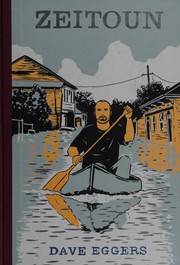
The first time I saw the cover of Dave Eggers's 2009 book, I remember thinking it looked like a children's book. It has a flat, folk-art illustration, a man in a small boat, and a palette that feels almost cheerful. That first impression is misleading in the extreme. Zeitoun is a work of nonfiction about a man who spent twenty-three days in a Louisiana prison after Hurricane Katrina, mostly because he looked like what authorities said a terrorist should look like. The book was published by McSweeney's, and it runs just over 350 pages in the original edition. It is one of the most quietly furious books I have read about America after 2001.
What stays with me is the central image, and it is the one on the cover. A man alone in a canoe, navigating a flooded city, pulling people from porches and feeding dogs he finds stranded on roofs. That is Abdulrahman Zeitoun, and for a few days in the aftermath of Katrina he was one of the only people moving freely through New Orleans. Eggers's book tells that story and then tells the much darker story of what happened when the authorities noticed him. The contrast between the man in the canoe and the prisoner in the cage is the whole book.
Before the water
Abdulrahman Zeitoun's life before the storm is worth knowing, because the book takes its time with it. He grew up in Syria and served an apprenticeship in the port city of Jableh. He then spent roughly twenty years at sea, working as a crewman, an engineer, and a fisherman, and travelling widely. He settled in the United States in 1988. In New Orleans he met Kathy, a native of Baton Rouge who converted to Islam, and the two of them built a life together around a painting and contracting business, Zeitoun Painting Contractors. They had four children.
Eggers is careful to show this ordinary domestic life before the disaster arrives. That is partly a matter of fairness to his subject. A man who is later treated as a threat deserves to be introduced as a husband, a father, and a small businessman first. But it is also a structural choice. The more solid the life looks, the more shocking its interruption becomes. By the time the storm approaches in late August of 2005, the reader understands exactly what Zeitoun has to lose. He is not an abstract victim of a policy failure. He is a man with a family, a company, and a home full of people who expect him to come back.
The canoe
As Katrina bore down on New Orleans, Kathy and the four children left for Baton Rouge. Zeitoun stayed. He had reasons that made sense to him: he wanted to watch over the family home, to check on ongoing job sites, and to keep an eye on the rental properties he owned. He expected to be away from his family for a day or two. Instead the storm flooded his neighborhood, which was miles from the nearest levee, and put water up to the second floor of most houses.
What he did next is the part of the book that has made the story famous. Zeitoun found a secondhand canoe and began to paddle through the flooded streets. He ferried neighbors to higher ground, carried supplies to people who were stuck, and distributed fresh water where he found it. He also began collecting the dogs he found abandoned, eventually caring for a number of them at his own house. There is something almost mythic in the image, a man navigating a drowned city by canoe, and Eggers does not overstate it. He reports what Zeitoun did with a flatness that lets the acts speak for themselves.
I keep coming back to the dogs. A man wading through a disaster zone, stopping to rescue animals that no one has thought about, is doing something that needs no political framing. It is simply decent behavior under impossible conditions. The book's later chapters, which are full of handcuffs and interrogations, are harder to hold in the same mind with those early pages. That difficulty is the point. The same man who rescued strangers and stray dogs was about to be treated as a threat to national security.
The arrest
On September 6, Zeitoun and three companions were arrested at one of his rental houses. The party that took them into custody was a mixture of Army National Guard soldiers, local police officers, and police from out of state. The stated reasons were never clear, but the accusation that emerged was serious: the men were suspected of terrorist activity. The evidence, such as it was, appears to have been the cash they were carrying, maps of the city, and a storage disc. In a city already on edge, those ordinary objects were read as proof of something sinister.
Zeitoun and the others were first taken to a makeshift jail set up in a Greyhound bus station, a place that became known as Camp Greyhound. They were held there for three days before being transferred to the Elayn Hunt Correctional Center in St. Gabriel. There Zeitoun spent another twenty days without a trial. He was given a bond of seventy-five thousand dollars, was interviewed by officers and later by immigration officials, and was placed in segregated cells. He was refused medical attention, and he was not allowed a phone call to tell his family where he was.
That last detail is the one that got me. A man who had been freely moving through the city, helping his neighbors, was now unable to let his wife know whether he was alive. Kathy and the daughters had fled to Baton Rouge and had no idea what had happened to him. The book alternates between the two experiences, and the effect is almost unbearable. One person sits in a cell wondering whether anyone knows where he is. The other sits in a house far away, watching the news and imagining the worst. Eggers keeps the prose plain through all of it, and the restraint makes the fear sharper.
Zeitoun was finally freed after twenty-three days. His three companions were not so lucky; some were held for as long as eight months. The charges against them were eventually dropped. The contrast between Zeitoun's rescue work and his treatment by the state is the argument of the book in miniature. Here was a man doing the job that the authorities were supposed to be doing, and the reward was a cell and an accusation.
How the book was made
Eggers did not write this book from a distance. He began work on it in 2006 after meeting Kathy and Abdulrahman through another project called Voices from the Storm. He worked closely with the family over several years, travelling to New Orleans repeatedly and letting them read six or seven versions of the manuscript. He also visited relatives in Syria and spoke with Abdulrahman's brother in Spain. This is not a reporter's book in the usual sense. It is a book produced with the cooperation and, to a significant extent, the participation of the people it describes.
That method has consequences, and Eggers is candid about them. He has said that he would not personally profit from the book, and that proceeds would be distributed through the Zeitoun Foundation, a nonprofit he set up with the family. He has also been clear that the family read drafts. For some readers, that level of involvement raises questions about how independent the account can be. For others, it is a mark of respect, a way of making sure that the story belongs to the people who lived it. My own feeling is that the book's emotional truth is not in doubt, even if its authorship is more collaborative than a conventional memoir would allow.
The prose itself is stripped down in a way that may surprise readers who know Eggers from his more experimental work. There are no tricks, no typographical stunts, no self-conscious cleverness. The book moves in short, clear chapters, alternating between Abdulrahman's experience and Kathy's. That choice matters. By giving Kathy equal weight, Eggers makes the imprisonment a family event rather than a solitary one. The person in the cell is only half the story. The person waiting, and not knowing, is the other half.
What the book is really about
On the surface, Zeitoun is the story of a wrongful arrest. Underneath, it is a book about who gets treated as an American and who gets treated as a suspect. Abdulrahman Zeitoun was a Syrian immigrant, a Muslim, and a businessman who happened to be in the wrong place with the wrong paperwork after a national trauma. The book does not need to lecture about race or religion. It simply shows how quickly a man can be recast from neighbor to enemy when the people with power decide to look at him a certain way.
That is why the book landed as hard as it did when it appeared in 2009. It arrived at a moment when the country was still arguing about torture, detention, and the treatment of Muslim men, and here was a concrete case, set on American soil, involving an ordinary family man. The Katrina coverage had famously focused on looting and lawlessness, often with racial undertones. Eggers's book offered a different picture of the same period: a man feeding dogs and ferrying neighbors, then disappearing into a prison system that did not bother to tell his family where he had gone.
The recognition was substantial. The book won the 2009 Los Angeles Times Book Prize for Current Interest, the 2010 American Book Award, and the 2010 Dayton Literary Peace Prize, and it was nominated for a Northern California Book Award. Entertainment Weekly put it on an end-of-the-decade list, with a writer noting that Eggers had bookended the decade with this selfless Katrina story. These honors are deserved. The book accomplishes something difficult: it makes a legal injustice feel personal without ever losing the specific details that make it credible.
The years after the story
The book ends with the family reunited, but Eggers does not pretend that everything healed. He writes about the difficulty Kathy had in the years after the jailing, about the stress that settled into the household and the marriage. The couple divorced in 2012. In the years that followed, Abdulrahman faced serious legal troubles of a different kind. He was charged in 2012 with plotting to have Kathy and others killed, was tried in 2013 and found not guilty of the attempted murder charges, and was later convicted of felony stalking. In 2018 he was ordered deported but released, in part because Syria was in the midst of a civil war and there was no practical way to send him there.
I include that because it is part of the record, and because leaving it out would turn the book into a fable. The man on the cover is a real person, and real lives do not stop at the last page. That said, none of what came later changes what happened in 2005. The arrest, the detention, and the treatment of the family stand on their own. A book can tell one true story without promising that everything after it will be tidy.
There was also talk of a film. In 2009 an animated adaptation was announced, with Jonathan Demme attached to direct. By 2014 it was still being described as in development. It is easy to see why filmmakers were drawn to the material. The image of a lone canoe in a flooded city is ready-made for animation, and the book has a visual directness that would translate well. For now, the book remains the definitive account.
I finished Zeitoun feeling something I do not feel often after nonfiction: gratitude for the restraint. Eggers had every opportunity to turn this into a spectacle, to shout about injustice at every turn. Instead he keeps his head down and tells the story of a man who helped his neighbors and was jailed for it, and a woman who waited for news that did not come. The facts are damning enough on their own. If you want to understand how quickly the categories of neighbor and enemy can shift in this country, and what that shift feels like from the inside, this is the book to read.
FAQ
What happened to Abdulrahman Zeitoun?
He stayed in New Orleans during Katrina, rescued neighbors by canoe, and was arrested in September 2005. He was held for twenty-three days without trial before being released.
How was the book researched?
Dave Eggers met the family through a Voice of Witness project and worked with them for years, letting them read several drafts. He pledged his proceeds from the book to a foundation set up with the family.
Is Zeitoun a novel?
No. It is nonfiction, published by McSweeney's in 2009, and it reports real events involving real people rather than inventing a story.
Similar books
The New Jim Crow: Mass Incarceration in the Age of Colorblindness
How mass incarceration became a racial caste system after civil rights.
2,413-word summary · 11 min read
1929
Sorkin's narrative history of the 1929 crash opens on 1 February of that year, seven months before the fall, and follows bankers and speculators through to…
2,953-word summary · 13 min read
Truman
McCullough's 1992 Pulitzer-winning biography follows Harry Truman from Missouri farm boy and senator to the president who ended a world war.
2,262-word summary · 10 min read

1491: New Revelations of the Americas Before Columbus
Charles C. Mann gathers archaeology, ecology, and demography to argue that the Americas before Columbus were older, fuller, and more deliberately shaped than…
2,712-word summary · 12 min read
The Wright Brothers
David McCullough tells the story of two self-taught Ohio brothers, working largely alone and out of a bicycle shop, who solved the problem of flight before…
2,027-word summary · 9 min read
Bury My Heart at Wounded Knee: An Indian History of the American West
Dee Brown's 1970 retelling of the American West from the point of view of the people it destroyed.
2,233-word summary · 10 min read
The Warmth of Other Suns
Three migrants ride north out of Jim Crow toward Chicago and LA.
2,561-word summary · 11 min read
Hidden Figures
Black women computers at Langley launch rockets past Jim Crow.
2,385-word summary · 11 min read
How to Be an Antiracist
Kendi blends memoir and history to argue that fair policy, not self fixing, creates an equal society.
2,513-word summary · 11 min read
Narrative of the Life of Frederick Douglass
Douglass names names from Maryland slavery to his 1838 escape, showing how literacy, wages, and faith were policed, then answers with defiance.
2,630-word summary · 12 min read
Caste: The Origins of Our Discontents
Wilkerson argues America runs on a hidden caste system, tracing eight pillars across the US, India, and Nazi Germany.
2,629-word summary · 12 min read
Between the World and Me
Coates writes to his son about the Black body in America, from Howard to the loss of Prince Jones.
2,234-word summary · 10 min read
The Innocent Man: Murder and Injustice in a Small Town
Grisham's first nonfiction book tells how Ron Williamson lost eleven years on death row for a murder he did not commit in Ada, Oklahoma.
2,245-word summary · 10 min read
The Guns of August
Tuchman narrates the first month of World War I, from a 1910 royal funeral to the Marne, and the decisions that trapped Europe.
2,405-word summary · 11 min read
Survival in Auschwitz
A chemist deported from Turin records ten months in Auschwitz with a restraint that makes the horror impossible to look away from.
2,177-word summary · 10 min read
Motherland: A Feminist History of Modern Russia, from Revolution to Autocracy
A feminist history of modern Russia told through women's lives, from the revolutionaries of 1917 to Pussy Riot and the politics of today.
2,191-word summary · 10 min read
Alive: The Story of the Andes Survivors
After a rugby team's plane crashes in the Andes in 1972, Piers Paul Read tells the survivors' 72-day fight to live, drawn from interviews with the men and…
2,179-word summary · 10 min read
The Reluctant Fundamentalist
In a Lahore cafe, Changez tells a nervous American how Princeton and a New York career gave way to anger after September 11.
2,340-word summary · 10 min read
Men Explain Things to Me
A short collection of essays that begins with a man explaining Solnit's own book to her and expands into an argument about who gets believed, who gets heard…
2,019-word summary · 9 min read
Mark Twain
Ron Chernow's 1,200-page biography follows Samuel Clemens from the Mississippi River to worldwide fame, weighing a literary genius against a lifetime of…
2,501-word summary · 11 min read
Hiroshima
In 1946 John Hersey followed six ordinary people through the atomic bombing of Hiroshima and its aftermath, using a plain style that made the reporting feel…
2,991-word summary · 13 min read
Everything Is Tuberculosis
John Green tells the story of a boy with tuberculosis in Sierra Leone and argues that a disease curable since the 1950s still kills a million people a year…
2,015-word summary · 9 min read
Dream Count
Four women narrate the 2020 lockdown in their own voices: a travel writer, a friend in early labor, a banker cousin and a housekeeper assaulted in a hotel room.
2,286-word summary · 10 min read
Carnegie's Maid
An Irish immigrant answers to a dead woman's name and lands a job as lady's maid in Andrew Carnegie's Pittsburgh household, where her mind for business draws…
2,271-word summary · 10 min read
Behold the Dreamers
A Cameroonian chauffeur and his wife chase the American dream while driving a Lehman Brothers executive through the 2008 crash in Mbue's debut novel.
2,578-word summary · 11 min read
The Autobiography of Benjamin Franklin
Franklin writes his own life in four parts, from a Boston boyhood and a runaway apprenticeship to printing, science, and public service, while keeping careful…
2,259-word summary · 10 min read

The Zookeeper's Wife: A War Story
The directors of the Warsaw Zoo hid roughly three hundred Jews in empty cages and outbuildings after the German invasion, while Jan worked for the resistance.
2,065-word summary · 9 min read

Take My Hand
In 1973 Montgomery, a young nurse discovers that two sisters were sterilized without consent, and spends the rest of her life living with what she could not…
2,126-word summary · 9 min read

Long Walk to Freedom
Mandela's account of a Thembu childhood, a law practice, a banned movement, twenty-seven years in prison, and the negotiation that ended apartheid.
2,454-word summary · 11 min read
The DaVinci Code: A Quest for Answers
A short 2006 dialogue in which three friends test Dan Brown's claims about Jesus, Mary Magdalene, Nicaea, and the canon.
2,088-word summary · 9 min read