
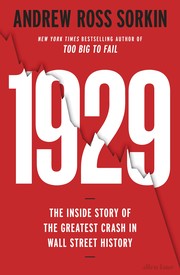
1929
2,953-word summary 13 min read 592 pages in the book
- First published
- 2025
- Publisher
- Viking Press
- Pages
- 592
- ISBN
- 9780593296967
Reading options
What's inside (10 sections)
I picked this up because the crash of 1929 is one of those events whose outline everybody knows and whose sequence almost nobody can recite. We all know there was a crash, that it ruined people, and that the Depression followed. Ask what actually happened, week by week, and most of us start guessing. Andrew Ross Sorkin's book is an attempt to supply that sequence in detail, and it is long enough to do it. The Viking Press edition came out on 14 October 2025, runs to 592 pages, and took him eight years to research. Roughly a hundred of those pages are notes, and there is a section up front called "Cast of Characters and the Companies they Kept," which tells you straight away what kind of book this is. It wants you to know who everyone is before the trouble starts.
What surprised me first was how patient it is. Sorkin does not open with the crash. He opens on 1 February 1929, seven months before it, when nobody involved knew where the year was going. That choice shapes everything. The book is chronological, and it asks you to sit with the optimism for a while, to understand why smart people kept buying. It is much easier to be clever after the fact. Sorkin withholds that advantage from his readers, which is why the early chapters are so absorbing.
Eight years and a room full of names
The research shows. This is not a book of broad strokes about the roaring twenties; it is built out of individuals and the institutions around them. The cast of characters is not a decorative device. Sorkin needs you to keep track of bankers, speculators, economists and politicians, because the argument is carried by what these people decided in particular rooms on particular days. The "Companies they Kept" part of the section heading matters too. Nobody here acts alone. Each name is attached to a bank, a brokerage, a newspaper or a government office, and those attachments explain what they could do and what they were afraid of.
Eight years of work buys a certain density. There is a great deal of detail here, and some of it is slow going. I found myself checking the cast list more than once in the early chapters. That is a small price for a book trying to hold a whole system in view at once. The notes at the back, close to a hundred pages, are where Sorkin shows the scaffolding. If you like seeing how a historian knows what he knows, they reward a look. If you do not, they are easy to skip, and the narrative still works without them.
The title is simply 1929, but the reach is longer. The final chapter gets to 21 June 1933. So this is not only a book about a single autumn of panic. It follows the consequences forward, into the years when it became clear that the crash was not a brief correction but the opening of something much worse. That longer arc changes how the early optimism reads. Seen from 1933, the decisions made in the spring of 1929 carry a weight that nobody at the time could have attached to them.
Call money and the ten percent margin
The first idea Sorkin wants you to grasp is the call money loan. This was the fuel of the market in 1929. An investor could borrow through a broker and put down as little as ten percent of the price of the shares. The rest was borrowed money, often money lent for very short terms that could be called in at a moment's notice. That is where the phrase "call money" comes from. It made buying stocks feel cheap, because you only needed a fraction of the cash up front, and it made the whole structure nervous, because those loans could be demanded back at any time.
I had known this in the abstract before, but Sorkin makes you feel the attraction. When you only need ten percent down, a small rise in the price of a stock produces a large gain on the cash you actually put in. The borrowed money magnified everything, and in a rising market it looked like genius. This is the machinery behind the mania he describes, and it explains why so many people were willing to play. It also explains why the fall was so severe. When prices drop, the same borrowed money works against you, and the demand for immediate repayment can force selling at the worst possible moment.
The call money market is not a glamorous subject, and Sorkin deserves credit for making it central. A book that only followed the colorful characters would be a weaker book. The margin loan is the quiet mechanism underneath almost every decision in the story, and once you understand it, the behaviour of the speculators and the worry of the bankers both make more sense.
The optimists in the big banks
Sorkin spends time with the bankers whose confidence set the tone. Charles Edwin Mitchell of National City Bank and Thomas William Lamont of the House of Morgan stand in for a wider belief that the market was sound and the economy had entered a new era. These are not cartoon villains in his telling. They are people whose judgment was shaped by what they had seen in their own careers, and who had good reason, as they saw it, to be optimistic. That is more interesting than a story about fools, because it lets you see how reasonable people can be caught out by a world that has changed around them.
The point is not that one banker said something foolish. It is that a whole class of influential people shared an assumption, and their positions gave that assumption weight. When the head of a major bank says the market is in good hands, the statement circulates. It reaches reporters, brokers and small investors who have no other way to judge the situation. Sorkin is good on this circulation of confidence. The mood is not an abstract thing called sentiment; it is passed from person to person by people with names and jobs and reputations to protect.
I did wonder, reading these sections, whether the book sometimes lets the bankers off too lightly. The focus on character and decision can make the crash look like the sum of individual misjudgments. That is a real strength when it comes to narrative, but it leaves a question hanging about the system those individuals were operating inside. Sorkin comes back to that question later, and not every reader has thought his answer is enough. The bankers are fascinating company, but fascinating company is not the same thing as a complete explanation.
Durant and the art of the pool
Of all the figures in the book, the one I found most vivid was William Crapo Durant. Sorkin presents him as a master of the stock pool. A pool was a group of traders who agreed to buy and sell a stock among themselves to create the appearance of heavy activity. Friendly trades passed shares back and forth at rising prices, and the rising price drew in outside buyers who thought they saw real demand. Durant was very good at this, and he was not shy about talking his positions up. Sorkin describes him leaking bullish rumours to the press, so that the story of a stock's rise reached the public before the reality had any substance behind it.
This is the part of the book that reads like a thriller, because it is about people deliberately building a false picture and profiting from it. Durant's methods were not secret. They were a known technique, and he worked them with unusual flair. The pool operator's skill is in making a market look busy and confident, and in knowing when to step aside and let the crowd carry the price higher. In Sorkin's account, Durant had a gift for exactly that. Watching him work, you can see how a market can rise for reasons that have nothing to do with the value of the companies whose shares are changing hands.
Jesse Livermore is the other great speculator in the story, and he is a different kind of figure. He is remembered for telling The New York Times that stocks were at "ridiculously high prices." That line is famous now, and it is easy to read it as hindsight. What matters in the book is that he acted on the view. Livermore shorted the market and, by the end of October, had made about $100 million doing it. Sorkin puts him beside Durant to show two very different ways of relating to a runaway market: one man pushing prices up, the other betting they would come down, and both of them using the same machinery of borrowed money and public opinion.
I found the contrast useful, but I should say that these are larger than life figures. They make for great scenes, and Sorkin clearly enjoys writing them. There is a risk in a book like this that the memorable characters crowd out the quieter mechanisms. The pool operator and the short seller are easy to narrate. The call money market and the Federal Reserve's reserve policy are harder. The book does cover both, but the human stories are what stick in the memory after you close it.
September, the peak and the warning
The market reached its closing high on 3 September 1929, with the Dow at 381.17. That number is the hinge of the book. Everything before it is a story about how the market got there, and everything after it is a story about what came apart. Sorkin gives the peak the attention it deserves, not by treating it as an obvious top but by showing how few people recognised it as one at the time. A record close feels like proof to most market participants, not a warning. That is part of why tops are hard to see from inside them.
Two days later, on 5 September, the economist Roger Babson warned that "sooner or later a crash is coming, and it may be terrific." The line is quoted often, and with good reason, because it is one of the few clear warnings on the record before the fact. Sorkin uses it well. He does not present Babson as a prophet who was proved right and ignored by fools. He sets the warning against the mood of the moment, in which a man saying a crash was coming sounded like a man who had missed the party. The timing matters too. Babson spoke when the market was still near its high, which meant that for a while the market kept going up and made him look wrong.
That gap between being right and being believed is one of the quieter themes of the book. Sorkin is interested in why warnings fail to change behaviour. A forecast of a crash is not useful if nobody acts on it, and people did not act on it because the incentives all pointed the other way. Traders who sat out the last months of the rise watched others make money. Bankers who pulled back would have looked timid to their customers and their boards. The crowd had its own logic, and that logic was not stupid, given what everyone could see at the time.
Hoover, the Fed and the failure to act
The political strand of the story centres on Herbert Hoover and the Federal Reserve. Sorkin describes Hoover pressing the Fed to restrict credit, because the wild speculation worried him. The Fed, in turn, feared that tightening would cause a panic. So it held back. That decision, or that failure to decide, sits near the centre of the book's account of how a market slide became a disaster. The institution whose job was to lean against the excesses of the market was reluctant to lean, and its reluctance was rooted in a reasonable fear of making things worse.
This is where the book becomes most interesting to me as a piece of narrative history. Sorkin is not writing about a vacuum. He is writing about people in positions of authority who could see the danger and chose, for defensible reasons, not to move decisively. The fear of panic is real. Any central banker knows that pulling credit away at the wrong moment can deepen a fall. The trouble is that the caution which made sense in the short term helped set the conditions for a much larger collapse. Sorkin lets both sides of that dilemma stand. He does not make the Fed into a villain, and he does not excuse the outcome either.
The pages covering the autumn of 1929 move faster than the early ones. Once the decline begins, the book picks up speed along with it. This is a chronological account, so the reader experiences the fall in order, without the benefit of a chapter that tells you in advance which day was the worst. That is an effective choice. The uncertainty of the people in the story becomes the uncertainty of the person reading it, at least for a few chapters. By the end of October, Livermore's paper profit of about $100 million is the number that sums up the reversal: one man made a fortune while the market around him came apart.
The long tail to 1933
The book does not stop when the crash stops. Sorkin carries the story forward to 21 June 1933, and that decision changes the shape of the whole work. A book that ended in late 1929 would be a book about a financial event. By extending to 1933, he is writing about the consequences, about the stretch of years in which it became plain that the economy was not going to bounce back quickly. The Depression is not a footnote here. It is the second half of the argument.
Reading that stretch, I felt the tone shift. The clever, character driven energy of the early chapters gives way to something heavier. The people who were so vivid in February are now dealing with a world that has changed around them. Sorkin keeps the same cast, which is a good way to show the cost of the crash in human terms. The jokes and the pools and the bullish interviews belong to a vanished moment. What replaces them is slower and harder to narrate, and the book is honest about that difficulty.
The notes section, close to a hundred pages, supports this longer view. Sorkin is careful to show where his account rests on records. For a book that spends so much time inside rooms and conversations, that care matters. It is easy to write scenes like these and leave a reader wondering how the author knows what was said. The notes are the answer, and they are substantial enough to make the point that this is researched history rather than invented drama.
The argument, and where it may go too far
The central claim of 1929 is that the crash had something to do with the gap between rich and poor. Sorkin's account of the call money mania, the pools and the bankers' optimism all feed into this. His view is that a country in which wealth is concentrated and ordinary wages lag behind cannot sustain the kind of consumption and speculation that the twenties encouraged. It is a thesis about structure, even though the book is full of individuals.
That thesis has drawn criticism, and I think some of it is fair. Several reviewers argued that Sorkin dwells on the lifestyles of the rich and famous and never actually proves that the split between rich and poor caused the crash. I felt that tension while reading. The book is at its best when it is showing how the market worked, day by day and trade by trade. It is on weaker ground when it steps back and announces what the whole thing meant. The characters are so entertaining that the argument can feel pasted on afterward, a lesson attached to a story that was more interested in the story itself.
The sharper criticism came from James A. Dorn of the Cato Institute, who argued that Sorkin neglects monetary policy and the contraction of the money supply in favour of human nature and what he calls "irrational exuberance." That is a serious objection, because it goes to the mechanism of the Depression rather than the mood of the twenties. A book can be excellent at describing the behaviour of speculators and still miss a large part of why a downturn lasted as long as it did. I am not qualified to settle the economics, but the objection is specific enough that a reader should take it seriously. If you come to this book wanting a full account of what the Fed did to the money supply after the crash, you may finish it feeling that a chapter is missing.
None of that makes the book a failure. It is a strong account of a year and its aftermath, written with a novelist's eye for the people in the room. My advice is to read it for what it does superbly, which is to put you inside the sequence of 1929, and to read the criticism alongside it so you can see where the argument runs ahead of the evidence. Sorkin has spent eight years on this, and the work shows on nearly every page. The book earns its length through detail. What it does not always earn is its certainty about cause.
FAQ
What makes Sorkin's 1929 different from other books about the crash?
It is a chronological narrative built from eight years of research, opening on 1 February 1929 and running through to 21 June 1933 rather than focusing only on the autumn of panic.
Who are the main figures in the book?
Sorkin follows bankers Charles Edwin Mitchell and Thomas William Lamont, speculators William Crapo Durant and Jesse Livermore, economist Roger Babson and President Herbert Hoover.
What is the main criticism of the book?
Reviewers said Sorkin lingers on the lives of the wealthy without proving that inequality caused the crash, while James A. Dorn of the Cato Institute argued that he neglects monetary policy and the contraction of the money supply.
Similar books
The Big Short: Inside the Doomsday Machine
Outsiders who read the bonds shorted subprime and watched the machine eat itself in 2008.
2,194-word summary · 10 min read

Zeitoun
A Syrian-American contractor rides out Hurricane Katrina by canoe, rescuing neighbors and stray dogs, until a routine arrest turns into twenty-three days…
2,097-word summary · 9 min read
Flash Boys: A Wall Street Revolt
Michael Lewis follows a Canadian trader and his band of Wall Street outsiders as they discover how speed was used to rig the stock market, then build an…
3,009-word summary · 13 min read
Truman
McCullough's 1992 Pulitzer-winning biography follows Harry Truman from Missouri farm boy and senator to the president who ended a world war.
2,262-word summary · 10 min read

1491: New Revelations of the Americas Before Columbus
Charles C. Mann gathers archaeology, ecology, and demography to argue that the Americas before Columbus were older, fuller, and more deliberately shaped than…
2,712-word summary · 12 min read
The Total Money Makeover: A Proven Plan for Financial Fitness
Dave Ramsey lays out seven Baby Steps, from a $1,000 starter fund to a paid-off house, with the debt snowball at the center.
2,663-word summary · 12 min read
The Wright Brothers
David McCullough tells the story of two self-taught Ohio brothers, working largely alone and out of a bicycle shop, who solved the problem of flight before…
2,027-word summary · 9 min read
Bury My Heart at Wounded Knee: An Indian History of the American West
Dee Brown's 1970 retelling of the American West from the point of view of the people it destroyed.
2,233-word summary · 10 min read
Prisoners of Geography: Ten Maps That Tell You Everything You Need to Know About Global Politics
Tim Marshall explains how mountains, rivers, coasts, and resources shape the choices of nations, from Russia's flat borders to the chokepoints of the South…
2,328-word summary · 10 min read
The World Is Flat: A Brief History of the Twenty-first Century
Thomas L. Friedman's 2005 bestseller argues that technology, trade, and open borders leveled the global playing field, and it names the ten forces that did it.
2,369-word summary · 11 min read
The Millionaire Next Door
Stanley and Danko survey wealthy Americans and find frugal savers living next door, not big spenders, in this 1996 money study.
2,466-word summary · 11 min read
The Intelligent Investor
Graham's 1949 guide teaches Mr Market, margin of safety, and defensive versus enterprising plans for calm stock and bond investing.
2,423-word summary · 11 min read
Seabiscuit: An American Legend
A crooked horse, a taciturn trainer, a half blind jockey, and a car man lift Depression America.
2,145-word summary · 10 min read
The Guns of August
Tuchman narrates the first month of World War I, from a 1910 royal funeral to the Marne, and the decisions that trapped Europe.
2,405-word summary · 11 min read

Survival in Auschwitz
A chemist deported from Turin records ten months in Auschwitz with a restraint that makes the horror impossible to look away from.
2,177-word summary · 10 min read
Motherland: A Feminist History of Modern Russia, from Revolution to Autocracy
A feminist history of modern Russia told through women's lives, from the revolutionaries of 1917 to Pussy Riot and the politics of today.
2,191-word summary · 10 min read
Alive: The Story of the Andes Survivors
After a rugby team's plane crashes in the Andes in 1972, Piers Paul Read tells the survivors' 72-day fight to live, drawn from interviews with the men and…
2,179-word summary · 10 min read
Mark Twain
Ron Chernow's 1,200-page biography follows Samuel Clemens from the Mississippi River to worldwide fame, weighing a literary genius against a lifetime of…
2,501-word summary · 11 min read

Hiroshima
In 1946 John Hersey followed six ordinary people through the atomic bombing of Hiroshima and its aftermath, using a plain style that made the reporting feel…
2,991-word summary · 13 min read

Everything Is Tuberculosis
John Green tells the story of a boy with tuberculosis in Sierra Leone and argues that a disease curable since the 1950s still kills a million people a year…
2,015-word summary · 9 min read
Breakneck: China's Quest to Engineer the Future
Dan Wang argues that America is run by lawyers and China by engineers, from a bicycle ride through Guizhou to the human cost of the one-child policy.
2,281-word summary · 10 min read
Blue Ocean Strategy: How to Create Uncontested Market Space and Make the Competition Irrelevant
Two INSEAD professors argue that companies win by creating uncontested markets rather than fighting rivals, and give managers tools to do it.
2,333-word summary · 10 min read
Abundance
Two journalists argue that rules written to fix the abuses of the 1970s now block the housing, energy and clean construction the 2020s need, and propose a…
2,306-word summary · 10 min read
The Autobiography of Benjamin Franklin
Franklin writes his own life in four parts, from a Boston boyhood and a runaway apprenticeship to printing, science, and public service, while keeping careful…
2,259-word summary · 10 min read
The Zookeeper's Wife: A War Story
The directors of the Warsaw Zoo hid roughly three hundred Jews in empty cages and outbuildings after the German invasion, while Jan worked for the resistance.
2,065-word summary · 9 min read
Nudge: Improving Decisions About Health, Wealth, and Happiness
Thaler and Sunstein show how defaults, framing, and social cues steer choices, and argue for choice architecture with an opt-out.
3,146-word summary · 14 min read
Long Walk to Freedom
Mandela's account of a Thembu childhood, a law practice, a banned movement, twenty-seven years in prison, and the negotiation that ended apartheid.
2,454-word summary · 11 min read
The DaVinci Code: A Quest for Answers
A short 2006 dialogue in which three friends test Dan Brown's claims about Jesus, Mary Magdalene, Nicaea, and the canon.
2,088-word summary · 9 min read

Nothing to Envy
Barbara Demick follows six defectors from Chongjin through the North Korean famine, showing how ordinary people lived, believed, and finally left.
2,068-word summary · 9 min read
Too Much and Never Enough: How My Family Created the World's Most Dangerous Man
Mary L. Trump's 2020 memoir traces how a cold, zero-sum Queens household shaped her uncle, and uses family tax documents to challenge his self-made story.
2,059-word summary · 9 min read