
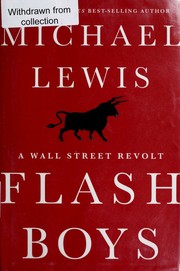
Flash Boys: A Wall Street Revolt
3,009-word summary 13 min read 274 pages in the book
- First published
- 2014
- Publisher
- W. W. Norton & Company
- Pages
- 274
- ISBN
- 9780393244663
Reading options
What's inside (8 sections)
I picked this up because I kept hearing the phrase "the market is rigged" in the years after the financial crisis, and I wanted to know what someone could actually mean by it. W. W. Norton published the book on March 31, 2014, and the first hardcover runs to 274 pages. It landed with a bang, topping the New York Times bestseller list for three weeks before Capital in the Twenty-First Century knocked it off in mid-May, and Bloomberg's Jonathan Weil reported an FBI inquiry into high-frequency trading a day after release that he linked to Lewis's claims. What I found inside was not a sweeping case against capitalism. It was a detective story about one narrow, technical kind of unfairness, told through a handful of people who turn out to be oddly sympathetic for Wall Street types.
The programmer nobody could explain
The book begins in a place that seems far from trading floors. In the summer of 2009, a Russian computer programmer named Sergey Aleynikov quit his job at Goldman Sachs for a rival firm and was arrested by the FBI on a charge of stealing the bank's computer code. Lewis found the case strange for a simple reason: after the financial crisis, the only Goldman employee anyone had charged with a crime was the man who had taken something from Goldman rather than the people who had done the risky things. Prosecutors argued that Aleynikov should not get bail because the code, in the wrong hands, could be used to manipulate markets unfairly. Lewis kept asking what that even meant. Nobody around him could say what high-frequency trading was, because the term itself was barely a few years old.
That question is the engine of the whole book. Lewis went looking for someone who could explain it and was pointed toward a Canadian trader named Brad Katsuyama, who was reportedly going around Wall Street telling anyone who would listen how the markets had changed. One of the pleasures here is that Lewis does not pretend he understood any of this at the start. He admits his ignorance, and the book is built out of what he learned from Katsuyama and the people Katsuyama gathered around him.
Lewis slips in a piece of his own history early on that I found more useful than I expected. He was working at Salomon Brothers in 1987, on the fortieth floor of One New York Plaza, when the market crashed on October 19 and fell 22.61 percent in a single day. Some brokers simply stopped answering their phones so they would not have to take their customers' sell orders. Lewis reads that episode as the moment regulators decided that computers could do the job better than those unreliable human beings. It is a neat bit of framing, and it explains why the book keeps returning to the idea that a rule meant to fix one problem creates the loophole for the next one.
A cable dug across Pennsylvania
Before Lewis gets to Katsuyama properly, he spends a chapter on a fiber-optic cable. In 2009 a company called Spread Networks set out to connect the Chicago Mercantile Exchange to Nasdaq's data center in Carteret, New Jersey, along the straightest legal line it could draw. The existing route took signals about 17 milliseconds. The new line was 827 miles long, cost roughly $300 million, and cut the trip to about 13 milliseconds. Traders were reportedly ready to pay $10.6 million a year for access to it.
What made this section stick with me was not the engineering but the pile of petty obstacles. Dan Spivey, the man driving the project, drew his route across Pennsylvania using small paved roads, dirt roads, bridges, railroad lines, and the occasional front yard or cornfield, because federal law would not let him lay fiber along the interstate. Near the town of Sunbury, the line ran into two parking lots, one belonging to a company that made wire rope for ski lifts and the other to a century-old grocery chain called Weis Markets. The owners would not return calls. The Weis Market chairman's secretary said he was at a golf tournament and unavailable. He had already decided, without telling Spread Networks, to turn down a low six-figure offer plus free high-speed internet for a ten-foot easement, because the line passed too close to his ice cream plant. Going around the town would have added four microseconds and months of work. In July 2010 the cable simply stopped at a bridge. Then, for reasons Spivey never worked out, the wire rope people softened and sold the easement. The company issued a press release about the 13-millisecond round trip.
I will admit this opening took some patience. There are pages of maps and rights of way, and the connection to ordinary investors feels distant at first. But it sets up the book's central claim in a way a lecture never could. Speed had become a thing you could buy, dig for, and sell access to, and the people with the fastest line would get to the price first.
Lewis folds in the origin of the title along the way. In May 2009, Senator Charles Schumer wrote to the SEC and then publicized his own letter, objecting to exchanges that let sophisticated traders see buy and sell orders a fraction of a second before everyone else did, for a fee. That was the first time Katsuyama heard the term "flash orders." The phrase in the book's title sits close to that scandal and to the young men who came to be defined by speed.
Brad Katsuyama notices something is wrong
Katsuyama was born in Canada and came to New York in 2002 at age 23, sent by the Royal Bank of Canada as part of a push to become a real player on Wall Street. Lewis is careful to show how much of an outsider he was. RBC was stable and had avoided the worst subprime lending, but Americans barely knew it existed. At the end of 2006 the bank paid $100 million for a small American electronic trading firm called Carlin Financial, apparently without its New York staff fully understanding what they were buying. Katsuyama ended up running electronic sales and trading for the bank.
Sometime after 2007, he noticed that he could no longer get the price he saw on his screen. He would press a button to buy shares at a quoted price and the price would move against him before the order was filled. It happened far too often to be news. His conclusion was that someone was reading his intention and getting there first. When he sent an order, it traveled to several exchanges at once, and because those exchanges sat at different distances, the messages arrived at different times. A fast trader could see his buy order land at one venue, race ahead to the others, scoop up the available shares, and sell them back to him higher. Lewis puts the discovery plainly: someone was using the different arrival times to front-run orders from one market to another.
This is the part of the book that is genuinely illuminating, and Lewis earns his reputation for making hard material readable. He walks through therules that made it possible. Regulation NMS required brokers to seek the best displayed price across all the exchanges, which meant exchanges had to report quotes to a processor that calculated the national best bid and offer. That calculation took a moment, and algorithms that built their own picture of the market could act on it sooner. The wider the gap between the official quote and the private one, the more a fast firm could make. Add maker-taker rebates, which paid traders for supplying liquidity and charged those who took it, and the exchanges had a financial reason to welcome the very firms causing the trouble. What looked like a neutral piece of plumbing was a system with a hidden tax on slow money.
Katsuyama started asking why. Lewis shows him as a man with an unusual talent for getting strangers to talk honestly, and as someone who could not quite let the puzzle go. That combination, more than any trading skill, is what makes him the center of the story.
The people he gathered
The supporting cast is where the book departs from the usual Wall Street stereotype. Ronan Ryan grew up in Ireland and wanted a Wall Street job so badly that he took work at MCI Communications when nobody would hire him. He taught himself the details of telecommunications, rose through the industry, and became an expert in what the firms called proximity services, moving a client's computers closer to an exchange and shaving tens of milliseconds off their trades. He had helped relatively small high-frequency firms outpace the big banks, then took a large pay cut to join Katsuyama at RBC. His job title was head of high-frequency trading strategies, but what he really did was explain to Katsuyama, in technical language, what was happening in the market.
John Schwall came from a product management job at Bank of America. He was the one who studied the rules and saw how a well-meant regulation could be turned into an opportunity by people who knew where the delay sat. Rob Park ran global algorithmic trading at RBC. Around them Lewis assembles systems analysts, programmers, veterans, and, memorable detail, national puzzle champions. The book sometimes calls them the Puzzle Masters, and the name suits a group that treats the market as a broken machine they want to take apart and rebuild.
What bound them together was less anger than curiosity plus the conviction that the game was fixed against the people whose money was actually being invested. Lewis is at his best when he lets them talk. There is a scene where Katsuyama asks who would follow him if he left the bank, and one by one they say they are in. Ryan, who had spent his whole career trying to get a Wall Street job, could not believe the man who had given him one was asking him to throw it away. His verdict was that Katsuyama was not a fool. That kind of line is why the book works as a story even when the subject is order types and routing.
An exchange with a speed bump built in
Katsuyama resigned from RBC on January 3, 2012, with no funding and no business plan, and walked away from a job reportedly worth millions. Lewis makes the oddness of that plain. Investors who controlled a large share of the American market petitioned RBC to let him go so he could fix things, which tells you how much trust he had built. The money was harder to raise than you would expect. Eight out of ten meetings began with the question of why a man who had done well under the system wanted to attack it. Lewis reports that Katsuyama got a much warmer response once he stopped talking about fairness and said the phrase "long-term greedy." People in finance understood greed; idealism made them nervous. Friends and family in Toronto sent $1.5 million in two hours, and he made some of them show bank statements to prove they could afford to lose it. In the end he raised $9.4 million from nine investors, with more added later, and put his own savings into the venture.
The solution they built was the Investors Exchange, or IEX. Its defining feature was a deliberate delay of 350 microseconds applied to every order. They calculated that roughly 320 microseconds was the time it took a signal to reach the farthest exchange, then rounded up to be safe. The exchange's matching engine sat in Weehawken, New Jersey, while traders connected in Secaucus, less than ten miles away, so a new employee named James Cape suggested winding 38 miles of fiber into a box the size of a shoebox. Every incoming order had to pass through all those tiny loops. From a high-frequency trader's point of view, as the book puts it, it was like being sent to the middle of Long Island. The point was not to ban fast firms but to make their speed irrelevant inside this one venue.
The rest of the design followed the same logic. Where other exchanges offered around 150 order types, many of them useful mainly to predators, IEX started with three: market, limit, and midpoint peg. There was no co-location, no rebates, and one fee for everyone, nine one-hundredths of a cent per share. Only investors such as pension funds and mutual funds were allowed to own it, and even the founders had to trade through a broker. There was an internal argument about a "Broker Nanny" system that would watch how brokers handled orders, with the team unable to agree whether a drunk nanny was worse than no nanny at all. That disagreement is revealing, because it is where the book admits that a fair exchange cannot police every conflict of interest.
IEX opened in October 2013 as an alternative trading system, a kind of private venue rather than a full public exchange, and it did not take long to meet resistance. Katsuyama found that banks would send small orders to test whether IEX had shares available, then decline to trade there even when it did. Pinging gave them cover for having looked elsewhere and let them collect information without revealing real demand. Meanwhile the banks sent the actual business to their own lightly regulated dark pools, where they could place customers against high-frequency firms that had paid for access. It is one of the bleaker stretches of the book, because it shows that a better venue does not help much if the people controlling the orders have a reason to avoid it. A small turning point came in December 2013, when Goldman Sachs began routing meaningful business to IEX under new management that had concluded it could not beat the fastest traders and no longer wanted to try.
The case, and the pushback
The sentence everyone quoted was Lewis's claim that the stock market had been rigged in favor of insiders. SEC chairwoman Mary Jo White told Congress on April 29, 2014, that American markets were not rigged. Michael Bloomberg said much the same on CNBC a few days later. On the other side, Lewis had investors and several exchange insiders who said the practices he described were real, and the book is at its strongest when it shows how an exchange could profit from selling an advantage.
I did not find the criticism unreasonable. Manoj Narang, chief executive of the trading firm Tradeworx, said the book was more fiction than fact and that Lewis needed a primer on high-frequency trading. Felix Salmon argued that the harm fell mostly on wealthy financial intermediaries, and that the story needed victims, pointing out that a mutual fund manager named Rich Gates was shocked to find he was paying 0.04 percent per trade while his own fund charged retail investors 2.41 percent in expenses. Andrew Ross of the Guardian called the book an effective exposé but objected to the way it awarded heroism to one group of insiders over another. The Economist noted that Lewis had stirred vigorous criticism while conceding that concerns about liquidity might have some merit. A reviewer at the Financial Post complained that the book glossed over the Flash Crash of May 6, 2010, which is a fair charge given how much that episode might have said about market fragility.
There is a second story running through the book that gives the criticism some weight. The last chapter returns to Aleynikov, who was prosecuted twice and acquitted twice over the same act of allegedly copying code before taking a new job. Lewis plainly thinks the case was a miscarriage of justice, and he uses it to argue that the system protects the powerful while punishing a relatively harmless man. It is a grim coda, and it does make the book's moral structure simpler than the facts. Katsuyama and his colleagues come out looking decent because they resigned and took a pay cut, while almost everyone else is painted with a broad brush. I believed the core account, but I noticed how tidy the lines of good and bad were drawn.
The epilogue takes Lewis out of the data center and onto a bicycle. He rides along the route of the Spread Networks line and finds a chain of microwave towers, which can send a signal from Chicago to New York and back about 4.5 milliseconds faster than fiber. When the cable was being laid, the conventional wisdom was that microwave links could not carry enough data and were too fragile in bad weather. The towers he sees are old, but the generator, bunker, and repeaters around them are new. The book ends with him climbing a summit where one of the towers stands. It is a quiet, slightly ominous image, and it suggests the race for speed was not over when the exchange opened.
I finished the book believing the central mechanism and unconvinced by some of the preaching. In June 2016 the SEC approved IEX as a national securities exchange, the thirteenth in the country, after a fight in which an Intercontinental Exchange executive called its approach un-American. That outcome is a modest vindication of the idea that rules can be redesigned, even if it did not undo the incentives Lewis was complaining about. This is a good book to read if you want to understand why a fraction of a second could be worth a fortune, and a frustrating one if you wanted a full account of who pays when markets break. It is at its best near the machines, where the details are strange enough to need no rhetorical pushing.
FAQ
What is the speed bump at the center of Flash Boys?
IEX deliberately delays every order by 350 microseconds, routing it through 38 miles of fiber coiled inside a shoebox-sized box. The delay cancels the edge a high-frequency trader would otherwise gain by placing computers physically closer to the exchange.
Is Flash Boys a novel or a work of nonfiction?
It is narrative nonfiction, published by W. W. Norton in 2014. Lewis builds the story around reporting on real people, including Brad Katsuyama, Ronan Ryan, John Schwall, Rob Park and the programmer Sergey Aleynikov.
Does the book claim high-frequency trading is illegal?
No. Lewis argues that the practices are legal but tilt the market toward insiders who can pay for speed and early information. The book notes that SEC chairwoman Mary Jo White and former New York mayor Michael Bloomberg publicly disputed his use of the word rigged.
Similar books
The Big Short: Inside the Doomsday Machine
Outsiders who read the bonds shorted subprime and watched the machine eat itself in 2008.
2,194-word summary · 10 min read
The Total Money Makeover: A Proven Plan for Financial Fitness
Dave Ramsey lays out seven Baby Steps, from a $1,000 starter fund to a paid-off house, with the debt snowball at the center.
2,663-word summary · 12 min read
The World Is Flat: A Brief History of the Twenty-first Century
Thomas L. Friedman's 2005 bestseller argues that technology, trade, and open borders leveled the global playing field, and it names the ten forces that did it.
2,369-word summary · 11 min read
The Millionaire Next Door
Stanley and Danko survey wealthy Americans and find frugal savers living next door, not big spenders, in this 1996 money study.
2,466-word summary · 11 min read
The Intelligent Investor
Graham's 1949 guide teaches Mr Market, margin of safety, and defensive versus enterprising plans for calm stock and bond investing.
2,423-word summary · 11 min read
Zero to One: Notes on Startups, or How to Build the Future
Thiel argues monopolies create value through vertical progress, not by copying competition.
2,582-word summary · 11 min read
Rich Dad Poor Dad
Kiyosaki contrasts his poor dad and rich dad to teach assets, liabilities and minding your business.
2,031-word summary · 9 min read
Liar's Poker
Michael Lewis recalls his years as a Salomon Brothers bond salesman in the 1980s, when bluffing paid better than analysis and the mortgage machine was just…
2,405-word summary · 11 min read
Moneyball
Oakland buys walks and patience to win 103 games on a small payroll in Lewis's 2003 baseball story.
2,955-word summary · 13 min read
Careless People
A former New Zealand diplomat recounts seven years at Facebook, from a Myanmar launch to a hospital bed where the job followed her between contractions.
2,413-word summary · 11 min read
Breakneck: China's Quest to Engineer the Future
Dan Wang argues that America is run by lawyers and China by engineers, from a bicycle ride through Guizhou to the human cost of the one-child policy.
2,281-word summary · 10 min read
Blue Ocean Strategy: How to Create Uncontested Market Space and Make the Competition Irrelevant
Two INSEAD professors argue that companies win by creating uncontested markets rather than fighting rivals, and give managers tools to do it.
2,333-word summary · 10 min read
Apple in China
A former Financial Times reporter argues that Apple poured about $275 billion into China, training a generation of engineers and leaving itself dependent on…
2,094-word summary · 9 min read
1929
Sorkin's narrative history of the 1929 crash opens on 1 February of that year, seven months before the fall, and follows bankers and speculators through to…
2,953-word summary · 13 min read
The Black Swan
Taleb argues rare shocks shape history more than models admit, and urges safer exposure over prediction.
2,588-word summary · 12 min read
SuperFreakonomics: Global Cooling, Patriotic Prostitutes And Why Suicide Bombers Should Buy Life Insurance
Levitt and Dubner apply incentives to prostitutes, suicide bombers, doctors, and climate fixes with cheeky data.
2,007-word summary · 9 min read
Predictably Irrational
Behavioral economist Dan Ariely shows why we overpay, procrastinate, and misjudge through simple experiments.
2,183-word summary · 10 min read
The Psychology of Money
Housel retells 19 short money stories on luck, compounding and knowing when enough is enough, arguing behavior shapes wealth more than math skill.
2,504-word summary · 11 min read
Bad Blood
How Theranos sold finger prick miracles, faked tests, and silenced staff who knew patients were at risk.
2,021-word summary · 9 min read
The Lean Startup
Ries lays out Build-Measure-Learn, MVPs, pivots and validated learning for building companies under extreme uncertainty.
2,581-word summary · 11 min read
Steve Jobs
Walter Isaacson's authorized Steve Jobs: forty interviews covering the garage, the 1985 ouster, Pixar, and the return that made the iPhone.
2,415-word summary · 11 min read
Built to Last: Successful Habits of Visionary Companies
Collins and Porras compare eighteen durable companies with their rivals and find habits like clock building, core ideology, and home grown management.
2,132-word summary · 9 min read
Source Code
Bill Gates's first memoir retells his Seattle childhood, from a grandmother's Ritz crackers to nights sneaking out to code. It stops just before the MS-DOS…
2,473-word summary · 11 min read
Getting to Yes: Negotiating Agreement Without Giving In
Fisher and Ury propose negotiating on interests rather than positions, using fair standards and a clear alternative if no deal is reached.
2,231-word summary · 10 min read
Emotional Intelligence 2.0
Bradberry and Greaves turn emotional intelligence into four learnable skills, a self-assessment and dozens of strategies, while their headline numbers rest on…
3,276-word summary · 15 min read
Digital Minimalism: Choosing a Focused Life in a Noisy World
Cal Newport argues that willpower cannot beat an attention economy designed against you, and offers a thirty day reset to rebuild your digital habits around…
2,701-word summary · 12 min read

Abundance
Two journalists argue that rules written to fix the abuses of the 1970s now block the housing, energy and clean construction the 2020s need, and propose a…
2,306-word summary · 10 min read
The Ride of a Lifetime: Lessons Learned from 15 Years as CEO of the Walt Disney Company
Bob Iger's 2019 memoir on leading Disney through Pixar, Marvel, Lucasfilm and a global rebuild, told through the lessons he learned along the way.
2,475-word summary · 11 min read
Extreme Ownership: How U.S. Navy SEALs Lead and Win
Two retired Navy SEALs turn their Ramadi combat experience into a blunt leadership creed: the leader owns everything, and the team follows when the why is…
2,368-word summary · 11 min read
The E-Myth Revisited
Gerber argues that most small businesses are run by technicians who own a job rather than a business, and that the fix is a system that runs without them.
2,169-word summary · 10 min read