
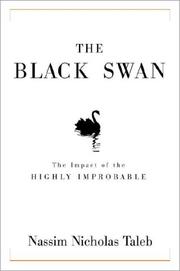
The Black Swan
2,588-word summary 12 min read
- First published
- 2007
- Publisher
- Random House
- ISBN
- 9781400063512
Reading options
What's inside (8 sections)
A friend who traded options told me to read this years ago, and his pitch was strange. He said it had made him less confident, and that was why it mattered. I expected another finance book with charts and tips. What I found was a loud and often funny attack on how we think about risk, written by a former trader who had lived through market moves his models said were near impossible.
The Black Swan came out in 2007 from Random House, just before the financial crisis made its theme look timely. Taleb uses the title to mean an event with three traits. It is rare and hard to foresee. It hits very hard. People then explain it afterward as if it had been obvious. Europeans once assumed all swans were white, until Dutch explorers saw black swans in Australia. That image gives him his name for the large surprises that shape history. Wars. Panics. New technologies. Sudden collapses. He thinks the steady trend matters less than a few jumps.
That claim fit my own life more than I wanted to admit. Most days run on routine. The shape of things, though, was set by surprises. A school place I got because someone else dropped out. A job that opened when a manager quit. An illness in the family that reset a whole year. Taleb turns that familiar feeling into a full view of markets and politics. Our minds like averages and neat causes. Reality likes shocks.
His tone takes getting used to. He mocks forecasters, bank chiefs, finance professors, and pundits who fit tidy stories to messy facts. I laughed in places. In other places I wanted him to allow that rough models can still help. Read him as someone to argue with, and the book works much better.
How the argument is built
The book is not a memoir, though Taleb's past runs through it. He grew up in Lebanon in a well known family and was a teenager when civil war broke out. A place that felt stable fell apart. People who had spoken with certainty about the future were left guessing.
He later worked in trading rooms in New York and London, dealing in options whose value jumps when prices move sharply. That job taught him to care about asymmetry. Some positions lose a little most days and gain a lot on the rare wild day. Many risk systems of that era did the reverse. They earned steady small gains and hid a large loss that arrived rarely and wiped them out.
From those roots comes his main point. We confuse two kinds of randomness. One is tame, with variation that stays near the mean. The other is wild, where a single case can outweigh all the rest. Our brains and our jobs push us to treat the second kind like the first, then to invent causes after the fact that make the result look orderly.
He does not ask you to guess the next shock. He thinks most such guessing wastes time. He asks you to set up your affairs so that being wrong does not ruin you. Shift from forecasting to exposure. That sounds plain, yet it cuts against much training in business and media.
Early on I changed how I marked the book. I stopped circling predictions and started circling lines about fragility. Who loses if wrong. What breaks under stress. That thread held the chapters together for me.
Mediocristan vs Extremistan
This invented pair carries much of the book.
Mediocristan is the land of the average. Height lives there. Weight lives there. If you measure a thousand people, no single person moves the average much. Even a very tall person shifts it only a little. Samples settle as they grow. The bell curve fits fairly well here.
Extremistan is the land where one case can rule the group. Wealth lives there. Book sales live there. Firm size lives there in many fields. Gather a thousand authors and add up their book income, and one star can earn more than all the rest combined. Add one more name and the total can jump. Averages mislead because the spread is so skewed. The past mean does not bind the next draw.
Taleb says our trouble comes from using Mediocristan tools in Extremistan. Schools teach the bell curve as the default. Risk programs assume it. Committees speak of standard deviations for income or war deaths as if those behaved like height. He saves sharp words for finance theory that treats a large move as too unlikely to matter. Anyone who traded through the 1987 crash or watched tech stocks around the turn of the century knows those moves arrive more often than smooth equations allow.
His casino image stayed with me. A casino handles known risks well. Roulette odds can be written down. A night of losses stays in a range the owners can fund. Real danger comes from outside the tables. A headliner cancels. Travel stops. A law changes. The house is safe from dice and open to the world. Taleb thinks firms and states act the same way. They polish control over small known risks while staying exposed to a large unknown one.
Not everything belongs in Extremistan. My commute varies but will not last a month. Taleb knows this. His warning is narrower. When success can copy at little extra cost, or when debt links firms together, assume wild randomness until shown otherwise. A novel can sell ten copies or ten million. A bank that funds long loans with short borrowing can look fine for years and fail in a week.
A short history of the idea
Taleb did not invent doubt. He gives it a family tree, and I liked these pages best.
He starts with David Hume and the puzzle of induction. Seeing white swans again and again does not prove that black swans do not exist. No run of confirming cases closes the gap. One contrary case breaks the rule. Taleb uses this against claims that a long calm proves danger has passed. His turkey image makes the point with humor. A bird fed each morning gains more reason each day to trust the farmer, until the feast day arrives. Confidence grows while risk builds.
Karl Popper is his hero. Popper held that science moves by bold claims that forbid something, followed by hard attempts to break them. A theory that fits every outcome teaches little. Taleb carries that standard outside the lab. He trusts people who say what would prove them wrong over people who pile up fitting stories.
More names pass through. Friedrich Hayek warned that planners could not gather the scattered knowledge held by millions. Benoit Mandelbrot, whom Taleb admires, showed that price charts stay jagged at every scale and that large moves cluster in ways smooth models miss. Montaigne earns praise for ease with not knowing. Sextus Empiricus, an ancient skeptic, stands in for the old habit of holding judgment when proof runs thin.
Taleb ties this line to his own youth. He recalls political talk in Beirut before the war, full of assurance, then the shock of collapse. He recalls older traders who taught him to fear the rare move rather than daily noise. The aim is to show why a trader ended up siding with old skeptics against modern business schools.
I wanted more pushback here. Hume states a hard problem, yet science still learns. Planes fly. Vaccines work. Many rough models guide action even while missing much. Taleb sometimes writes as if admitting limits means dropping measurement. Still, as a short course in doubt, these chapters work. They give you thinkers to follow and show why false precision sells.
Why prediction keeps failing
The middle chapters tour mental traps. Most readers will catch themselves in a few.
The narrative fallacy comes first. We love tight stories with clear motives. After stocks fall, pundits supply causes that sound firm. A speech spooked traders. A report calmed fears. Taleb says such tales drop randomness and press many small links into one clean chain. Memory keeps the plot and sheds the noise. I saw this in my own accounts of choices. I say I picked a school for its program and skip the chance meeting that tipped me, the weather on visiting day, the small grant that made costs workable. The named cause is real but partial.
Confirmation error is next. We notice facts that fit belief and pass over the rest. Taleb notes how hard it feels to seek the fact that would break your view. It also pays poorly in public. A forecaster who admits doubt sounds weak beside a rival who speaks with polish. The trade then selects for poise over care.
Silent evidence was new to me. We study winners and forget the crowd that tried the same path and failed. Survivors give talks. Closed shops leave no memoir. When we judge risk from winners alone, the path looks safer than it was. Publishing shows this plainly. One breakout debut makes success look near, while many strong manuscripts earn little. Taleb extends the point to markets and science. Luck hides because the unlucky go quiet.
His term ludic fallacy means mistaking games for life. In a game, rules stay fixed and odds can be listed. In life, rules shift and new moves appear. A die has six faces. A market can invent a product that changes what a price means. Students who train on neat puzzles may carry game habits into a world without bounds. His scorn for elegant risk math comes from this gap.
He adds two habits that narrow what we prepare for. We latch onto numbers we happen to hear and adjust too little. We also read no recent shock as proof that none can come. Both make plans brittle.
The weak spot is sweep. He writes as if near all expert judgment were worthless. Work on forecasting is more mixed. Short range weather models beat hunches. Engineers land probes on target. Careful teams that track results and update often beat lone stars. Taleb grants the gap between physics and social fields, but his rhetoric blurs it. I left these chapters distrusting grand market and political calls, without throwing out every model.
Where to stand: the barbell and robustness
If foresight is weak, change your footing. Build habits that survive being wrong.
Taleb pictures a barbell. Keep most resources where a shock cannot hurt much. Place a small share where a good shock would pay a lot. Avoid the middle ground where risks look contained but can grow unseen. An investor might hold mostly very safe assets with small speculative stakes. A writer might keep paid work that covers rent while trying a bold project with open upside. A city might keep cash and spare beds rather than run every system at full use.
I put this in home terms. I keep files backed up in two places because drives fail without warning. I avoid debt for daily spending because debt turns a setback into a trap. I leave open hours each week because good work often arrives unplanned. None of this calls the future. All of it cuts the cost of error.
Redundancy pairs with this stance. Taleb praises slack that looks wasteful in calm years. Extra stock. Extra cash. A second skill. Critics call it waste. He calls it cover for a world that jumps. He warns against trimming every buffer to lift a quarterly figure. A supply chain with no spare runs cheap until one port closes. A clinic with rooms always full runs lean until flu season hits. Savings show at once. Exposure shows later.
He applies the same view to news and advice. Read books that have lasted, since new titles include many that will soon fade. Distrust exact long range plans. Prefer trials with small downsides over grand designs. Trust counsel from people who lose when wrong over fame seekers who pay nothing for bad calls.
Limits remain. Slack costs money and time. A small firm cannot sit on cash while rivals build. A young worker cannot train for two trades at once with ease. Taleb gives stance more than steps. How small should a bold bet be. How much reserve is enough. He answers in spirit, which fits his distrust of formulas but can leave a reader wanting numbers. Even so, I changed course in small ways. I moved savings to safer ground, cut a loan tied cost, and began a cheap side project with room to grow.
What holds up and what wears thin
The core lens holds. Once you learn Extremistan, you see it often. A few videos draw most views. A few titles earn most of a shop's profit. A few days set a trader's year. His attack on after the fact stories holds too. Anyone who has watched pundits explain a market fall with poise one day and give the reverse account the next will feel its force.
His stress on exposure over foresight also holds. Readers who met this book in 2007 and then watched banks fail the next year saw the abstract point turn concrete. You did not need to name the trigger to see that thin capital with dense borrowing would end badly. That lesson travels to tech builds and to reputations tied to one outlet. Ask what would break you. Fix that first.
Repetition wears thin. The same cases return under new labels. The turkey. The casino. The rude meeting with an economist. The mockery of bell curve finance. Restating can teach, but here it pads. A firmer edit would have kept the punch with fewer rounds.
Tone also narrows reach. Taleb lumps careful students of wild randomness with the worst forecasters. Many researchers share his worries in calmer prose and build better tools. By mocking the whole trade, he loses allies and tempts readers in those fields to quit early and miss the useful part. I agreed often while wincing at the delivery.
Practical help stays thin as well. The barbell is a strong image, yet a teacher or nurse or shop owner with tight funds will ask how to use it on a small scale. Later books add terms and cases, but here counsel stays at stance. Stay humble. Shun ruinous debt. Keep options open. Sound, but not a plan.
One tension never quite clears. Taleb says rare shocks cannot be called, then takes pride in having braced for shocks in finance. Both can fit if the claim is only that timing and form stay unknown while fragility shows. He at times writes as if he saw more, which strains his own rule for modesty. The fair reading is this. He saw fragility plainly and refused to name the spark, and the refusal was the wisdom.
Who should try it now. Anyone whose work hinges on rare turns should. Investors. Founders. Writers. Lab researchers. Managers of tangled projects. Those who want calm steps may chafe. Those who like a fight will enjoy it even in dissent. I would pair it with a book on sound forecasting and one on stats, so doubt meets craft.
My copy now has bent corners on silent evidence and the barbell. When a winner's tale tempts me, I ask who is missing. When a plan looks sleek, I ask where slack went. Those two checks do not foretell shocks. They keep me from inviting them in.
FAQ
When was The Black Swan published?
Random House published it in 2007, just before the financial crisis gave its warning about fragile risk models added weight.
What do Mediocristan and Extremistan mean?
Mediocristan covers tame variation near the mean, like height. Extremistan covers skewed fields like wealth and book sales, where one case can outweigh the rest.
Is this book only for investors?
No. Taleb writes from trading, but the lessons on stories, hidden losers, slack, and ruin avoidance fit writers, founders, researchers, and managers.
Similar books
The Total Money Makeover: A Proven Plan for Financial Fitness
Dave Ramsey lays out seven Baby Steps, from a $1,000 starter fund to a paid-off house, with the debt snowball at the center.
2,663-word summary · 12 min read
SuperFreakonomics: Global Cooling, Patriotic Prostitutes And Why Suicide Bombers Should Buy Life Insurance
Levitt and Dubner apply incentives to prostitutes, suicide bombers, doctors, and climate fixes with cheeky data.
2,007-word summary · 9 min read
Predictably Irrational
Behavioral economist Dan Ariely shows why we overpay, procrastinate, and misjudge through simple experiments.
2,183-word summary · 10 min read
Nudge: Improving Decisions About Health, Wealth, and Happiness
Thaler and Sunstein show how defaults, framing, and social cues steer choices, and argue for choice architecture with an opt-out.
3,146-word summary · 14 min read
The Courage to Be Disliked: The Japanese Phenomenon That Shows You How to Change Your Life and Achieve Real Happiness
A philosopher and an angry young man argue over five nights about Adlerian psychology, trauma, approval, and the freedom to be disliked.
2,054-word summary · 9 min read
Made to Stick: Why Some Ideas Survive and Others Die
The Heath brothers break down why some ideas vanish on contact while others lodge in memory, tracing six traits that make a message stick.
2,527-word summary · 11 min read
Four Thousand Weeks: Time Management for Mortals
Oliver Burkeman turns the whole productivity project on its head, arguing that a human lifespan of roughly four thousand weeks is not a problem to optimize…
2,447-word summary · 11 min read

The Road Less Traveled: A New Psychology of Love, Traditional Values and Spiritual Growth
M. Scott Peck argues that maturity begins with accepting difficulty, then builds discipline, love, and spiritual growth through honest, often painful work.
2,200-word summary · 10 min read

The World Is Flat: A Brief History of the Twenty-first Century
Thomas L. Friedman's 2005 bestseller argues that technology, trade, and open borders leveled the global playing field, and it names the ten forces that did it.
2,369-word summary · 11 min read
Dare to Lead
Research on courage shows how leaders build trust through vulnerability and clear values.
2,442-word summary · 11 min read
Think Again
Adam Grant argues for holding views loosely and testing them like a scientist, moving past preacher, prosecutor, and politician habits at work and in debate.
3,204-word summary · 14 min read
Essentialism
McKeown argues for less but better: discern the vital few, refuse the trivial many, and use buffers, small wins, and steady routines so key work gets done well…
2,421-word summary · 11 min read

The Untethered Soul
Singer names the noisy inner voice and shows how watching thoughts, loosening old hurt, and keeping the heart open through surrender can ease daily suffering…
2,752-word summary · 12 min read
The Millionaire Next Door
Stanley and Danko survey wealthy Americans and find frugal savers living next door, not big spenders, in this 1996 money study.
2,466-word summary · 11 min read
The Art of Happiness
The Dalai Lama and psychiatrist Howard Cutler link lasting happiness to training the mind, human warmth, compassion, and basic spiritual values for daily life.
3,394-word summary · 15 min read
Drive: The Surprising Truth About What Motivates Us
Pink argues fair pay plus autonomy, mastery, and purpose at work beat carrots and sticks, using FedEx days, ROWE, flow, and clear Goldilocks tasks to explain…
2,339-word summary · 10 min read
Emotional Intelligence
Goleman argues self awareness and empathy shape success more than IQ alone.
2,026-word summary · 9 min read
Moneyball
Oakland buys walks and patience to win 103 games on a small payroll in Lewis's 2003 baseball story.
2,955-word summary · 13 min read
The Big Short: Inside the Doomsday Machine
Outsiders who read the bonds shorted subprime and watched the machine eat itself in 2008.
2,194-word summary · 10 min read
Influence: The Psychology of Persuasion
Six levers plus unity explain why people say yes, learned undercover in salesrooms and labs.
2,030-word summary · 9 min read
The 48 Laws of Power
Robert Greene turns court history into 48 blunt power laws, each taught through stories like Fouquet and Louis XIV, plus reversals that show when each law…
2,846-word summary · 13 min read
Never Split the Difference
Ex-FBI hostage negotiator Chris Voss shares tools for high stakes talks, from mirroring to calibrated questions. His 2016 book is direct, story driven, and…
2,965-word summary · 13 min read
David and Goliath: Underdogs, Misfits, and the Art of Battling Giants
Gladwell argues disadvantages can become advantages, from biblical sling to dyslexia and class size.
3,197-word summary · 14 min read

A New Earth
Tolle maps ego pain and shows how presence can loosen roles, thoughts, and suffering.
1,909-word summary · 8 min read
12 Rules for Life
Twelve essays on responsibility from posture to truth to petting cats.
2,045-word summary · 9 min read
Zero to One: Notes on Startups, or How to Build the Future
Thiel argues monopolies create value through vertical progress, not by copying competition.
2,582-word summary · 11 min read
Think and Grow Rich
Hill teaches desire, faith and autosuggestion, distilling lessons from Carnegie interviews into thirteen principles for success.
2,458-word summary · 11 min read
Who Moved My Cheese?
A tiny parable about two mice and two little people hunting cheese in a maze, and why adapting to change beats waiting for old days to return.
2,533-word summary · 11 min read
Thinking, Fast and Slow
Kahneman's tour of two minds: fast gut System 1 and slow careful System 2, and how biases, overconfidence, and framing shape every choice.
2,306-word summary · 10 min read
The Power of Habit
Why we do what we do: the cue routine reward loop, keystone habits, and how companies and movements use the same science, from toothpaste to the bus boycott.
2,207-word summary · 10 min read