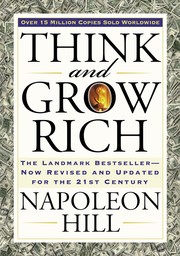
Think and Grow Rich
2,458-word summary 11 min read 320 pages in the book
- First published
- 1937
- Publisher
- The Ralston Society
- Pages
- 320
- ISBN
- 9781585424337
Reading options
What's inside (9 sections)
I picked up Think and Grow Rich because a friend kept quoting it at his small business. Every setback became a line about desire or persistence. I expected a thin pamphlet from the 1930s, interesting as history but light. The real book is stranger and more forceful. It is part philosophy, part sales manual, part sermon, and it keeps insisting that riches begin as a definite thought held long enough to change conduct.
Hill gives a famous origin story. In 1908, as a young reporter, he interviewed Andrew Carnegie. Carnegie was impressed and supposedly asked him to spend twenty years studying successful men and distilling a philosophy of achievement. Hill says he interviewed more than five hundred people, including Henry Ford, Thomas Edison, Alexander Graham Bell, and Theodore Roosevelt. Historians have found little proof for the partnership as Hill describes it. Treat that story as legend that frames the book rather than verified biography. The book itself appeared in 1937, published by The Ralston Society, in the middle of the Great Depression. Readers were broke and frightened. Hill offered a plan that started with thought rather than capital.
His claim is simple and repeated in many forms. Thoughts become things when mixed with definiteness of purpose, persistence, and burning desire. He lays this out in thirteen principles that build on each other. The repetition can tire you by the middle, but the structure is clear enough to follow.
Desire: name it and date it
Desire comes first, and Hill means something narrower than wishing. Wishing is vague. Desire is specific, heated, and written down. He gives six famous steps. Fix in mind the exact amount of money you want. Decide what you will give in return. Set a definite date. Make a definite plan and begin at once, whether you feel ready or not. Write it out. Read it aloud twice daily, morning and night, and picture yourself already in possession of the money.
The exercise sounds mechanical because it is meant to be. A clear target changes what you notice and what you refuse. A salesman with a quota and a deadline acts differently from a man who says he hopes to do well someday. Hill pushes you to pick a number, a date, and a service to offer, then to look at that paper until excitement or embarrassment forces action.
He illustrates this with Edwin Barnes, who wanted to work with Edison rather than merely for him. Barnes arrived with little money, took low paid office work, waited, and later became the main seller of the Edison Dictating Machine. Hill also tells of R U Darby, who quit drilling three feet from gold in Colorado, then learned to persist in later work. The details are compressed and hard to verify. Read them as parables. Most ventures need a second plan after the first breaks, and most people quit just before the break.
My reaction was mixed. Writing a sum, a date, and a plan exposes how fuzzy most goals are. That part helps. But Hill writes as if intensity removes obstacles. He says little about luck, starting money, race, gender, or the Depression itself. Take the worksheet and leave the promise that thought alone guarantees wealth.
Faith and autosuggestion
Faith is the second principle and autosuggestion is the third. Together they form Hill's psychology. Faith here is not only religious faith, though he borrows that language. It is a state of mind you can induce by repetition. Autosuggestion is the method. The subconscious accepts statements repeated with feeling, then steers behavior to match them.
Hill is blunt about practice. Say your written statement aloud with emotion. See and feel yourself already achieving it. Repeat until doubt quiets. He even prints a self confidence creed for daily recital about ability and persistence. He tells of job seekers who acted like people already worthy of the post, which changed how employers received them.
There is a modern echo Hill could not have named. Athletes rehearse performance. Therapists teach cognitive rehearsal. Sales trainers teach a short routine before calls. When you picture a calm interview, you walk in calmer. That is preparation, not magic.
The trouble starts when Hill treats faith as a substance that attracts money through vibrations in the ether. He also suggests that fear works the same way in reverse, that negative repetition creates failure just as surely. That framing can sound like blame. If you failed, you must not have believed enough. I found it better to split the chapter while reading. Keep the practical half: write clearly, repeat daily, picture the next step, speak to yourself firmly. Set aside the physics about thought waves.
Hill also warns about fear, especially fear of criticism. Relatives will laugh at a new plan, often from kindness, and laughter kills more ideas than opposition. His remedy is to choose counsel carefully and keep your purpose mostly private until it has roots. That still reads as sound advice for anyone starting a business in a skeptical household.
Knowledge, imagination, and organized planning
The next three principles answer the obvious objection. Wanting is not enough. You need something to sell and a way to sell it.
Hill argues that general schooling matters less than specialized knowledge organized toward a definite end. Ford, in Hill's telling, did not need to know everything because he had experts on call. Hill praises night courses, trade journals, apprenticeships, and close study in one field. The modern equivalents are plain: documentation, community college classes, tutorials from practitioners, mentors at work. Pick the knowledge your plan requires and get it fast, rather than collecting credentials for display.
Imagination gets two forms. Synthetic imagination rearranges old ideas into new combinations. Creative imagination receives hunches. Most of the chapter concerns the first kind. He tells of Asa Candler turning a syrup into Coca Cola through distribution and advertising, and of merchants who rebuilt after the Chicago fire because they had decided to stay. The examples are loose with facts, but the pattern is familiar. Someone sees an unused asset and pictures it at scale.
Organized planning is the longest and most grounded section. Hill says no one grows rich on brains alone. You need plans that survive contact with buyers, bosses, and banks. He lists causes of failure with bluntness: lack of purpose, procrastination, expecting pay before effort, fear of criticism, and poor choice of associates. He gives advice on selling personal services, really advice on getting and keeping a job, including his QQS formula of quality plus quantity plus spirit of cooperation. He ranks failures in leadership, from inability to organize details to disloyalty and love of authority over competence. The office language is dated, yet the core holds. Be useful, be easy to direct, keep learning, and choose allies with care.
Decision and persistence
Decision and persistence are short principles with long effects. Hill says successful people decide quickly and change slowly, while unsuccessful people decide slowly and change quickly. He traces indecision to stray opinions from neighbors, papers, and gossip. If you talk too much, you collect doubts until the plan dissolves.
He uses sweeping history, like the signing of the Declaration of Independence as a decision with no retreat, and Ford's decision to build the V8 in one casting after engineers said it could not be done. The stories are heroic and compressed. The psychological point is fair. Teams that keep reopening settled questions exhaust themselves. A written decision, reviewed on schedule rather than whenever fear spikes, steadies a group.
Persistence gets its own chapter because Hill thinks it sorts dreamers from earners. He lists symptoms of weak persistence that sting: alibis, self satisfaction, indifference, blaming others, and quitting at the first sign of opposition. His supports for persistence are plain: definiteness of purpose, desire, self reliance, and definiteness of plans. He wants a reader at a kitchen table in 1937 to stand up, reread the written statement, and make one more call.
A modern filter helps here. Quick decisions are not always good. A surgeon or investor should often decide slowly and change fast when evidence shifts. Hill is writing about a specific failure he saw in salesmen: endless consultation followed by retreat. If that is your pattern, his scolding helps. If your pattern is impulsiveness, you need the opposite medicine, and Hill does not supply it.
The master mind alliance
No mind grows rich alone. That is Hill's premise for the mastermind, which he spells master mind, his favorite social idea. A master mind is a small group whose members coordinate knowledge and effort in harmony toward a definite purpose. He credits Carnegie with the concept and points to Ford, Edison, and Harvey Firestone meeting and trading ideas that later appeared as products.
The practical version is familiar today. Three to five people with different skills, meeting weekly, reviewing goals and obstacles honestly. Hill adds a mystical claim, that pooled minds create a third super mind with powers no member possesses. You do not need the metaphysics to get value. The right circle sharpens plans and catches blind spots. The wrong circle flatters and distracts. Hill is good on choosing: pick people who will tell you when your plan is weak, compensate them fairly, and meet on a fixed rhythm.
He follows this with the strangest chapter for modern readers, sex transmutation. Hill argues that sexual energy is among the strongest drives and can be redirected into creative work. He claims many men do their best work after channeling passion into ambition with love and purpose. He writes almost entirely about men, treating women mainly as wives who inspire or distract. That narrow lens dates the chapter badly.
Read with distance, two plain points survive. Strong emotion fuels sustained work when tied to purpose, whether that emotion is love, rivalry, or devotion as a parent. And self control matters for long projects. Late nights, drink, and constant stimulation drain the focus a new business needs. Hill wraps those observations in grand theory about energy transfer. Keep the counsel about focus and set aside the theory. He also lists other stimuli that excite the mind, like music, friendship, shared adversity, and burning desire for achievement. Music gets warm praise. The catalog reads like a preacher's list, inconsistent and very much of its time.
The subconscious, the brain, and the sixth sense
The final three principles are Hill's attempt to describe the wiring behind the earlier how to chapters. They are also where criticism lands hardest.
The subconscious, in his telling, records every thought and acts on the dominant pattern. It is especially open to thoughts mixed with feeling, which is why autosuggestion must be emotional. He advises feeding it constructive plans and starving fears through replacement. He warns about conversation soaked in complaint. People who rehearse grievances get fluent in grievance. People who rehearse next actions get fluent in action. His daily ritual is simple: sit quietly, recall your written purpose, feel it as present fact, and review it with calm. Readers from many traditions will recognize the shape. Attention training plus mood regulation beats frantic worry.
The brain chapter loses most modern readers. Hill proposes the brain is a broadcasting and receiving station for thought vibrations, able to pick up ideas from other minds and from what he calls Infinite Intelligence. He speculates about frequencies and telepathy. No controlled evidence is offered. The radio analogies, impressive in the 1930s, now read as category errors. Radio waves are physical and measurable. Thought influence of the kind he describes is not.
The sixth sense chapter continues in the same key. Hill calls it the apex, an intuitive flash that warns of danger and announces opportunity after the other principles are mastered. He describes imagined council meetings with Lincoln, Edison, and Ford around a table in his mind, debating his problems at night. He admits these advisors were imaginary, yet reports guidance that felt external. Stripped of claims about spirits, the council is a useful creative exercise. Asking what a respected mentor would do forces you to borrow their standards for an hour. Writers and executives still do versions of this as journaling. Hill spoils the insight by insisting the flashes arrive through a universal medium rather than from preparation meeting rest.
He also says little about sleep, health, or study as foundations for intuition. Modern work reverses that emphasis. Intuition improves with domain knowledge, feedback, and rest. A mechanic intuits engine faults because he has heard thousands of engines. Hill wants the flash without always demanding the thousand engines first.
Reading it honestly now
What remains after criticism? More than skeptics admit, and less than devotees claim.
The durable core is a routine. Write a definite purpose with a number and a date. State what you will give. Read it morning and night with feeling. Learn the specific skills the plan needs. Combine old parts into new offers. Decide without endless polling, persist through early failures, and meet weekly with a few serious people who tell the truth. That routine has helped salespeople, builders, students, and founders for generations, not because thought prints money but because clarity organizes effort.
The dated parts need naming. The science of vibrations is pseudoscience. The history is often unverified. The language about success centers men and assumes a reader who can walk into an office and get a hearing. The promises about wealth overreach. Hill implies a universality his evidence cannot carry. A philosophy that says faith decides outcomes can comfort the persistent and wound the unlucky. Illness, layoffs, discrimination, and bad timing are not failures of autosuggestion. Hill allows for temporary defeat but rarely for structural barriers or chance. Effort raises odds. It does not set them to one.
Why does the book still sell? The routine is simple enough to start tonight. The scenes stick in memory: Barnes at Edison's door, quitting three feet from gold, Ford willing his team toward the V8. And Hill speaks to shame. He tells a reader with little money that thought is still capital and that a written plan read with conviction is a respectable beginning. In 1937 that landed like good news. It still lands, even though we now demand better evidence.
If you try it, use a pencil and a filter. Do the written exercises for thirty days and track what changes in your calendar, not only your mood. Form a small group that meets at a fixed hour. Mark the three failure causes in the planning chapter that fit you best. Try the imaginary council once as a journal prompt. Leave the ether, keep the work, and the book earns shelf space without needing to be true in every line.
FAQ
Did Andrew Carnegie really commission Hill to write the book?
Hill says Andrew Carnegie commissioned him in 1908 to interview successful men and distill a philosophy of achievement. Historians have found little proof for the meetings as Hill described them, so treat the origin story as legend that frames the book rather than verified biography.
When was Think and Grow Rich first published?
It was first published in 1937 by The Ralston Society, during the Great Depression. Hill had published earlier versions of his philosophy in the 1920s, but the 1937 book is the famous and lasting edition.
Is the book only about getting rich with money?
No, despite the title. Hill writes about riches in a broad sense and says money is one common measure, but the thirteen principles are about purpose, discipline and working with others. Many readers apply the ideas to career, creative work or personal goals.
Similar books
More like Think and Grow Rich →
The Power of Habit
Why we do what we do: the cue routine reward loop, keystone habits, and how companies and movements use the same science, from toothpaste to the bus boycott.
2,207-word summary · 10 min read

Outliers: The Story of Success
Success comes from practice, timing, and hidden chances more than talent alone.
1,934-word summary · 9 min read

Maybe You Should Talk to Someone
Therapist Lori Gottlieb counsels John, Julie and Rita while seeing her own therapist Wendell after a breakup.
2,234-word summary · 10 min read

Who Moved My Cheese?
A tiny parable about two mice and two little people hunting cheese in a maze, and why adapting to change beats waiting for old days to return.
2,533-word summary · 11 min read

Quiet
Cain traces the Extrovert Ideal from Harvard Business School to open offices and defends the power of quiet.
2,898-word summary · 13 min read

The Tipping Point: How Little Things Can Make a Big Difference
How tiny shifts push ideas and products past a tipping point into epidemics.
2,014-word summary · 9 min read