
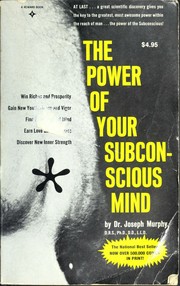
The Power of Your Subconscious Mind
2,259-word summary 10 min read 226 pages in the book
- First published
- 1963
- Publisher
- Prentice Hall
- Pages
- 226
- ISBN
- 9780136859253
Reading options
What's inside (7 sections)
I picked this book up because a friend of mine swore it had carried him through a rough stretch of his life. He would not say much beyond "it changed the way I talk to myself," which is precisely the kind of sentence that makes me suspicious of a book. It was first published in 1963 by Prentice Hall, and it has never really left the shelves since. You find it in airport shops, in thrift stores, and in endless new editions with different covers. It has sold millions of copies. I wanted to know what was actually on the page, so I read all twenty short chapters straight through and tried to take the argument seriously on its own terms, rather than laughing at it from a distance.
What I found was not a self-help book in the modern sense. There are no worksheets, no morning routines, no numbered plans. Murphy writes like a minister delivering a run of Sunday sermons, which makes a great deal of sense once you know who he was. He was born in County Cork, Ireland, in 1898, started training for the Jesuit priesthood, then walked away from that life and sailed to the United States in 1922. He worked as a pharmacist in New York, drifted into the New Thought movement, and eventually landed in Los Angeles, where Ernest Holmes ordained him in Religious Science in 1946. A few years later he was leading a Divine Science congregation that grew into one of the largest of its kind in the country. He wrote more than thirty books, and this one, appearing when he was in his sixties, became the famous one. That background matters, because the engine running under the practical advice is theological, even when the prose sounds like a manual.
The machine Murphy thinks we are running
The opening chapters set up a picture of the mind that is simple enough to fit on a postcard. Murphy divides everything into two. The conscious mind is the part that reasons, weighs evidence, makes decisions, and says no. The subconscious is the part that remembers everything, feels things intensely, and, in his account, accepts whatever the conscious mind keeps handing it without ever arguing back. He compares it to a garden: whatever you plant in it, whether that is fear or confidence or resentment, will grow and eventually crowd out everything else. He also describes it as a storehouse, a treasury, a place where every impression you have ever received is filed away and kept alive.
The book announces its plan in the first chapter title, The Treasure House Within You, and the second chapter, How Your Mind Works, is the closest thing to a theory section. One thing I did not expect was how much of the book is taken up with a single exercise. Again and again Murphy tells the reader to get quiet, to relax the body, to hold one clear picture in mind, and to feel the desired result as though it had already happened. He insists that the feeling matters more than the words, and that a person who repeats a phrase without any conviction is only making noise. The third chapter, The Miracle-Working Power of Your Subconscious, then tells the reader that this feeling is what gives the picture its force.
The claim he wants you to accept is what he calls the law of belief. Whatever you deeply believe to be true becomes true for you, not because the universe has heard your request and answered it, but because the belief itself shapes what you notice, what you attempt, and how you interpret what happens. A person who is certain they will fail will spot every possible reason to quit. A person who is certain they will find a way will keep looking after everyone else has gone home. Murphy is at his best when he stays inside this psychological claim and leaves the metaphysics alone. He has a sharp eye for the way a person can talk themselves into a corner, and several of his examples read like accurate descriptions of people I have known.
He is much less careful when he starts describing the subconscious as a separate practical reasoner that never sleeps and never stops working on your behalf. The book keeps sliding between two positions. One is that your habits of thought change your attention and your behavior, which is a reasonable thing to say. The other is that your thoughts travel out into the world and rearrange circumstances, which is a much larger claim and one he never demonstrates. I found myself underlining the first kind of sentence and putting the book down whenever it veered into the second.
Healing, ancient and modern
Chapters three through six are where Murphy makes his biggest promises. He argues that the subconscious has a natural tendency toward life and wholeness, and that illness can be met by deliberately impressing the mind with thoughts of health. He fills these pages with stories of people who recovered after they stopped dwelling on symptoms and began, in his phrase, to "claim" their healing. A person with a chronic condition starts each day by picturing themselves well. Someone afraid of an operation calms the fear by repeatedly imagining a successful outcome. A man who has been told he will never walk again slowly finds his strength returning after months of mental rehearsal.
Chapters four, five, and six carry the titles Mental Healings in Ancient Times, Mental Healings in Modern Times, and Practical Techniques in Mental Healings. They move from temples and faith healers to Murphy's own account of psychotherapy, and he clearly sees himself as part of a long line of people who noticed that belief changes the body. He is especially interested in what happens when a person stops rehearsing the worst possible outcome and starts, deliberately, to expect something better.
I want to be fair here. Murphy is not telling people to ignore doctors, and he repeatedly says that prayer and medical care can work together. He also has an obvious compassion for people in pain, and the tone of these chapters is gentle rather than harsh. When he writes about modern psychotherapy and the power of suggestion, he is describing a real phenomenon: expectation changes how we experience symptoms, and a calm, focused state of mind can reduce fear and help the body rest. There is genuine comfort in the idea that your inner life is not a bystander to your physical life.
The trouble is the distance between that modest observation and the conclusions he draws from it. When a recovery follows a change in attitude, Murphy treats the attitude as the cause rather than one factor among many. When someone does not recover, the framework quietly suggests they did not believe hard enough, which is a cruel thing to imply to a sick person. I have watched versions of this idea do real damage in the world, and reading it in a book that otherwise sounds so kindly made me uneasy. The anecdotes are all success stories. There is no control group, no follow up, no account of the people who tried the same techniques and got worse.
Money, work, and the sleeping mind
After healing, Murphy turns to prosperity, and this is the part of the book that later writers would carry straight into the law of attraction industry. Chapters nine and ten are called Your Subconscious Mind as a Partner in Success and Your Right to Be Rich. The argument is that wealth begins as a state of mind, and that a person who is chronically convinced of their own lack will keep producing lack. He tells the story of a man buried in debt who begins each morning by settling into a feeling of already having what he needs, and who gradually finds opportunities he had previously walked past. Another example concerns a salesperson who stops rehearsing rejection and starts rehearsing the interview going well.
Again, there is a useful kernel here. If you have ever gone into a meeting already certain it will go badly, you know how accurately a fearful mind can sabotage its own predictions. Murphy is good at naming that pattern and at describing how a repeated inner sentence can become a habit that shapes a whole life. He also has a stubborn optimism about ordinary people that I found appealing. He insists that prosperity is not a reward reserved for a few lucky families, and that the mental habits of successful people can be learned by anyone willing to practice them.
There is also a chapter called How Scientists Use the Subconscious Mind, where Murphy argues that discovery often arrives only after a stretch of conscious effort has been set aside. He points to the familiar experience of solving a problem in the shower or on a walk, after hours of staring at it have produced nothing. The point is well observed, though he uses it to support a much grander theory than the observation can carry.
Then there is the chapter on sleep, which is probably the most memorable idea in the book. Murphy says the subconscious never switches off, and that if you hand it a clear problem just before you fall asleep, it will keep working on it through the night. He calls this sleeping on a problem in a deliberate way, and he suggests that the answer often arrives as a thought the next morning, or in a dream, or in a sudden change of feeling. I actually like this advice when I strip away the claim about a midnight worker. There is solid evidence that a good night of sleep reorganizes what we have learned and helps us see a problem differently. A friend of mine uses a version of this before difficult conversations, and he swears by it. I am willing to believe that Murphy stumbled onto something real here, even if his explanation of the mechanism is wrong.
Marriage, fear, and the long road to forgiveness
The second half of the book moves into relationships. Murphy writes about marital problems with a tact that surprised me. His basic point is that you cannot change another person by nagging them, but you can change the atmosphere you create by changing your own reactions. He describes a husband and wife who keep having the same fight, and he asks what would happen if one of them stopped supplying the usual response. The advice is not profound, but it is the kind of thing people genuinely need to hear, and it is delivered without any of the smugness that usually accompanies it.
He has chapters on happiness, on harmonious human relationships, and on forgiveness. The forgiveness chapter is the one I would hand to someone else first. Murphy argues that resentment is a poison you drink yourself, that holding a grudge keeps the original injury alive long after the person who caused it has moved on, and that letting go is a practical act of self-interest rather than a moral performance. He is careful to say that forgiveness is not the same as pretending nothing happened or staying in a harmful situation. That distinction matters, and he makes it clearly.
The final chapters take up fear, mental blocks, and staying young in spirit. Murphy treats fear as an accumulation of old impressions that can be slowly replaced by new ones, and he recommends the same basic exercise over and over: quiet yourself, hold a specific picture in mind, feel it as already true, and repeat it until it becomes familiar. By the time I reached chapter twenty I could have written the exercise myself. The repetition is part of the design, of course. He wants the idea to become so ordinary that it stops sounding strange. For a reader looking for a new insight on every page, that gets tiring. For a reader who wants one simple practice to return to, the repetition is probably the point.
What I make of it now
I do not believe the central claim of this book. I do not think your subconscious mind can heal a disease or deliver a raise because you pictured it often enough, and I think the book is at its weakest whenever it makes that suggestion. The evidence it offers is a pile of uplifting stories, which is no evidence at all. There is also an uncomfortable undertone in which trouble is treated as a failure of belief, as though a person in poverty or in pain has simply been thinking incorrectly. I would want anyone I care about to read that part with a healthy suspicion.
And yet I understand why the book has lasted. Murphy is a generous writer, and he is writing to people who feel stuck. His best passages are about attention: what you keep returning to grows larger in your life, and a mind that rehearses defeat will find plenty of evidence for it. That is a useful thing to tell a person, and it does not require you to accept any of the mystical machinery. I closed the book feeling that I had spent time with an earnest man who wanted his readers to suffer less, even though I disagreed with him about nearly everything that mattered. I would recommend it with a caveat attached, which is more than I can say for most books that make this many promises.
FAQ
When was The Power of Your Subconscious Mind first published?
It was first published in 1963 by Prentice Hall. Murphy was an Irish-born New Thought minister who wrote more than thirty books.
Does Murphy offer scientific evidence for his claims?
Not in the scientific sense. The book relies on personal anecdotes and success stories, and it never demonstrates that thoughts directly rearrange circumstances or cure illness.
What is the main exercise Murphy recommends?
He asks readers to get quiet, hold one clear picture in mind, and feel the result as already real, repeating the practice until it feels familiar.
Similar books
The Road Less Traveled: A New Psychology of Love, Traditional Values and Spiritual Growth
M. Scott Peck argues that maturity begins with accepting difficulty, then builds discipline, love, and spiritual growth through honest, often painful work.
2,200-word summary · 10 min read

The Untethered Soul
Singer names the noisy inner voice and shows how watching thoughts, loosening old hurt, and keeping the heart open through surrender can ease daily suffering…
2,752-word summary · 12 min read
The Art of Happiness
The Dalai Lama and psychiatrist Howard Cutler link lasting happiness to training the mind, human warmth, compassion, and basic spiritual values for daily life.
3,394-word summary · 15 min read

A New Earth
Tolle maps ego pain and shows how presence can loosen roles, thoughts, and suffering.
1,909-word summary · 8 min read

Ikigai: The Japanese Secret to a Long and Happy Life
Two Spanish writers explain the Japanese idea of a reason for being, drawing on Okinawan centenarians, flow, friendship and the acceptance of imperfection.
2,030-word summary · 9 min read
Flow: The Psychology of Optimal Experience
Csikszentmihalyi's 1990 study of optimal experience asks when people feel most alive and finds the answer in a balance of challenge and skill. Drawing on…
3,073-word summary · 14 min read
Digital Minimalism: Choosing a Focused Life in a Noisy World
Cal Newport argues that willpower cannot beat an attention economy designed against you, and offers a thirty day reset to rebuild your digital habits around…
2,701-word summary · 12 min read

Everything is F*cked: A Book About Hope
Manson argues that hope, built on control, values, and community, keeps despair at bay, then takes apart the stories and diversions we use to sustain it.
2,789-word summary · 12 min read

As a Man Thinketh: A book that will help you to help yourself
In seven short chapters, James Allen argues that character and circumstance grow from thought, and that changing how you think is the practical route to…
2,673-word summary · 12 min read

The Courage to Be Disliked: The Japanese Phenomenon That Shows You How to Change Your Life and Achieve Real Happiness
A philosopher and an angry young man argue over five nights about Adlerian psychology, trauma, approval, and the freedom to be disliked.
2,054-word summary · 9 min read

Four Thousand Weeks: Time Management for Mortals
Oliver Burkeman turns the whole productivity project on its head, arguing that a human lifespan of roughly four thousand weeks is not a problem to optimize…
2,447-word summary · 11 min read
10% Happier
An ABC newsman panics on air, then finds meditation without losing his edge.
2,590-word summary · 12 min read

12 Rules for Life
Twelve essays on responsibility from posture to truth to petting cats.
2,045-word summary · 9 min read
The Defining Decade: Why Your Twenties Matter - and How to Make the Most of Them Now
A clinical psychologist argues that the twenties are not a holding pattern and urges readers to build skills, ties, and commitment now.
2,443-word summary · 11 min read
How to Change Your Mind
Pollan blends the history of psychedelic research, his own guided trips, and current neuroscience to ask what these drugs reveal about consciousness.
2,466-word summary · 11 min read

You Can Heal Your Life
Louise Hay's 1984 bestseller argues that thoughts and beliefs shape the body, pairing a mirror-and-affirmation workbook with an A to Z list of ailments and…
3,672-word summary · 16 min read

Women Who Run with the Wolves
A Jungian analyst reads fairy tales as maps to a woman's instinctual self, from La Loba to Bluebeard and Vasalisa.
2,331-word summary · 10 min read

Wild at Heart: Discovering the Secret of a Man's Soul
Why do men feel bored and tame? John Eldredge argues a man's heart is wild by design, and that recovering it means facing the wound and the question of whether…
2,289-word summary · 10 min read
The Pursuit of God: The Human Thirst for the Divine
Ten short chapters on wanting God rather than merely knowing about him, from a pastor who wrote the book in a single night on a train.
2,014-word summary · 9 min read
The Miracle Morning
Hal Elrod argues that the first hour of the day sets its tone, and offers six short practices, silence, affirmations, visualization, exercise, reading and…
2,240-word summary · 10 min read
The Art of Loving
Fromm argues that love is an art requiring care, responsibility, respect and knowledge, not a feeling we simply fall into. A short, stern classic of 1950s…
3,175-word summary · 14 min read
Rising Strong: The Reckoning. The Rumble. The Revolution.
Brené Brown's 2015 book asks what happens after we fall, and argues that examining the stories we invent about failure and heartbreak is the path to getting…
2,271-word summary · 10 min read

My Utmost for His Highest
A posthumous collection of 366 daily devotional readings assembled from Oswald Chambers's sermons, built around surrender, discipleship and the gap between…
2,015-word summary · 9 min read
Getting to Yes: Negotiating Agreement Without Giving In
Fisher and Ury propose negotiating on interests rather than positions, using fair standards and a clear alternative if no deal is reached.
2,231-word summary · 10 min read

Emotional Intelligence 2.0
Bradberry and Greaves turn emotional intelligence into four learnable skills, a self-assessment and dozens of strategies, while their headline numbers rest on…
3,276-word summary · 15 min read
Captivating: Unveiling the Mystery of a Woman's Soul
A Christian companion to Wild at Heart in which John and Stasi Eldredge argue that women carry three God-given desires that wounds can bury. Warm, scriptural…
2,722-word summary · 12 min read
Boundaries: When to Say Yes, How to Say No to Take Control of Your Life
A Christian self-help book that treats a boundary as a personal property line and applies the idea to family, friendship, marriage, work and the self.
2,047-word summary · 9 min read

Atlas of the Heart: Mapping Meaningful Connection and the Language of Human Experience
Brené Brown maps 87 emotions and experiences into thirteen 'places we go,' arguing that precise language changes what we can ask for and how we connect.
2,491-word summary · 11 min read
The Prayer of Jabez: Breaking Through to the Blessed Life
A tiny 2000 devotional built on two verses in Chronicles became a publishing phenomenon and a lightning rod for criticism.
2,296-word summary · 10 min read
The Obstacle Is the Way: The Timeless Art of Turning Trials into Triumph
A 2014 Stoic self-help book arguing that perception, action and will can turn setbacks into fuel, told through historical anecdotes.
2,669-word summary · 12 min read