
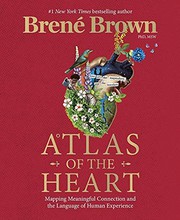
Atlas of the Heart: Mapping Meaningful Connection and the Language of Human Experience
2,491-word summary 11 min read 336 pages in the book
- First published
- 2021
- Publisher
- Random House
- Pages
- 336
- ISBN
- 9780399592553
Reading options
What's inside (9 sections)
I came to this book expecting another volume of Brené Brown research packed with stories about shame and courage, and I got something stranger and more useful. It opens not with a study but with a recurring dream. Brown is the only server working a dining room that is completely slammed, orders piling up, every table wanting something at once. Anyone who has ever worked in a restaurant will recognise the feeling she is describing. What made me sit up was the language she brings to it. In restaurant shorthand, being "in the weeds" means you are swamped but still functioning, still able to take a specific request and act on it. Being "blown" means you are past that point. You need someone else to step in. She uses those two phrases to separate stress from overwhelm, and the distinction lands immediately because it is concrete. Ask for the wrong kind of help and you get the wrong kind of response.
That little scene is the whole book in miniature. Brown's claim is that the words we have for an experience change what we can do about it. If all you can say is that you are stressed, you will get one kind of help. If you can say that you are overwhelmed and need someone to take a task off your hands, you will get another. She builds the rest of the book on that small, practical idea, and she keeps returning to it from different angles. The title's promise of a map is not decoration. She wants a set of names that helps a person work out where they are, how they got there, and what to do next.
The book appeared in November 2021 from Random House, a 336-page hardcover that became a bestseller and later spawned a five-part series on HBO Max. It sits in the same corner of Brown's work as Daring Greatly and Rising Strong, but it is less a argument about vulnerability than a reference book for ordinary moments. I found it easiest to read in short stretches, one chapter at a time, and that seems to be how it was designed to be used.
How the map was made
Brown does not begin with a list of feelings. She begins with herself as a child who watched people closely. She describes a kind of observation she thought of as a special power, the ability to read a room and guess what someone would do next. She could avoid her swim teacher's disapproval by switching to backstroke. She could shield herself and her siblings when her parents fought. She came to think that all that watching raised her anxiety and made her less willing to be vulnerable, because knowing what was coming meant she could try to control it. As a teenager she numbed the discomfort with activity, fun, drugs and alcohol, and later, after her mother entered recovery and therapy following her parents' divorce, she started what she calls doing her own work. That personal history matters here because the book is about language as a way of facing experience rather than managing it from a distance.
The research behind the atlas is real and fairly painstaking. Brown says she and her team sifted through roughly 550,000 comments from an online course she taught in 2013 and 2014, looking for the emotions and experiences that came up most often and the ones people struggled to name. They brought in experienced therapists to weigh which ones mattered most in clinical work, and she spent years refining the list with researchers and interns. The result is a set of 87 emotions and experiences, grouped into 13 chapters, each chapter named for a "place we go" rather than for a single feeling. She mentions that when she has surveyed workshop crowds over the years, the emotions people most often name are happy, sad and angry. Three words, for the whole of human feeling. That gap is what she is trying to close.
The map metaphor runs deeper than the cover art. Brown argues that a map tells you where you are, where you came from and where you can go next, and she wants emotional vocabulary to do the same job. She talks about emotional granularity, the skill of putting a finer label on a feeling, because a precise label helps a person communicate a need and get the support they actually want. She is careful to say that naming an experience does not make it disappear. In her words, naming an experience does not give the experience more power, it gives us the power of understanding, meaning and choice. That is a modest claim, and it is the one the book keeps making.
Uncertainty, comparison and plans gone wrong
The early chapters introduce the machinery. Chapter one gathers stress, overwhelm, anxiety, worry, avoidance, excitement, dread and vulnerability under the heading of places we go when things are uncertain or too much. Brown leans on her restaurant shorthand again: stressed is being in the weeds, overwhelmed is being blown. She describes anxiety as an escalating loss of control, with worst-case thinking and total uncertainty attached to it. She says plainly that worry is not an emotion but the thinking part of anxiety, and that digging into the feeling driving the worry is more useful than arguing with the thoughts. Avoidance gets similar treatment. It looks like calm from the outside, but it takes a great deal of energy to keep zigzagging away from something.
What I appreciated is how she separates neighbours that people routinely mix up. Anxiety and excitement can feel almost identical in the body, and the difference is the story the mind tells about the sensation. Dread is anxiety with a known target. These distinctions are small on the page but useful in the moment, because a person who can say "this is dread, not fear" has already taken a step back from it.
Chapter two deals with comparison: admiration, reverence, envy, jealousy, resentment, schadenfreude and freudenfreude. Envy is wanting what someone else has. Jealousy is the fear that a relationship is threatened. Schadenfreude is pleasure at another's misfortune, and freudenfreude is its opposite, taking joy in someone else's good luck. I had never met the second word before, and it is a genuinely handy one. Chapter three covers boredom, disappointment, expectations, regret, discouragement, resignation and frustration, the places we go when things do not go as planned. Here Brown is at her best on the everyday textures of let-down, the small private disappointment that has no name and so gets filed under a shrug. Chapter four moves to awe, wonder, confusion, curiosity, interest and surprise, the places that are beyond us. It is a short breather before the book gets darker.
When things are not what they seem, and when we hurt
Chapter five collects amusement, bittersweetness, nostalgia, cognitive dissonance, paradox, irony and sarcasm. These are not all emotions in any strict sense, and Brown does not pretend otherwise. She is mapping experiences, including thoughts and social moves, because that is what people actually report feeling. Bittersweetness and nostalgia sit close together. Irony and sarcasm are ways of holding two things at once, sometimes kindly and sometimes not. This is where the taxonomy starts to feel loose, but it also produces some of the book's sharpest observations about how we talk to each other.
Chapter six is the grief chapter: anguish, hopelessness, despair, sadness and grief. Brown draws a line between hopelessness and despair that I found genuinely clarifying. Hopelessness is the sense that a particular task or situation cannot be managed. Despair is the sense that life itself has become too much. They can feel the same from the inside, yet they ask for different responses. One might be met with help and a plan; the other needs companionship and time. Grief, in her telling, is not a problem to be solved. Her treatment of it is quieter and less tidy than the chapters around it, which felt right.
Other people, and the ways we fall short
Chapter seven covers compassion, pity, empathy, sympathy, boundaries and comparative suffering. Brown introduces the idea of near enemies here, responses that resemble a virtue while quietly undermining it. Pity is a near enemy of compassion because it keeps the other person beneath you. Sentimentality is a near enemy of loving-kindness. Comparative suffering, the habit of measuring one person's pain against another's, is one she returns to often, and her point is that suffering does not stop being real because someone else has it worse. This is also where she corrects something she said in earlier books. We cannot reliably read other people's emotions from the outside, so the right move is to ask and then listen, rather than assume.
Chapter eight is the one readers of her earlier work will recognise most clearly: shame, self-compassion, perfectionism, guilt, humiliation and embarrassment. Guilt says I did something bad. Shame says I am bad. She has written about that split before, but placing it inside this larger atlas sharpens it, because you can see how shame sits next to perfectionism and how self-compassion is a practice rather than a feeling that arrives on its own. I found the shorter entries a little frustrating here. Perfectionism in particular gets less space than its reputation in her other books would lead you to expect.
Belonging, an open heart and good feelings
Chapter nine is about the search for connection: belonging, fitting in, connection, disconnection, insecurity, invisibility and loneliness. The distinction between belonging and fitting in is one Brown has made famous elsewhere, and it fits neatly here. Fitting in asks what I have to change to be accepted. Belonging asks where I can be accepted as I am. Invisibility and loneliness get careful treatment too, especially the way a person can feel unseen in a crowded room.
Chapter ten, on the heart being open, gathers love, lovelessness, heartbreak, trust, self-trust, betrayal, defensiveness, flooding and hurt. Flooding is one of the more useful entries, that sudden surge where a person goes from calm to completely overwhelmed in a conversation and can no longer take in what is being said. Brown pairs it with defensiveness because the two feed each other. Self-trust gets its own entry, separated from trust in others, and her point is that the two are learned in different ways.
Chapter eleven covers the good feelings: joy, happiness, calm, contentment, gratitude, foreboding joy, relief and tranquillity. Foreboding joy is the one that stayed with me, the habit of bracing for disaster at the exact moment something wonderful is happening, as if relaxation might invite the worst. Brown treats it as a problem of vulnerability rather than a mood, and links it to the way people try to protect themselves from disappointment. The chapter ends with a section on cultivating meaningful connection, which turns the whole atlas toward a practical question: once you can name what is happening, how do you stay in relationship with someone who is naming it too?
Wronged, self-assessed and left with a question
The last two chapters are the shortest. Chapter twelve covers anger, contempt, disgust, dehumanization, hate and self-righteousness, the places we go when we feel wronged. Brown is interested in how contempt and dehumanization make it easier to treat another person as less than human, and how self-righteousness feels like certainty while closing off the possibility of being wrong. Chapter thirteen, on self-assessment, has only three entries: pride, hubris and humility. It is a slim ending for a book with such a large frame, and I noticed the drop in momentum. The final pages lean on the idea of being a steward of someone else's story, which means receiving what a person tells you with care instead of dismissing it, hijacking it, diagnosing it or racing to fix it. That is a strong note to finish on, even if the chapters leading to it feel rushed.
The book ends with a call to be a mapmaker and a traveller, someone willing to get lost and find their way back. Brown writes that she wants this to be an atlas for everyone, because with an adventurous heart and the right maps, people can travel anywhere and never fear losing themselves, even when they have no idea where they are. It is the most lyrical passage in the book and the one most likely to appear on a mug, but given the plain, careful pages around it, it earns its place.
The drawings and the doubts
One thing that surprised me is how much of the book is given over to pictures. The illustrations are by Gavin Aung Than, the cartoonist behind Zen Pencils, and there are comics, diagrams and large quoted lines throughout. A comic based on a conversation from Brown's podcast sits among them. The artwork gives the book a pace that a wall of text would not have, and it reinforces the atlas idea by making the pages feel like a field guide you can dip into. It also takes up space. In a 336-page book, a fair number of those pages are given to a single drawing or a quotation set in very large type.
That leads to the main criticism, which is that the scope is bigger than the space. Eighty-seven entries in roughly three hundred pages means most get only a few paragraphs, and the treatment is uneven. Some, like the restaurant distinction or the discussion of foreboding joy, feel fully worked. Others read like a dictionary definition followed by an example. The category "emotion" is doing a lot of loose work too. Irony, sarcasm, expectations and vulnerability are not feelings in the way sadness is, and Brown never sets out a clear rule for what earns a place on the map. A reader looking for a rigorous theory of emotion will not find one here, and the book does not always admit that its map is built around contemporary American therapy language rather than something universal.
I would hand this to someone who wants better words for what they feel and who likes the idea of a book they can open at any page. It is generous, readable and often sharp, and the sections on comparison, grief and being a steward of another person's story are worth the price on their own. I would be cautious with a reader who wants a single sustained argument or a scientific account of how emotions work. Brown is offering a vocabulary and a way of listening, not a theory of everything. Read it in pieces, keep it within reach, and use it the next time someone asks what you are feeling and the only word that comes is "fine."
FAQ
Is Atlas of the Heart self help or a work of research?
It is both. Brown draws on years of research, including roughly 550,000 comments from an online course and input from therapists, then turns the findings into a practical vocabulary for everyday moments.
How many emotions does the book cover, and how are they organised?
Brown and her team settled on 87 emotions and experiences, grouped into 13 chapters named for places people go in situations such as uncertainty, comparison, grief and connection.
Does the book offer a scientific theory of emotion?
No. It is a usable map rather than a rigorous taxonomy, and it mixes feelings with thoughts and social behaviours, so readers wanting a strict science of emotion will find it loose.
Similar books
The Defining Decade: Why Your Twenties Matter - and How to Make the Most of Them Now
A clinical psychologist argues that the twenties are not a holding pattern and urges readers to build skills, ties, and commitment now.
2,443-word summary · 11 min read
Getting to Yes: Negotiating Agreement Without Giving In
Fisher and Ury propose negotiating on interests rather than positions, using fair standards and a clear alternative if no deal is reached.
2,231-word summary · 10 min read
Boundaries: When to Say Yes, How to Say No to Take Control of Your Life
A Christian self-help book that treats a boundary as a personal property line and applies the idea to family, friendship, marriage, work and the self.
2,047-word summary · 9 min read

Attached
A psychiatrist and a psychologist explain adult attachment styles and show how anxious, avoidant, and secure patterns shape dating, conflict, and the search…
2,157-word summary · 10 min read
All About Love: New Visions
bell hooks borrows a definition of love as an action rather than a feeling, then spends thirteen chapters showing how hard it is to practice.
2,385-word summary · 11 min read

Men Are from Mars, Women Are from Venus
Gray's Mars-and-Venus guide to why men withdraw and women talk, and how small daily acts of care keep a relationship working.
2,073-word summary · 9 min read
Rising Strong: The Reckoning. The Rumble. The Revolution.
Brené Brown's 2015 book asks what happens after we fall, and argues that examining the stories we invent about failure and heartbreak is the path to getting…
2,271-word summary · 10 min read
Dare to Lead
Research on courage shows how leaders build trust through vulnerability and clear values.
2,442-word summary · 11 min read
Braving the Wilderness: The quest for true belonging and the courage to stand alone
Belonging to yourself first lets you stand alone and still stay close to others.
2,004-word summary · 9 min read
The Gifts of Imperfection
Shame research turned into ten guideposts for dropping perfectionism and living with courage and connection.
2,799-word summary · 12 min read

Wild at Heart: Discovering the Secret of a Man's Soul
Why do men feel bored and tame? John Eldredge argues a man's heart is wild by design, and that recovering it means facing the wound and the question of whether…
2,289-word summary · 10 min read
The Power of Your Subconscious Mind
Joseph Murphy argues that the subconscious accepts whatever the conscious mind repeats, so worry and confidence quietly grow into very different lives.
2,259-word summary · 10 min read
The Miracle Morning
Hal Elrod argues that the first hour of the day sets its tone, and offers six short practices, silence, affirmations, visualization, exercise, reading and…
2,240-word summary · 10 min read
The Art of Loving
Fromm argues that love is an art requiring care, responsibility, respect and knowledge, not a feeling we simply fall into. A short, stern classic of 1950s…
3,175-word summary · 14 min read

Ikigai: The Japanese Secret to a Long and Happy Life
Two Spanish writers explain the Japanese idea of a reason for being, drawing on Okinawan centenarians, flow, friendship and the acceptance of imperfection.
2,030-word summary · 9 min read
Flow: The Psychology of Optimal Experience
Csikszentmihalyi's 1990 study of optimal experience asks when people feel most alive and finds the answer in a balance of challenge and skill. Drawing on…
3,073-word summary · 14 min read
Emotional Intelligence 2.0
Bradberry and Greaves turn emotional intelligence into four learnable skills, a self-assessment and dozens of strategies, while their headline numbers rest on…
3,276-word summary · 15 min read
Digital Minimalism: Choosing a Focused Life in a Noisy World
Cal Newport argues that willpower cannot beat an attention economy designed against you, and offers a thirty day reset to rebuild your digital habits around…
2,701-word summary · 12 min read

Everything is F*cked: A Book About Hope
Manson argues that hope, built on control, values, and community, keeps despair at bay, then takes apart the stories and diversions we use to sustain it.
2,789-word summary · 12 min read
What Happened to You?
Oprah Winfrey and psychiatrist Bruce Perry explain how early experience shapes the brain, and why asking what happened to someone works better than asking what…
2,238-word summary · 10 min read
The Courage to Be Disliked: The Japanese Phenomenon That Shows You How to Change Your Life and Achieve Real Happiness
A philosopher and an angry young man argue over five nights about Adlerian psychology, trauma, approval, and the freedom to be disliked.
2,054-word summary · 9 min read
Moonwalking with Einstein: The Art and Science of Remembering Everything
A journalist spends a year training for the U.S. Memory Championship and discovers that extraordinary memory is mostly technique, attention, and a lot of…
2,027-word summary · 9 min read
The Total Money Makeover: A Proven Plan for Financial Fitness
Dave Ramsey lays out seven Baby Steps, from a $1,000 starter fund to a paid-off house, with the debt snowball at the center.
2,663-word summary · 12 min read
Don't Sweat the Small Stuff ... and It's All Small Stuff: Simple Ways to Keep the Little Things from Taking Over Your Life
Richard Carlson’s 1997 bestseller offers one hundred short chapters on lowering the volume on daily irritations, and it is more pragmatic than its title…
2,502-word summary · 11 min read
Made to Stick: Why Some Ideas Survive and Others Die
The Heath brothers break down why some ideas vanish on contact while others lodge in memory, tracing six traits that make a message stick.
2,527-word summary · 11 min read
Four Thousand Weeks: Time Management for Mortals
Oliver Burkeman turns the whole productivity project on its head, arguing that a human lifespan of roughly four thousand weeks is not a problem to optimize…
2,447-word summary · 11 min read
The Road Less Traveled: A New Psychology of Love, Traditional Values and Spiritual Growth
M. Scott Peck argues that maturity begins with accepting difficulty, then builds discipline, love, and spiritual growth through honest, often painful work.
2,200-word summary · 10 min read
How to Stop Worrying and Start Living
Carnegie offers day-tight routines for worry built from interviews and worker stories.
2,505-word summary · 11 min read
10% Happier
An ABC newsman panics on air, then finds meditation without losing his edge.
2,590-word summary · 12 min read
Essentialism
McKeown argues for less but better: discern the vital few, refuse the trivial many, and use buffers, small wins, and steady routines so key work gets done well…
2,421-word summary · 11 min read