
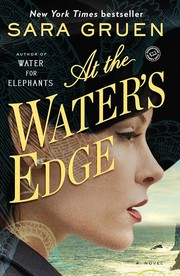
At the Water's Edge
2,906-word summary 13 min read 368 pages in the book
- First published
- 2015
- Publisher
- Spiegel & Grau
- Pages
- 368
- ISBN
- 9780385523233
Reading options
What's inside (8 sections)
I came to this one through Water for Elephants, which I loved, and through a vague memory that the same author had written something about the Loch Ness monster. That is an odd premise, and the book does not entirely live up to the promise of it. At the Water's Edge was published in 2015 by Spiegel & Grau, an imprint of Random House, and the first hardcover runs to roughly 368 pages. It is set almost entirely in a small Highland village during the Second World War, and it turns out to be far less interested in a monster in the loch than the title suggests. The creature is a device. The real subject is a young woman learning, rather late and rather painfully, that the life she has been handed is a fraud and that she is allowed to want something else.
The book opens not with Maddie Hyde but with grief, in 1942, in the village of Drumnadrochit. A young woman named Màiri Grant visits the grave of her infant daughter, having just learned that her husband, Captain Angus Grant, is missing and presumed killed in action. Seven crows settle on the cemetery wall, and an old rhyme about seven crows, "seven for a secret, never to be told," hangs over the scene. Màiri walks to the ruins of Urquhart Castle, goes down through a passage called the Water Gate to the shore, and wades into the freezing loch. She does not come back. It is a bleak, folktale-flavored beginning, and it sets up the book's habit of treating Highland legend and ordinary human sorrow as much the same thing. Three years later, in January 1945, a Philadelphia socialite arrives at the village inn and the story proper begins.
A party in Philadelphia and a coin toss
Madeline "Maddie" Hyde is the daughter of a wealthy Philadelphia family, married to Ellis Hyde and trailed everywhere by Ellis's best friend, Hank Boyd. The two men have been classified 4F, unfit for military service: Ellis because he is color blind, Hank because of flat feet. While other men their age go off to fight, they drink and party, and Maddie is expected to smile beside them. Their trouble comes to a head at a New Year's Eve party in Philadelphia, where Ellis grows bitter, lashes out, and publicly claims that his father faked the photographs that once made him famous. The father, Colonel Whitney Hyde, is a retired army officer who has never forgiven Ellis for being the kind of son who cannot serve. He and Ellis's mother, Edith, cut off Ellis's allowance, which leaves the couple trapped in his parents' house and rankled with humiliation.
Ellis seizes on an idea that Hank has joked about for years. The Colonel's reputation was ruined in 1934 when a photograph he took of the Loch Ness monster was exposed as a hoax. Ellis decides he will do what his father could not: go to Scotland, find the creature, and win back the family name and the money that comes with it. Hank is game. Maddie, who has no real say in the matter, is packed off with them. The way the marriage is described in retrospect makes painful sense of everything that follows. Maddie overhears Ellis and Hank joking that they tossed a coin to decide which of them would marry her. She was a prize, a pretty arrangement between friends, and her lack of intimacy with Ellis, Hank's constant presence, and Ellis's casual cruelty all suddenly have an explanation.
Her own past helps explain why she had so little resistance left. Her mother, Vivian, was a narcissistic woman who drew attention to herself and drowned after a failed suicide attempt when Maddie was fifteen. Shuttled into boarding school and followed by rumors, Maddie never made a real friend. In Bar Harbor she met Ellis, Hank, and a young man named Freddie Stillman. Freddie proposed, Maddie refused, and Ellis proposed a few days later. Hank arranged a quick wedding in Maryland, and just like that her life belonged to other people's plans. Gruen plants these details early and lets them gather weight; by the time Maddie understands the coin toss, the reader already senses that she has been treated as an object for most of her life.
Across the Atlantic in wartime
The crossing to Scotland is one of the book's strongest stretches. Hank arranges passage on a cargo ship through Freddie Stillman, the son of an admiral whose proposal Maddie once turned down, a small irony she cannot ignore. They travel in a convoy through the Battle of the Atlantic. German U-boats torpedo another vessel, and Maddie watches as badly burned survivors are hauled aboard their own ship while the convoy keeps moving. She has a nightmare about the crossing that stays with her. The horror of the war is not background decoration here; Gruen uses it to measure how insulated Maddie's old life was, and how quickly the world can stop caring about a socialite's comforts.
They reach Drumnadrochit late at night and find the Fraser Arms, an inn founded in 1547, with no electricity, little hot water, and oil lamps for light. The bearded landlord, Angus, is unimpressed by the noisy Americans and nearly turns them away, but he takes pity on the exhausted Maddie. The redheaded barmaid Meg and a young woman named Anna McKenzie make up the rest of the staff. Ellis registers them under Maddie's maiden name to avoid any connection with his disgraced father, but an elderly local recognizes him and insults the family in public. Angus quietly corrects the register to their real names and does not throw them out. It is the first sign that this large, rough-looking man notices things and chooses his moments.
Ellis and Hank leave for Inverness without telling Maddie, stranding her at the inn with no money and no idea when they will return. When they come back, they begin daily expeditions onto the loch, and Maddie starts to see how little she matters to her own husband. It is here that the book shifts into the domestic story that critics praised and that carries the novel. Maddie has never made a bed, sliced bread, or mashed potatoes, and she begins to learn. She starts helping around the inn, hiding it from Ellis, who would not approve of his wife working or mixing with the staff. The small physical tasks are handled with care, and they feel like a real education rather than a montage.
The people at the Fraser Arms
The friendships Maddie forms with Anna and Meg are the warmest part of the book. Anna is sharp and steady, the daughter of the local midwife, Mhàthair, and she has lost brothers to the war. Meg is younger, restless, and flirtatious, still grieving the family she lost in the Clydebank Blitz. Neither woman has any reason to like this spoiled American, and for a while they do not. Maddie wins them over by showing up and working, and Gruen is good on the slow, unglamorous way that trust builds between women who start out with nothing in common. Maddie also grows attached to Conall, the enormous dog at the inn, and to a herd of white ponies, and her early fear of the animals gives way to small acts of care.
Maddie begins to gather evidence about Ellis. He has been quietly taking the nerve pills that were prescribed for her. He recoils from a handful of mushrooms called elves' cups because of their ugly red color, which proves he is not color blind at all. She tells him her red gloves are green and watches him panic, and that confirms it. His entire identity as a man excused from the war is a lie, built on a condition he does not have. The discovery changes the texture of every scene between them. His drinking, his rages, and his detachment are no longer the behavior of a disappointed man but the behavior of someone terrified of being found out.
There is a strand of Highland folklore woven through these chapters. Lost in the woods, Maddie sees an old woman in green washing a rust-stained shirt in a river who will not speak to her. Anna names the figure as the Caonaig, the washerwoman whose appearance foretells death. Soon after, another of Anna's brothers is killed. Gruen never explains whether the figure is supernatural or whether Maddie simply saw a grieving woman, and that refusal to settle the question is one of the book's quiet strengths. It lets the old beliefs sit alongside telegrams and air raid sirens without asking either to win.
Angus, Màiri, and the Water Gate
The prologue pays off slowly and well. Maddie notices Angus placing snowdrops on the family grave, and she sees the thick scars across his torso when he washes. Anna fills in the story. Angus Grant was a decorated commando, gutted by wounds in France, left for dead, and sheltered by the French Resistance. His identification tags were torn away, so he was declared killed in action. When he finally made it home, the telegram had already reached Màiri, and she had drowned herself in the loch, believing him dead and having lost their baby. Angus has never entered the water since. He is not simply the gruff innkeeper he first appeared to be; he is a man living inside a mistake that the war made and that he cannot undo.
That revelation reframes the whole setting. The castle on the bluff, the ruined Urquhart, the Water Gate, and the cold water are not scenery. They are the place where one family's life came apart, and Angus carries it in his body. Gruen handles the grief with restraint. Angus does not deliver speeches about his guilt. He puts flowers on a grave, refuses to go near the loch, and holds Maddie when she cries by the fire after learning about Anna's brother. When Rory, a lumberjack with the Forestry Corps, beats Meg senseless over a pair of stockings Maddie gave her, Angus pins him against the wall and throws him down the stairs. Maddie and Angus sit up with Meg through the night, and the bond between them grows out of that shared vigil rather than any sudden declaration.
Ellis grows more dangerous as Maddie pulls away. On the night of a Valentine's Day dance, he pounds on her locked door in a drunken rage, and Hank has to lock him in his room. After Maddie flushes his remaining pills down the toilet, he ransacks her room. He and Hank disappear for two weeks. When they return, Hank warns her that Ellis has arranged to have her lobotomized, that a single phone call is enough to put her away as a nervous woman. Ellis has also looked into poaching penalties and intends to have Angus jailed for taking game from the estate. Maddie, who has spent most of her life being managed by other people, finally understands that the men around her are not careless so much as calculating. The threat is not romantic rivalry. It is control over her body and her freedom.
What the loch gives back
The last movement of the novel brings the monster hunt and the emotional story together in a storm of ugly scenes. A telegram tells Maddie that her father has died and that she has inherited her grandfather's entire fortune. Ellis is delighted at the prospect of her money, even as he plots to have her declared insane. Walking by the loch, Maddie is struck by a huge shadow and pulled back to safety by something she cannot see. Meg tells her it was Màiri's spirit, testing her and protecting her because she truly loves Angus. That night Maddie goes to Angus, and after he initially sends her away, saying she is grieving, he comes to her room. Their first night together is written as a quiet, deliberate choice, and it is the first thing in the book Maddie does entirely for herself.
The police arrive to arrest Angus for poaching on the Craig Gairbh estate, only for Angus to produce proof that he is the laird of Craig Gairbh, the closest surviving male relative of the previous owner, and a cousin of the Hydes. The joke is on Ellis, and it lands neatly. Maddie races to the loch to confront him and finds the miniature model monster that he and Hank built to fake footage, the same trick his father pulled decades earlier. She throws it into the water and accuses him of faking his color blindness. Ellis punches her. Something large hits the boat from below, tipping Maddie into the loch, and underwater she sees Ellis pressing an oar against her chest to hold her down. Angus dives in and drags her out. Ellis destroys the camera, wiping away evidence of both the attack and whatever it was that struck the boat.Gruen keeps the source of that bump deliberately unclear, and the ambiguity is the point.
Maddie develops hypothermia and pseudopneumonia and spends days in a dangerous fever, nursed by Mhàthair and watched over by Angus. During the worst of it she has a vision of Màiri. Then a policeman reports that Ellis has been found dead at the water's edge, facedown in two inches of water, and the death is filed as accidental. Hank, devastated, tells Maddie before he leaves that he intends to tell the Colonel the truth about the color blindness. Maddie sends Ellis's body home. Angus proposes, and on Victory Day, with bonfires and bagpipes and a village celebrating the end of the war, they marry. Anna and Willie the Postie marry the next day. In the epilogue, Maddie and Angus turn Craig Gairbh into a convalescent hospital for wounded soldiers, Meg joins as a nurse and marries a young corporal on Valentine's Day, and the couple have two children. Maddie ends by observing that monsters usually hide in plain sight and that those who survived the war opened their arms wide and embraced life.
Where the book stumbles, and where it lands
I want to be fair about the weaknesses, because the premise invites them. The opening chapters lean on coincidence and on a villain whose cruelty sometimes feels too tidy for the story's own good. Ellis is a drunk, a liar, a would-be murderer, and a man who wants his wife lobotomized, and while the book gives him a motive in his father's contempt, he is mostly a monster in the most literal sense: a figure of pure hostility. The Highland folklore, the U-boat attack, the air raids, the fake monster, and the inheritance all pile up in the final chapters, and the plotting can feel more engineered than lived in. Kirkus called the central romance unlikely, and there is truth in that. A reader looking for subtlety in the bad guy may be disappointed.
The book also asks you to accept that a sheltered American woman will be embraced by a Scottish village that has every reason to resent her. Gruen works hard at the class question, and in an interview she explained that she wanted to contrast the war as ordinary people lived it with the war as the privileged could choose to watch it. Maddie's awakening is meant to be a recognition that class barriers are artificial and that she was never better than the people she looked down on. That theme is sincere and often moving, particularly in the scenes where she learns to work alongside Anna and Meg. But the villagers warm to her quickly enough that the transformation can feel arranged for her benefit, as if the local characters exist mainly to teach her a lesson.
What holds it together is Maddie herself. Gruen gives her a specific, unglamorous arc: a woman who cannot boil an egg becomes a woman who can run a household, read a man's lies, and choose who she wants to be with. The scenes of her learning ordinary tasks matter more than the monster plot, and the friendship with Anna and Meg is drawn with more affection than the romance with Angus. Angus is appealing, but he is also another man who knows things Maddie does not and waits for her to catch up. The book's central claim is the one its narrator arrives at in the epilogue, that the frightening things are not in the loch but sitting across the dinner table or hiding behind a respectable name. That idea is not subtle, and Gruen does not dress it up as a twist. She simply keeps circling back to it until Maddie can finally see it too.
I would hand this to a reader who wants a historical novel with a strong sense of place and a heroine who changes in believable, small ways. I would be more careful with someone drawn in by the Loch Ness angle, because the creature is only ever a symbol and a prop. The novel is at its best in the kitchen and at its weakest on the water. It is a comfortable, well-researched book with a real emotional core, and it is longer on feeling than on surprise. That is a fair trade for a story about a woman who finally stops being someone else's prize.
FAQ
What is At the Water's Edge about?
It is a 2015 historical novel set in a Scottish Highland village during the Second World War. A Philadelphia socialite follows her husband and his friend on a hunt for the Loch Ness monster and discovers a larger world and her own strength.
Is the Loch Ness monster real in the book?
No. The monster is a hoax built from a model that Ellis and Hank use to fake footage, echoing a scandal involving Ellis's father. Gruen leaves one strange disturbance in the loch unexplained.
Who is Angus and what is his connection to the village?
Angus is the gruff man at the Fraser Arms who secretly runs the inn, is a wounded former commando, and is the laird of Craig Gairbh. He is haunted by the death of his wife Màiri, who drowned in the loch believing him killed in the war.
Similar books
Voyager
Claire returns through the stones in 1968 after learning Jamie survived Culloden.
2,901-word summary · 13 min read
Dragonfly in Amber
Claire 1968 recalls Jacobite Paris with Jamie to stop Culloden.
2,530-word summary · 11 min read
The Beekeeper's Apprentice
In 1915 a bookish fifteen-year-old American girl stumbles across a retired Sherlock Holmes keeping bees on the Sussex Downs, and talks him into taking her on…
2,215-word summary · 10 min read
The Dressmaker's Gift
In occupied Paris, three seamstresses hide dangerous secrets, and decades later one granddaughter returns to the same building to learn what really happened.
2,277-word summary · 10 min read
The Bronze Horseman
On the day Germany invades the Soviet Union, Tatiana Metanova meets a mysterious Red Army officer, and their love is tested by the Siege of Leningrad.
2,461-word summary · 11 min read

The Orphan's Tale
A Dutch teenager rescues a Jewish baby from a death train and joins a German circus, where a Jewish aerialist teaches her to fly.
2,943-word summary · 13 min read

The Japanese Lover
A Polish refugee and the son of a Japanese gardener fall in love in San Francisco in 1939, then keep the affair secret for nearly seventy years.
2,286-word summary · 10 min read
The Valley of Horses
Exiled from the Clan, Ayla survives alone in a hidden valley, tames a horse and a cave lion, and nurses a wounded stranger back to life.
2,311-word summary · 10 min read

Ivanhoe
A disinherited Saxon knight, a great tournament, a besieged castle and a trial by combat. Scott's most famous novel, set in England in 1194.
2,834-word summary · 13 min read
The Keeper of Happy Endings
Barbara Davis's 2021 standalone braids a Paris dressmaker's wartime losses with a grieving Boston artist who unlocks her family's secrets through an old row…
2,437-word summary · 11 min read
Code Name Verity
In 1943 France, captured agent Verity writes a confession for von Linden to buy time. Her pilot friend Maddie survives the crash and searches for her by…
2,690-word summary · 12 min read
Written in My Own Heart's Blood
1778 war splits Jamies and Claires across rebellion and time as Brianna hunts a kidnapped son.
2,008-word summary · 9 min read

The Paris Library
Odile lands her dream job at the American Library in Paris as war closes in, then hides that past in Montana until teen Lily draws it out.
2,813-word summary · 13 min read
The English Patient
In a ruined Italian villa in 1945, a burned man, a nurse, a thief, and a sapper trade pasts shaped by desert love and war.
2,006-word summary · 9 min read
One Thousand White Women: The Journals of May Dodd
May Dodd journals joining Cheyenne as a bride in an 1875 government swap, learning prairie life and loss.
2,036-word summary · 9 min read
Daughter of Fortune
Eliza Sommers flees Chile for California gold rush San Francisco, disguised and searching for her lover, finding freedom with Tao Chi'en.
2,009-word summary · 9 min read
The Scarlet Pimpernel
A foppish baronet rescues aristocrats from the guillotine while his French wife hunts the hero she scorns.
2,980-word summary · 13 min read

The Gentleman's Guide to Vice and Virtue
Bisexual heir Monty flees across Europe with his crush Percy and sister Felicity after stealing a dangerous box.
2,724-word summary · 12 min read
The Huntress
A Soviet night pilot, a Boston photographer doubting her stepmother Annelise, and a Nazi hunter chase Die Jagerin from wartime Europe to 1950 Boston in a long…
2,666-word summary · 12 min read
A Breath of Snow and Ashes
Jamie and Claire Fraser face the coming Revolution on Fraser's Ridge, torn between Crown oaths and rebel neighbors as old enemies return.
2,362-word summary · 10 min read
The Things We Cannot Say
A Florida mother travels to Poland to answer her silent grandmother's plea, uncovering a wartime love story and a decades-old identity swap.
2,365-word summary · 11 min read
The Fiery Cross
Jamie musters militia for Tryon while Brianna and Roger wed on the Ridge, ending at Alamance with a hanging that steals Rogers voice.
2,719-word summary · 12 min read
Drums of Autumn
Brianna crosses stones to save parents, finding love, assault fallout, and a home to build.
2,003-word summary · 9 min read
The Rose Code
Three Bletchley Park women reunite in 1947 to expose a wartime traitor in Quinn's codebreaking novel.
3,219-word summary · 14 min read

Lilac Girls
Three women meet across World War II: a New York volunteer, a Polish courier turned prisoner, and a German camp doctor.
2,731-word summary · 12 min read

City of Girls
City of Girls retold: a Vassar dropout, a shabby theater, one scandal, and a love like no other.
2,823-word summary · 13 min read
The Three Musketeers
Young dArtagnan joins Athos, Porthos and Aramis to recover the queens diamonds and face Milady.
2,569-word summary · 11 min read
The Giver of Stars
Alice Wright joins Kentucky packhorse librarians with Margery and faces marriage strain and a murder trial.
3,439-word summary · 15 min read

Outlander
Nurse Claire Randall slips through Craigh na Dun from 1945 to 1743 Scotland, torn between Frank and Jamie Fraser as clan politics, war and witch trials close…
2,190-word summary · 10 min read
Water for Elephants
Water for Elephants retold: Jacob on a circus train, Marlena and Rosie, Prohibition era dust.
1,925-word summary · 9 min read