
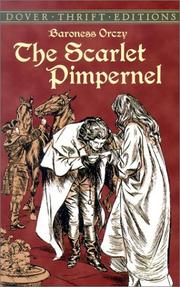
The Scarlet Pimpernel
2,980-word summary 13 min read 224 pages in the book
- First published
- 1905
- Publisher
- Greening & Co.
- Pages
- 224
- ISBN
- 9780486421223
- Series
- The Scarlet Pimpernel (#1)
Reading options
What's inside (8 sections)
I picked up The Scarlet Pimpernel because I kept running into its shadow in other books. Every masked hero with a silly public face seemed to point back here, and I wanted to see if the original still read well or if it survived on reputation alone. It was published in 1905 by Greening and Co. in London, after Orczy and her husband turned the story into a stage play that ran in the West End. The copy I read runs 224 pages in the Dover Thrift paperback, which reprints the early text, and it is the first book in the Scarlet Pimpernel series.
What surprised me right away was how fast it moves. I had braced for a slow classic with long speeches about honor. Instead the first chapter drops you at a Paris barricade in September 1792 with a crowd waiting for aristocrats to be caught. From there the book hardly pauses. It is a romance and a rescue story and a marriage misunderstanding all packed together, and it knows exactly which of those three you care about at any moment.
Paris in September 1792 and the man they cannot catch
The novel opens in Paris during the Terror. Mobs gather daily near the gates to watch prisoners taken toward the guillotine. Orczy gives us Sergeant Bibot at the West Barricade, a loud patriot who boasts that no aristocrat slips past him. He checks papers, sneers at women in carts, and enjoys the approval of the fishwives and idlers around him.
Then an old woman and a young man drive through with a cart, bickering and weeping in a way that makes the guards laugh. Bibot waves them on. Only after they pass does another guard find a hidden message with a small red flower drawn on it. The cart held the Comtesse de Tournay de Basserive and two of her people, smuggled out under Bibot's nose. The flower is the sign of the Scarlet Pimpernel.
That pattern sets the whole book. The Pimpernel is an Englishman who leads a small secret group, the League of the Scarlet Pimpernel, about twenty young English gentlemen with money, swords, and time. One commands and nineteen obey. They slip into Paris in disguise, bribe jailers and innkeepers, forge papers, hire carts, and sail their rescues across the Channel on Percy's private schooner, the Day Dream. They leave behind a card with a scarlet pimpernel flower, which drives the Paris Committee half mad.
Orczy never pretends the French authorities are stupid. Citizen Chauvelin, the agent sent to London to unmask the Pimpernel, is patient and careful. The point is that the League plans better and pays better. They study tides, roads, guard changes, and human vanity. A guard who wants to look clever in front of a crowd will wave through a crying old woman rather than search her cart twice. A tired innkeeper who has been paid in good English gold will forget what time a guest left. The rescues feel closer to heists than to duels, even though swords come out when plans fail.
Marguerite and Percy, the worst marriage in London
If the Paris chapters supply the danger, the London chapters supply the ache. Marguerite St Just married Sir Percy Blakeney about a year before the main action. She was the star of the Comedie Francaise, famous for beauty and wit, running a salon where writers and politicians argued late into the night. He was the richest young baronet in England, famous for wealth, good tailoring, and very little brain.
London society adored Marguerite at first and then turned cool when the marriage soured. By the time we meet them they live in the same fine house and barely speak. Percy drawls, laughs loudly at his own jokes, talks about cravats and dinners, and falls asleep when politics come up. Marguerite holds court with French exiles and English lords and tries not to show how much his cold politeness stings.
The backstory comes out in pieces. Before her marriage, Marguerite denounced the Marquis de St Cyr after his men had her beloved younger brother Armand beaten for courting the Marquis's daughter. She passed information along through channels she trusted. The result was larger than she intended. The Marquis and his sons went to the guillotine. Percy heard about her part in it soon after their wedding and withdrew from her without asking for her side. Marguerite, proud and hurt, never explained that she had meant to punish one cruel man rather than send a family to death, or that she had acted to protect Armand.
So each thinks the other is empty. Percy believes he married a woman who informed on aristocrats for applause. Marguerite believes she married a handsome fool who cares more about a well tied stock than about France bleeding a few miles away. Both are wrong, and Orczy lets that misunderstanding sit for half the book while the plot tightens around them.
The social center of this half is a ball at Lord Grenville's. The Prince of Wales attends. French exiles cluster together. Sir Andrew Ffoulkes and Lord Antony Dewhurst drift through with news from Paris. The Comtesse de Tournay, now safe in London thanks to the League, still treats Marguerite with open contempt because of the St Cyr affair. Her daughter Suzanne, kinder and younger, likes Marguerite and confides in her. Her son the Vicomte sulks. Into this room walks Chauvelin in his plain black coat, watching everyone, and Percy in cream and blue, drawling out his silly verse about the Pimpernel that London starts repeating the next day.
That verse matters more than it looks. Percy stands up and recites in his lazy voice the lines about seeking the Pimpernel here and there while French agents seek him everywhere, in heaven or hell. The company laughs and quotes it for weeks. Orczy uses it as cover. A man willing to make himself the joke of London will never be suspected of running a secret league at night.
Chauvelin tightens the screw
Chauvelin did not cross the Channel for balls. He has orders to learn the Pimpernel's identity and stop the escapes. He fixes on Marguerite because she is French, because she knows both the exile circle and London society, and because she has a weak point.
Her brother Armand serves with the League in Paris. Chauvelin’s people intercept a letter that points to Armand's ties to the Pimpernel. Chauvelin shows Marguerite enough to frighten her and offers a trade. Spy on the Pimpernel for France and Armand lives. Refuse and Armand faces arrest and the guillotine when he is next caught.
Marguerite hates the choice. She still loves Armand, who raised her after their parents died and who now serves the republic in a way she cannot fully follow. She also admires the Pimpernel from afar, like many women in London, without knowing he dines at her own table. She agrees to watch and report, telling herself she will pass along only small things, only enough to keep Armand safe.
Orczy handles this stretch well because Marguerite is not naive. She pumps Sir Andrew at the ball and later in a private talk, using her charm and her old school tie to Suzanne to draw him out. Sir Andrew, who loves Suzanne and trusts Marguerite as Suzanne's friend, lets slip more than he should about coming orders from Paris. Marguerite also watches Percy with new attention and misreads him completely. She sees him dozing by the fire, hears him order new boots in the middle of a crisis, and concludes he could never keep a secret larger than a dinner menu.
The saddest scene in this middle part comes at night in their London house. Marguerite, frightened for Armand, finally breaks and begs Percy for help as a wife might beg a husband she respects. Percy listens, promises in general terms that her brother will be safe, and gives her nothing solid to hold. She leaves thinking he is kind in a shallow way and useless in a real crisis. He lets her think it because telling the truth would put her under Chauvelin's eye. His silence protects the League and wounds the marriage in the same stroke. I found those pages uncomfortable in a good way. Both people act from love and both make the wrong call.
Marguerite then passes Chauvelin a scrap that seems harmless. It points toward a meeting and a time. Chauvelin, who is better at this than she is, combines it with his own watching of Lord Antony and Sir Andrew and decides the Pimpernel will leave for Paris very soon. He plans to follow the principals across the Channel and take them on French soil where he holds power.
The road to Calais and the Chat gris
Once Percy leaves London, Marguerite learns the truth too late to use it calmly. She finds proof in his rooms that the drawling fool writes the daring orders, pays the bribes, and signs the little flower. The shock rearranges every memory she has of the past year. His stupid laugh was acting. His absences were Channel crossings. His coldness was a man guarding a secret he thought his wife had already betrayed once with the St Cyrs.
She decides to follow him to France to warn him that Chauvelin knows his face and his errand. Sir Andrew, guilty about what he revealed and loyal to both Percy and Suzanne, agrees to escort her as far as he can. Tides and weather delay them. Chauvelin travels separately with his own passes and reaches Calais ahead of the emotional weight of the story.
The Calais chapters are my favorite part of the book. Percy walks openly into the Chat gris, a poor inn kept by a man named Brogard who takes English money and keeps his mouth shut when it suits him. Chauvelin has set soldiers around the roads and has papers to search every traveler. Percy arrives in disguise, then drops disguise at the right moment, bows to Chauvelin, offers snuff with grand manners, and leaves Chauvelin sneezing and weeping from pepper while the Englishman slips out the back.
The trick works because Percy understands how Chauvelin sees him. Chauvelin expects a bold swordsman or a cunning plotter. He does not expect a fop to hand him a snuffbox in the middle of a manhunt. Percy plays the role Chauvelin despises, and contempt slows Chauvelin's reaction by exactly the seconds Percy needs.
Behind that comedy sits a firm plan. Armand is in hiding and marked. The Comte de Tournay, father of Suzanne and the Vicomte, has stayed too long in Paris from pride and now needs extraction before an execution order catches him. Percy has staged fresh horses, a changed route, clean papers, and a boat waiting near the coast. Marguerite, hidden nearby with Sir Andrew, watches parts of this without grasping the whole shape. She sees her husband limping as an old man one hour and ordering wine as a buck the next. She hears him laugh his silly laugh in a dark lane and finally understands it is a signal to his men rather than a sign of an empty head.
The final rescue runs on timing rather than swordplay, though Percy does draw when cornered. Chauvelin chases the wrong party, guards a road the League has already left, and searches an inn where Brogard lies with a straight face. By the time Chauvelin grasps that the old man he arrested and released was Percy himself, the Day Dream has its passengers. Percy and Marguerite speak plainly for the first time in a year on board. She tells him she never sold the St Cyrs for gain and that she has paid for that mistake in scorn ever since. He tells her he stayed away because he feared she would sell him too. Her pursuit across France proves otherwise. They land in England reconciled, with Armand and the Comte safe and Sir Andrew free to court Suzanne without hiding his absences.
What creaks when you read it now
For all its pace, the book has flaws that show quickly. Orczy writes French patriots as a single howling crowd for long stretches. The fishwives shriek, the guards strut, the Committee snarls. A few individuals like Chauvelin and Armand get inner lives, but most French characters exist to hate aristocrats or to be rescued from them. That flatness made the Paris opening less rich on a second pass. I wanted one Parisian besides Chauvelin with mixed motives, someone who fears the guillotine but also fears what happens if the League keeps mocking French law.
The Jewish disguise passage near Calais will trouble modern readers. Percy poses as a stooped old man and Orczy leans on crude physical tags that read as caricature today. The plot purpose is clear, to pass a checkpoint where soldiers look for a tall English blade, but the writing around it has aged badly. A new reader should know it is coming and read it as evidence of 1905 attitudes rather than as necessary color.
Marguerite's arc also depends on men withholding facts and then blaming her for guessing wrong. Percy could have tested her with a partial truth months earlier. Sir Andrew could have refused her questions at the ball. Armand could have warned her he was in danger instead of letting Chauvelin be the messenger. Orczy needs Marguerite ignorant so the middle can work, and she keeps her ignorant a little past belief. The novel admits this near the end when Percy asks her pardon, but the apology does not fully fix the months of coldness that preceded it.
The prose itself is heavily theatrical. People cry out, clasp hands, fall to knees, and speak in exclamations. In small doses it fits a story that began as a play. Over 224 pages it can tire you, especially in the London drawing rooms where three pages of banter carry one page of news. If you like spare modern thrillers, you will need to adjust. Read it as a stage piece in prose and the broad gestures bother you less.
None of this stopped me finishing in two sittings. It did make me pause and argue with the book, which I prefer to smooth admiration.
Why the secret still holds up
What lasts is the central device and how Orczy commits to it. Percy does not wear a mask. He wears a personality. Anyone can put on a domino and be mysterious for a night. Percy performs stupidity for a year in front of his wife, his friends, and the Prince of Wales. He lets London laugh at him. He pays tailors and hosts suppers and writes bad poetry on purpose so no one looks twice when his money disappears into bribes and boats. That choice costs him love and respect, and Orczy never lets you forget the price.
It also gives the reveal real force. When Marguerite pieces it together, old scenes replay with new meaning. His sleepiness at the ball was listening. His interest in boots was a message about roads. His verse was a toast to his own men in front of his enemy. Rereading those early chapters after you know feels like getting a second book free.
The love story earns its keep for the same reason. This is not a couple kept apart by war or parents. They live together and wound each other through pride. Percy punishes Marguerite for the St Cyr denunciation without asking what drove it. Marguerite punishes Percy for shallowness without asking what the shallowness hides. Their reunion works because both admit fault on the boat rather than blaming Chauvelin alone. Forgiveness here is specific. She names what she did with the Marquis family. He names why he stayed silent. They agree on what each will do next.
If you read it, watch for the small logistics that make the League plausible. Orczy tells you what things cost, how long horses take, where papers are checked, and why a schooner can wait off the coast without drawing a battery. She tells you that nineteen men obey one, which sounds quaint until you see how it prevents leaks. She shows you Percy paying innkeepers well and treating servants as allies rather than scenery. The adventure rests on money and planning more than on luck, and that keeps the escapes satisfying even when you see the twist coming.
Readers who enjoy classic adventure with a strong romance will have the best time. Fans of Zorro, the Scarlet Pimpernel's most famous heir, will spot the template at once. The hidden sign, the public fool, the loyal few, the relentless policeman, the woman torn between scorn for her husband and admiration for the hero without knowing they are one man. Stan Lee said the Pimpernel was the first character he would call a superhero, and you can feel why in the Calais chapters where disguise and nerve matter more than strength.
Start with this first novel and stop after if you like. Orczy wrote many sequels about Percy, his league, his ancestors, and his heirs, and some readers chase them all. I found this opening volume complete on its own. The Day Dream sailing home with two families mended is enough. If the fop act charms you and the Paris danger grips you, the second book, I Will Repay, waits with a new rescue and a harder moral knot.
For me the takeaway sits in that last talk on board. Cleverness saves lives in Paris, but only plain speech saves the marriage in London. Percy had to stop performing to keep Marguerite. Marguerite had to stop performing popularity to keep Percy. The flower on the card gets them out of France. Honest talk gets them home.
FAQ
Is The Scarlet Pimpernel the first book in its series?
Yes. Published in 1905 by Greening & Co., it is the first novel about Sir Percy Blakeney and his League, followed by sequels such as I Will Repay.
Why does Percy act like a fool in London?
Percy performs stupidity for a year so no one suspects him, and the mask costs him his wife's respect until she follows him to France and sees the planning behind it.
Is the book hard to read today?
The Calais inn chapters and the pepper snuff escape hold up best, while the broad crowd scenes and the dated disguise passage feel stagey to modern readers.
Similar books
More from The Scarlet Pimpernel first, then related titles.

Ivanhoe
A disinherited Saxon knight, a great tournament, a besieged castle and a trial by combat. Scott's most famous novel, set in England in 1194.
2,834-word summary · 13 min read

The Valley of Horses
Exiled from the Clan, Ayla survives alone in a hidden valley, tames a horse and a cave lion, and nurses a wounded stranger back to life.
2,311-word summary · 10 min read
The Last of the Mohicans
During the French and Indian War, Hawkeye and two Mohican warriors try to save two British sisters from a Huron chief whose revenge will end the Mohican line.
2,017-word summary · 9 min read

Doctor Zhivago
A doctor and poet lives through revolution, war, and love in Pasternak's novel of private life under the pressure of Russian history.
2,213-word summary · 10 min read

Anne's House of Dreams
Newlyweds Anne and Gilbert start in a seaside house with kind neighbors.
2,465-word summary · 11 min read

Written in My Own Heart's Blood
1778 war splits Jamies and Claires across rebellion and time as Brianna hunts a kidnapped son.
2,008-word summary · 9 min read

One Thousand White Women: The Journals of May Dodd
May Dodd journals joining Cheyenne as a bride in an 1875 government swap, learning prairie life and loss.
2,036-word summary · 9 min read

Daughter of Fortune
Eliza Sommers flees Chile for California gold rush San Francisco, disguised and searching for her lover, finding freedom with Tao Chi'en.
2,009-word summary · 9 min read

The Gentleman's Guide to Vice and Virtue
Bisexual heir Monty flees across Europe with his crush Percy and sister Felicity after stealing a dangerous box.
2,724-word summary · 12 min read

A Breath of Snow and Ashes
Jamie and Claire Fraser face the coming Revolution on Fraser's Ridge, torn between Crown oaths and rebel neighbors as old enemies return.
2,362-word summary · 10 min read

Shogun
An English pilot wrecked in 1600 Japan becomes a pawn in Lord Toranaga's patient bid for power, and slowly becomes Japanese himself.
2,251-word summary · 10 min read

Lonesome Dove
Two retired Texas Rangers drive cattle from Texas to Montana in a harsh and tender western epic.
2,410-word summary · 11 min read

The Fiery Cross
Jamie musters militia for Tryon while Brianna and Roger wed on the Ridge, ending at Alamance with a hanging that steals Rogers voice.
2,719-word summary · 12 min read

Drums of Autumn
Brianna crosses stones to save parents, finding love, assault fallout, and a home to build.
2,003-word summary · 9 min read

Voyager
Claire returns through the stones in 1968 after learning Jamie survived Culloden.
2,901-word summary · 13 min read
Robinson Crusoe
Shipwrecked near South America, Crusoe spends 28 years farming, building, praying, and facing who he becomes alone.
2,520-word summary · 11 min read

For Whom the Bell Tolls
An American dynamiter joins Spanish guerrillas for three days to blow a mountain bridge, finding love and doomed courage.
2,286-word summary · 10 min read
The Three Musketeers
Young dArtagnan joins Athos, Porthos and Aramis to recover the queens diamonds and face Milady.
2,569-word summary · 11 min read

Dragonfly in Amber
Claire 1968 recalls Jacobite Paris with Jamie to stop Culloden.
2,530-word summary · 11 min read

A Farewell to Arms
Frederic loves Catherine in Italy until desertion leads to Switzerland and stillbirth.
2,502-word summary · 11 min read

The Princess Bride
Buttercup loses Westley to pirates and is forced to marry Prince Humperdinck in Florin.
3,412-word summary · 15 min read

Gone with the Wind
Scarlett O'Hara schemes through the Civil War and Reconstruction, from Tara to burning Atlanta, chasing Ashley while Rhett waits and watches.
2,049-word summary · 9 min read

The Adventures of Huckleberry Finn
Huck Finn fakes his death, floats the Mississippi with the runaway Jim, and tears up the letter that would betray him. Twain's river classic, its cons and…
2,605-word summary · 12 min read

The Stationery Shop
Two teenagers fall in love in a Tehran stationery shop in 1953, are separated by the coup and a family deception, and meet again sixty years later.
2,024-word summary · 9 min read

The Long Winter
Dakota Territory, 1880: seven months of blizzards cut a town off from the railroad, and a family survives on twisted hay, ground wheat, and a dangerous wheat…
2,210-word summary · 10 min read

The Japanese Lover
A Polish refugee and the son of a Japanese gardener fall in love in San Francisco in 1939, then keep the affair secret for nearly seventy years.
2,286-word summary · 10 min read

Anatomy: A Love Story
In 1817 Edinburgh, a noblewoman who wants to be a surgeon disguises herself to study anatomy and falls for the grave robber who supplies her with bodies.
2,031-word summary · 9 min read

Vow of Thieves
Kazi and Jase return to Tor's Watch to find it occupied, and their marriage is tested by captivity, betrayal, and a war for the town of Hell's Mouth.
2,059-word summary · 9 min read

The Shadow Sister
Star D'Apliese steps out of her sister's shadow and follows a bookshop clue into the Edwardian life of Flora MacNichol, a woman who gave up love for duty.
2,260-word summary · 10 min read

Little Town on the Prairie
In the spring after the Long Winter, fifteen-year-old Laura sews shirts, studies for a teaching certificate, and helps send her blind sister Mary to college.
2,071-word summary · 9 min read