
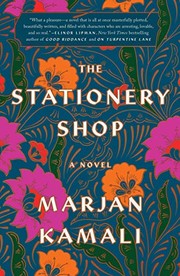
The Stationery Shop
2,024-word summary 9 min read 320 pages in the book
- First published
- 2019
- Publisher
- Gallery Books
- Pages
- 320
- ISBN
- 9781982107482
Reading options
What's inside (11 sections)
There is a particular kind of novel that makes you feel homesick for a place you have never lived, and this is one of them. Marjan Kamali's second book begins in Tehran in 1953, in a stationery shop that smells of ink and paper, and it spends the next fifty pages making that shop feel like the safest place in the world. Then history arrives, and the safety is gone.
The novel is about Roya Archer, who is seventeen in 1953, and Bahman Aslan, the boy she meets among the fountain pens. It is also about the sixty years that follow, and the way a single missed appointment can reorganize two entire lives. Kamali alternates between the Tehran of the coup and a New England town in 2013, and the structure is both the book's pleasure and its problem.
The shop
Roya is a dreamy, bookish teenager who lives with her parents and her younger sister Zari. Her favorite place in Tehran is Mr. Fakhri's stationery shop, a dusty, beautiful store full of pens, ink bottles, and paper. Mr. Fakhri is a gentle man with a calligrapher's hands, and he treats Roya like a daughter. When he introduces her to Bahman, a handsome customer with a passion for Rumi and a burning sense of justice, he is doing what romantics have done in novels since novels began: he is arranging a love story.
Bahman is not just handsome. He is serious. He talks about democracy, about Mossadegh, about the future of Iran. He quotes poetry. He has a mother who disapproves and a father who is passive, and he has the kind of conviction that makes a seventeen-year-old girl believe the world can be changed by people who care enough. Roya falls for him quickly, and Kamali lets the reader fall too. The early chapters are suffused with warmth. There is tea, there is music, there is the pleasure of being young in a city that feels alive.
The engagement follows. Roya's parents approve. Bahman's mother, Badri, does not. Badri is volatile and frightening, and she has already chosen a different bride for her son, a girl named Shahla whose family is connected to the Shah. Bahman tells Roya that his mother is mentally ill, and the novel asks the reader to sympathize with her even as she makes everyone miserable. It is a complicated portrait, and Kamali handles it with more care than the plot sometimes deserves.
The coup
The political backdrop is not decoration. In 1953, Iran's prime minister, Mohammad Mossadegh, was overthrown in a coup supported by British and American intelligence. The novel does not turn into a history lecture, but it makes the coup personal. Bahman is involved in the demonstrations. Roya's family argues about politics at dinner. The streets become dangerous, and the danger is not abstract.
On the day they are supposed to meet, Roya goes to the square and waits. Violence erupts. She searches for Bahman in the crowd and does not find him. Mr. Fakhri appears, tries to tell her something, and is shot and killed in front of her. The shop burns. Bahman never comes. The scene is the hinge of the novel, and it is handled with real force. The chaos is convincing, and the loss lands because Kamali has spent so much time making the shop and the romance feel permanent.
What follows is the part that makes the book painful. Roya waits. She writes. She hears nothing. Then Badri tells her that Bahman has chosen Shahla, and a letter arrives from Bahman saying the same thing. Roya is devastated. She applies to schools abroad, leaves Iran, and does not return.
America
The American chapters are quieter and, for me, more interesting. Roya studies science in California, meets a kind American named Walter Archer, and marries him. They move to Boston, where Walter goes to law school. Roya works as a secretary because the laboratory jobs do not come through. She has a daughter, Marigold, who dies of croup at one year old. She has a son, Kyle, much later, when she is forty-two.
Kamali is good at the texture of immigrant life: the careful navigation of a new culture, the way food becomes a language, the small compromises of a marriage that is loving but not passionate. Walter is a decent man. He is not Bahman, and Roya knows it, and the novel does not pretend otherwise. Their life together is real and good, and it is also a life built on a wound that never closed.
The 2013 timeline gives the book its frame. Roya is seventy-seven, widowed, and living in New England. One day she walks into a stationery shop that looks exactly like Mr. Fakhri's, and the owner, Omid, turns out to be Bahman's son. Bahman is alive, in a retirement home nearby, and he has been in America since his family fled the Iran-Iraq war. Roya goes to see him.
The family
Roya's family is the novel's warm center. Her mother, Maman, is anxious and loving, and her father, Baba, is gentle and a little defeated. Her sister Zari is sharper than Roya and sees the romance for what it is, which makes her the reader's ally. The scenes around the dinner table are some of the best in the book, because Kamali writes food the way she writes the stationery shop: with attention, pleasure, and a sense that a meal is a way of saying what cannot be said.
The family also gives the novel its immigrant texture. Roya's parents want her to be safe, which means married, which means not too much like them. They are proud of her and frightened for her at the same time. When she leaves for America, the goodbye is not dramatic. It is practical and sad, and the novel does not pretend that distance is easy.
Zari's life in Iran continues while Roya's life in America unfolds, and the contrast is quietly effective. Zari stays, marries, has children, lives through the revolution and the war. Roya leaves, builds a life in New England, and never quite stops looking back. Neither choice is presented as better. They are just different ways of surviving the same history.
The reunion
The reunion is the scene the whole novel has been building toward, and Kamali writes it with restraint. Roya and Bahman are old. They are not the people they were. They talk, and the conversation goes wrong almost immediately, because their memories do not match. Bahman insists that he waited for her at the square. Roya insists that he never came. Each of them has been carrying a version of the story in which the other one abandoned them.
The explanation arrives in a letter. Badri, Bahman's mother, had the meeting place altered. She used Mr. Fakhri, who had once loved her and abandoned her, to change the letter, and then she told each of the lovers that the other had refused to come. The deception was small and total. It cost Roya and Bahman sixty years.
The revelation is satisfying and also a little too neat. Badri's motive is jealousy and social ambition, and Mr. Fakhri's complicity is explained by guilt and old love. It works, but it reduces a complicated family tragedy to a single act of maternal malice. The novel is more interesting when it lets Badri be mentally ill and sympathetic than when it makes her the architect of everything.
Bahman is dying. Roya goes to him, lies beside him, and holds him while he dies. It is a tender, difficult scene, and it earns its emotion. After the funeral, a nurse gives Roya the letters she wrote him decades ago, letters he kept. She goes home, cooks Persian food for a young woman who works at the home, and her son Kyle surprises her for dinner. The ending is not a reunion. It is an acceptance.
The politics
The 1953 coup is the novel's historical spine, and Kamali is careful with it. She does not turn the book into a lecture, but she does not soften the facts either. Mossadegh was a democratically elected prime minister. The coup that removed him was organized with British and American help. The consequences were felt for decades. The novel shows this through the lives of ordinary people: Bahman's activism, the arguments at Roya's table, the soldiers in the square, the way a political crisis becomes a personal one in a single afternoon.
What Kamali does well is show how politics enters a life without asking permission. Roya is not an activist. She is a girl in love. But the coup does not care about her love story, and the violence arrives anyway. That is how history usually works for people who are not making it. It interrupts.
The American chapters are less political on the surface, but they are shaped by the same forces. Roya's immigration is not only a response to heartbreak. It is a response to a country that has become unsafe for the life she imagined. The novel does not say this explicitly, and it does not need to. The reader can feel it in the distance between the Tehran chapters and the New England ones.
What works
The prose is warm and readable, and Kamali has a gift for sensory detail. The stationery shop is one of the best-realized settings I have read in recent historical fiction. The ink, the paper, the smell of the place, the way Mr. Fakhri wraps a purchase: it all feels lived in. The Tehran sections have color and noise and food, and the American sections have the grey light of a New England winter.
Roya is a good protagonist because she is not passive. She makes choices. She leaves. She marries. She raises a child. She builds a life that is not the one she wanted, and she finds meaning in it. The novel is honest about the fact that a good life can coexist with a broken heart.
The political material is handled with a light touch. Kamali does not pretend to explain the coup, but she shows how it entered ordinary lives. The scene at the square is the best example. It is a historical event and a personal catastrophe at the same time, and the novel does not separate them.
What does not
The central coincidence is hard to swallow. Roya walking into a stationery shop in New England that looks like the one in Tehran, owned by the son of the man she loved, is the kind of plotting that belongs in a fairy tale. Kamali writes it with such sincerity that you almost accept it, but it is a stretch.
The romance is also idealized. Bahman is handsome, brave, poetic, and doomed. He has almost no flaws. The novel is more interested in Roya's grief than in Bahman as a person, and the result is that the love story feels thinner than the marriage to Walter, which is rendered with more nuance.
And the ending, while moving, ties things up a little too tightly. The letter explains everything. The funeral resolves everything. The dinner with Kyle and the young woman suggests healing. Real grief is messier than that, and the novel's neatness softens what could have been a harder, better book.
The verdict
The Stationery Shop is a lovely, sad, readable novel about first love and second chances, and about the way history can reach into a single afternoon and change everything. It is not a great book, but it is a good one, and it does what popular historical fiction should do: it makes another time and place feel close enough to touch.
If you have ever wondered what happened to someone you loved, this book will find you. It understands that the unanswered question is often more powerful than the answer, and that a life can be full and still have a hole in it. The shop is gone. The paper is gone. The love is not, and that is the point.
FAQ
What happened to Bahman at the square?
He waited at Baharestan Square, but Badri had Mr. Fakhri alter the letter to send Roya to Sepah Square. When Mr. Fakhri tried to reach Roya during the coup violence, he was shot and killed.
Does Roya end up with Bahman?
No. They reunite when they are seventy-seven, but Bahman is dying, and he dies in her arms shortly after they learn the truth about the letters.
Is The Stationery Shop the same as The Stationery Shop of Tehran?
Yes. The novel was published as The Stationery Shop in the United States and as The Stationery Shop of Tehran in the United Kingdom and some other markets.
Similar books

The Shadow Sister
Star D'Apliese steps out of her sister's shadow and follows a bookshop clue into the Edwardian life of Flora MacNichol, a woman who gave up love for duty.
2,260-word summary · 10 min read
The Lowland
Two brothers grow up beside a marshy lowland in Calcutta, and the choices of the younger one draw the older into a life of duty, distance, and quiet grief that…
2,213-word summary · 10 min read
A Long Petal of the Sea
A pregnant widow and her brother-in-law marry for passage on a ship of Spanish exiles bound for Chile, then spend decades building and losing homes together.
2,016-word summary · 9 min read
The Evening and the Morning
Edgar, Ragna, and Aldred build a bridge town that becomes Kingsbridge around 997, facing Viking raids, harsh law, and a scheming bishop in Follett's prequel.
2,833-word summary · 13 min read
Brooklyn
Eilis Lacey leaves Enniscorthy for Brooklyn boarding house work, love with Tony, then a home death forces divided choice.
2,143-word summary · 10 min read
The Thorn Birds
Meggie loves priest Ralph across decades on Drogheda sheep station.
2,280-word summary · 10 min read
Pachinko
Four generations of a Korean family in Japan, from Sunja's fall and brave marriage to pachinko parlors, discrimination, and sons who choose different ways to…
2,210-word summary · 10 min read
Violeta
A woman born in 1920 writes her life story to her grandson, from one pandemic to another, through wealth, ruin, passion, and dictatorship in South America.
2,555-word summary · 11 min read

The Japanese Lover
A Polish refugee and the son of a Japanese gardener fall in love in San Francisco in 1939, then keep the affair secret for nearly seventy years.
2,286-word summary · 10 min read

Anatomy: A Love Story
In 1817 Edinburgh, a noblewoman who wants to be a surgeon disguises herself to study anatomy and falls for the grave robber who supplies her with bodies.
2,031-word summary · 9 min read

Mrs. Everything
Two Jewish sisters in Detroit grow up, apart and together, across seven decades of American life, from the 1950s to the 2016 election.
2,362-word summary · 10 min read
The Valley of Horses
Exiled from the Clan, Ayla survives alone in a hidden valley, tames a horse and a cave lion, and nurses a wounded stranger back to life.
2,311-word summary · 10 min read
Only Time Will Tell
A Bristol dockworker's son wins a scholarship, falls in love with the daughter of the family that owns the shipyard, and learns that his father's death was not…
2,082-word summary · 9 min read
Stones from the River
Trudi Montag is born a dwarf in a small German river town in 1915 and grows up to keep the town's library and its secrets, from the First World War to the…
2,818-word summary · 13 min read

Origins
Stefan's diary of 1864 and 1888: how he and Damon fell for Katherine, became vampires, and went looking for a killer in London.
2,056-word summary · 9 min read
Last Night at the Telegraph Club
The 2021 National Book Award winner follows Lily Hu, a Chinese American teenager in 1954 San Francisco, as she falls for Kath and learns what it costs to be…
2,336-word summary · 10 min read

Ivanhoe
A disinherited Saxon knight, a great tournament, a besieged castle and a trial by combat. Scott's most famous novel, set in England in 1194.
2,834-word summary · 13 min read
Euphoria
Three anthropologists in 1930s New Guinea turn fieldwork into a love triangle, and a real history breathes behind them.
2,048-word summary · 9 min read
What the Wind Knows
Annie scatters her grandfather's ashes on Lough Gill and is pulled into 1921 Ireland, where she becomes the missing Anne Gallagher and falls for Dr. Thomas…
2,056-word summary · 9 min read
Troubles in Paradise
In the final Paradise novel, Irene Steele rebuilds her life on St. John while the truth about Russ's death and Todd Croft's criminal empire finally surfaces.
2,471-word summary · 11 min read

This Is How You Lose Her
Yunior cycles through love affairs and betrayals in nine linked stories, tracing the damage he does and the family history behind it.
2,195-word summary · 10 min read
Loving Frank
Mamah Borthwick Cheney leaves her family for Frank Lloyd Wright, and their affair becomes a public scandal that ends in tragedy at Taliesin.
2,034-word summary · 9 min read

Doctor Zhivago
A doctor and poet lives through revolution, war, and love in Pasternak's novel of private life under the pressure of Russian history.
2,213-word summary · 10 min read
A Voice in the Wind
A young Christian slave in Rome serves a spoiled patrician daughter and catches the eye of her brother, while a captured German gladiator fights for freedom.
2,322-word summary · 10 min read
The Storm Sister
Ally D'Aplièse loses her father and her lover within weeks, then follows a brass frog and a Norwegian biography into Anna Landvik's music and the world of…
2,376-word summary · 11 min read
The Keeper of Happy Endings
Barbara Davis's 2021 standalone braids a Paris dressmaker's wartime losses with a grieving Boston artist who unlocks her family's secrets through an old row…
2,437-word summary · 11 min read
Grave Mercy
Convent assassin Ismae spares Gavriel and hunts traitors in Brittany.
2,357-word summary · 10 min read
Esperanza Rising
Esperanza trades ranch life for farm labor camps in California.
2,338-word summary · 10 min read
Edge of Eternity
Five families cross civil rights, Cold War and Berlin Wall to the eighties.
2,489-word summary · 11 min read
Chain of Gold
Cordelia and James hunt demons in Edwardian London while hearts tangle.
2,364-word summary · 11 min read