
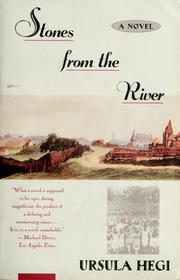
Stones from the River
2,818-word summary 13 min read 528 pages in the book
- First published
- 1994
- Publisher
- Touchstone
- Pages
- 528
- ISBN
- 9780684844770
- Series
- Burgdorf Cycle (#1)
Reading options
What's inside (12 sections)
I picked up Stones from the River expecting a war and got a village instead, which turned out to be the better of the two. The war is everywhere in it, two of them, plus the squeezed years in between when Germany went broke and angry. But Ursula Hegi keeps the history at the edges of the frame and puts a library on a riverbank in the middle, and what sits at the center is a small town called Burgdorf and one woman in it who notices everything that happens in the street.
Poseidon Press published the first English edition in 1994. The Touchstone edition runs 528 pages and carries the ISBN 9780684844770. It is the first volume of the Burgdorf Cycle, which also includes Floating in My Mother's Palm, The Vision of Emma Blau and Children and Fire. Hegi was born in Düsseldorf in 1946, left West Germany for the United States in 1964 at the age of eighteen, and died in Sag Harbor, New York in July 2026. The novel was chosen for Oprah's Book Club in 1997, the year Hegi appeared on the show, and the publisher reprinted 1.5 million hardcovers and half a million paperbacks. The New York Times named it a best book of 1994, and it was shortlisted for the PEN/Faulkner Award.
Trudi is born in 1915
Leo Montag is the first soldier home from the war, walking with a plate disk lodged in his knee. He runs a pay-library on the ground floor of his house, the kind of business where readers pay a small sum to borrow, and his wife Gertrude is not steady. Their daughter is born on 23 July 1915, and Trudi is a dwarf. For the first three months of her life Gertrude will not look at her or touch her, convinced that her own sin has deformed the child, and she hides under the house, among the weeds and boulders. Leo finds her there and holds the baby up between them like a priest extending the sacrament, until his wife crawls out and snatches the child and the three of them are on the ground together. It is the first of the scenes that tell you how this book is going to work: an ordinary act of grace, found in the middle of a catastrophe.
Gertrude is erratic, is confined to the sewing room, and is eventually taken to the asylum at Grafenburg, where she dies of pneumonia when Trudi is four. Home from the asylum for a while, she announces that a stork might deliver a baby if sugar cubes are left on the windowsill overnight. Trudi, who does not want a sibling, eats the sugar to prevent it. The baby, Horst, is born prematurely anyway and does not live, and Trudi carries the guilt of it for the rest of the book. Neighbor women from the street pitch in, and take a hand in raising her.
A child the town will not treat as a child
At school the nuns tell Trudi to hold her hand down and wait to be asked, which she does badly. She hangs from doorframes trying to make herself grow. She makes a friend of Georg Weiler next door, a boy his mother dresses in girls' clothes, and when he asks her to cut his hair she does, and the friendship ends there, though the two of them remain tangled up in each other for years. She makes a second friend in Eva Rosen, who has a red birthmark spread across her chest and who is as friendless as Trudi is. When Eva turns on her, Trudi trades the birthmark to another child and learns, early, that information is the only currency she will ever be handed.
Her father gives her a dog, Seehund, which becomes the companion of her loneliness, and later sends the dog away when she cannot bear to be reminded of what it saw. At a carnival she meets Pia, a dwarf entertainer with a trailer whose furniture is scaled to her body, and it is a shock of recognition. Trudi learns to sew her own clothes. Leo alters the library furniture so she can reach the shelves and sit at the counter. When she asks the priest about the patron saint of people like her, he can offer St Giles, patron saint of cripples, which tells her where she stands in the local imagination.
The cruelty starts small and early, with a kitten swung by its tail against a barn wall, and it is only the rehearsal for what is coming.
The barn, and the stones in the river
In the summer when she is fourteen, Trudi swims alone and comes on four boys bathing naked. They drag her into Hans-Jürgen's barn and molest her. One of them is Georg Weiler, the boy she cut hair for. Alexander Sturm happens along and shouts for Frau Braunmeier, and the boys scatter. Wrapped in a cow blanket, Trudi gets back to the river, gathers her clothes, and throws stones into the water, calling out the name of each of them as she does.
That is the hinge of the entire novel, and the title comes from it. Afterwards Trudi stops eating, cannot sleep, wraps herself in loose clothes and blankets and stays inside through the winter and into the spring. She cannot bear Seehund near her. Then the spring floods arrive and loosen her rage, and she takes her revenge on her assailants not with violence but with talk, spreading stories that hurt the local baker's business and cost a boy his apprenticeship. She tells Hans-Jürgen that no woman will ever love him. With Georg she holds back, and that restraint tells you more about her than the rage does.
And the town closes ranks. Nobody asks what happened in that barn. The question becomes what Trudi does with what she knows, because the only thing she has to spend is other people's secrets.
The library and the town's secrets
By the time the pay-library becomes Trudi's, she is the repository of Burgdorf. People bring her their scandals because she will keep them and because she is the one person in town who does not count. She trades a secret for a favor, holds back the ones that do not pay, and takes a malicious pleasure in turning a story to hurt someone who has hurt her. Being a dwarf, she explains, means carrying your deepest secret inside out, there for everyone to see. The Publishers Weekly review put it plainly, calling her a perennial outsider who exploits her gift for eliciting people's secrets and often reveals them maliciously. Hegi does not correct the reader's appetite here. Trudi is cruel, and being the victim of a barn does not entitle her to the town.
Around her runs a second thread of quiet kindness. An unknown benefactor leaves gifts for people in the village, and for years nobody can work out who he is. Leo, who was a soldier and then a librarian, counsels patience: there will be more to hide later, and quiet help is worth more than open resistance. Trudi inherits both the ethics and the complicity, and the second is harder to forgive. She is on the side of the people who hide Jews in their cellar, and she is also the woman who knows where the money in the town comes from. The secret-keeping is not incidental to the story. It is the story.
The years of the Third Reich
History reaches Burgdorf as rumor, as a parade, and as children in uniforms. Boycotts of Jewish shops. An anti-Semitic torch parade, with a boy marching in it wearing the face of someone receiving communion. Book burnings in 1933, and Leo and Trudi hiding the banned books in the pay-library where no one thinks to look. The Hitler-Jugend taking the boys, the League of German Girls taking the girls, and a ten-year-old boy, Bruno Stosick, who hangs himself because his father pulled him out of the movement.
A nine-year-old girl, Fienchen Blomberg, is pelted with stones in the street and Frau Weiler drives the boys off with a broom. Frau Weiler is arrested for it. Leo goes to the police station and lies about the ages involved, and then advises everyone to wait, because there is going to be more. The Nuremberg laws arrive, and Eva marries Alexander a month before them. Kristallnacht comes, and the Abramowitz house is wrecked and Michel Abramowitz beaten, and the townspeople watch. Renate Eberhardt is denounced by her own son. Nothing is described from above. Hegi shows a whole town making small decisions until the decisions have made a monster of the place, and then she declines to explain, which is the hardest thing to do well and she does it well.
The cellar, the tunnel, and Max
In 1942 Trudi and Leo hide Erna Neimann and her son Konrad under the library, and dig a tunnel connecting the cellar to the Blau house next door. They build alibis for the visitors. They cook a farewell dinner out of the forbidden books for Eva, who is about to be arrested. Eva is taken by the Gestapo and never comes back. Trudi herself is arrested after a remark about the flags at a piano concert, and spends three weeks in a convent that the Nazis have turned into a stronghold. A guard questions her, and she tells him the story of a man whose heart was outside his chest, and he lets her go with a warning.
Around the same time she answers a lonely-hearts advertisement with a false person, so that she can watch men look straight through her, and one of them interests her enough that she speaks to him on impulse. His name is Max Rudnick, he is an anti-Nazi painter and schoolteacher, and he is the one good thing in the second half of the book. He is also married. They are happy for a while. In February 1945 Max goes to Dresden on an errand for a murdered Jewish family and is killed in the bombing, and Trudi cannot accept it, so she tells herself stories about him falling in love with somebody else and running away, which is what the dead get to do in her head.
The silence after the war
After 1945 the town goes quiet in a different way. Everyone denies what they did. Former Nazis ask Trudi and Leo to vouch for them, since the library is the one place in Burgdorf where a person's word counts. The synagogue's footprint is paved over and made into a car park. A girl, Fienchen Blomberg, has grown up in the town that once stoned her. Hans-Jürgen murders his girlfriend and her male companion, and is tried for it, with Trudi holding back what she knows. Trudi loves a child called Hanna too much and pulls away from her when it starts to hurt, and she watches herself turning her own stories from weapons into something she can live with.
The end comes in the last years the book covers, after American tanks have rolled through Burgdorf and the town has settled into its silence. Leo, who has just turned sixty-seven, dies the day after his birthday, and Trudi has prepared the meal for it. Gifts appear on the doorstep of the pay-library. Then she walks along the river she has swum in and named her grief in, and the last pages are about the dead and the telling of them, and about the discovery that her own life, with its long plod from a barn to a library counter, has been the work of making a record. She has no husband, no children, no romantic ending. What she has is the town, the books, and the story, and she intends to go on telling it.
What works and what does not
The town is the achievement. Hegi gives Burgdorf a street map, a set of trades, a church, a school and a river, and then moves dozens of ordinary lives through it with a chronology so exact it feels like a parish register. The result is the thing she wanted from her own childhood, which was silence about the war. She grew up in Düsseldorf in 1946 in a house where the Holocaust was not discussed, and she has said that Americans of her generation knew more about the Holocaust than she did. The novel is built to sit in that silence and show what it costs.
The library is the engine. A pay-library on the ground floor of a house, with a daughter who cannot reach the shelves, is a small set of facts that turns into a moral position: whoever controls the books and the borrowing records controls the town's memory, and Trudi inherits that job along with her mother's madness. Hegi is also scrupulous about not handing anyone a clean bill. Ingrid Baum is as broken as Trudi and more culpable in one way and less in others. Helmut Eberhardt is a monster. Renate Eberhardt is brave. Leo is good and small and frightened. Nobody in the book is a lesson.
What does not work
It is a big book and it is not in a hurry. Some readers treat the length as the point, and Michael Dorris in the Los Angeles Times praised it as a long book you do not want to end, but he also noticed that the complication which makes the novel brilliant is the same thing that makes its story hard to summarize. Other readers found the pacing slow, the divisions excessive, the book longer than it needed to be, and one wrote that the premise deserved a whole chapter rather than a paragraph. That is a fair complaint about a novel that stops to render every shopkeeper's grief.
The world outside Burgdorf is mostly summarized. Hegi is at her best in the street and at her most distant on the shop floor of history: what we get is effect rather than mechanism, the parade, the boy in the uniform, the laws arriving, the arrests, the bombing, the silence afterwards. The Library Journal noticed the trade she makes, reading the book as the emergence of Nazi Germany on an intimate canvas of a small town and its humanly flawed population, and finding that the book's real appeal lies in the humanity of its characters. Read as a novel about what ordinary people did, it is excellent. Read as a history of the Rhineland, it is a frame around someone else's book.
The vocabulary around Trudi's body has dated. The publisher's own cover copy still calls her a Zwerg, a dwarf, short and undesirable, and the 1994 reviews use language that would not pass muster now. Some readers also find the treatment sentimental in the older sense: Trudi as the tragic outsider, betrayed by everyone, unheroically good. That was a different conversation thirty years ago, and the book is not wrong to have been written inside it, but it is a conversation a reader today may want to have with someone else.
The later volumes are not easier. Floating in My Mother's Palm, published before this one and set after it, reads more like linked vignettes with a teenage narrator, and Children and Fire, set on the first anniversary of the burning of the Reichstag, builds a whole novel out of an incident that was only a passing mention here. Publishers Weekly found its narrative too loose, and called the family secret it turns on tired. The cycle gets more ambitious and less accessible as it goes.
Who it is for
This is for readers who want a long, careful historical novel with a moral argument inside it, and who are willing to be patient with a town where nothing happens quickly. It is for readers of historical fiction who like their history embedded in kitchens rather than in campaigns. It is also the right book for anyone curious about how ordinary people talk themselves into cruelty, which is the question Hegi keeps asking.
I will not forget Trudi's mother in the weeds, refusing to touch the thing she had made. That is the whole book in one image: a town, a family, a country, all of them flinching away from what they have made and calling it weakness or sin or madness. Hegi does not offer Trudi a cure, and she does not offer the reader one either. What she offers is a woman at the end of her life walking a riverbank with the full story in her head, deciding to keep telling it. That is enough, and after 500 pages it feels like a great deal.
FAQ
Is Stones from the River the first book in the Burgdorf Cycle?
It is the first volume in story order, opening the cycle in 1915 with Trudi's birth. Floating in My Mother's Palm was published earlier, in 1990, but is set later and reads as the second volume, followed by The Vision of Emma Blau and Children and Fire.
Is Stones from the River a war novel?
Only in part. It runs from 1915 to 1951 and covers both world wars, the rise of the Nazis and the silence afterward, but its center is one small town and the woman who keeps its secrets.
How does Hegi handle Trudi's dwarfism?
Trudi is treated as an outsider and often as a child, and she ends up running the town library. The vocabulary the book and its cover copy use around her body, and the sentiment of the tragic outsider, have both dated.
Is it suitable for readers who dislike long books?
It is a long, patient read. The Touchstone edition runs 528 pages and moves slowly, which readers who loved the book call the point and other readers call slow pacing.
Similar books
More from Burgdorf Cycle first, then related titles.

Violeta
A woman born in 1920 writes her life story to her grandson, from one pandemic to another, through wealth, ruin, passion, and dictatorship in South America.
2,555-word summary · 11 min read

The Lowland
Two brothers grow up beside a marshy lowland in Calcutta, and the choices of the younger one draw the older into a life of duty, distance, and quiet grief that…
2,213-word summary · 10 min read
Mother Night
Howard W. Campbell Jr., a Nazi propagandist and American spy, tells the story of his double life from an Israeli prison cell while waiting to be tried for war…
1,988-word summary · 9 min read
The War That Saved My Life
Ten-year-old Ada has never left her London flat, hidden away because of her clubfoot. Wartime evacuation sends her to Kent, where a reluctant guardian and a…
2,252-word summary · 10 min read
The English Patient
In a ruined Italian villa in 1945, a burned man, a nurse, a thief, and a sapper trade pasts shaped by desert love and war.
2,006-word summary · 9 min read
The Covenant of Water
Three generations of a Kerala family face a drowning affliction from 1900 to 1977, from child bride Big Ammachi to physician Mariamma who seeks its cause.
2,955-word summary · 13 min read

Fried Green Tomatoes at the Whistle Stop Cafe
Evelyn meets Ninny in a nursing home and hears the story of Idgie and Ruth and their Alabama cafe.
2,825-word summary · 13 min read
All the Light We Cannot See
Doerr's All the Light We Cannot See retold: blind Marie-Laure, Werner the radio boy, and Saint-Malo.
1,962-word summary · 9 min read

The Stationery Shop
Two teenagers fall in love in a Tehran stationery shop in 1953, are separated by the coup and a family deception, and meet again sixty years later.
2,024-word summary · 9 min read
The Orphan's Tale
A Dutch teenager rescues a Jewish baby from a death train and joins a German circus, where a Jewish aerialist teaches her to fly.
2,943-word summary · 13 min read

The Japanese Lover
A Polish refugee and the son of a Japanese gardener fall in love in San Francisco in 1939, then keep the affair secret for nearly seventy years.
2,286-word summary · 10 min read

The Shadow Sister
Star D'Apliese steps out of her sister's shadow and follows a bookshop clue into the Edwardian life of Flora MacNichol, a woman who gave up love for duty.
2,260-word summary · 10 min read

The Only Woman in the Room
A novel about Hedy Lamarr's escape from an arms-dealer husband, her Hollywood career, and the frequency-hopping patent the Navy ignored.
2,067-word summary · 9 min read

Mrs. Everything
Two Jewish sisters in Detroit grow up, apart and together, across seven decades of American life, from the 1950s to the 2016 election.
2,362-word summary · 10 min read

Sophie's Choice
A young Southern writer in 1947 Brooklyn befriends a brilliant, unstable couple and slowly learns the story of the Polish Catholic woman at the center of their…
2,798-word summary · 12 min read
Only Time Will Tell
A Bristol dockworker's son wins a scholarship, falls in love with the daughter of the family that owns the shipyard, and learns that his father's death was not…
2,082-word summary · 9 min read
Once There Were Wolves
A biologist reintroduces fourteen wolves to the Scottish Highlands while protecting her traumatized twin sister, then finds a body in the snow that could…
2,682-word summary · 12 min read

The Storyteller's Secret
A New York journalist goes to India to learn why her grandmother loved a British officer, and why a family servant kept the truth for forty years.
2,270-word summary · 10 min read

Ivanhoe
A disinherited Saxon knight, a great tournament, a besieged castle and a trial by combat. Scott's most famous novel, set in England in 1194.
2,834-word summary · 13 min read
Euphoria
Three anthropologists in 1930s New Guinea turn fieldwork into a love triangle, and a real history breathes behind them.
2,048-word summary · 9 min read

Big Lies in a Small Town
A 22-year-old woman leaves prison to restore a 1940 mural, and Edenton, North Carolina, starts talking.
2,187-word summary · 10 min read

A Spool of Blue Thread
Four generations of the Whitshank family in Baltimore, and the silences, resentments and quiet love they hand down without ever saying so.
2,408-word summary · 11 min read

Wide Sargasso Sea
Jean Rhys gives the first Mrs. Rochester a Caribbean childhood, a marriage built on money and suspicion, and a voice that Charlotte Bronte left in the attic.
2,021-word summary · 9 min read
The Tuscan Child
After her father's death, Joanna follows a returned letter to Tuscany and uncovers his wartime love, a hidden painting and a village secret. A dual-timeline…
2,095-word summary · 9 min read
The Sisters Brothers
Two hired killers ride from Oregon to Gold Rush California to murder a prospector, and find their trade, their brotherhood, and the frontier myth coming apart.
2,095-word summary · 9 min read
The Silence of the Girls
Briseis, queen of Lyrnessus, is captured by Achilles and narrates the Trojan War from inside the Greek camp, where women are prizes and survival is its own…
2,098-word summary · 9 min read

The Birth of Venus
A Florentine merchant's daughter trains as an artist, marries a man who hides a secret, and survives Savonarola's bonfire of the vanities.
2,404-word summary · 11 min read

Bring Up the Bodies
Thomas Cromwell sets out to destroy Anne Boleyn, building a case from rumor and revenge while Henry VIII waits to marry Jane Seymour.
2,066-word summary · 9 min read

Olive, Again
Elizabeth Strout returns to Crosby, Maine, as Olive Kitteridge marries Jack Kennison, confronts her son, and faces old age, grief, and small-town judgment.
2,333-word summary · 10 min read
Those Who Save Us
A Minnesota professor hunts her mother's hidden wartime past in Weimar, where survival came wrapped in an SS officer's protection. A dual timeline about…
2,345-word summary · 10 min read