
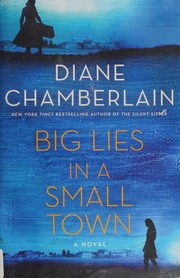
Big Lies in a Small Town
2,187-word summary 10 min read 400 pages in the book
- First published
- 2020
- Publisher
- St. Martin's Press
- Pages
- 400
- ISBN
- 9781250087331
Reading options
What's inside (10 sections)
I picked this up for a train ride because the title promised a small town murder, and what I got was a two-hander about a wall painting, two women who come apart in different decades, and a town that has been telling itself the same story for eighty years. The St. Martin's Press hardcover runs 400 pages, arrived on January 14, 2020, and carries ISBN 9781250087331. The premise in one breath: a young woman in prison is released early to restore a mural that a stranger painted in 1940, and the closer she looks at the paint, the more the town wishes she would stop.
Diane Chamberlain has been writing suspenseful romantic novels for thirty years, more than two dozen of them, sold in more than twenty languages, and the title is fair warning that this is a book with a genre engine under it. It is also much stranger than the shelf it sits on. Kirkus filed it under mystery and detective, and under family life and friendship, which is about right for a story where the crime and the relationship are the same subject. People magazine picked it as one of its best new books of the year, and First for Women called it an escape, which tells you what shape the pleasure takes. There is a prologue before the first chapter, and the reading guide that goes with the book asks readers to say what it left them wondering about, which is a fair description of the effect.
Morgan, in Raleigh, June 2018
The novel opens in the North Carolina Correctional Facility for Women in Raleigh, with Morgan Christopher in a hallway of cinder block that feels cold in any weather. She is 22. She is doing time for an alcohol-related car crash that left the other driver paralyzed, and she took the fall for it. The rest of that story she keeps to herself for most of the novel. What she wanted before the crash was a life in art.
The offer arrives in the form of a dead man's will. Jesse Jameson Williams, an artist and philanthropist from Edenton, North Carolina, spent his career pushing money toward struggling artists, and his last gift was to Morgan, a complete stranger who had admired his work from prison. His daughter Lisa, who holds the will, engineers the early release so that Morgan will come to Edenton and restore an old post office mural, painted in 1940 by Anna Dale, that was never hung on the wall it was made for. Jesse's money also buys Morgan a deadline, a gallery opening on August 5, 2018, and fifty thousand dollars she has no idea what to do with. She knows nothing about restoration. She takes the job anyway.
Lisa is a presence rather than a portrait. She is the one who has to make the conditions of her father's will true, and she is not sentimental about it. Morgan never quite understands why Jesse knew of her at all, and that question sits under the whole book like a stone under a rug.
Edenton, 1940
Anna Dale is also 22, also alone, and also desperate for work. She is from New Jersey and she arrives in Edenton in 1939 with a federal art contest win and a commission to paint the post office mural. What she finds is a town where prejudice runs deep, where people keep secrets behind closed doors, and where the price of being different might end in murder. She is the outsider with the brush, a northerner painting a civic celebration in a southern town that is not sure it wants to celebrate.
Then Anna's mother dies, and Anna's own mother had manic episodes. The 1940 strand slows down into something domestic and unravelling. In 2018 the people of Edenton say, with the confidence of a town that has repeated something for decades, that Anna lost her mind, and that this is why the mural looks the way it does. They are not lying about the breakdown. They are simply telling you the end of the story instead of the whole one.
Kirkus noted that Anna's mural of civic pride is strange, which is another way of saying that she did not paint what Edenton expected a government painter to paint. Whatever is on that wall, it is the one thing about Anna Dale that the town has never stopped arguing about, and it is the reason a woman in prison is now cleaning it in 2018.
The work
The middle of the book is craft, and it is the part I would recommend to anyone who has ever sat in front of a canvas. Morgan learns to clean a surface, fill losses, and retouch where the paint has lifted, under the instruction of Oliver Jones, the curator of Jesse's gallery and a trained restorer. He is a single father. He is careful with her. An attraction builds, and Chamberlain writes it the way she writes everything else, at a low temperature, with nothing pushed and nothing performed.
The restoration gives Morgan something prison took from her, which is a skill and a set of hours that belong to her. Kirkus thought this was where the book was strongest, praising the depiction of the painter's process in Anna's case and of the restorer's art in Morgan's, and the two strands end up doing more for each other than the plot requires. The romance, meanwhile, is a second restoration project: Morgan relearning how to be around a decent man without waiting for the catch.
The way the mystery runs is also worth naming, because it is not the usual engine. Nobody lies to Morgan in a way you can catch. Edenton is simply polite, and politeness is what a town uses when it does not want to say a thing out loud. People answer a different question, or they answer the question she asked a moment earlier, and the reader has to notice the gap. It is slow, and it works on the reader's own suspicion, which by the end of the 1940 strand is well earned.
Jesse, and the will
Jesse is the hinge. In 1940 he is the young Black painter whose talent Anna notices and mentors, to the visible irritation of Edenton's white establishment, and whose career and standing depend on a town that resents him. In 2018 he is the dead patron whose money moves everyone. He connects the two timelines, and he is the reason Morgan is in a room with that particular wall at all.
His will also sets a trap for the reader. Lisa has to carry out the conditions, and the conditions are strange, tight and slightly petty in ways that never quite get the attention they deserve. Kirkus called that out, and it is a fair piece of criticism. The book treats Jesse's arrangements as part of the mystery, and then leaves some of their teeth on the table.
What the town said, and what happened
The reveal is the reason to read the novel. Edenton has a public version of 1940, and the public version is that a lonely young artist lost her grip and ruined a nice mural. The private version involves a killing, and Jesse, who helps Anna Dale cover it up, paying for that help with his own life. How much of the past the present-day characters are allowed to learn, and when they learn it, is the engine of the second half.
Late in the book, the story reveals the real connection between Anna and Morgan, and the real reason a dying man in 2018 asked a woman in prison to clean a wall in North Carolina. The last pages add one more turn: a character named Judith Shipley, whose true identity is not the one the town has been carrying, because she deliberately wiped her own slate clean and built a new life on top of it.
How the two strands work
Double timelines are a hazard, and this book uses them well. The trick is that the two women rhyme without matching. Anna Dale and Morgan Christopher are both artists, both twenty-two, both alone, and both wrecked by something they cannot talk about. Anna's is her mother's death, and the illness that ran in her family. Morgan's is the crash and the years inside. What separates them is what they do with the sight of the town they are both looking at. Chamberlain alternates the strands in short blocks rather than long chapters, so the reader carries one timeline into the other, and the coincidences of plot do their own work: a name, a gift, a piece of paper, a date on a wall.
The method also gives the ending somewhere to land. When the two timelines finally touch, it is not a shock so much as a recognition, the feeling of a key that has been sitting in your pocket all along.
The final business is quieter than the twist. Morgan has spent a lot of the novel turning over Emily Maxwell, the woman whose actions wrecked the life she used to have, and by the end she has decided to go and see her. That decision is not explained to you in a speech. It sits in a chapter, and it lands hard because of it.
What works, what does not
Publishers Weekly liked it, and especially liked what Chamberlain does with creative work as a way of holding people together across time. Booklist compared the structure to a quilt made of pieces from different people and places. Library Journal thought it faintly reminded them of The Goldfinch and called the meeting of art, history and mental health in it multifaceted. All fair.
My doubts are on the mystery side. Kirkus found that conflict is lacking, that the racial tensions of 1940 come across as unrealistically mild for a southern town in that decade, and that the conditions in Jesse's will are not mined for their full stakes. I agree about the mildness. A story about a mural and a murder in Edenton in 1940 has to do more work with the obvious ugliness of the place, and Chamberlain often writes around it, letting the horror live in what the characters do not say. Readers who want the knife turned all the way will be frustrated. Readers who want a story about making art and getting through a life will be in good hands.
The 2018 strand is also the softer half. Morgan's business is a restoration job with a deadline, and its pleasures are real but small: solvents, fills, a gallery opening, a boy, a slowly thawing single dad. The 1940 strand has the sharper material, and it is where the book earns its final twist.
Chamberlain spent part of her career as a social worker and a psychotherapist, and it shows in how she handles Anna's illness and Morgan's damage. She does not treat either woman as a puzzle to be solved by the people around them. Anna is not mad. Morgan is not broken. They are both people who have done something they cannot undo and then had to keep living, and the book is mostly about the living.
If you want to know where the author stands, the other editions answer that too. A Thorndike large print edition came out in 2020, the paperback followed from St. Martin's Griffin on January 5, 2021 at 416 pages, and the audiobook is read by Susan Bennett. Chamberlain has been writing books at this pace for so long that the reading is fast and sure, and the prose never calls attention to itself, which is why the last chapter can be so quiet and still hurt.
Who to hand it to
If you want a murder mystery, go in knowing the killing is the least of it. If you want a two-strand novel about art, obligation and the stories towns tell about their own history, this is a good one to read slowly, in two sittings, because the 1940 material is worth the attention.
Two more things for the deciding reader. The book is not a romance with a mystery attached, whatever the marketing wants, and the love story between Morgan and Oliver stays small and slightly grayed on purpose. It is also not a cozy, despite the hours spent in a restoration studio. People die in it, and the worst of it happens to women in a town that would rather talk about the mural.
I finished it on the train, an hour late, and kept thinking about a wall in a post office in a town I had never heard of, and about how long a place can go on telling a version of itself that is almost true. That is the book underneath the title. The title is a good one, and it oversells the genre a bit, but the book earns the word small. It is 400 pages, and at the end I wanted another hundred.
FAQ
What is Big Lies in a Small Town about?
Morgan Christopher, 22, is released from a North Carolina women's prison to restore a mural painted in 1940 by Anna Dale. The closer she studies the paint, the more the town of Edenton wishes she would stop.
When was Big Lies in a Small Town published?
St. Martin's Press published it on January 14, 2020. The hardcover runs 400 pages and the ISBN is 9781250087331.
Is Big Lies in a Small Town part of a series?
No, it is a standalone novel with no sequel. Diane Chamberlain's later book The Last House on the Street is a different small-town mystery with its own cast and plot.
Similar books
The Clockmaker's Daughter
A London archivist finds a Victorian satchel holding a photograph, a sketchbook and a letter, then follows them to Birchwood Manor, where a young woman died in…
2,886-word summary · 13 min read
The Art Forger
A disgraced Boston painter agrees to copy a Degas stolen from the Gardner Museum, then begins to suspect the original she is copying is itself a forgery.
2,117-word summary · 9 min read

The Echo of Old Books
Barbara Davis's 2023 novel sends a rare-book dealer in 1984 New Hampshire hunting for the authors of two unpublished volumes that tell opposite sides of one…
2,491-word summary · 11 min read
The Tuscan Child
After her father's death, Joanna follows a returned letter to Tuscany and uncovers his wartime love, a hidden painting and a village secret. A dual-timeline…
2,095-word summary · 9 min read
The Book of Lost Friends
Three women trace Lost Friends ads from 1875 to find stolen sons.
2,368-word summary · 11 min read
The Lake House
Detective Sadie reopens 1933 Edevane baby vanishing tied to writer Alice.
2,055-word summary · 9 min read
People of the Book
Conservator Hanna traces Sarajevo Haggadah stains back to 1480 Seville.
2,479-word summary · 11 min read
Ordinary Grace
In 1961 Minnesota, thirteen-year-old Frank Drum faces a summer of deaths that tests his minister family and forces him to weigh truth, guilt, and mercy.
2,948-word summary · 13 min read

How the Light Gets In
Gamache investigates the murder of the last Ouellet quintuplet while the Sûreté he served is dismantled from inside by the man who took his protégé.
2,279-word summary · 10 min read

Bury Your Dead
Recovering from a failed raid that killed his officers, Gamache investigates a murder in a Quebec City library while Beauvoir reopens a case in Three Pines.
2,022-word summary · 9 min read

Anatomy: A Love Story
In 1817 Edinburgh, a noblewoman who wants to be a surgeon disguises herself to study anatomy and falls for the grave robber who supplies her with bodies.
2,031-word summary · 9 min read

The Shadow Sister
Star D'Apliese steps out of her sister's shadow and follows a bookshop clue into the Edwardian life of Flora MacNichol, a woman who gave up love for duty.
2,260-word summary · 10 min read
The Unmaking of June Farrow
A woman in a North Carolina flower-farming family walks through a red door into 1951, where she must solve her mother's disappearance and decide whether to…
2,701-word summary · 12 min read
The Black Dahlia
James Ellroy builds a fiction around the real Black Dahlia murder, following two Los Angeles cops whose partnership and obsessions destroy them.
2,533-word summary · 11 min read

The Agony and the Ecstasy
Irving Stone turns Michelangelo's seventy years of carving, painting, and arguing with popes into a novel about the cost of making something that outlives you.
2,260-word summary · 10 min read
Only Time Will Tell
A Bristol dockworker's son wins a scholarship, falls in love with the daughter of the family that owns the shipyard, and learns that his father's death was not…
2,082-word summary · 9 min read
Once There Were Wolves
A biologist reintroduces fourteen wolves to the Scottish Highlands while protecting her traumatized twin sister, then finds a body in the snow that could…
2,682-word summary · 12 min read
Once Upon a River
A wounded man stumbles into a riverside inn carrying what appears to be a drowned child who is not quite dead, and the story braids the guesses of everyone who…
2,173-word summary · 10 min read

The Storyteller's Secret
A New York journalist goes to India to learn why her grandmother loved a British officer, and why a family servant kept the truth for forty years.
2,270-word summary · 10 min read

Stones from the River
Trudi Montag is born a dwarf in a small German river town in 1915 and grows up to keep the town's library and its secrets, from the First World War to the…
2,818-word summary · 13 min read
Last Night at the Telegraph Club
The 2021 National Book Award winner follows Lily Hu, a Chinese American teenager in 1954 San Francisco, as she falls for Kath and learns what it costs to be…
2,336-word summary · 10 min read

Indigo Ridge
A new police chief in a Montana town meets the founding family's eldest son in a bar, and one night later a body turns up under their cliff.
2,763-word summary · 12 min read

Worth Dying For
Reacher stops for one night in rural Nebraska and finds a family that runs the county, a missing girl and a shipment worth killing for.
2,021-word summary · 9 min read
True Believer
Jeremy Marsh, a science journalist who debunks paranormal claims, comes to a small North Carolina town and falls for a librarian who believes in things he…
2,125-word summary · 9 min read
The Diviners
In 1920s New York, Evie O'Neill's ability to read objects pulls her into an occult investigation that awakens something far older and more dangerous.
2,045-word summary · 9 min read

The Birth of Venus
A Florentine merchant's daughter trains as an artist, marries a man who hides a secret, and survives Savonarola's bonfire of the vanities.
2,404-word summary · 11 min read

Say You're Sorry
A widowed prosecutor defends the teenager accused of killing her babysitter, uncovering a small town's secrets and a killer hiding in plain sight.
2,116-word summary · 9 min read
Loving Frank
Mamah Borthwick Cheney leaves her family for Frank Lloyd Wright, and their affair becomes a public scandal that ends in tragedy at Taliesin.
2,034-word summary · 9 min read
A Rule Against Murder
Gamache's anniversary at a remote lodge turns into a closed-circle murder when the family statue kills Julia, and everyone at the Manoir had a reason.
2,201-word summary · 10 min read

The Survivors
Kieran Elliott returns to Evelyn Bay twelve years after a storm killed his brother, and a young woman's murder forces the town to face what it has concealed.
2,571-word summary · 11 min read