
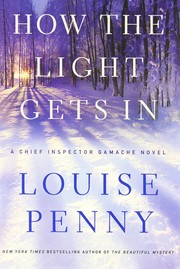
How the Light Gets In
2,279-word summary 10 min read 405 pages in the book
- First published
- 2013
- Publisher
- Minotaur Books
- Pages
- 405
- ISBN
- 9780312655471
- Series
- Chief Inspector Armand Gamache (#9)
Reading options
What's inside (8 sections)
The first thing you notice about this book is how much of it happens in rooms where nobody says what they mean. A retired shopkeeper sits in a Montreal apartment with a locked door and a hat in a box. A police officer writes a resignation letter and sends it to every member of the Sûreté du Québec, not because he is quitting but because he is sending a message nobody outside his ruined department can read. And in Three Pines, a village that exists mostly so that people can recover from the world, a psychologist named Myrna Landers is buying groceries for a friend who is coming for Christmas and will not arrive.
Louise Penny's ninth Gamache novel is a triple braid, and the trick of it is that the three strands look unrelated for a long time. There is a murder in a village. There is a civil war inside a police force. There is a dead clerk at the Ministry of Transport with a file about a bridge. By the end they are the same story, and the fact that they converge is both the book's best effect and the place where it strains hardest.
Let me start with the murder, because that is where the reader starts.
A reserved woman and a hat with two initials
Constance Ouellet has been renting a small house in Three Pines under the name Constance Pineault. She is in her late seventies, quiet in a way that reads as rude to people who expect warmth, and she has recently buried the last of her four sisters. Myrna, who has known her for years and loves her without quite understanding her, has invited her to stay through the holidays. When Constance does not appear, Myrna assumes a change of plans. Gamache and Isabelle Lacoste find her instead, dead in her home, and the scene is staged to look like a fall.
The detail that matters is a hat. Constance had bought it as a Christmas present for Myrna, and it is monogrammed with the letters MA. Gamache, working from the assumption that the hat belonged to Constance's mother, sends it for DNA testing. The result comes back male. The puzzle turns on that, and on a phrase Myrna remembers: Constance once mentioned a Brother André. Myrna heard a priest, the famous healer from Montreal. Constance meant her brother, Marc-André, a man the world was never told about.
That is the hinge of the whole investigation. Constance Ouellet was one of five identical sisters whose birth in the 1930s made them international celebrities, a Canadian sensation in the shadow of the Dionne quintuplets. Their mother had spent years unable to conceive, went to Frère André, and afterward produced five girls at once. The family presented them as a miracle, and the province, the church, and the press all agreed to keep saying so.
Gamache gets access to sealed records, and what he finds is ugly in a very ordinary way. The parents did not raise those girls so much as rent them out. There were contracts, appearances, money that arrived and money that was asked for again. The girls were an asset with a story attached, and the story required them to be a miracle, which meant the family could never admit that one of the five had died as a child and that a brother had done it.
Penny handles this material with a light hand for most of the book, then stops being light. There is a sequence where Gamache watches old film reels of the girls as small children, banging on a door while their mother shoos them away, and the image does more work than any explanation could. It is the sort of scene that could easily be sentimental and is not, because Penny keeps it short and lets the noise of the knocking carry it.
The interviews are where the book gets its teeth. Gamache finds an old man the family calls Uncle André, bitter and closed off, living out his remaining years in the wreckage of a secret. The reader figures out before Gamache does that this is the brother, and that the brother is the killer. Marc-André killed Virginie, another of the sisters, by accident when they were children, and the family buried the fact because a dead girl breaks the arithmetic of a quintuplet miracle. He has been hidden his entire life, which is a strange kind of punishment: kept alive, kept quiet, kept from being anyone.
The department that eats its own
While that unfolds, Gamache is being dismantled professionally, and this is the strand that gives the novel its anger.
You need the previous book to feel the full weight of it. In A Beautiful Mystery, Jean-Guy Beauvoir, Gamache's second in command and the closest thing he has to a son, slid back into painkiller addiction under pressure from Sylvain Francoeur, the Chief Superintendent. Gamache found out, suspended him, and demanded he go to rehab. Beauvoir responded by attacking him and going to work for Francoeur instead. That is not a small betrayal. It is the kind of rupture that reorganizes a person's life.
When this book opens, Francoeur has already won the institutional fight. The homicide division has been broken up and its people scattered into other departments. Only Isabelle Lacoste remains, and she remains in the awkward position of being loyal to a man the organization has decided to bury. Gamache's new team is made of people who cannot do the job, assigned not to help but to make failure look like his fault. He is isolated, surveilled, and slowly starved of information. Penny is very good on the texture of this: the meetings that exist to produce minutes rather than decisions, the colleague who is friendly in the hallway and poisonous in the report.
What makes the plot work is that Gamache does not fight back the way a thriller hero would. He writes a resignation letter and sends it to the entire Sûreté. Francoeur reads it as surrender, which is exactly what Gamache wants him to read. It is actually a coded signal to the agents Francoeur scattered, telling them the moment has arrived and where to be. The letter is the best idea in the book, and it is a good example of Penny's sense of what leadership looks like: not a speech, not a confrontation, but a message that only the right people will understand.
The bridge thread runs underneath all of this. A clerk at the Ministry of Transport has died in circumstances that do not add up, and the file he was working on leads to the Champlain Bridge, which is quietly falling apart while the people responsible for inspecting it are being managed rather than listened to. Penny uses the bridge the way a novelist should: as a literal structure with cracks in it and as the thing everyone in the story is standing on without knowing.
The convergence, when it comes, is loud. On the day of the climax, Lacoste shuts down the Champlain Bridge before it can collapse, and Gamache's scattered agents surface to arrest Francoeur's man Renard and the rest of his operation. Gamache meets Francoeur in the woods in the snow. They fight. Gamache shoots him. Then he runs toward the schoolhouse, because he believes a bomb is there and that Beauvoir is inside it, and Beauvoir, who has finally understood that Gamache never stopped loving him, shoots Gamache in the leg to stop him from opening the door. The schoolhouse explodes. Both men live.
That sequence is the emotional payoff of five books, and it is also where the machinery of the plot is most visible. Francoeur's operation required an extraordinary amount of access, an improbable number of people in the right positions, and a level of coordination that would embarrass most real conspiracies. Penny is not interested in the plausibility of the scheme so much as its meaning, and the meaning is that institutions protect themselves before they protect anyone else. A reader who wants the logistics to hold up under pressure will find places to push.
Three Pines as a hiding place
The village chapters are the book's relief valve, and they are doing more than comic relief.
Ruth Zardo is still foul-mouthed and still carrying Rosa, her duck, and Penny writes her with obvious affection and no sentimentality. Clara Morrow is painting. Gabri and Olivier are running the bistro and the inn and complaining about the Christmas rush. Myrna is grieving a friend she did not know she had lost. These people are not decorative. When Francoeur's people come to Three Pines looking for the Brunels, the village hides them, and hides Agent Nichol too, while performing cooperation for the visitors with a straight face. The village becomes a small state with its own foreign policy, and the comedy of that is inseparable from the seriousness of it.
This is also where the title earns itself. Leonard Cohen's line about the crack in everything is doing real work in this novel, because almost every major character is broken in a way they cannot hide and cannot fix. Gamache is grieving a partnership. Beauvoir is addicted and ashamed. Myrna has lost someone who mattered. The Ouellet sisters were broken by being made into an exhibit. The bridge is cracked. The department is cracked. The book's argument is not that cracks are fine but that they are where anything gets in at all, including other people.
Beauvoir, and the hardest thing the book does
If you asked me what this novel is actually about, I would not say the quintuplets. I would say Jean-Guy Beauvoir.
His arc is the one Penny takes seriously enough to make uncomfortable. He is not redeemed by a speech. He is redeemed by a long, humiliating process: withdrawal, anger, the discovery that the man he betrayed never stopped working to get him back. The moment in the snow, when he shoots Gamache to keep him from the door, is the reversal the whole series has been building toward. He has spent two books believing he was disposable. He shoots the father figure in the leg to save his life, which is a strange and completely earned gesture.
The wedding at the end, a few months later, is the payoff. Beauvoir is sober. Gamache has retired and moved to Three Pines. Lacoste is the new Chief Inspector of Homicide. It is generous, and it is a little too neat, and I think Penny knows it. After five books of accumulated damage, she chooses to let people be all right.
What does not quite work
The quintuplet backstory is the weakest large element. The history itself is compelling, and the film reels are devastating, but the plotting around it tips into melodrama. A hidden brother, a childhood killing, a family conspiracy sustained for seventy years: it is a lot, and the novel's careful realism does not always survive it. Uncle André is a good scene and a thin character, more a mechanism for the final reveal than a person you believe in.
Francoeur has the same problem at a larger scale. He is a force rather than a man. His corruption is total, his motives are mostly institutional, and he never gets a moment that makes him human in the way the novel's better villains do. That is a choice, and it costs something.
Readers who start here will be lost, and I do not think that is a flaw exactly, but it is a fact worth stating. This is the resolution of an emotional arc that runs back through several volumes. The book does not slow down to explain what Gamache and Beauvoir mean to each other, because explaining it would flatten it. Come in cold and the snow scene will still work, but it will work as action rather than as reckoning.
And the ending is kind to nearly everyone. That is a real authorial decision, not an accident, but it does soften the book's own argument about institutions. The department that ate its own gets new leadership and a clean slate in about two pages.
Why it stays with you
What holds up is the braid. A murdered woman in a village, a police force at war with itself, and a bridge nobody wants to look at turn out to be one story about the cost of maintaining a comforting lie. The Ouellet family sold a miracle and could never stop selling it. The Sûreté sold the idea of itself and could not tolerate an honest man inside it. The bridge was declared safe because declaring it safe was cheaper than fixing it.
Gamache's answer to all three is the same, and it is not heroism. It is presence. He shows up, he asks the question nobody wants asked, and he refuses to treat people as assets. That is why the letter works, and why the snow works, and why the wedding at the end feels earned even when it feels easy.
Penny's prose is plain and her chapter endings are often too tidy, and she has a habit of telling you what a scene means right after she has shown you. But she can build a community on the page, and she can make a man's recovery matter more than a conspiracy. I finished this one in two nights and then went back to reread the schoolhouse. It is not the best-plotted book in the series. It may be the one with the most heart.
FAQ
Do I need to read the earlier Gamache books first?
Yes, ideally. The novel resolves an emotional arc built over several previous volumes, and the rift between Gamache and Beauvoir loses most of its force if you start here.
Who killed Constance Ouellet?
Her hidden brother, Marc-André, known in the family as Uncle André. He had accidentally killed another sister, Virginie, as a child, and the family concealed him to protect the quintuplet miracle.
Does Gamache die at the end?
No. Beauvoir shoots him in the leg to keep him from opening the schoolhouse door, and Gamache survives, retires, and moves to Three Pines.
Similar books
More from Chief Inspector Armand Gamache first, then related titles.

Still Life
A beloved teacher found with an arrow in Three Pines looks like hunting accident until Gamache looks closer.
1,996-word summary · 9 min read
A Fatal Grace
Gamache returns to Three Pines for Christmas where hated CC de Poitiers is electrocuted on a frozen lake.
2,339-word summary · 10 min read
The Cruelest Month
Gamache returns to Three Pines where a seance ends in murder.
2,529-word summary · 11 min read
A Rule Against Murder
Gamache's anniversary at a remote lodge turns into a closed-circle murder when the family statue kills Julia, and everyone at the Manoir had a reason.
2,201-word summary · 10 min read
Bury Your Dead
Recovering from a failed raid that killed his officers, Gamache investigates a murder in a Quebec City library while Beauvoir reopens a case in Three Pines.
2,022-word summary · 9 min read

The Trespasser
A Dublin Murder Squad detective investigates a staged dinner-party killing and finds a cover-up that reaches into her own department.
2,051-word summary · 9 min read

Rules of Prey
Minneapolis detective Lucas Davenport hunts a killer who leaves a new rule at every scene and treats murder as a game of wits.
1,914-word summary · 9 min read

The Late Show
Exiled to the LAPD night shift after accusing her supervisor, Renée Ballard keeps two cases that were meant to be handed off at dawn: a brutal assault and a…
2,563-word summary · 11 min read
The Bat
Oslo detective Harry Hole aids Sydney police after a young Norwegian woman is murdered and finds a wider pattern. Grief, drink, and a lost partner shape the…
2,766-word summary · 12 min read
Finger Lickin' Fifteen
Lula sees a celebrity chef decapitated and talks Stephanie into entering a barbecue contest to lure the killers, while Ranger hires her to find a security leak…
2,248-word summary · 10 min read
The Last Mile
Melvin Mars is hours from execution for his parents' murder when another man confesses, and FBI cold case detective Amos Decker goes looking for the trap.
2,746-word summary · 12 min read
Fearless Fourteen
Bounty hunter Stephanie Plum babysits a teenager, guards a fading singer, and hunts nine stolen million dollars under her boyfriend's basement.
2,466-word summary · 11 min read

3rd Degree
The third Women's Murder Club novel follows a San Francisco terror cell and a three-day killing schedule, and it costs the club a member.
2,685-word summary · 12 min read

Worth Dying For
Reacher stops for one night in rural Nebraska and finds a family that runs the county, a missing girl and a shipment worth killing for.
2,021-word summary · 9 min read

Say You're Sorry
A widowed prosecutor defends the teenager accused of killing her babysitter, uncovering a small town's secrets and a killer hiding in plain sight.
2,116-word summary · 9 min read
Lean Mean Thirteen
Stephanie Plum's ex-husband disappears after she attacks him, leaving her suspected of murder and chasing a forty-million-dollar secret through Trenton.
2,100-word summary · 9 min read
The Survivors
Kieran Elliott returns to Evelyn Bay twelve years after a storm killed his brother, and a young woman's murder forces the town to face what it has concealed.
2,571-word summary · 11 min read
The Memoirs of Sherlock Holmes
Doyle's second Holmes collection gathers twelve Strand stories, including the early case of the Gloria Scott and the confrontation with Moriarty at Reichenbach…
2,390-word summary · 11 min read
The Redbreast
Harry Hole chases an ageing sniper through modern Oslo while two Norwegian volunteers on the Eastern Front carry a fifty-year-old betrayal toward a royal…
2,453-word summary · 11 min read
The Murder on the Links
Poirot arrives in France too late to save his client, who is found stabbed in a grave and was not the man he claimed to be. Christie's second Poirot novel.
2,055-word summary · 9 min read
Men at Arms
The City Watch gets new recruits and a murder case when the Disc's only handgun turns up in Ankh-Morpork, in the fifteenth Discworld novel.
2,216-word summary · 10 min read

Broken Harbor
A family is found slaughtered in a half-built Dublin estate where no one broke in, and star detective Scorcher Kennedy must explain the holes in the walls.
2,308-word summary · 10 min read
Triptych
A GBI agent with dyslexia hunts a rapist while two Atlanta cops hide pasts.
2,576-word summary · 11 min read
The Maltese Falcon
Sam Spade hunts a jeweled bird through lies after his partner is killed.
2,529-word summary · 11 min read
One, Two, Buckle My Shoe
Poirot links a dentist murder to a missing banker and stolen millions.
2,549-word summary · 11 min read
Cruel & Unusual
Scarpetta links an execution to a boy's murder while someone steals bodies.
2,533-word summary · 11 min read
Case Histories
A Cambridge PI takes three cold cases that tangle with his own loss.
2,465-word summary · 11 min read
Blindsighted
Sara and Jeffrey hunt a killer staging women in small-town Georgia.
2,400-word summary · 11 min read
At Bertram's Hotel
Miss Marple finds a luxury hotel fronting robbery and murder.
2,550-word summary · 11 min read
The Man in the Brown Suit
Anne Beddingfeld sees a Tube death in London and chases a paper clue to South Africa, diamonds, and the hidden Colonel.
2,292-word summary · 10 min read