
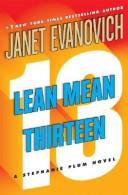
Lean Mean Thirteen
2,100-word summary 9 min read 310 pages in the book
- First published
- 2007
- Publisher
- St. Martin's Press
- Pages
- 310
- ISBN
- 9780312349493
- Series
- Stephanie Plum (#13)
Reading options
What's inside (8 sections)
I have a soft spot for the Stephanie Plum books. They are not realistic mysteries, and they are not trying to be. They are comedy machines with a body count, and when they work, they are the reading equivalent of a bag of chips. Lean Mean Thirteen is the thirteenth book in the series, published in 2007 by St. Martin's Press, and it has all the familiar ingredients: Stephanie, Morelli, Ranger, Lula, Grandma Mazur, a ridiculous bounty, and at least one car that does not survive the week. It also has a better central mystery than some of the later entries, which makes it one of the stronger books in the middle of the run.
The story starts with a favor. Ranger asks Stephanie to visit her ex-husband, Richard "Dickie" Orr, and find out if he is doing something shady. Dickie is a lawyer, and Ranger wants to know what he is up to. Stephanie poses as a client seeking legal advice and brings Connie and Lula along. The plan falls apart when she sees a photograph of Dickie with Joyce Barnhardt, the woman he cheated on Stephanie with during their brief marriage. Dickie treats the affair as a joke. Stephanie attacks him. Connie and Lula pull her away. Before she leaves, she takes a desk clock from his office, claiming it was a wedding present from her aunt.
The Trenton setting is one of the series' quiet pleasures. Stephanie's parents live in the Burg, a neighborhood where everyone knows everyone and no one has privacy. Her mother wants her to be safe and married. Her father wants quiet. Her Grandma Mazur wants gossip and action. The family dinners are funny because they are recognizable. The stakes of the mystery are high, but the emotional stakes are about who is dating whom and who embarrassed themselves at the funeral home. Evanovich is good at this kind of domestic comedy, and she uses it to ground the more absurd action.
That night, Joe Morelli tells Stephanie that Dickie has vanished from his apartment. The scene contains blood, bullets, and signs of a violent struggle. The police suspect abduction or murder. Stephanie was seen attacking Dickie shortly before he disappeared, so she becomes a prime suspect. Joyce, who is still involved with Dickie, reports Stephanie to the police and the press. Then Stephanie learns that Dickie never changed his will after the divorce. If he is dead, she inherits his property and money. The motive is almost too perfect.
The favor for Ranger
Morelli has to go undercover, and he recommends that Stephanie seek Ranger's protection. Stephanie demands to know why Ranger wanted the listening device planted in Dickie's office. Ranger explains that Dickie's law firm prepared tax returns for his employee Ziggy Zabar, an accountant who has disappeared. Ziggy's body later washes ashore, shot in the head. The case is bigger than a missing lawyer.
Stephanie investigates Joyce's house and finds handwritten notes pointing to a Smith Barney account in Dickie's name. The account has recently been emptied of forty million dollars. As Stephanie and Ranger follow Dickie's trail, the violence escalates. Two of Dickie's three partners are found dead, both killed with flamethrowers. The buildings containing their bodies are rigged with bombs, forcing Stephanie and Ranger to escape before explosions destroy the crime scenes.
The mystery is a familiar Evanovich construction: a white-collar crime with a body count, a convenient witness, and a villain who is more grotesque than frightening. The fun is in the investigation, not the solution. Stephanie is not a great detective. She is a person who keeps showing up and asking questions until someone tries to kill her. That is her method, and it works.
The romantic triangle is also in full swing. Morelli is the steady option, the man who wants to marry Stephanie and give her a normal life. Ranger is the dangerous option, the man who appears when she needs help and disappears before she can ask for more. The book does not resolve the choice, and it does not need to. The tension is the point. Evanovich keeps both men slightly out of reach, which is frustrating if you want a conclusion and entertaining if you enjoy the banter. I am somewhere in the middle. I like Morelli more than Ranger, but I understand why Stephanie cannot decide. Both men represent a version of adulthood she is not sure she wants.
Joyce Barnhardt
Joyce is the book's secret weapon. She is Stephanie's nemesis, a woman who takes pleasure in other people's humiliation and who has no apparent shame. She follows Stephanie, inserts herself into a Plum family dinner, and even helps save Stephanie from a musclebound kidnapper. Her Mercedes is temporarily disabled when one of Ranger's men removes its engine. The car is later repaired. Joyce is not a villain in the criminal sense. She is a force of chaos, and the novel uses her to keep Stephanie off balance.
The Joyce material is funny because it is petty. The stakes of the mystery are high, but the emotional stakes are about who slept with whom and who gets to feel superior at dinner. That is the Evanovich formula. The plot can involve murder and international drug trafficking, but the characters are still arguing about the seating arrangement at a family meal.
The FTAs
The main case is interrupted by several FTAs, the fugitives Stephanie has to bring in to pay her rent. Carl Coglin is a taxidermist charged with destroying private property. He builds improvised explosives inside stuffed animals. Stephanie gets him to surrender by arranging for Grandma Mazur to house-sit, then buys a stuffed beaver and detonates it in Joyce's living room as revenge. Simon Diggory is a professional grave robber wanted for assault and disturbing the peace. After failed attempts, including Stephanie and Lula being stranded in an open grave during a rainstorm, he agrees to surrender if Stephanie lets him finish preparing tax returns for his clients and does her taxes for free. Stuart Hansen is wanted for possession of a controlled substance. He hides in a family home converted into a marijuana farm. A stray shot from Lula breaks a bottle of ether, causing the house to explode. The resulting marijuana fumes draw people from across New Jersey to breathe the air.
The FTA scenes are pure comedy. They do not advance the main plot, and they do not need to. They give the book its texture. The stuffed animal bomber and the grave robber are more memorable than the actual villain, which is both a strength and a weakness. The strength is that the book is entertaining. The weakness is that the mystery feels like a frame for the jokes.
Lula is the best of the supporting players. She is a former prostitute turned file clerk who dresses like a burst of color and treats every dangerous situation as an opportunity to comment on someone's outfit. She is not a sidekick in the traditional sense. She is a partner in chaos. Her scenes with Stephanie are the closest the book comes to a friendship story, and they are warmer than the romantic plot. Connie, the office manager, is the straight woman who keeps everyone alive. The series would not work without them.
The salvage yard
The central mystery is clarified when Stephanie visits Morelli's home to borrow DVDs for Lula and discovers Dickie alive. Dickie had turned himself in several days earlier and offered to testify against his former partners. He trusted only Morelli to protect him. He explains that the firm was a front for a criminal operation. Roland Petiak's men stole guns from military depots. Peter Smullen traded the weapons to South American drug cartels for drugs that were distributed in Trenton. The illegal proceeds were disguised as attorney fees on the firm's tax records.
Dickie claims he was recruited as the firm's token real lawyer and did not understand the scheme until Ziggy disappeared. He overheard Petiak saying Ziggy had been eliminated. Fearing for his life, Dickie emptied the firm's Smith Barney account and prepared to flee the country. When Stephanie visited his office, she unknowingly stole the key card to the account because it was hidden inside the desk clock she took.
Morelli realizes that Dickie's willingness to testify may be mostly self-serving. Dickie's real priority is recovering the key card, which is why he stays close to Morelli. Stephanie concludes that Petiak is hunting her because he knows she has the key. She remembers that the clock was left in her disabled Crown Victoria, which Ranger had towed to a salvage yard.
Petiak and two thugs ambush Stephanie after she visits her parents and force her to lead them to the salvage yard. She escapes into the foreman's office and locks the door. Petiak attacks with a flamethrower, but the flames ricochet, ignite him, and send him falling into an operating garbage crusher. Stephanie calls Morelli, who arrives with Ranger, Dickie, and Joyce. Joyce is furious when she learns that Dickie has lost the forty million and dismisses him as a waste of her time. Stephanie's interference has also destroyed Joyce's chance of sharing the money.
The ending is satisfying in a cartoonish way. The villain dies by his own weapon. The love triangle does not resolve. Dickie may still inherit the office property and the funds because he appears legally guilty only of being stupid and devious. Morelli suggests that justice may eventually prevent him from benefiting. It is not a neat ending, but it is a fitting one. The bad guys are punished, the worse guys are embarrassed, and Stephanie survives with her car destroyed and her dignity mostly intact.
What works and what does not
Lean Mean Thirteen is one of the better middle books because the mystery is personal. Dickie is not a random villain. He is a reminder of Stephanie's past, and his disappearance forces her to confront the life she left behind. The book is also good at using the supporting cast. Lula is funny. Grandma Mazur is funny. Joyce is a nightmare, but she is an entertaining nightmare. Ranger and Morelli are both present, and the romantic tension is handled with a light touch.
The weaknesses are the usual ones. The plot relies on coincidence and contrivance. The villain's plan is not as clever as it needs to be. The FTA scenes are more memorable than the main case. The book also has a tendency to repeat the series formula: Stephanie gets a car destroyed, Stephanie gets threatened, Stephanie gets rescued by a man, Stephanie makes a joke about her hair. If you have read twelve of these books, you know the rhythm. The pleasure is in the variation, not the surprise.
There is also a casual quality to the violence that has not aged well. Characters die in comedic ways, and the bodies pile up without much weight. The book treats death as a punchline, which is part of its appeal and part of its limitation. If you want a mystery that takes murder seriously, this is not it. If you want a mystery that uses murder as a way to get Stephanie into a ridiculous situation, it delivers. The tone is consistent, and the series has never pretended to be grim.
The reception was typical for the series. Fans enjoyed it. Critics noted that it was more of the same. I think that is fair. Evanovich is not trying to reinvent the character. She is trying to deliver a few hours of entertainment, and she does. The book is fast, funny, and forgettable in the way that a good sitcom episode is forgettable. You enjoy it while it is on, and you are happy to watch the next one.
Who should read it
This is for readers who have already read at least a few Stephanie Plum books. It is not a good starting point, because the pleasure depends on knowing the characters and their history. It is for fans of comic mysteries, messy heroines, and romantic triangles that never resolve. It is not for readers who want a serious procedural or a fair-play puzzle. The mystery is not the point. The point is the ride.
I read Lean Mean Thirteen in two days, and I laughed out loud at the stuffed beaver. That is not a sentence I expected to write, but it is true. The book is silly, and it knows it. Sometimes that is exactly what you need.
FAQ
Is Lean Mean Thirteen a standalone novel?
It can be read alone, but it works better as part of the Stephanie Plum series because the relationships and running jokes build across the books.
Who is Dickie Orr?
Dickie Orr is Stephanie's ex-husband, a lawyer who cheated on her with Joyce Barnhardt and later becomes the center of a missing-person and money-laundering case.
Does Stephanie choose between Morelli and Ranger?
No. The novel keeps the romantic triangle unresolved, with both men present and neither relationship settled by the end.
Similar books
More from Stephanie Plum first, then related titles.

One for the Money
Janet Evanovich's One for the Money fully retold: Stephanie Plum's first bounty hunt, Morelli on a murder charge, Ranger, Lula, Ramirez, and why Trenton still…
2,339-word summary · 10 min read

Two for the Dough
Janet Evanovich's Two for the Dough retold: Stephanie Plum's second hunt, a missing gun dealer, Morelli and Ranger, and why Trenton still charms.
3,677-word summary · 16 min read
Three to Get Deadly
Stephanie hunts a beloved candy man holding army money everyone wants.
1,981-word summary · 9 min read

Four to Score
Stephanie hunts waitress Maxine Nowicki through coded clues, firebombs, and counterfeit cash while living with Morelli in Trenton.
2,870-word summary · 13 min read

High Five
Stephanie hunts missing Fred with Ranger's help while Morelli sulks and Grandma shops for funerals and husbands.
2,228-word summary · 10 min read

Hot Six
Stephanie Plum hunts a missing bail jumper tied to Ranger's mentor while Morelli, Lula, and Grandma Mazur stir Trenton chaos.
2,035-word summary · 9 min read

Seven Up
Stephanie hunts old mobster Eddie DeChooch, finds a body, a missing heart, and trouble from Morelli to Ranger.
2,798-word summary · 12 min read

Hard Eight
Janet Evanovich's Hard Eight fully retold: a missing mother and child, Abruzzi's medal hunt, Valerie's rescue, and Ranger crossing a line.
2,961-word summary · 13 min read
To the Nines
Janet Evanovich's ninth Stephanie Plum case retold: a missing skip, threats in Trenton, and a rescue run to Las Vegas.
2,839-word summary · 13 min read

Ten Big Ones
Stephanie witnesses a gang robbery dressed as a devil, and the Comstock Street Slayers put her on a list of people to kill.
2,062-word summary · 9 min read

Eleven on Top
Stephanie quits bounty hunting for normal jobs, but a killer and a wedding keep pulling her back.
2,508-word summary · 11 min read

Twelve Sharp
Stephanie Plum is stalked by a woman claiming to be Ranger's wife, and when Ranger's daughter is kidnapped, Stephanie becomes both bait and target.
2,064-word summary · 9 min read

Fearless Fourteen
Bounty hunter Stephanie Plum babysits a teenager, guards a fading singer, and hunts nine stolen million dollars under her boyfriend's basement.
2,466-word summary · 11 min read
Finger Lickin' Fifteen
Lula sees a celebrity chef decapitated and talks Stephanie into entering a barbecue contest to lure the killers, while Ranger hires her to find a security leak…
2,248-word summary · 10 min read

Finlay Donovan Is Killing It
A broke single mom novelist is mistaken for a hitwoman over lunch and takes the job. Funny crime caper, first in the series.
2,538-word summary · 11 min read

Size 12 Is Not Fat
Former teen pop star Heather Wells investigates two dorm elevator deaths while juggling her ex, her crush, and a size-12 wardrobe.
2,805-word summary · 12 min read

How the Light Gets In
Gamache investigates the murder of the last Ouellet quintuplet while the Sûreté he served is dismantled from inside by the man who took his protégé.
2,279-word summary · 10 min read

First Grave on the Right
Charley Davidson is a private investigator in Albuquerque and the grim reaper. When three murdered lawyers come back as ghosts, her two jobs collide.
2,770-word summary · 12 min read

Bury Your Dead
Recovering from a failed raid that killed his officers, Gamache investigates a murder in a Quebec City library while Beauvoir reopens a case in Three Pines.
2,022-word summary · 9 min read

The Trespasser
A Dublin Murder Squad detective investigates a staged dinner-party killing and finds a cover-up that reaches into her own department.
2,051-word summary · 9 min read

Rules of Prey
Minneapolis detective Lucas Davenport hunts a killer who leaves a new rule at every scene and treats murder as a game of wits.
1,914-word summary · 9 min read

The Late Show
Exiled to the LAPD night shift after accusing her supervisor, Renée Ballard keeps two cases that were meant to be handed off at dawn: a brutal assault and a…
2,563-word summary · 11 min read

3rd Degree
The third Women's Murder Club novel follows a San Francisco terror cell and a three-day killing schedule, and it costs the club a member.
2,685-word summary · 12 min read

Say You're Sorry
A widowed prosecutor defends the teenager accused of killing her babysitter, uncovering a small town's secrets and a killer hiding in plain sight.
2,116-word summary · 9 min read
Finlay Donovan Knocks 'Em Dead
Someone has put a contract on Finlay Donovan's ex-husband, and the novelist and her nanny have to find the hitman before the school pickup.
1,990-word summary · 9 min read

The Memoirs of Sherlock Holmes
Doyle's second Holmes collection gathers twelve Strand stories, including the early case of the Gloria Scott and the confrontation with Moriarty at Reichenbach…
2,390-word summary · 11 min read

The Redbreast
Harry Hole chases an ageing sniper through modern Oslo while two Norwegian volunteers on the Eastern Front carry a fifty-year-old betrayal toward a royal…
2,453-word summary · 11 min read
The Murder on the Links
Poirot arrives in France too late to save his client, who is found stabbed in a grave and was not the man he claimed to be. Christie's second Poirot novel.
2,055-word summary · 9 min read

Dial A for Aunties
A wedding photographer accidentally kills her blind date, and her mother and three aunties help her hide the body during the biggest wedding of their careers.
2,076-word summary · 9 min read

Broken Harbor
A family is found slaughtered in a half-built Dublin estate where no one broke in, and star detective Scorcher Kennedy must explain the holes in the walls.
2,308-word summary · 10 min read