
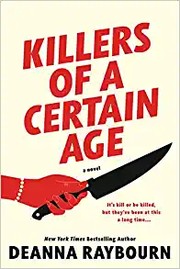
Killers of a Certain Age
2,014-word summary 9 min read 368 pages in the book
- First published
- 2022
- Publisher
- Berkley
- Pages
- 368
- ISBN
- 9780593200681
- Series
- Killers of a Certain Age (#1)
Reading options
What's inside (11 sections)
I read Killers of a Certain Age on a flight that was delayed for three hours, which is the ideal condition for a book that promises "Golden Girls meets James Bond." The premise is a gift. Four women in their sixties, retired assassins, are sent on a luxury cruise to celebrate their retirement. Then they discover that their own organization has marked them for death. The book could have been a novelty. Instead, it is a sharp, funny thriller with a real point to make about what happens to women who become invisible.
Deanna Raybourn published the novel in 2022 through Berkley. The hardcover runs 368 pages. It is the first in a series, though it works as a standalone. The story moves between the present and a series of flashbacks to the 1970s and 1980s, when the four women were recruited, trained, and sent on missions. The flashbacks are not just backstory. They are the evidence that the present-day betrayal is not an accident. It is the culmination of forty years of being underestimated.
The Museum
The organization is called the Museum. It began as a group of assassins targeting former Nazis who had escaped after World War II. Over time, its mission expanded to include war criminals, dictators, drug traffickers, and other people the official systems could not or would not touch. It is extra-governmental, which is a polite way of saying that it operates outside the law and answers to a board of directors.
Billie Webster, Mary Alice Tuttle, Helen Randolph, and Natalie Schuyler were the first all-female squad. They were recruited in 1979 by Richard Halliday and trained by his sister Constance. Constance calls them sphinxes: feminine, quiet, and lethal. The name is a joke and a strategy. The world looks at four women and sees stewardesses, nurses, nuns, or tourists. It does not see assassins.
The flashbacks show the women learning their trade. They learn languages, hand-to-hand combat, explosives, and the art of disappearing into a role. They also learn that the men around them will underestimate them, and that this is an advantage. The training scenes are fun because they are specific. The women are not just generic badasses. They have different skills and different personalities. Billie is the fighter. Mary Alice is the planner. Helen is the sharpshooter. Natalie is the charmer.
The cruise
The present-day story begins on a cruise ship in the Caribbean. The four women are sixty. Helen is newly widowed. Mary Alice is married to a woman named Akiko and has never told her what she does for a living. Natalie is looking forward to retirement. Billie is not sure who she is without the work.
Billie goes into a walk-in freezer to deal with a hot flash and sees another Museum operative, Brad Fogerty. He pretends not to know her. That is the first clue that something is wrong. Billie and Helen search his room and find a bomb. Billie kills Fogerty before he can detonate it, then plants the bomb in the engine room and starts a small fire. The four women fake their deaths and escape in a lifeboat.
The escape is a good set piece. It establishes the tone: violent, dryly funny, and fast. Raybourn does not linger on the carnage. She is more interested in the logistics. How do four women in evening wear get off a cruise ship without being seen? How do they get new identities? How do they find out who ordered the hit?
New Orleans
The women regroup in New Orleans, at a dilapidated former convent that Billie owns. They are joined by Minka, Billie's protege, a forger and computer expert with a taste for dramatic entrances. Mary Alice's wife, Akiko, arrives and has to absorb the news that her wife is an assassin. The scene is played for comedy, but it also has real weight. Mary Alice has been lying to the person she loves most for years. Akiko's anger is not brushed aside. She stays, but she does not pretend that the lie is small.
Minka is a useful addition to the group because she is not a field agent. She is a support system. She makes the fake identities, tracks the board members, and keeps the communications running. She also gives the older women someone to mentor. The book is interested in lineage. The Sphinxes learned from Constance. Now they are teaching Minka. The cycle of women training women is one of the novel's quiet pleasures.
The women contact Charles Sweeney, a former colleague with a history with Natalie. Sweeney is not an ally. He has been promised a bounty for killing them. Billie realizes it during the meeting and signals Helen to shoot him. Helen freezes. Billie takes the shot herself. The moment is important because it shows that the women are not invincible. Helen, the best shot in the group, is grieving her husband and cannot pull the trigger. Billie covers for her, but the group knows. The book does not resolve Helen's grief in a single scene. It lets it sit, and it lets Helen recover at her own pace.
The middle section of the book is a road trip and a revenge mission. The women identify the members of the Museum's board who signed off on their execution. They kill Gunther Paar, the head of Acquisitions, at a Swiss spa by poisoning his mud bath with nicotine. Paar is a man who has spent his career arranging logistics for assassins, and he dies in a mud bath because he cannot resist a spa treatment. The irony is not subtle, but it is satisfying.
They kill Carapaz, another board member, in the Paris catacombs. The sequence is darker than the spa scene. The catacombs are narrow, wet, and full of bones. Billie is injured. The women have to improvise. The assassinations are inventive and grimly funny. Raybourn has a good time inventing ways for older women to kill people in places where no one expects them to be.
The board and the betrayal
The board has three members. Paar and Carapaz are dead. The last is Vance Gilchrist, a man with a long history of resentment toward Billie. The curator Martin Fairbrother appears to be helping the women, but he is actually manipulating them. He wants to take over the Museum, and he has been framing the four women as corrupt agents who take unauthorized jobs.
Naomi Ndiaye, another curator, is the wild card. She has been investigating Martin for years. She cannot prove his guilt, so she lets the women do it for her. The alliance is uneasy. Naomi is not a friend. She is a professional who wants to restore the Museum to its original mission. The distinction matters. The book is not naive about institutions. It knows that saving an organization sometimes means making a deal with the least corrupt person in the room.
Zanzibar
The flashbacks to Zanzibar are the emotional core of the book. In the 1980s, the four women were sent to kill an elderly Nazi, the Baroness von Waldenheim, and recover looted art. Billie is drawn to a painting called The Queen of Sheba Arising. The painting depicts a powerful queen, and Billie sees something of herself in it.
The mission goes wrong. Billie kills the Baroness to save Vance, who was her colleague and, briefly, her lover. Vance is furious. He feels threatened by her competence. He tells her she will never be his equal. The painting is damaged in the fight. The resentment between Billie and Vance begins there, and it grows for forty years.
The Zanzibar sections give the present-day plot its weight. Vance is not just a cardboard villain. He is a man whose ego was wounded by a woman who was better at the job than he was. His betrayal is personal. He wants to erase Billie and everything she represents.
Benscombe
The final battle takes place at Benscombe, the Hallidays' old estate in Dorset. Helen owns it now. The women turn it into a fortress. They have Minka and Akiko in a bunker, Taverner, Billie's old love, in the kitchen, and a plan that involves potatoes stuffed with firecrackers.
The plan is absurd, and it works. Vance arrives with Martin and a group of henchmen. The women fight them in the house, in the garden, and on the grounds. Billie defeats Vance in hand-to-hand combat and stabs him with a hair barrette. Helen shoots Martin before he can escape with Billie as a hostage. Naomi arrives to clean up the mess and offer the women a deal. They can disappear, keep their pensions, and live.
The ending is not a triumph. The women have lost friends. They have killed people. They are tired. But they are alive, and they are free. Mary Alice goes back to Akiko. Helen stays at Benscombe to restore it. Natalie plans a trip to Japan. Billie considers a quiet retirement in Greece with Taverner. The endings are individual, which is right. The four women have been a unit for forty years, but they are not the same person.
Naomi's deal is the novel's final joke about institutions. The Museum is corrupt, but it is also the only structure that can protect the women from the consequences of their own violence. Naomi offers them a pension and a disappearance. They take it. The book does not pretend that this is justice. It is a settlement. The women have won, but they have not changed the system. They have only survived it.
What the book gets right
The book is very good at age. It does not pretend that sixty is the same as thirty. The women have hot flashes, aching joints, and grief. They have spent decades being overlooked, and they have learned to use that invisibility. The scene where Billie walks through a hotel lobby and no one looks at her is both funny and sad. She is a lethal professional, and the world sees a middle-aged woman with a bag.
The book is also good at friendship. The four women love each other, but they also irritate each other. They have old arguments and old loyalties. The banter is sharp because it comes from history. They know exactly which buttons to push.
The humor is another strength. Raybourn finds comedy in the gap between how the women see themselves and how the world sees them. A hotel clerk assumes Billie is someone's grandmother. A waiter ignores Natalie. A security guard does not notice Mary Alice. The women use those assumptions to their advantage, but the jokes also sting. The book is funny because it is angry.
Where it creaks
The villains are thin. Vance is a misogynist with a grudge, and that is all he is. Martin is a bureaucrat with ambition. The board members are obstacles rather than characters. The book is more interested in the women than in the people they are hunting, which is fine, but it means the stakes are personal rather than political.
The plot is also predictable. The betrayals are telegraphed. The final battle is a series of action-movie beats. Readers who want a realistic thriller will find the body count absurd. Readers who want a fun ride will not mind.
Why it works
Killers of a Certain Age works because it is confident. It knows what it is: a violent, funny, fast-paced story about women who refuse to go quietly. It does not apologize for the violence or the jokes. It also does not pretend that the women are young. Their age is the point. They are not trying to be twenty-five. They are trying to be sixty and alive.
I finished the book in two sittings and immediately wanted to read the sequel. That is the best review I can give it. It is not a profound novel. It is a very good time, with a sharp edge underneath.
FAQ
Is Killers of a Certain Age part of a series?
Yes, it is the first book in the Killers of a Certain Age series, though it works as a standalone.
How old are the main characters?
Billie, Mary Alice, Helen, and Natalie are sixty and have worked for the Museum for forty years.
Is the book violent?
Yes. It is a thriller with a high body count, but the violence is stylized and often comic.
Similar books
More from Killers of a Certain Age first, then related titles.

61 Hours
A bus crash strands Jack Reacher in a snowbound South Dakota town where a drug gang, a corrupt police force, and a single witness are on a collision course.
2,227-word summary · 10 min read
American Assassin
Before he became the CIA's most feared counterterrorist, Mitch Rapp was a Syracuse student mourning his girlfriend, killed on Pan Am Flight 103. Then came…
2,114-word summary · 9 min read

Bad Luck and Trouble
A deposit of $1,030 summons Jack Reacher back to his old army unit, which is being picked off one name at a time.
2,366-word summary · 11 min read

Worth Dying For
Reacher stops for one night in rural Nebraska and finds a family that runs the county, a missing girl and a shipment worth killing for.
2,021-word summary · 9 min read
Finlay Donovan Knocks 'Em Dead
Someone has put a contract on Finlay Donovan's ex-husband, and the novelist and her nanny have to find the hitman before the school pickup.
1,990-word summary · 9 min read

Echo Burning
Reacher hitches a ride with a Texas woman who wants her abusive husband killed, then has to prove she did not murder him when he comes home.
2,209-word summary · 10 min read
The Affair
In 1997, Reacher goes undercover in a Mississippi town where a murder near an army base collides with a senator's power. The case that ends his military career.
2,039-word summary · 9 min read
Without Fail
Reacher is asked to test vice presidential security by planning to kill.
2,084-word summary · 9 min read
The Innocent
A government hitman refuses one kill and must protect a teenage girl at the center of a cover-up.
2,403-word summary · 11 min read
Running Blind
Jack Reacher must catch a killer who murders women with no forced entry and no trace.
2,008-word summary · 9 min read

One Shot
Six shots, five dead in Indiana, and James Barr asks for Jack Reacher. Reacher leaves Miami to test the proof in this 2005 Delacorte Press thriller, 376 pages,…
2,972-word summary · 13 min read
Tripwire
In Key West, Jack Reacher follows a murdered detective's trail to New York, an old mentor's files, and a loan shark stealing a dead soldier's name.
2,688-word summary · 12 min read
Everyone in My Family Has Killed Someone
A mystery writer narrates his own snowbound family reunion, where everyone has killed someone and the bodies pile up.
2,961-word summary · 13 min read
The Bourne Supremacy
David Webb is pulled back into Jason Bourne when an impostor kills in his name in Hong Kong and Marie is kidnapped. Ludlum's dense 1986 sequel stretches…
3,266-word summary · 15 min read
Killing Floor
Ex-military policeman Jack Reacher is arrested for murder in Margrave, Georgia, then learns the victim was his brother.
2,872-word summary · 13 min read
The Bourne Identity
An amnesiac pulled from the sea hunts his identity as Jason Bourne while assassins and the CIA close in.
2,994-word summary · 13 min read
The Girl with the Dragon Tattoo
Stieg Larsson's The Girl with the Dragon Tattoo explained: Blomkvist at Vanger, Lisbeth Salander, the Vanger family secret, and the long mid-book hush.
2,254-word summary · 10 min read

What She Knew
Rachel lets her eight-year-old son run ahead in a Bristol park, and the nine-day search turns her into a suspect in the public eye.
2,952-word summary · 13 min read

The Beach House
A young valet is beaten to death at a Hamptons party, and his law-student brother spends a year building a case against the family that covered it up.
2,049-word summary · 9 min read

Size 12 Is Not Fat
Former teen pop star Heather Wells investigates two dorm elevator deaths while juggling her ex, her crush, and a size-12 wardrobe.
2,805-word summary · 12 min read

Six Years
A professor who promised to forget the woman he loved sees her husband's obituary and discovers that the wedding, the marriage, and the woman herself may never…
2,076-word summary · 9 min read
First Grave on the Right
Charley Davidson is a private investigator in Albuquerque and the grim reaper. When three murdered lawyers come back as ghosts, her two jobs collide.
2,770-word summary · 12 min read

The Trespasser
A Dublin Murder Squad detective investigates a staged dinner-party killing and finds a cover-up that reaches into her own department.
2,051-word summary · 9 min read

Rules of Prey
Minneapolis detective Lucas Davenport hunts a killer who leaves a new rule at every scene and treats murder as a game of wits.
1,914-word summary · 9 min read

Ace of Spades
Two Black seniors at an elite academy are celebrated by day and hunted by an anonymous texter in this YA thriller about institutional racism.
2,066-word summary · 9 min read

The Late Show
Exiled to the LAPD night shift after accusing her supervisor, Renée Ballard keeps two cases that were meant to be handed off at dawn: a brutal assault and a…
2,563-word summary · 11 min read
Night Film
A disgraced journalist investigates the death of a reclusive horror director's daughter, following a red coat through hospitals, secret clubs, and a family…
2,690-word summary · 12 min read
Finger Lickin' Fifteen
Lula sees a celebrity chef decapitated and talks Stephanie into entering a barbecue contest to lure the killers, while Ranger hires her to find a security leak…
2,248-word summary · 10 min read

4th of July
Lindsay Boxer shoots two armed teenagers in self-defense, faces a wrongful-death trial, and spends her leave chasing a string of throat-slashing murders in…
2,192-word summary · 10 min read
The Camel Club
Four Washington misfits witness a murder on Roosevelt Island and stumble into a conspiracy that reaches the Oval Office, with a hostage president and a nuclear…
2,354-word summary · 10 min read