
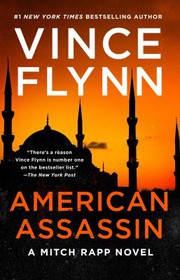
American Assassin
2,114-word summary 9 min read 448 pages in the book
- First published
- 2010
- Publisher
- Atria Books
- Pages
- 448
- ISBN
- 9781439100516
- Series
- Mitch Rapp (#1)
Reading options
What's inside (10 sections)
The first thing the novel does is refuse to start where you expect. It opens in a hotel room in Beirut, where Mitch Rapp is studying his own reflection in a cracked, dusty mirror and deciding to let himself be captured, because two of his colleagues have been taken by Islamic Jihad and nobody in Washington is going to do anything about it.
That is the end of the story, or close to it. Then the book goes back a year, to a rutted gravel road in southern Virginia and a blindfolded passenger in the back of a brown Ford Taurus, and it stays there for a long time.
Vince Flynn published American Assassin through Atria Books on October 12, 2010. The trade paperback runs 448 pages. It is book one of the Mitch Rapp series, although it was the eleventh book Flynn published, because it is the first thing that happens to Rapp.
The girl named Mary
The setup is grief, and Flynn does not soften it.
Rapp met Mary when they were sixteen. He was playing baseball, she was running track, and her father was a navy captain who came to every lacrosse match. They dated through high school and then went to Syracuse together, where Mary ran track and moved into the Newhouse School of Public Communications with a plan to become a sports announcer.
On a December night in 1988 she was flying home from a semester abroad. Her plane was Pan Am Flight 103. It came down over Lockerbie in Scotland, killing 259 people on board and 11 on the ground.
Rapp was home for Christmas break and meant to pick her up at Dulles. When the news came he never questioned it, never asked for proof. He refused to see a soul for a week, including Mary's parents, then shaved, put on a suit and tie, and sat through the funeral stone-faced. His own father had died young, and the novel is clear that the first loss taught him the clock was ticking. The second one broke him.
What he did with the grief is the engine of the whole series. Every night before he slept he thought about the network of faceless men who had planned the bombing, and by the time the CIA came looking for him he was ready to be useful.
The recruiter is Irene Kennedy, an operations officer whose father was among the 63 people killed when a van loaded with explosives hit the US embassy in Beirut in 1983. Kennedy and Stan Hurley are partners in this, and Hurley has known her since she was a child. She has been watching Rapp since he was twenty-two, and she hands him to Hurley as a problem rather than a gift. Hurley, who runs the training, calls him a college puke who does not know the difference between a gun and a rifle.
The camp in Virginia
The training happens at a camp near Lake Anna, in woods that Rapp clocks immediately. The men who came before him were marched into those trees, shot in the back of the head and dropped into fresh holes, and the book lets the place do the talking about what the Agency does with people who know too much.
Rapp's arrival is a wrestling match in a barn. He beats Hurley badly enough that the older man has to break the rules and take him down by force to escape the hold. A clinical psychologist named Tom Lewis is brought in to keep the peace and to study the recruits. There is a bully called Victor, who breaks another trainee's nose and turns out to be one of the instructors planted among the recruits to test them. Rapp answers with Brazilian jiu-jitsu, takes him down and wrecks his elbow.
The shooting is where Rapp looks worst, because he arrives with no real instruction. He is bad at first, embarrassed, and Sergeant Smith stays behind with him instead of sending him to the punishment run. By the end of the session he can shoot. Only Rapp and Bobby Richards finish the program, which is called Orion, and its whole design is that the men who work in it do not exist on paper.
Nobody at the Agency knows what Rapp did before. His Brazilian jiu-jitsu sensei tells Lewis that the kid claimed almost no experience, then throttled every other student in the dojo inside a month and a half. That kind of gap between the cover story and the man is the kind of thing this program is built on.
Rapp grows up in northern Virginia and is proud of it, which matters later, when the story spends time on Civil War history. Richards is from Covington, Georgia, and Hurley teaches them both with Sherman's march to the sea as his preferred example of how to win something ugly.
Istanbul and a bench in a park
The first mission is Hamdi Sharif, a Turkish arms dealer who supplied components for the Lockerbie bomb. The plan is patient: Rapp arrives two days early for countersurveillance, Hurley and Richards join on the third day, five days of observation, then the kill.
Rapp hates the plan. Too many moving parts, as his college coach used to say. He does sit-ups in a park near Sharif's apartment and watches the man come out at eight-oh-seven with sunglasses, a long black trench coat and a small brown Dachshund. Sharif bends over to untie the dog, throws a blue ball onto the grass and sits down on a bench with his phone in his hand.
Rapp kills him there with a silenced pistol and leaves Turkey. He went alone against orders, and he defends the choice in words that explain the man for the rest of the series: when the best course of action is staring at you, all the planning in the world is in the way.
The distinction Flynn keeps pressing, with Lewis doing the asking, is between revenge and retribution. Revenge is wild and personal. Retribution is punishment that is morally right and deserved. Rapp insists on the second word, and the series hangs on whether that is a real distinction or a story he tells himself in order to sleep.
Hamburg, Zurich and Geneva
The missions after Istanbul are about money, which is the part of the book that surprised me most.
In Hamburg they take Hans Dorfman, a banker who launders money for terrorists and who is far more attached to his poodles than to his wife. Rapp puts a knife near a dog's eye until the safe opens. Hurley kills Dorfman afterward. In Zurich they meet Carl Ohlmeyer, a Swiss banker and an old friend of Hurley, who moves twenty-six million dollars out of terrorist accounts electronically to see what panic it provokes, and who hands Rapp a set of false identities and offshore accounts that will carry him through the rest of the series. Ohlmeyer's granddaughter Greta is also in Zurich, and Rapp spends much of that mission trying not to stare at her.
In Geneva they kill Tarik al Ismael, a Libyan intelligence operative who works out of a UN office. Ismael takes a civilian hostage, and Rapp uses the confusion of the running gunfight to put a single round into him.
Underneath those missions runs a Russian thread. Mikhail Ivanov, deputy director of the SVR's Directorate S, has been stealing from his own service, and when the Zurich money vanishes he needs to know where it went. His deputy, Nikolai Shvets, is caught in the middle of it. We learn this in Moscow chapters that are largely about account balances, and it is the weakest material in the book, even though Flynn clearly enjoys the idea of the CIA and the SVR as rival crime families.
Beirut
Back in Beirut, Hurley and Richards are arrested by the police and handed over to Islamic Jihad. Washington talks and stalls. Rapp does not wait.
He seeds disinformation so his captors come to him, then lets himself be taken on the street, takes a truncheon across the back of the head and is dumped in the trunk of a car. He pretends to be Hurley's frightened son. A three-inch piece of a bandsaw blade has been threaded into his hair by Rob Ridley, and he uses it to get his wrists free of duct tape. When Abu Radih brings him to watch Hurley executed in front of his son, Rapp breaks out and kills him.
Richards is already dead, tortured. Hurley is alive and still talking. Rapp starts a firefight between rival factions in Martyrs' Square to cover the escape, and at the airport, where Imad Mughniyah is holding an auction for the prisoners, he and Hurley take Sayyed and a Russian officer as the price. Sayyed's description of the plan is that they will sell the American spies to the highest bidder.
The last beat of that sequence is Hurley greeting the men with a profane Christmas greeting, which is about the level of taste the book runs at.
The epilogue in Zurich
The novel closes with Stansfield meeting Yevgeny Primakov, the SVR director, on a park bench in Zurich. Rapp is there as the bodyguard. Stansfield hands over evidence that lets the SVR destroy Ivanov and asks in return for the release of John Schnoz Cummins, the deep cover man whose capture started the Beirut mess. Primakov agrees. Ivanov is set up to be purged by his own service, and the fate of Sayyed is a question Stansfield declines to answer.
Rapp is given a week off. When Stansfield asks where he is going, he looks at the snow-capped mountains and says he thinks he will stay in Zurich. A book about revenge ends with a man thinking about a woman he met in Switzerland.
Where the book strains
Several things about American Assassin will bother you.
The Moscow material is scaffolding for later books, and it shows. The characters who matter most after Rapp are often not on the page. Flynn was better at action than at people, and reviewers of the series have noted that nobody here except Rapp is fully alive. Hurley is a device, Kennedy is an argument, and the villains are interchangeable.
The Russian subplot also pulls the book away from the terror story it advertises. Flynn's real subject is the early 2000s conviction that the West had spent years failing to understand its enemies, and he makes that argument through conversation rather than incident. The sharpest passage in the novel is Hurley telling Rapp about Iran Air Flight 655 and the Navy's part in it, two hundred and ninety civilians shot down over the Gulf, and admitting that the country blamed the other side instead of owning it. That is a Cold War man talking about a war he lost, and it is the closest thing to an argument the book makes.
One more thing to know before you start. The novel is dedicated to the victims of the Pan Am Lockerbie terrorist attack and their families. When it reached Britain in 2012, some relatives of the victims objected to a thriller that invents a Turkish arms dealer in the bombing's supply chain. Frank Duggan, who ran the Victims of Pan Am Flight 103 group, argued the book risked putting a false story into circulation; other bereaved families disagreed, saying fiction was free to use what it liked. It is a fair objection to any thriller built on a real atrocity, and it has not gone away as the series has grown.
Who should read it
Buy it if you want the origin of the character. It explains the training, the false identities, the willingness to go in alone, and the line about retribution that Flynn repeats in every later book. It is also the only place in the series where you watch him learn, which is reason enough to start here.
Skip it if you want a fair account of how counterterrorism work is actually done, or if you need the good guys to be uncomplicated. Flynn's people torture people, and he defends it in print, and the standard complaint about the book is that the prose admires the work. That is a fight worth having with the text rather than a reason to skip it.
The prose is fast, the dialogue is sharp, and the whole thing is lighter than it feels. Read this one and then go back to Transfer of Power, which is the same man ten years further down the road.
FAQ
Who is Mitch Rapp?
He is a young Syracuse athlete recruited by the CIA after his girlfriend died on Pan Am Flight 103. The novel follows his training and first missions across Europe and the Middle East.
Is American Assassin the first Mitch Rapp book?
Yes in series order, even though it was the eleventh book Flynn published. It is set earliest, before Transfer of Power and the rest.
Is the book violent?
Yes. There are shootings, torture scenes and killings described plainly, along with one adult love scene.
Similar books
More from Mitch Rapp first, then related titles.
Stormbreaker
A fourteen-year-old boy loses his uncle, then his ordinary life, when MI6 sends him undercover to a Cornish computer plant where the giveaway machines hide a…
2,822-word summary · 13 min read
The Bourne Supremacy
David Webb is pulled back into Jason Bourne when an impostor kills in his name in Hong Kong and Marie is kidnapped. Ludlum's dense 1986 sequel stretches…
3,266-word summary · 15 min read
The Chemist
A former government interrogator on the run takes one last job, then learns the case she was handed was built to pit her against him.
2,249-word summary · 10 min read

Bad Luck and Trouble
A deposit of $1,030 summons Jack Reacher back to his old army unit, which is being picked off one name at a time.
2,366-word summary · 11 min read
Tinker, Tailor, Soldier, Spy
Retired spymaster George Smiley is brought back to find a Soviet mole inside British intelligence, and the trail leads through old friends, old betrayals, and…
2,092-word summary · 9 min read
The Broker
A disgraced Washington lobbyist is pardoned and hidden in Bologna, where the CIA uses him as bait to find out who wants a stolen satellite.
2,211-word summary · 10 min read
Killers of a Certain Age
Four sixty-year-old assassins discover their retirement cruise is a trap and turn their skills on the agency that trained them.
2,014-word summary · 9 min read
The Affair
In 1997, Reacher goes undercover in a Mississippi town where a murder near an army base collides with a senator's power. The case that ends his military career.
2,039-word summary · 9 min read
The President Is Missing
President Jonathan Duncan faces impeachment over a secret call while a virus called Dark Ages threatens to erase American data in this 2018 Clinton and…
2,324-word summary · 10 min read
Clear and Present Danger
Jack Ryan uncovers a secret U.S. drug war in Colombia and fights to bring abandoned soldiers home.
2,954-word summary · 13 min read
Patriot Games
Jack Ryan saves royals in London then faces IRA revenge aimed at his family in America.
2,089-word summary · 9 min read
The Hunt for Red October
Soviet captain Ramius defects with stealth sub Red October while Jack Ryan must prove intent.
2,305-word summary · 10 min read
The Bourne Identity
An amnesiac pulled from the sea hunts his identity as Jason Bourne while assassins and the CIA close in.
2,994-word summary · 13 min read

Cross My Heart and Hope to Spy
Cammie Morgan returns to Gallagher Academy for a second year of spy training, only to fall for a boy from a rival spy school and hunt a mole in her own school.
2,567-word summary · 11 min read
The Camel Club
Four Washington misfits witness a murder on Roosevelt Island and stumble into a conspiracy that reaches the Oval Office, with a hostage president and a nuclear…
2,354-word summary · 10 min read
Persuader
Reacher goes undercover in a Maine crime family to find a missing DEA agent and the man he once failed to kill, and Lee Child keeps the whole thing tight,…
2,278-word summary · 10 min read

61 Hours
A bus crash strands Jack Reacher in a snowbound South Dakota town where a drug gang, a corrupt police force, and a single witness are on a collision course.
2,227-word summary · 10 min read
The Troop
A Boy Scout troop on a Canadian island takes in a stranger who cannot stop eating, and the worm inside him turns a camping trip into a war.
2,457-word summary · 11 min read
Heir to the Empire
Grand Admiral Thrawn returns from the Unknown Regions and outmaneuvers the New Republic while Luke, Leia, Han and smuggler Talon Karrde race him toward…
2,323-word summary · 10 min read

Worth Dying For
Reacher stops for one night in rural Nebraska and finds a family that runs the county, a missing girl and a shipment worth killing for.
2,021-word summary · 9 min read

The Queen's Fool
A young Jewish refugee with second sight becomes a court fool to Edward VI, Mary I, and Elizabeth, and learns what it costs to tell the truth.
2,412-word summary · 11 min read
The Brethren
Three disgraced judges run a blackmail scam from a federal prison and accidentally trap a presidential candidate, pulling the CIA into their scheme.
1,967-word summary · 9 min read

Echo Burning
Reacher hitches a ride with a Texas woman who wants her abusive husband killed, then has to prove she did not murder him when he comes home.
2,209-word summary · 10 min read
Without Fail
Reacher is asked to test vice presidential security by planning to kill.
2,084-word summary · 9 min read
The Innocent
A government hitman refuses one kill and must protect a teenage girl at the center of a cover-up.
2,403-word summary · 11 min read
Gone Tomorrow
Reacher stops a suicide bomber on the subway, then hunts her handlers.
2,308-word summary · 10 min read
Absolute Power
A thief watches the president kill, then runs with a lawyer who believes him.
2,401-word summary · 11 min read
The Spy Who Came In from the Cold
A burnt-out Berlin agent takes one last mission that requires him to look like a traitor.
2,578-word summary · 11 min read
Running Blind
Jack Reacher must catch a killer who murders women with no forced entry and no trace.
2,008-word summary · 9 min read
One Shot
Six shots, five dead in Indiana, and James Barr asks for Jack Reacher. Reacher leaves Miami to test the proof in this 2005 Delacorte Press thriller, 376 pages,…
2,972-word summary · 13 min read