
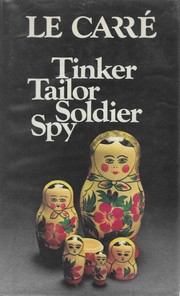
Tinker, Tailor, Soldier, Spy
2,092-word summary 9 min read 349 pages in the book
- First published
- 1974
- Publisher
- Hodder & Stoughton
- Pages
- 349
- ISBN
- 9780340188798
- Series
- George Smiley (#5)
Reading options
What's inside (10 sections)
Tinker, Tailor, Soldier, Spy is a spy novel for people who are not sure they like spy novels. There are no car chases, no gadgets, and almost no gunfire. The action takes place in interview rooms, archives, and the memories of tired men. The central question is not who will win a fight. It is who has been lying for years, and whether the institution that is supposed to catch liars can survive the truth. I read it slowly, and I think that is the right way to read it. It rewards attention.
The novel was published in 1974, in the middle of the Cold War, and it draws on le Carré's own experience in British intelligence. George Smiley is the protagonist, but he is not a hero in the usual sense. He is middle-aged, overweight, and recently retired. His wife, Ann, has left him again. He spends his days reading, walking, and trying not to think about the Circus, the nickname for the Secret Intelligence Service. Then he is asked to come back.
The request comes from Sir Oliver Lacon, a civil servant, after a botched operation in Czechoslovakia. A British agent named Jim Prideaux was sent to meet a Czech general who claimed he could identify a Soviet mole inside British intelligence. The meeting went wrong. Prideaux was shot in the back and captured. The operation was disowned. Control, the former chief, was forced out, and Smiley went with him. Now Lacon wants Smiley to find out what really happened. The government cannot afford a public scandal, and the service cannot afford another failure.
Smiley agrees, but he does not do it the way a movie spy would. He does not break into buildings or seduce informants. He talks to people. He reads files. He remembers. His method is patience. He carries a notebook and a set of index cards, and he builds a picture from fragments. The book is structured around these interviews, and each one adds a piece. The reader is invited to do the same work. That is why the novel feels so satisfying when the pieces finally fit.
The Circus
The Circus is a bureaucracy, and le Carré is very good at bureaucracies. The new chief is Percy Alleline, a man who is ambitious, vain, and not as clever as he thinks. His deputy is Bill Haydon, charming and cultured. Toby Esterhase runs the watchers, the people who follow suspects. Roy Bland handles the satellite countries. These four men are the inner circle. They have a source code-named Merlin, and Merlin gives them high-grade Soviet intelligence. The material is so good that it has made Alleline's reputation. It has also made the Circus dependent on it.
Smiley suspects that Merlin is not what he appears to be. The intelligence is too good, too convenient, and too well timed. It arrives in ways that flatter the people who receive it. Smiley begins to think that the Soviets are feeding the Circus information through a mole, and that the mole is one of the men at the top. The phrase "tinker, tailor, soldier, spy" comes from a nursery rhyme, and it becomes a code for the suspects. Tinker is Alleline, Tailor is Haydon, Soldier is Bland, Sailor is Esterhase, and Spy is the unknown. The novel's title is a list of roles, and the plot is about finding out which role the mole is playing.
The investigation takes Smiley to people who have been pushed to the edges of the service. Connie Sachs, a retired researcher, remembers everything about Soviet agents, and she has been dismissed for knowing too much. Jerry Westerby, a journalist and occasional agent, has been used and discarded. Sam Collins, a former colleague, has been posted abroad. Peter Guillam, Smiley's protégé, is still inside and helps him. Mendel, a retired police inspector, does the legwork. These are not glamorous people. They are professionals who have been treated badly by an institution they believed in. Their loyalty to Smiley is personal, not patriotic. That is one of the novel's quiet arguments.
The mole
The mole is Bill Haydon. He is Smiley's old friend, his rival, and the man who had an affair with Ann. The revelation is not a surprise to a careful reader, but the novel is not built on surprise. It is built on the slow accumulation of evidence and the awful recognition that the betrayal is intimate. Haydon is not a monster. He is charming, intelligent, and genuinely liked. He betrayed his country for reasons that are never fully explained, and that ambiguity is the point. Le Carré is more interested in the texture of betrayal than in the motive.
The interrogation scene is the heart of the book. Smiley and his allies confront Haydon in a safe house. Haydon does not deny it. He is calm, almost relieved. He talks about the Circus with the affection of a man who has been inside it for too long. He admits that he recruited Prideaux, that he set up the Czech operation, and that he has been feeding information to the Soviets for years. He also admits that he slept with Ann, and that he did it partly to hurt Smiley. The scene is painful because it is so controlled. There is no shouting, no violence. Just two men in a room, one of whom has been living a lie.
Haydon is taken away. Later, he is killed in prison. The official story is suicide, but the reader knows that Jim Prideaux is responsible. Prideaux was the agent who was shot and captured, and he has spent years piecing together what happened. He was Haydon's friend, and he was used by him. His revenge is quiet and terrible. He goes back to his job as a schoolteacher, and the novel ends with him watching the boys play. The cycle of betrayal is complete, but nothing has been resolved. The Circus will go on. The country will go on. The people who were hurt will carry it.
Smiley
Smiley is one of the great characters in spy fiction because he is so unremarkable. He is not a fighter. He is not a seducer. He is not even particularly brave. He is a man who notices things and remembers them. He is also deeply lonely. His marriage is a wreck, and he knows it. Ann is unfaithful, and he loves her anyway. That vulnerability makes him human, and it also makes him a good spy. He understands weakness because he lives with his own.
The novel is careful about Smiley's age. He is not old enough to be retired, but he is old enough to be obsolete. The new leadership wants energy, innovation, and good press. Smiley represents the old way: slow, cautious, and unglamorous. The irony is that the old way is the only way to catch a mole. The new men are too busy protecting their reputations to see what is in front of them. Smiley wins because he is willing to look foolish, to ask the same question twice, and to admit that he does not know.
The atmosphere
Le Carré is a master of atmosphere. The novel is full of rain, bad coffee, and institutional carpet. The offices are shabby. The hotels are second-rate. The people are tired. The Cold War is not a clash of civilizations. It is a long, grinding argument conducted by men who have forgotten why they started. That tone is what makes the book feel true. It is also what makes it depressing. There is no triumph at the end, only a kind of grim satisfaction that the truth has been found.
The dialogue is excellent. Le Carré has an ear for the way people talk when they are hiding something. His characters speak in ellipses, qualifications, and small jokes that are not really jokes. The interview scenes are tense even when nothing dramatic is happening. A pause can be a threat. A change of subject can be a confession. The novel rewards close reading because so much of the meaning is in what is not said.
The Merlin deception
The Merlin operation is the mechanism that makes the plot work. Alleline's circle believes it has a high-level Soviet source, and the intelligence it receives is used to shape British policy. The material is passed through a chain of cutouts, including a Soviet defector and a radio signal, and it is designed to look difficult and dangerous. That is what makes it convincing. A source that is too easy to access would be suspicious. A source that requires risk and secrecy feels real.
Smiley's insight is that the source is too perfect. The intelligence flatters the people who receive it. It confirms their assumptions, protects their reputations, and never embarrasses the Soviets in a way that would force them to shut it down. That is not how a genuine source behaves. It is how a controlled operation behaves. Karla, the Soviet spymaster, is not trying to give the British useful information. He is trying to shape their decisions, and he is using their own vanity to do it.
The mole is the hinge. Without someone inside the Circus, the operation could not be protected. The mole knows which reports are read, which officers are trusted, and which questions are being asked. He can steer the investigation away from himself and toward someone else. That is why Smiley cannot solve the case by looking at the intelligence alone. He has to look at the people who handle it, and at the small inconsistencies in their stories. The novel is a study in how deception works at an institutional level. It is not enough to lie. You have to make the truth look like a lie, and you have to do it for years.
What the book gets wrong
The novel is slow, and some readers will find it too slow. The first hundred pages are mostly setup, and the cast is large enough to require a diagram. If you are looking for action, this is not the book for you. It is also very male. Ann is important, but she is mostly offstage. Connie Sachs is a vivid presence, but she is an exception. The world of the Circus is a world of men, and the novel does not examine that fact. It just reflects it.
The ending is also quiet. The mole is caught, but the consequences are limited. The institution survives. The people who were betrayed do not get their lives back. That is realistic, but it can feel unsatisfying. Le Carré is not interested in catharsis. He is interested in the way power works, and power usually survives. The novel's bleakness is deliberate, but it is still bleak.
The adaptations
The novel has been adapted twice, once as a celebrated television series in 1979 and once as a film in 2011. Both versions work because they understand that the story is about rooms, faces, and conversations. The television version, with Alec Guinness as Smiley, is especially good at the silence. The film compresses the plot but keeps the mood. Neither version improves on the book, because the book's pleasure is in the accumulation of detail. The reader is the interrogator, and the novel gives us the time to do the job.
Why it endures
Tinker, Tailor, Soldier, Spy endures because it is about more than espionage. It is about friendship, loyalty, class, and the stories people tell themselves to justify what they do. It is about the difference between patriotism and institutional loyalty. It is about the way a person can be charming and generous and still be hollow. Haydon is a traitor, but he is also a product of a system that trained him to believe he was special. The novel does not excuse him. It explains him.
I would recommend it to readers who like political thrillers, character studies, and books that take their time. It is not a beach read. It is a book to read in a quiet room, with a notebook nearby. The payoff is worth the effort. The final image of Prideaux watching the boys play is one of the coldest endings I know. It suggests that the past is never really over, and that the people who survive are the ones who learn to live with what they have done. That is a hard lesson, and le Carré delivers it without raising his voice.
FAQ
Who is the mole in Tinker, Tailor, Soldier, Spy?
Bill Haydon, a senior officer in the Circus and a close friend of George Smiley, is the Soviet mole.
Do I need to read the earlier George Smiley books first?
No. The novel works as a standalone, though it gains depth from Smiley's earlier appearances and his marriage.
Why is the book called Tinker, Tailor, Soldier, Spy?
The title comes from a nursery rhyme used as a code for the five senior men suspected of being the mole.
Similar books
More from George Smiley first, then related titles.
The Spy Who Came In from the Cold
A burnt-out Berlin agent takes one last mission that requires him to look like a traitor.
2,578-word summary · 11 min read

What She Knew
Rachel lets her eight-year-old son run ahead in a Bristol park, and the nine-day search turns her into a suspect in the public eye.
2,952-word summary · 13 min read

The Beach House
A young valet is beaten to death at a Hamptons party, and his law-student brother spends a year building a case against the family that covered it up.
2,049-word summary · 9 min read

Six Years
A professor who promised to forget the woman he loved sees her husband's obituary and discovers that the wedding, the marriage, and the woman herself may never…
2,076-word summary · 9 min read

Rules of Prey
Minneapolis detective Lucas Davenport hunts a killer who leaves a new rule at every scene and treats murder as a game of wits.
1,914-word summary · 9 min read

4th of July
Lindsay Boxer shoots two armed teenagers in self-defense, faces a wrongful-death trial, and spends her leave chasing a string of throat-slashing murders in…
2,192-word summary · 10 min read

The Camel Club
Four Washington misfits witness a murder on Roosevelt Island and stumble into a conspiracy that reaches the Oval Office, with a hostage president and a nuclear…
2,354-word summary · 10 min read

61 Hours
A bus crash strands Jack Reacher in a snowbound South Dakota town where a drug gang, a corrupt police force, and a single witness are on a collision course.
2,227-word summary · 10 min read

American Assassin
Before he became the CIA's most feared counterterrorist, Mitch Rapp was a Syracuse student mourning his girlfriend, killed on Pan Am Flight 103. Then came…
2,114-word summary · 9 min read

The Chemist
A former government interrogator on the run takes one last job, then learns the case she was handed was built to pit her against him.
2,249-word summary · 10 min read

Still Missing
A realtor is abducted at a Vancouver Island open house and held for more than a year. Told through therapy sessions, the novel follows her escape and the hunt…
2,466-word summary · 11 min read

Bad Luck and Trouble
A deposit of $1,030 summons Jack Reacher back to his old army unit, which is being picked off one name at a time.
2,366-word summary · 11 min read

3rd Degree
The third Women's Murder Club novel follows a San Francisco terror cell and a three-day killing schedule, and it costs the club a member.
2,685-word summary · 12 min read

Worth Dying For
Reacher stops for one night in rural Nebraska and finds a family that runs the county, a missing girl and a shipment worth killing for.
2,021-word summary · 9 min read

The Broker
A disgraced Washington lobbyist is pardoned and hidden in Bologna, where the CIA uses him as bait to find out who wants a stolen satellite.
2,211-word summary · 10 min read

The Best of Friends
Three lifelong friends discover their teenage sons were hiding more than anyone knew after a night that leaves one dead, one in a coma and one silent.
2,040-word summary · 9 min read

Say You're Sorry
A widowed prosecutor defends the teenager accused of killing her babysitter, uncovering a small town's secrets and a killer hiding in plain sight.
2,116-word summary · 9 min read

Echo Burning
Reacher hitches a ride with a Texas woman who wants her abusive husband killed, then has to prove she did not murder him when he comes home.
2,209-word summary · 10 min read

The End of Her
A sleep-deprived mother of twins faces a stranger's accusation that her husband murdered his first wife in Shari Lapena's domestic suspense novel.
2,383-word summary · 11 min read

Girl, Forgotten
A rookie US marshal guards a judge with a stalker and ends up reopening the 1982 prom-night murder of the judge's pregnant daughter.
2,111-word summary · 9 min read
When No One Is Watching
Sydney Green watches her Brooklyn block's Black residents vanish one by one in Cole's Edgar-winning thriller about gentrification as a crime scene.
2,165-word summary · 10 min read

The Woods
Twenty years after two teenagers were murdered and two vanished at summer camp, prosecutor Paul Copeland identifies a fresh corpse as one of the missing.
2,490-word summary · 11 min read

The Boy from the Woods
Wilde, found feral in a New Jersey forest in 1986, hunts for a missing teenager while a senator's secrets tear a wealthy town apart.
2,270-word summary · 10 min read
Without Fail
Reacher is asked to test vice presidential security by planning to kill.
2,084-word summary · 9 min read
Things We Do in the Dark
A comedian kills her husband, then a podcaster digs up her teen murder past.
2,427-word summary · 11 min read

The Widow
A widow of a suspected criminal faces reporters and police while hiding what her marriage really cost.
2,599-word summary · 12 min read

The Therapist
A couple moves to a gated street where the previous therapist was murdered in their house.
2,437-word summary · 11 min read
The Reappearance of Rachel Price
Bel films a doc when her missing mother walks back after years.
2,254-word summary · 10 min read
The Racketeer
A jailed lawyer trades a judge murder secret for freedom and revenge.
2,434-word summary · 11 min read

The Night Swim
A true crime podcaster covers a rape trial while probing an old drowning in a small town.
2,260-word summary · 10 min read