
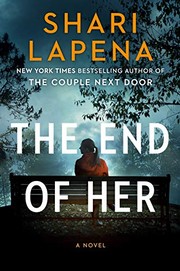
The End of Her
2,383-word summary 11 min read 352 pages in the book
- First published
- 2020
- Publisher
- Pamela Dorman Books
- Pages
- 352
- ISBN
- 9781984880512
Reading options
What's inside (10 sections)
I read The End of Her during a week when I was sleeping badly, which turned out to be either the best or the worst way to approach it. Shari Lapena's 2020 novel is about a couple with four-month-old twins who are so tired that they cannot trust their own memories. I had no twins and no colic, but I knew the feeling of walking into a room and forgetting why. The book uses that fog well. It makes the ordinary details of a marriage feel unstable, and then it drops a stranger into the middle of them.
This is the Pamela Dorman Books edition, cited at 352 pages, published in 2020. It is a domestic thriller with a small cast, a lot of driving between upstate New York and Colorado, and a plot that keeps changing its mind about who the villain is. I will spoil the whole thing, including the ending, because the ending is the reason to talk about it.
The prologue in the snow
The book opens in January 2009 in Creemore, Colorado. Lindsey Kilgour is eight months pregnant, waiting in a small apartment while her husband, Patrick, shovels snow off the car. They are supposed to drive to her family's house. She is restless and isolated. She watches him through the window. Then the scene ends, and we do not learn what happened for a long time.
The official story, the one Patrick tells for most of the book, is that Lindsey died of carbon monoxide poisoning. She got into the running car while he was clearing the exhaust pipe, which had been blocked by snow. It was a terrible accident. He was devastated. He moved on. He met Stephanie, they married, and they had twin girls.
The prologue tells us something is wrong with that story, but it does not tell us what. Lapena is good at this kind of opening. She gives you the shape of a tragedy and then makes you wait for the details.
Aylesford, 2018
The main story is set in Aylesford, New York, a town small enough that neighbors notice a stranger looking at a house for sale. Stephanie Kilgour is at home with the twins, Emma and Jackie, who have colic. She is not coping well. She falls asleep on the sofa and wakes to find a pan of oil burning on the stove. She cannot remember putting it there. The house fills with smoke. The babies scream. It is the kind of scene that makes you feel the exhaustion in your own body.
Patrick is also fraying. He is an architect, or he works at an architectural firm, and he is making mistakes at work. One day a woman comes in for a temporary position. It is Erica Voss, someone he knew in Colorado more than nine years earlier. He leaves work early without telling Stephanie. That reaction is the first real clue that Patrick is not simply a grieving widower.
Erica is not in town by accident. She moved to Newburgh, nearby, and she looked him up on purpose. She meets him for drinks and then drops the act. She believes Patrick killed Lindsey. She wants two hundred thousand dollars to stay quiet. She has done her research. She knows Stephanie inherited money. She knows enough about Patrick's life to make the threat credible.
Patrick refuses to pay. That night he tells Stephanie about the accusation, but he leaves out the part where Erica was Lindsey's best friend and the part where he slept with her. Stephanie is horrified, but she believes him. She thinks Erica is a blackmailer. She refuses to pay. Paying would only invite more demands. That is a reasonable position, and it is also the moment the marriage starts to come apart.
The woman with the file
Erica does not go away. She approaches Stephanie in a park while texting Patrick a photograph of his wife and children. She seduces Niall Foote, Patrick's business partner. She breaks into the Kilgour house and steals Stephanie's handbag. She is not a subtle villain. She is a woman with a grievance and a plan, and she enjoys making people squirm.
The book also follows Cheryl and Gary Manning, a couple in Denver with an adopted son named Devin. Devin is almost nine. His birth mother was Erica. During the adoption, Erica extorted an extra hundred thousand dollars in cash, threatening to keep the baby. Now Cheryl thinks Erica is back, watching Devin. That thread could feel like a distraction, but it matters. It shows that Erica has been running the same con for years, and it gives her a history that is more complicated than simple grief for a friend.
Erica tells Patrick she had a baby after Lindsey died and that the baby is his. She demands the money again. She suggests that Stephanie's death would solve both their problems. Patrick is appalled. He is also, by this point, lying about how much he has told his wife. The book keeps tightening the screws in small increments. Every chapter gives Stephanie another reason to doubt him without giving her enough proof to act.
The safety deposit box
Stephanie finds a hidden key in Patrick's home office. She traces it to a safety deposit box. Inside are Lindsey's death certificate, insurance documents, and a marriage certificate showing that Lindsey was three months pregnant when she and Patrick married. There is also evidence that Patrick took out a large life insurance policy on Lindsey. Stephanie has been told that the pregnancy was a surprise and that the policy was ordinary planning. The documents do not prove murder, but they do prove that Patrick has been editing the story of his first marriage.
Erica visits Stephanie directly and tells her that she and Patrick met almost every day, that Patrick wanted to be free of Lindsey, and that after Lindsey died he looked triumphant. She warns Stephanie that a man who killed once can kill again. Stephanie does not want to believe her. She also cannot stop thinking about the pan of oil and the missing time.
One night someone tries to run Erica down on a dark road near the hospital where she works. Erica assumes Patrick did it. She flies to Colorado and meets Sheriff Lorne Bastedo, who reviews the original file with the coroner, George Yancik. The investigation was thin. They agree to hold a coroner's inquest. That decision turns the novel from a domestic dispute into a legal proceeding, and it raises the stakes for everyone.
The inquest
The inquest is the best sustained sequence in the book. It is not a trial, but it has the same shape: witnesses, cross-examination, and a room full of people who have something to hide. The former sheriff admits he never asked Patrick about the insurance or the state of the marriage. Erica testifies that she saw triumph in Patrick's eyes after Lindsey died. Under cross-examination she cannot prove how extensive the affair was. Patrick's lawyer, Robert Lange, accuses her of blackmail. Erica reverses the claim and says Patrick offered her cash to stay quiet.
Then a surprise witness, an emergency room doctor, testifies that Lindsey came to the hospital in November 2008 with extensive bruising after falling down stairs. Patrick never mentioned that. The jury returns a verdict of undetermined. It is not a conviction, but it is not an exoneration either.
The district attorney authorizes a polygraph. Lange arranges a private test first, and Patrick fails it. Stephanie has a panic attack and flies home. Patrick goes to the Sheriff's Office, refuses the police polygraph, and is arrested for murder. For a few chapters it looks like the book is heading toward a courtroom drama.
Then the case collapses. Bastedo's investigation finds that Erica stole oxycodone from a drugstore in Creemore and sold it. Her criminal history destroys her credibility. The charges against Patrick are dropped. He comes home and admits that he perjured himself at the inquest. The affair with Erica was more extensive than he said. He still insists he did not kill Lindsey.
The truth about Lindsey
The full truth arrives in stages. Patrick did push Lindsey down the stairs in November 2008. He was hoping she would die. When she survived, he came up with the exhaust pipe plan. He killed her deliberately and made it look like an accident. He had also been planning to kill Stephanie for her inheritance. During a family picnic, he intended to drive the car into a lake, but Stephanie insisted on driving and ruined the plan.
The book does not reveal all of this through a confession scene with a convenient monologue. It comes through investigation, through Patrick's own slips, and through Stephanie's growing certainty. By the time Patrick visits Erica and furiously tells her she should have given him more time, the reader knows what he is. He is not a man who made one terrible mistake. He is a man who kept making the same choice.
Stephanie reaches the same conclusion. She visits a divorce attorney to create a paper trail. She tells her neighbor Hanna that she plans to divorce Patrick and that he has been depressed, that he has said the family would be better off without him. She loads his Glock while wearing latex gloves so that only his fingerprints are on it. One evening she coaxes him into drinking whisky, retrieves the gun, and shoots him in the head. She stages the scene, flushes the gloves, showers, and calls the police. The medical examiner rules the death a suicide.
It is a cold, carefully planned killing, and the book does not flinch from showing it. Stephanie is not a hero. She is a woman who has decided that the legal system will not save her and that she has to save herself. The fact that Patrick was guilty does not make her innocent. It makes her a person who chose to become dangerous.
The novel also reveals that Stephanie, not Patrick, tried to run Erica down on the dark road. She did it to scare Erica away from the police. The attempt backfired. It sent Erica straight to the coroner, which is exactly the kind of irony Lapena likes.
The epilogue
Days after Patrick's funeral, Erica visits Stephanie. She says, "If you killed him, you have my blessing." She adds that Patrick was not the suicidal type. Stephanie denies everything, but she is sick with fear. She knows Erica will try to blackmail her next.
The final chapter is a brief newspaper article dated November 9, 2018. It reports that the body of thirty-one-year-old Erica Voss has been recovered from the Hudson River. The cause of death has not been determined. The identity of her killer is left open.
That ending is the most interesting thing about the book, and it is also the most frustrating. There are at least four people with a motive: Stephanie, who needs Erica silenced; the Mannings, who are still being extorted; Nancy and Niall Foote, who fear Erica will expose Niall's old hit-and-run; and possibly someone else entirely. The novel does not choose. It closes on a question mark.
I did not mind the ambiguity. Domestic thrillers often end with a tidy confession, and Lapena resists that. What I minded was how much of the book depends on coincidence and withheld information. Stephanie and Patrick's marriage is built on a series of revelations that arrive exactly when the plot needs them. The police investigation is competent in one chapter and conveniently blind in the next. Erica is a skilled manipulator until she is not.
The prose is plain and fast. Lapena writes short chapters, often ending on a line of dialogue or a small shock, and the pages turn because you want to know what the next person knows. The sleep deprivation material is the best writing in the book. It gives Stephanie a physical vulnerability that makes her fear believable. The scenes with the twins are not decorative. They explain why she cannot think clearly, and they make Patrick's control of the household feel more sinister.
The weakest parts are the legal and investigative sections. The coroner's inquest is compelling, but the aftermath is rushed. The polygraph, the arrest, the discovery of Erica's drug theft, and the dropped charges all happen quickly enough to feel like a summary. I wanted more time with Bastedo and Yancik, and less time with the Mannings, whose subplot is necessary but never as interesting as the main story.
The book also has a problem with Erica. She is the engine of the plot, but she is not a person so much as a series of threats. Her grief for Lindsey is real, or seems real, but the novel keeps her at a distance. When she dies, I felt the loss of a plot device more than the loss of a character. That is not fatal, but it keeps the book from being more than a well-engineered thrill ride.
Who is it for?
If you like Shari Lapena's other books, this is more of the same: a marriage under pressure, a suspicious spouse, a small town full of secrets, and a final twist that reframes what you thought you knew. If you want a fair-play mystery, this is not it. The clues are not distributed evenly, and the solution depends on information the reader cannot have until the author decides to share it.
If you want a book about the reality of coercive control or the legal system's failure to protect women, this will feel thin. Stephanie's decision to kill Patrick is treated as a clever reversal, not as a moral catastrophe. The novel is more interested in whether she gets away with it than in what it does to her.
I enjoyed it for what it is. It is a fast, mean domestic thriller with a good premise and a strong opening. It is not a book I will think about for weeks, but it did exactly what I wanted on a bad night: it kept me awake, and it made my own sleep problems feel mild by comparison.
FAQ
Who killed Lindsey in The End of Her?
Patrick killed Lindsey. He pushed her down the stairs in 2008 and then rigged the car exhaust to poison her, making the death look like an accident.
Does Stephanie kill Patrick in The End of Her?
Yes. After learning that Patrick murdered Lindsey and intended to kill her for her inheritance, Stephanie shoots him with his own gun and stages the scene as a suicide.
Who killed Erica in The End of Her?
The novel never confirms it. The epilogue reports that Erica's body was found in the Hudson River, and several characters had reasons to want her dead.
Similar books

The Therapist
A couple moves to a gated street where the previous therapist was murdered in their house.
2,437-word summary · 11 min read

What She Knew
Rachel lets her eight-year-old son run ahead in a Bristol park, and the nine-day search turns her into a suspect in the public eye.
2,952-word summary · 13 min read

Still Missing
A realtor is abducted at a Vancouver Island open house and held for more than a year. Told through therapy sessions, the novel follows her escape and the hunt…
2,466-word summary · 11 min read
Saving Noah
A seventeen-year-old swimmer confesses to molesting two girls he coached, and his mother must decide what unconditional love is worth.
2,976-word summary · 13 min read

The Best of Friends
Three lifelong friends discover their teenage sons were hiding more than anyone knew after a night that leaves one dead, one in a coma and one silent.
2,040-word summary · 9 min read
Things We Do in the Dark
A comedian kills her husband, then a podcaster digs up her teen murder past.
2,427-word summary · 11 min read

The Widow
A widow of a suspected criminal faces reporters and police while hiding what her marriage really cost.
2,599-word summary · 12 min read
The Night Swim
A true crime podcaster covers a rape trial while probing an old drowning in a small town.
2,260-word summary · 10 min read
The Last House on Needless Street
A lonely man, a cat and a mysterious neighbor pull you into a house full of buried trauma.
2,627-word summary · 12 min read
In My Dreams I Hold a Knife
College friends reunite ten years after a murder with a trap set.
2,252-word summary · 10 min read
Twenty Years Later
A TV host reinvestigates a 20-year-old murder after a 9/11 victim ID names the accused, and the case pulls her own hidden past into view.
2,726-word summary · 12 min read
The Good Lie
A psychiatrist and a grieving lawyer reopen a closed serial killer case in California and find the profile points somewhere painful.
2,964-word summary · 13 min read
The Breakdown
After driving past a stranded driver who is found dead, teacher Cass forgets pills and codes while silent calls mount.
2,424-word summary · 11 min read
The Wives
A woman who sees her husband only on Thursdays tracks down his other wives and learns her marriage is not what she believed.
2,454-word summary · 11 min read
The Wife Upstairs
A struggling dog walker falls for a wealthy widower in Alabama, but his missing wife may still be alive upstairs.
3,255-word summary · 14 min read
The Turn of the Key
A nanny writes from prison about a smart Highland house, four girls, and the night one child died.
3,207-word summary · 14 min read
Before I Go to Sleep
Christine wakes each day with no memory, and her secret journal reveals her husband lies.
2,577-word summary · 11 min read
Into the Water
A drowning pool, eleven narrators, and sisters divided in Hawkins's murky second thriller.
2,598-word summary · 12 min read
Behind Closed Doors
Grace seems to have a perfect marriage to Jack, until her sister and a friend see the locks and rules.
2,056-word summary · 9 min read
Verity
Colleen Hoover's Verity explained: Lowen, injured Verity Crawford, the hidden autobiography, and the letter that flips everything.
2,593-word summary · 12 min read
The Silent Patient
Alex Michaelides's The Silent Patient retold: Alicia's silence, Theo's obsession, the Alcestis clue, and the final flip.
2,412-word summary · 11 min read
The Girl on the Train
Paula Hawkins's The Girl on the Train retold: Rachel's commute, Jess and Jason, Megan missing, and what really happened that night.
2,391-word summary · 11 min read
Gone Girl
Gillian Flynn's Gone Girl fully retold: Nick and Amy Dunne, the diary, Desi, the treasure hunt, and why the ending stays ugly.
2,334-word summary · 10 min read
An Unwanted Guest
Ten guests snowed in at Mitchell's Inn wake to a death on the stairs, then another, with no way to call out.
2,650-word summary · 12 min read
Not a Happy Family
After a bitter Easter dinner, Fred and Sheila Merton are found dead and their three adult children each hold a motive.
3,764-word summary · 17 min read
The Couple Next Door
After a dinner next door, Anne and Marco find baby Cora gone and every neighbor has a motive.
2,053-word summary · 9 min read

The Beach House
A young valet is beaten to death at a Hamptons party, and his law-student brother spends a year building a case against the family that covered it up.
2,049-word summary · 9 min read

Six Years
A professor who promised to forget the woman he loved sees her husband's obituary and discovers that the wedding, the marriage, and the woman herself may never…
2,076-word summary · 9 min read

Rules of Prey
Minneapolis detective Lucas Davenport hunts a killer who leaves a new rule at every scene and treats murder as a game of wits.
1,914-word summary · 9 min read

4th of July
Lindsay Boxer shoots two armed teenagers in self-defense, faces a wrongful-death trial, and spends her leave chasing a string of throat-slashing murders in…
2,192-word summary · 10 min read