
Reading options
What's inside (8 sections)
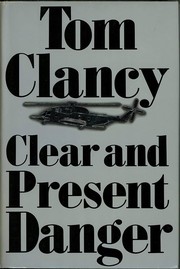
I picked up Clear and Present Danger because Patriot Games had left me liking Jack Ryan as a family man, and I wanted to see what Clancy did with him when the fight got bigger. Clear and Present Danger by Tom Clancy was first published on August 17, 1989 by Putnam, a 656 page hardcover with ISBN 9780399134401. It is a much heavier book than Patriot Games in every sense. Where that one stayed close to Ryan, his wife, and one vengeful gunman, this one spreads across Washington meeting rooms, Colombian airstrips, submarines listening offshore, and a Coast Guard cutter in the Caribbean. I read it across a week, and the middle tested my patience.
The surprise for me was how little of the book feels like a simple shootout. Most of it is about permission. Who approved what, who was told, who was deliberately not told, and what happens to the men on the ground when the people who sent them decide the politics have changed. Ryan spends half the novel trying to get a straight answer out of his own building. That slow squeeze stayed with me after I closed it.
If you only know the Harrison Ford film, the book will feel familiar in outline and different in weight. The movie runs about two hours and keeps Ryan and the rescue. The novel takes its time with the money trail, the air operations, and a young sergeant named Ding Chavez who becomes the heart of the ground war. Some of that extra material drags. A lot of it earns its place.
A yacht, a boarding, and $650 million
The book opens far from Washington, on open water. A Coast Guard cutter named Panache stops a private yacht in the Caribbean and finds two men scrubbing down a boat that has clearly been the scene of murder. The owner, his wife, and his children are dead. The two men on board killed them, and Clancy stages the scene with a cold eye for procedure. The Coast Guard crew cannot simply shoot the killers or let them walk. The senior men on the cutter talk through the legal box they are in, then stage a mock trial and a fake execution to frighten a confession out of them. Rules matter here, and men keep bending them for reasons that sound good in the moment.
Ryan gets pulled in because the dead businessman turns out to matter. He was washing money for the Medellin cartel, moving large sums through American and European banks, and skimming at the same time. Clancy puts the figure at around $650 million, a number so large that both the cartel and the FBI notice when it freezes. The Bureau seizes accounts. The cartel leader, Ernesto Escobedo, realizes that the man he ordered killed had been stealing from him even while working for him. So the opening crime does two jobs at once. It gives the Americans a legal reason to follow the money, and it gives Escobedo a reason to feel humiliated and angry at exactly the wrong moment.
I liked this stretch more than I expected. Clancy is often accused of loving hardware more than people, and there is some of that later, but the Panache pages are about sailors making decisions with incomplete information. The cutter returns at the end of the book, which I will get to, and the symmetry pleased me. A story that starts with a boarding ends with one.
One honest complaint this early: Clancy introduces a large cast in quick succession, and if you do not write names down you will mix up bankers, lawyers, and cartel middle managers. I kept a short list on a scrap of paper. Escobedo at the top. His intelligence man Felix Cortez just below. Washington names on the other side. That helped.
An election year and a quiet decision
Back in Washington, the president is running for reelection and getting hammered on drugs. His challenger, Ohio governor J. Robert Fowler, is telling crowds that the administration has failed, and the polls suggest people believe him. The president wants something he can point to. His national security adviser, James Cutter, sees an opening and brings him a plan that sounds forceful in a briefing: treat the cartel as a direct threat to American security and hit it quietly, without a public debate or a vote.
The phrase the White House settles on gives the book its title. Lawyers use it about speech that the government can restrict. Here it becomes the justification for secret action. The president signs off on the idea that the drug trade counts as that kind of danger, which in his mind permits steps he does not have to explain to Congress.
CIA director Arthur Moore and his operations deputy Robert Ritter build the hidden side. The design has several moving parts with plain code names. SHOWBOAT puts small teams of light infantry soldiers into Colombia to watch hidden airstrips used by smugglers. Most of these soldiers are Hispanic Americans with Spanish and field skills, which lets them blend better than a conventional unit would. EAGLE EYE uses their reports to aim interceptions of drug flights. CAPER listens to cartel phone calls, which helps find both planes and meetings. Later a sharper phase called RECIPROCITY is added.
On paper it almost sounds tidy. Small teams watch. Planes intercept. Phones give targets. In practice, as the book keeps showing, each layer needs lies to protect the layer below it. The soldiers cannot be acknowledged. The intercepts cannot be admitted in court. The airstrikes have to look like something else entirely, a car bomb, a rival gang hit, anything except American air power. I found these chapters slow in places, full of ranges and call signs, but the moral shape is plain. Every success makes the next cover story harder to maintain.
Cutter is the figure I disliked most. He is not written as a cartoon villain. He is a staff man who confuses a briefing slide with a war he will not have to fight himself. Ritter is colder and more professional, a career officer who believes laws about oversight are obstacles to be routed around. Moore drifts between them, uneasy but compliant. None of them tells Ryan, which becomes the engine of the whole middle of the novel.
Bogota
The war stops being theoretical when Escobedo orders revenge for the seized money. His intelligence officer Cortez has been cultivating Moira Wolfe, the secretary to FBI director Emil Jacobs, by pretending romantic interest. Moira does not know who he really is. She mentions travel plans she should never have repeated. Cortez passes the dates up the chain, and Escobedo, without warning Cortez in advance, orders a hit during Jacobs visit to Bogota for meetings with the Colombian attorney general.
Clancy writes the ambush as a traffic problem first and a gunfight second. A motorcade moves through a city the Americans do not control. Men with rockets wait where the road narrows. Jacobs dies, along with the head of the Drug Enforcement Administration and the American ambassador to Colombia. Moira survives and later tries to take her own life when she understands how her loose talk was used. She lives, but Clancy does not soften what her guilt does to her.
The killings change the temperature in Washington. The president, who had approved a quiet campaign, now authorizes the harder phase with real anger behind it. RECIPROCITY means taking the fight to cartel leadership directly. An American attack plane drops a guided bomb on a villa while cartel figures are meeting inside. Everyone in the room dies. Because of the way the bomb is built, with a casing meant to burn up and a delayed fuse, the blast is supposed to read as a car bomb set by rivals. Clancy spends pages on the engineering of this deception. Only a small chemical clue, the particular explosive used, gives Cortez a reason to doubt the cover story.
Cortez was supposed to be in that villa as Escobedo's representative and arrived late. He stands outside the wreckage and starts doing arithmetic. Too precise. Too convenient. He keeps his suspicion to himself because he sees an advantage in it. If the Americans are secretly killing cartel chiefs and letting the survivors blame each other, he can ride that fear. He can point Escobedo at rivals, thin the leadership, and step into the gap. From this point on, Cortez plays two games. He hunts the Americans while using their attacks to improve his own position.
Both sides have a professional in the middle, Clark for the Americans and Cortez for the cartel, and both men reach the same conclusion about what the bombings will cause. Paranoia. The difference is what they do with it. One tries to end the operation before more men die. The other tries to steer it toward a promotion.
Ryan starts asking questions
While all of this happens, Jack Ryan is supposed to be one of the best informed men in Washington. His boss, Admiral James Greer, is in the hospital with pancreatic cancer, so Ryan serves as acting deputy director for intelligence. In theory that means he sees almost everything. In practice, Colombia keeps producing events he cannot explain, and his requests for background come back thin.
The push comes from an old friend. Robby Jackson, a Navy pilot, hears ship and aircraft talk that does not fit any announced exercise and asks Ryan what the Navy has stumbled near. Ryan has no answer, which bothers him more than he admits at first. He starts pulling files. He notices money moving, aircraft tasked in odd patterns, and colleagues changing the subject. When he asks Moore directly whether America bombed anyone in Colombia, the answer he gets is shaped like a denial and feels like a warning. Greer, weak in his hospital bed, tells him in plain terms to trust his gut and do the right thing. That scene stayed with me because Greer has always been the steady adult in these books, and here he is spending what strength he has to point Ryan at a fight.
Ryan does something that would end a real career on the spot. He gets into Ritter's private files and copies the plans for SHOWBOAT, EAGLE EYE, CAPER, and RECIPROCITY. Clancy makes the break in feel like office work rather than a caper, which makes it more believable. Ryan knows where the safe is. He knows the habits of the man who uses it. The papers confirm what he feared. His own agency has been running a war, people are dead, and Congress was never told.
From there Ryan moves carefully. He takes what he found to the FBI, to assistant director Dan Murray and the acting director Bill Shaw after Jacobs is gone. He also seeks out John Clark, the field man who has been running much of the ground side. Clark is a former Navy SEAL, quiet, competent, and furious in his own controlled way about how the teams are being used. The two men do not trust each other instantly. Ryan is a headquarters analyst with a Marine past. Clark is a man who has buried people. Their alliance forms around one shared belief. The soldiers in Colombia cannot simply be erased.
There is a stretch here where Clancy piles on meetings, initials, and legal arguments about oversight, and I will admit my attention wandered. when every other page adds another deputy and another memo, the human cost can feel distant. That distance seems deliberate, and it makes the return to the jungle hit harder.
Ding Chavez and the teams on the ground
If Ryan is the conscience of the book, Domingo Chavez is its pulse. Chavez, called Ding, is a young Army staff sergeant, a former Los Angeles gang member who found discipline in uniform and turned into the kind of squad leader men follow without being ordered. He belongs to Team KNIFE, one of four eleven man teams inserted quietly. The others go by BANNER, OMEN, and FEATURE. Their job is to lie near dirt strips, count planes, note times, and report by radio so intercepts and surveillance can do the rest. No firefights in the plan. Just eyes and patience.
Clancy shows the work in close detail. Bugs and heat. Batteries and blisters. Spanish spoken softly into handsets. A missed meal that matters. One team point man, sick with food poisoning and not thinking clearly, walks his men straight into a cartel camp, and the resulting fight kills half the team. The survivors join up with KNIFE. Later, cartel hunters find the combined group at what was supposed to be a safe extraction point, and most of them die there too. Only Chavez and a few others get out, guided in part by radio calls from Clark overhead.
I am not a soldier and I cannot judge the fieldcraft line by line, but the feeling of it rang true to me. Tired men making small errors that turn large. Radios that fail at bad moments. Orders that made sense in Virginia and make no sense on a hillside at night. Chavez keeps his head when others lose theirs, not because Clancy makes him superhuman but because he keeps doing the next useful thing. Check the wounded. Save ammo. Move downhill toward water. I thought of him often during the Washington chapters, which may be exactly the contrast Clancy wanted.
Clark flies in to warn the teams once he realizes Washington means to cut them loose. He reaches two teams in time and redirects them to backup pickup points. He cannot reach everyone. Scenes of him circling in a small plane, trying to raise men who may already be dead, carry more tension than the bombing runs because the stakes are named men rather than targets. Julio Vega, Chavez's big sergeant, and the other survivors come through as individuals in a few quick strokes. Clancy gives them thirst, fear, and stubbornness, which is plenty.
By the time Cutter meets Cortez in secret and hands over the locations of the teams in exchange for a promise to slow drug shipments, the betrayal lands with full force. Whatever you think of the original mission, these are American soldiers left on a map for the other side. Clark learns of it, and his rage is quiet rather than loud. Ryan, who has spent the book writing memos, finally gets on a helicopter.
What holds and what wears thin
The rescue is the payoff, and Clancy stages it well. Ryan and Clark, with FBI help and an Air Force special operations crew flying out of Panama, go back in for the survivors. They use a large helicopter with real firepower, stage through the cutter Panache waiting offshore as a backup landing spot, and pull out Chavez's group plus another team under fire. The crew chief, Sergeant Buck Zimmer, is hit and dies of his wounds, and Ryan promises to look after the family. That promise matters because the whole book has been about men in offices treating such promises as paperwork.
Then comes the settling of accounts. Ryan and Clark raid the cartel command post, seize Escobedo and Cortez, and fly them out to the Panache. Escobedo is handed to rival cartel chiefs, which everyone understands means a death sentence without American fingerprints. Cortez is sent back to Cuba, where his old service treats him as a traitor. Clark confronts Cutter with proof that he sold out the teams. Cutter walks in front of a bus rather than face arrest. Ryan confronts the president, who refuses to admit wrongdoing but understands that Ryan will brief Congress. In the end the president runs a weak campaign and loses to Fowler, accepting defeat as the price of keeping the operation buried. Congress goes along to spare the country an open scandal.
There is much to admire here. The money trail is clear. The chain from election pressure to secret authority to abandoned men feels plausible in a way that still makes me uneasy. Clark and Chavez are excellent company, and Cortez is one of Clancy's better opponents because he is smart about the same things Clark is smart about.
It also sags, and a reader should know where. At 656 pages the novel carries at least a hundred pages of briefings, aircraft specifications, and signal routing that slow the story without deepening it. I skimmed the passages about phone switches and bomb chemistry without missing much. Women get thin parts. Cathy Ryan barely appears, and Moira Wolfe exists mainly to be used and then to suffer. The politics lean toward a belief that tougher secret action would work if only weak men did not spoil it, which the ending partly undercuts but never fully examines. And the final twist, that the president loses on purpose, struck me as too neat for so hard eyed a book.
Still, I finished it thinking the good outweighs the slow. The opening on the Panache and the closing on the same deck give the story a frame that most long thrillers lack. Ryan grows from a man who writes analysis into someone willing to fly into danger and then tell the truth to Congress when it costs him. Chavez earns his place beside Clark, which matters for later books. If you have patience for procedure and want a thriller that asks who pays when orders stay secret, this one will hold you. If you want a fast beach read, start with Patriot Games instead and save this for a week when you can give it room.
FAQ
When was Clear and Present Danger published?
Putnam published it on August 17, 1989. The first edition hardcover runs 656 pages with ISBN 9780399134401.
Is it part of a series?
No series is listed for this post. Jack Ryan returns in other Clancy novels, but the story stands alone and you can start here.
Do you need military knowledge to enjoy it?
No. Clancy explains teams, radios, and air operations as the story moves, though some technical passages run long and can be skimmed.
Similar books
Patriot Games
Jack Ryan saves royals in London then faces IRA revenge aimed at his family in America.
2,089-word summary · 9 min read
The Hunt for Red October
Soviet captain Ramius defects with stealth sub Red October while Jack Ryan must prove intent.
2,305-word summary · 10 min read
American Assassin
Before he became the CIA's most feared counterterrorist, Mitch Rapp was a Syracuse student mourning his girlfriend, killed on Pan Am Flight 103. Then came…
2,114-word summary · 9 min read
The Troop
A Boy Scout troop on a Canadian island takes in a stranger who cannot stop eating, and the worm inside him turns a camping trip into a war.
2,457-word summary · 11 min read

The Chemist
A former government interrogator on the run takes one last job, then learns the case she was handed was built to pit her against him.
2,249-word summary · 10 min read

Bad Luck and Trouble
A deposit of $1,030 summons Jack Reacher back to his old army unit, which is being picked off one name at a time.
2,366-word summary · 11 min read
Tinker, Tailor, Soldier, Spy
Retired spymaster George Smiley is brought back to find a Soviet mole inside British intelligence, and the trail leads through old friends, old betrayals, and…
2,092-word summary · 9 min read
The Broker
A disgraced Washington lobbyist is pardoned and hidden in Bologna, where the CIA uses him as bait to find out who wants a stolen satellite.
2,211-word summary · 10 min read
The Affair
In 1997, Reacher goes undercover in a Mississippi town where a murder near an army base collides with a senator's power. The case that ends his military career.
2,039-word summary · 9 min read
Stormbreaker
A fourteen-year-old boy loses his uncle, then his ordinary life, when MI6 sends him undercover to a Cornish computer plant where the giveaway machines hide a…
2,822-word summary · 13 min read
Gone Tomorrow
Reacher stops a suicide bomber on the subway, then hunts her handlers.
2,308-word summary · 10 min read
The Spy Who Came In from the Cold
A burnt-out Berlin agent takes one last mission that requires him to look like a traitor.
2,578-word summary · 11 min read
The Enemy
In January 1990, MP major Jack Reacher investigates a dead general, a stolen briefcase, and three murders tied to an Army power struggle.
2,123-word summary · 9 min read
The Day of the Jackal
An English assassin takes an OAS contract to kill de Gaulle while a quiet French detective races to stop him in 1963 Paris.
2,969-word summary · 13 min read
The Bourne Supremacy
David Webb is pulled back into Jason Bourne when an impostor kills in his name in Hong Kong and Marie is kidnapped. Ludlum's dense 1986 sequel stretches…
3,266-word summary · 15 min read
I Am Pilgrim
A retired spy turned crime writer is pulled back when a grisly New York murder points toward a hidden bioterror plot, and the hunt runs from forensics to the…
3,023-word summary · 13 min read
The Bourne Identity
An amnesiac pulled from the sea hunts his identity as Jason Bourne while assassins and the CIA close in.
2,994-word summary · 13 min read
Digital Fortress
NSA cryptographer Susan Fletcher chases a killer code that could expose every secret, across Seville and Fort Meade.
2,125-word summary · 9 min read

What She Knew
Rachel lets her eight-year-old son run ahead in a Bristol park, and the nine-day search turns her into a suspect in the public eye.
2,952-word summary · 13 min read

The Beach House
A young valet is beaten to death at a Hamptons party, and his law-student brother spends a year building a case against the family that covered it up.
2,049-word summary · 9 min read

Six Years
A professor who promised to forget the woman he loved sees her husband's obituary and discovers that the wedding, the marriage, and the woman herself may never…
2,076-word summary · 9 min read

The Trespasser
A Dublin Murder Squad detective investigates a staged dinner-party killing and finds a cover-up that reaches into her own department.
2,051-word summary · 9 min read

Rules of Prey
Minneapolis detective Lucas Davenport hunts a killer who leaves a new rule at every scene and treats murder as a game of wits.
1,914-word summary · 9 min read

Memories of My Melancholy Whores
A ninety-year-old journalist pays for a night with a teenage girl, cannot go through with it, and discovers love for the first time in García Márquez's late…
2,101-word summary · 9 min read

Ace of Spades
Two Black seniors at an elite academy are celebrated by day and hunted by an anonymous texter in this YA thriller about institutional racism.
2,066-word summary · 9 min read

The Late Show
Exiled to the LAPD night shift after accusing her supervisor, Renée Ballard keeps two cases that were meant to be handed off at dawn: a brutal assault and a…
2,563-word summary · 11 min read

Night Film
A disgraced journalist investigates the death of a reclusive horror director's daughter, following a red coat through hospitals, secret clubs, and a family…
2,690-word summary · 12 min read

Cross My Heart and Hope to Spy
Cammie Morgan returns to Gallagher Academy for a second year of spy training, only to fall for a boy from a rival spy school and hunt a mole in her own school.
2,567-word summary · 11 min read

4th of July
Lindsay Boxer shoots two armed teenagers in self-defense, faces a wrongful-death trial, and spends her leave chasing a string of throat-slashing murders in…
2,192-word summary · 10 min read
The Camel Club
Four Washington misfits witness a murder on Roosevelt Island and stumble into a conspiracy that reaches the Oval Office, with a hostage president and a nuclear…
2,354-word summary · 10 min read