
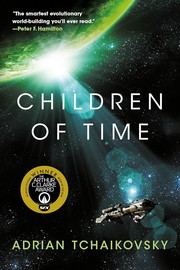
Children of Time
2,976-word summary 13 min read 416 pages in the book
- First published
- 2015
- Publisher
- Orbit
- Pages
- 416
- ISBN
- 9780316452502
- Series
- Children of Time (#1)
Reading options
What's inside (8 sections)
A friend handed me this book with a warning that sounded like a joke. You will care about spiders by page one hundred, he said. I do not like spiders in the house. My copy is the Orbit paperback, 416 pages, first published in 2015, the first volume in the Children of Time series. It won the Arthur C. Clarke Award in 2016. I started it on a train and missed my stop.
That is the shape of the book. Two stories run side by side. One follows the last people from a ruined Earth aboard an old ark ship called Gilgamesh. The other follows spiders on a terraformed planet called Kern's World across thousands of years, from hunters in leaf litter to engineers who point dishes at the sky. Chapters alternate. The human chapters feel cramped and tired. The spider chapters feel wide and fast, even though they cover far more time. The collision at the end works because both sides have been given room to become real.
I want to be clear at the start about what kind of science fiction this is. It is patient and physical. Tchaikovsky cares how a leg bends and how chemicals carry meaning when you have no voice. He also cares how a ship joint fails after centuries. If you want quick action, the first third may test you.
A ship full of sleepers looking for home
The human story begins long after Earth has wrecked itself. Wars and cold and poisoned soil leave no future there. The remnant builds ark ships and fills the holds with half a million sleepers in cargo. Gilgamesh is one of those ships. It is not sleek. It groans. Pipes sweat. Systems that were meant to last decades are asked to last centuries. Most people stay frozen while a small crew wakes in shifts to keep the hull moving and to argue about where to go.
Holsten Mason is the man we follow most. He is a classicist, which means he studies the Old Empire, the fallen culture that once seeded planets for colonization. He can read Imperial C, the old technical language, and that skill keeps getting him woken up when the crew finds a station or a signal they cannot parse. He is not a hero in the usual way. He is thin from bad sleep, anxious, good at dead languages and bad at ship politics. I found him easy to trust because he admits when he does not understand something, which happens a lot.
Around him are a few awake faces who recur across centuries. Isa Lain is chief engineer, the person who actually keeps Gilgamesh alive with patches and workarounds. Commander Guyen holds formal command as factions form. Vitas runs science with a cold eye. Karst runs security and shoots first when frightened.
What makes these chapters heavy is repetition with decay. Each waking is a little worse. Food stocks thin. Children are born on board who have never seen sky. Cults grow around the idea of return. Mutinies flare. Lain ages between Mason's sleeps while Mason stays younger, and their uneven aging gives the ship story its only soft center.
My complaint here is plain. The ship plot circles. A crisis over course, a fight over rations, a sabotage, a vote, another sleep. Some of that is the point, since a failing ark would feel like that, but pages can drag when the same argument returns with new names. Tchaikovsky writes the exhaustion well and then asks you to sit in it a while longer than needed. I kept reading for the spider chapters and forgave the ship, which tells you where the energy lies.
The woman who stayed upstairs
The spider story starts with a human mistake that takes millennia to flower. Dr. Avrana Kern leads a terraforming team in orbit above a green and ready world. The plan is grand in the old style. Seed the planet, release a nanovirus that speeds mental growth in monkeys, then shape a new branch of humanity guided by Kern's ideas. Kern is brilliant and arrogant. She records lectures meant for the uplifted to study later. She expects gratitude from creatures not yet born.
Then soldiers from an anti technology faction board her station. Fighting breaks out. The monkeys in the habitat die in the crossfire. The station breaks apart. In haste, Kern vents the nanovirus toward the planet anyway, hoping some of it will take. She escapes to an observation satellite with a copy of her own mind stored beside her, and goes into stasis to wait for rescue. Rescue never comes because Earth itself falls into war and silence. A shutdown signal spreads that kills high technology everywhere. Kern sleeps and wakes and sleeps again, talking to herself and to the empty radio, growing stranger each time.
Below, the virus does what viruses do. It finds hosts that were never intended. It settles most strongly in Portia labiata, a kind of jumping spider, clever hunters with good eyes and quick bodies. Monkeys are gone. Spiders remain. Generation by generation, the virus tweaks development. Memory passes not only by teaching but by chemical inheritance that the spiders later call Understandings. A mother leaves her young more than food. She leaves patterns for hunting and hiding and later for counting and building.
Kern watches without understanding for a long time. From orbit she sends out automatic lessons meant for monkeys. Down on the surface, spider females pick up fragments through crystals that shake with radio noise. They hear a voice from the sky. They build worship around it. Kern, who wanted to be a teacher, becomes a god by accident, then a confused god who shouts. When Gilgamesh finally answers her signal centuries later, she lies to it and tries to send it away. She has decided the planet is hers and the spiders are hers, even though she barely knows what they have become.
Kern can be hard to take in these stretches. Her messages repeat. Her pride curdles into paranoia. That is honest to the situation, a mind copied into a failing satellite and left alone for thousands of years, but it makes her scenes feel narrow after the wide spider chapters. I accepted it because the book needs her to be both pitiable and dangerous. She loves her world in the way a hoarder loves a room. She will burn a visitor rather than share it.
Hunters who learn to count
The joy of the middle of the book is watching spiders become people without ceasing to be spiders. Tchaikovsky does not give them human bodies or human speech. They signal with leg movements and with scents laid on silk. They taste the air for news. Males are small and often eaten after mating in early generations, which shapes everything about law and family. Females run war and worship. Males run and hide and later, quietly, think.
We meet Portia as a name that returns. It is not one spider but a line. Each Portia inherits Understandings from the last and adds something new. One learns to hunt with a partner instead of alone. The book moves in jumps. A chapter ends with a tribe around a fire of rotted wood. The next opens generations later with a walled nest and priests arguing about the Messenger.
The Messenger is Kern's voice, caught in vibrating crystal. Early spiders treat the messages as scripture. They copy the rhythms without knowing the words. Later spiders, sharper and more skeptical, start to test the sounds. Bianca is the name given to curious females who push at edges. A Bianca learns to make silk hold a charge. Another learns that the crystal sings stronger on hilltops. Their work feels like real science because it is slow and often wrong. A roof falls in. A batch of eggs fails. Someone gets bitten trying to milk a new plant for glue.
Ants matter as much as spiders here. The planet has big colonies that farm and march and strip fields clean. Spiders cannot outfight them head on, so they learn to steer them. They lay scent trails that divert a column. They plant bitter crops the ants dislike around sweet crops they want to keep. Control of ants becomes wealth and power. Cities that master the trick grow. Cities that fail get eaten. I loved these passages for their texture, the smell of formic acid, the tha-thump of soldiers on a bridge of silk, the way a nest goes quiet when scouts report dust on the horizon.
If you struggle anywhere, it may be here with names. Portia and Bianca return as titles more than individuals, and Fabian joins them later for clever males. At first I kept flipping back, trying to remember which Portia had burned the Seven Trees outpost and which Bianca had built the first battery. After a while I stopped trying to track each life and tracked the line instead. Portia dares. Bianca tests. That rhythm holds across centuries and lets you feel progress without a family tree.
Gods, batteries and ant wars
Around the halfway mark the spider civilization tips from clever animals to engineers. This is my favorite stretch. Fabian, a male who should by custom stay quiet, figures out how to condition ants with rewards instead of only blocking them with smells. He is not strong, so he must be exact. He breeds lines of ants that answer to spider handlers. He trains crews to move them like living tools. His success forces a social crisis because females must admit that a male can know something they do not. Some nests accept it. Others call it pollution of custom.
Great Nest and Seven Trees are the two poles that emerge. Great Nest is old, priestly, rich in ritual around the Messenger. Seven Trees is newer and more willing to let males work openly. Portia of Great Nest tries to hold tradition and experiment together. Bianca of that generation, once a priestess, leaves the temple to build instruments that listen better to the sky voice.
War comes because ants do not respect borders and food runs short after a plague year. Fabian wins his fight not by being brave but by being able to move ants at night across a stream the enemy thought impassable. Nests burn. The victors must then feed the losers or face revolt, and that necessity pushes law forward faster than any sermon.
Above it all, Kern keeps talking. Bianca builds a better receiver and finally sends a clear signal up. Kern wakes fully and is stunned to see through the satellite's eyes that her monkeys are spiders. For a moment her pride breaks and curiosity wins. She starts to teach in earnest, sending diagrams for lenses and circuits. The spiders, who had begun to treat the Messenger as metaphor, must adjust to a loud and demanding teacher who wants obedience with the lessons. Portia and Fabian manage that tension by filtering Kern, taking the geometry and leaving the threats. Their first small satellite, kicked into orbit on a chemical rocket, is the proof that the student has outgrown the school.
I admired the patience here and also felt its cost. Chapters cover centuries in pages, so individual spiders can feel brief. You mourn less for one death and more for a whole practice lost when a workshop burns. Readers who need one hero to follow may feel unmoored. I solved it by treating the species as the hero and each named spider as a chapter in its life. That worked until the human ship returned, at which point the book narrows to particular lives again and the pace quickens.
When the sky starts answering back
Gilgamesh does not reach Kern's World cleanly on the first try. Kern hacks its systems during the first exchange and feeds it coordinates for a different planet to get rid of it. Mason sends correct answers to her math puzzles out of scholarly habit, which lets her slip inside their network. The crew, desperate and divided, follows her false lead to a barren moon and pays for it in lives and fuel. By the time they limp back toward the true green world, centuries have passed on the surface and the spiders have radios and rockets and plans of their own.
The return sets up the hardest chapters. A group of mutineers drops early in a shuttle, hoping to claim land before the commanders can stop them. Ants kill most of them within hours. One woman survives and is taken by spiders, and her body becomes a source of study. Karst answers with a heavier shuttle full of armed crew. Spiders answer that with darts and silk and numbers. Mason watches from orbit with Lain, both old now in different ways, and understands before the soldiers do that the things below are not animals to be cleared. They build, they signal, they aim.
First contact fails in the way it would if neither side could read the other. Humans broadcast warnings and threats. Spiders catch fragments and hear noise. Kern, awake and furious, urges the spiders to kill the intruders outright. She has waited so long and lost so much that sharing feels like death. Portia argues for caution, Fabian for study. They board Gilgamesh in a scene that still makes my skin prickle, moving through vents and ducts that humans built for hands, not for eight legs. They take the ship room by room while Mason hides with Lain and tries to think of words that might cross the gap.
Tchaikovsky keeps the violence ugly rather than thrilling. People die choking. Spiders die crushed under boots. Eggs that will never hatch dry out in a burned nest. The point is not who has better weapons, though spiders have surprise and numbers and humans have fire. The point is that both peoples arrived believing there was no one else to ask. Humans thought the planet was empty because they could not imagine spiders as neighbors. Spiders thought the sky things were demons from old stories. Hunger made both sides stupid and fear made them cruel.
My criticism of this section is not about blood but about talk. The debates aboard Gilgamesh before the landing repeat points made two hundred pages earlier. Should sleepers be woken. Should cargo be risked. Who speaks for Earth. Guyen and Vitas and Karst hold fixed positions while Mason pleads for delay. The scenes are well acted and still feel stuck. I wanted one fewer council and one more quiet hour with Lain showing Mason the embryo store and saying what future she actually wants. When that quiet hour finally comes, it lands hard precisely because the noise around it is so loud.
What the ending asks you to accept
The turn that saves both peoples comes from the virus itself. Spiders study the captured humans and the frozen cargo and realize the same tool that raised them can be tuned again. Fabian's line of workers, with Bianca's instruments and Kern's reluctant data, builds a strain that does not make humans smarter or spiders stronger. It makes each able to feel something of what the other feels. Not words, exactly. States. Fear as a taste. Calm as a warmth. Grief as a weight that slows the legs or the hands.
I know how that sounds. A magic bridge after so much hard biology. I resisted it for a chapter. Then I watched how Tchaikovsky uses it and decided it earns its place. The virus does not translate speeches or erase history. It only stops both sides from treating the other as meat or machines. They still need to negotiate land and food and air. Feeling does not solve supply. It only makes murder harder, which is enough to start talks.
Lain does not live to see much of the peace. She dies on grass under open sky, which she had wanted for centuries, carried by Mason when her legs give out. I found that scene plain and devastating after all the metal corridors. No speeches. Just wind and weight and relief. Kern survives too, if survival is the word for a copied mind in a box, and must face spiders who no longer worship her and humans who fear her. Her last chapters are her best because she finally listens. Arrogance drains. Curiosity returns. She helps plot courses instead of guarding gates.
The final movement jumps forward to a shared project. Spiders and humans grow a living ship called Voyager from spider silk and human systems, meant to seek other terraformed worlds. Aboard is Helena, descended from Mason and Lain's stored line. Graves stay in the ground. Nests keep their walls.
Is the ending too neat. Partly. The empathy strain works fast for a book that took so long to show slow change, and some readers will call it a cheat. I think it works as fable logic after hard detail, a deliberate choice to say intelligence must be met with more than guns. The last pages do not claim harmony. They claim a chance, which feels right for peoples who spent the whole book learning that minds can differ in shape and still count as minds.
Would I press this on a friend now. Yes, with caveats I wish someone had given me. Expect the human chapters to feel bleak and sometimes circular. Expect to lose track of spider names until you learn to follow the lines instead of the lives. If you can accept those trades, you get something rare, a first contact story where the aliens are truly alien and still knowable. I closed the Orbit edition feeling wrung out and oddly tender toward eight legged engineers who learned to aim at stars.
FAQ
When was Children of Time published, and what edition is this summary based on?
It was first published in 2015 and won the Arthur C. Clarke Award in 2016. This summary follows the Orbit edition, 416 pages, ISBN 9780316452502, first in the Children of Time series.
Do I need to like spiders to read this book?
It helps to tolerate them, since half the book lives inside spider heads. Tchaikovsky writes them as hunters who think with chemistry and sight, strange at first, then easy to follow.
Is the Gilgamesh story as strong as the spider story?
Not quite. The ship chapters are bleaker and more repetitive, with mutinies and failing systems. They matter for the ending, but most readers will wait for the return to Kern's World.
Similar books
More from Children of Time first, then related titles.
Network Effect
Murderbot's contract job turns into a rescue mission when a hijacked research ship and a colony of corrupted colonists appear.
2,256-word summary · 10 min read
We Are Legion (We Are Bob)
A dead software engineer wakes up as a self-replicating space probe, clones himself into a squabbling fleet of Bobs, and tries to keep a ruined Earth alive.
2,357-word summary · 10 min read
Ancillary Justice
A ship mind trapped in one human body hunts the emperor who betrayed her across frozen worlds.
2,595-word summary · 12 min read
Abaddon's Gate
A dead detective guides Holden, an assassin hunts him, and a pastor walks unarmed into a mutiny as the Ring opens new worlds.
2,672-word summary · 12 min read
Heretics of Dune
Fifteen centuries after Leto II, the Bene Gesserit raise a new Duncan Idaho while the Honored Matres return and Rakis burns.
2,673-word summary · 12 min read
Foundation's Edge
Exiled councilman Golan Trevize hunts for the Second Foundation and the lost world of Earth, and finds a planet with one mind waiting to change the galaxy.
2,335-word summary · 10 min read

Carve the Mark
On a planet divided between conquered and conqueror, the tyrant's sister and a kidnapped oracle's son discover that their gifts make them useful to everyone…
2,340-word summary · 10 min read
Consider Phlebas
The first Culture novel follows a spy for the opposing side, a man hired to hunt a fugitive through a war between an anarchist post-scarcity utopia and a…
2,350-word summary · 10 min read
Heir to the Empire
Grand Admiral Thrawn returns from the Unknown Regions and outmaneuvers the New Republic while Luke, Leia, Han and smuggler Talon Karrde race him toward…
2,323-word summary · 10 min read
Saga, Volume 3
Marko, Alana, and Hazel hide on the planet Quietus with the reclusive author who inspired their romance, while assassins and a prince close in.
1,989-word summary · 9 min read
Exhalation
Ted Chiang's second collection contains nine stories about time, memory, free will, and artificial minds, told with clarity and moral seriousness.
2,075-word summary · 9 min read
Nemesis Games
The Rocinante crew scatters across the solar system just as Marco Inaros and the Free Navy bombard Earth. The Expanse reaches its turning point.
2,506-word summary · 11 min read
Exit Strategy
Murderbot returns to help its humans as corporate hunters close in and old friends risk all.
2,088-word summary · 9 min read
Cibola Burn
Settlers and a company fight over a new world while Holden tries to stop a war.
2,011-word summary · 9 min read

An Absolutely Remarkable Thing
Hank Green's An Absolutely Remarkable Thing follows artist April May after she and Andy film a giant Carl robot in New York that appears in cities worldwide…
2,699-word summary · 12 min read
The Fall of Hyperion
Keats persona Severn dreams pilgrims to the Time Tombs as Hegemony falls and TechnoCore war breaks the farcasters.
2,115-word summary · 9 min read
Rogue Protocol
Murderbot hunts GrayCris evidence on a dead colony world and befriends a trusting pet robot in this third Murderbot Diaries novella.
2,213-word summary · 10 min read
The Toll
After Endura sinks and the Thunderhead falls silent, Greyson Tolliver becomes its sole voice while Citra and Rowan fight to return.
2,744-word summary · 12 min read
Death's End
A hibernating engineer inherits a star, holds the trigger of a cosmic truce, and watches humanity face the dark forest.
2,980-word summary · 13 min read
Contact
A radio astronomer catches prime numbers from Vega, helps build a strange machine, and returns with no proof but static.
2,763-word summary · 12 min read
Illuminae
Exes flee invasion on ships with rogue AI, told in chats and files.
1,959-word summary · 9 min read
Rendezvous with Rama
In 2131 a silent cylinder enters the solar system, and Commander Norton's crew explores its seas and empty cities before Rama seals itself and sails on.
3,108-word summary · 14 min read
Thunderhead
Rowan hunts corrupt scythes as Scythe Lucifer while Citra, now Scythe Anastasia, defies the new order. Then Endura sinks.
2,396-word summary · 11 min read
The Left Hand of Darkness
Envoy Genly Ai lands on icebound Gethen, where fluid gender upends his assumptions, and crosses a glacier with Estraven.
2,268-word summary · 10 min read
Second Foundation
The Mule hunts the hidden Second Foundation, then a girl carries the secret that shapes the Plan.
2,060-word summary · 9 min read
Old Man's War
At 75, John Perry joins the army for a new body and a brutal war over colonies.
2,636-word summary · 12 min read
Foundation and Empire
The Foundation faces a dying Empire and a mutant conqueror called the Mule who can bend minds.
2,026-word summary · 9 min read
Morning Star
Broken in a box by the Jackal, Darrow rises with Howlers to open Mars mines to sky.
2,009-word summary · 9 min read
Hyperion
Seven pilgrims cross Hyperion telling tales of faith, war, and time while the Shrike waits at the Tombs.
1,996-word summary · 9 min read
All Systems Red
A self aware security robot just wants soap operas, but its survey team keeps walking into corporate murder.
2,119-word summary · 9 min read