
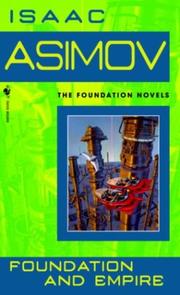
Foundation and Empire
2,026-word summary 9 min read 304 pages in the book
- First published
- 1952
- Publisher
- Spectra
- Pages
- 304
- ISBN
- 9780553293371
- Series
- Foundation (#2)
Reading options
What's inside (7 sections)
I read Foundation as a teen and loved the trick. History as math, a collapsing empire, a plan to shorten the dark age. Foundation and Empire, second in the series, first out in 1952 from Gnome Press, is where Asimov breaks his own toy to see what happens. The Spectra paperback most people find now is 304 pages, ISBN 9780553293371. It holds two linked novellas, The General and The Mule, written years apart and stitched into a novel.
The fun is watching inevitability fail. Hari Seldon predicted the Foundation would survive crises by economics and politics. Then a dying Empire produces one brilliant general, and a nobody planet produces a mutant who can edit emotions. Math meets person. Person wins, for a while.
Asimov's style is all talk. Rooms, maps, arguments. Little description, almost no interior lyricism. People explain, deduce, bluff. If you need texture, you will be hungry. If you like a mystery where the clues are trade routes and election results, you will be happy.
The General who almost won
The first half follows Bel Riose, the last strong Imperial general. Young, capable, liked by his men, curious about the Foundation on the edge of the galaxy. He gets limited ships, a political watcher named Ammel Brodrig sent by a paranoid emperor, and orders that amount to go see without starting anything expensive.
Riose does the competent thing. He probes, takes small worlds, studies Foundation tech, uses captured jump ships, interviews traders. He concludes the Foundation is rich, soft in the center, beatable if the Empire commits. He asks for more men.
Back on Trantor, the emperor Cleon II and his secretary see a different equation. A victorious general is more dangerous than a distant enemy. They starve Riose of reinforcements, recall him, execute him for treason he did not commit. The Foundation survives not by heroism but by Imperial rot. Seldon appears in the Time Vault, says the crisis passed as predicted, everyone cheers.
I admired this section more on reread. As a kid I wanted space battles. As an adult working near bureaucracies, I recognize the dynamic. Talent in the field, fear in the capital. Memos as weapons. Riose is not evil. He is good at a job his system cannot afford to let him do well.
Asimov hammers the moral a bit hard. Strong men cannot save a dying structure, only loot it. True, but he repeats it in dialogue three times. Trust the reader once.
There is also a trader hero, Lathan Devers, who tries to warn both sides and ends up playing spy. Devers talks fast, gambles, cracks jokes. He is the American trader archetype Asimov loved. Modern readers may find him thin. He has no family, no doubt, just function. Still, his trial scene, where he talks his way out of treason charges by explaining economics to aristocrats, is pure pleasure. Logic as action scene.
My criticism: women barely exist here. One secretary, no voice. The book feels like a men's club of generals and merchants. Asimov fixes this in the second half, but the imbalance dates the first novella.
Enter the Mule
The second half jumps forward. The Empire is background noise. The Foundation is cocky, rich, trading, bickering between Terminus city folk and frontier traders. Then worlds start falling to a conqueror no one has seen. The Mule.
Rumors say mutant, clown, pirate. Planets surrender without bombardment. Generals defect with smiles. Foundation ships lose because their crews lose will at the critical minute.
Asimov keeps the Mule off stage for a long time, which is smart. Fear spreads through communiques. A mayor argues about budgets while a map turns red. A scientist insists Seldon accounted for everything. A young couple, Toran and Bayta Darell, traders from the independent world Haven, get pulled into a mission to find the Mule's origin and, if possible, a way to stop him.
Toran is decent, brave, a bit dull. Bayta is the point. Sharp, humane, tired of men quoting Seldon at her. She notices people, not just patterns. Her uncle, Ebling Mis, is a famous psychologist who may hold a clue in old Imperial libraries on Trantor. And they pick up a strange passenger, Magnifico, a gangly clown who fled the Mule's court, who plays an odd instrument called the visi-sonor and flinches at loud voices.
The road trip structure works. Haven to Terminus to Trantor to dead ends. Each stop shows a different reaction to collapse. Terminus politicians deny. Haven democrats argue. Trantor survivors pick through ruins of a world that once held forty billion. Asimov's Trantor chapters, with farmers on a former capital planet, are quietly devastating. Imagine growing potatoes in a parking garage that used to run the galaxy.
Magnifico is heartbreaking and funny. He cowers, babbles, plays beautiful music that makes people weep without knowing why. Bayta protects him when Toran and Mis treat him as luggage. That kindness matters more than any gun.
If you guess the twist early, do not feel bad. Asimov plants it fairly and many readers spot it. The pleasure is watching Bayta spot it too, later than you, earlier than the men around her, and act alone.
Psychohistory cracks
The intellectual meat is Seldon versus exception.
Psychohistory works on crowds, not individuals. It assumes no single person can shift quadrillions. The Mule can. He senses and shapes emotions, turning enemies loyal, making the fearful brave for him, making the brave despair. He does not need to be everywhere. Convert a general, get a fleet. Convert a mayor, get a planet.
Ebling Mis spends chapters trying to save the theory. Maybe the Mule is many people. Maybe Seldon allowed for him. Maybe the Second Foundation, rumored backup group of mental scientists at the other end of the galaxy, will intervene. Mis works himself sick in the Great Library, chasing coordinates while the war closes in.
I love how Asimov lets smart men fail smartly. Mis is not stupid. His data is real. His logic is sound except for one human blind spot. He trusts the clown in the corner because the clown seems harmless. Who would suspect a sniveling musician of being the conqueror? Bayta does, because she watched how people relax around Magnifico, how guards lower guns, how she herself feels oddly fond.
The reveal still lands after seventy years because it is not just plot. It is argument. Statistics cannot model a mind reader who cares about being loved. The Mule wants belonging, not just power. He was mocked as a freak, thin, awkward. Now he forces affection he never earned. That need makes him both pitiable and unstoppable. You cannot bribe someone who can make you love him.
Asimov's handling of mental powers is dated in mechanism, vague waves and glands, but fresh in ethics. The Mule does not torture. He rewrites. Victims thank him. That is creepier than pain. Bayta's horror is not that she might die, but that she might stop wanting to resist and call it happiness.
A man who can make you loyal with a touch does not need chains. He needs only to be lonely enough to use it.
Bayta sees clearly
Let me praise Bayta properly because Asimov does not always write women this well.
She starts as wife sidekick, packing lunches while men plan. Gradually she becomes investigator. She asks why Magnifico's music moves even soldiers. Why Ebling Mis tires exactly when close to answers. Why Toran, brave Toran, keeps missing obvious lies.
Her final act is not a speech. It is a shot in a dark vault, after understanding, to stop a mind from taking the last free minds. She grieves immediately. She liked Magnifico, or the person he pretended to be. Killing him, or rather killing the Mule wearing him, costs her. Asimov gives her no medal scene. Just Toran holding her while Seldon's image flickers irrelevantly behind them.
Toran's reaction is complicated. He loves her, he is horrified, he is grateful. Their marriage survives but changes. I appreciated that Asimov does not make it tidy. Trauma in space opera usually resets next chapter. Here Bayta will dream about it.
Ebling Mis dies of effort and manipulation, a scholar killed by the subject he studied. His death scene, laughing because he finally understands and cannot tell, is cruel and perfect. Knowledge without power to share it.
The book ends with the Foundation fallen, the Mule ruling, Seldon's plan in ruins, and only a whisper of the Second Foundation left as hope. For 1952, that downer ending was bold. Series fiction was supposed to reset. Asimov lets the good guys lose the war to win a larger argument about humility.
Does it hold up? Mostly, with caveats. The dialogue is stiff, all declarative sentences and logic puzzles. The science of psychohistory is hand waving. Race and gender are narrow. Trantor's fall mirrors Rome so closely it sometimes feels like homework. But the structure, two crises, one solved by sociology, one unsolvable by it, remains elegant. And the Mule remains one of the saddest villains in early SF. Not a dark lord. A lonely kid with too much power and a clown's act he cannot drop.
Trantor, Haven, and ordinary people
What I liked more this time was not the generals but the stops in between.
Trantor first. Asimov shows the old capital as farms inside broken metal. People live in the skin of a dead world, raising chickens where clerks once filed star charts. Ebling Mis digs for records while kids steal his tools. It is funny until you realize no one there remembers why the planet mattered. Collapse, in this telling, is not fire. It is forgetting plus rent.
Haven second. Toran's home world of traders who stayed independent, proud democrats who argue in assemblies while the Mule's fleet approaches. They vote, they filibuster, they lose time. Asimov, who loved democratic talk, does not mock them. He shows their courage and their slowness. Bayta's father runs guns, her mother keeps books. Family politics as war council. Dinner tables with maps under the plates. I know that mood from family businesses during bad years. Work and worry in the same room.
Neotrantor, the rump Empire world, gets a short brutal sketch. A petty emperor with robes too big, courtiers lying about harvests, a general who knows the fleet cannot fly. Asimov does decline in three paragraphs better than some novels do in three hundred pages.
These places sell the stakes. The Foundation is not an idea. It is clerks, farmers, mechanics who will live or die depending on whether Seldon's math holds. When the Time Vault speech fails to predict the Mule, the camera stays on faces. Old men crying, young techs laughing too loud, Bayta feeling sick. Theory breaking has a sound. It is chairs scraping.
A personal gripe that turned into appreciation. Asimov never describes food, clothes, smells. Everything is clean nouns. At first I missed texture. Then I noticed how fast I turned pages. No friction. The lack becomes a feature on a long flight or a sick day. You float on dialogue.
Still, one wishes for one scene of daily life under the Mule to feel his rule. We hear planets converted, see few. Fear by report is less scary than fear witnessed. The book tells us people love him now. Showing one converted captain eating breakfast with his conqueror, happy, wrong, would chill more than ten maps turning red.
Who should read it? Anyone who finished Foundation and wondered if Asimov believed his own math. He did not, fully. This is the book where he admits people break models, and that models must include mercy and vanity and love, or they lie.
I closed it thinking of modern forecasts, election models, market predictions, all confident until one person does the unmodeled thing. Seldon would nod. Then he would update his equations and remind us the update will also fail, somewhere, sometime. That is not despair. That is Asimov's strange optimism. We muddle through, with help from observant people like Bayta who notice the quiet musician in the corner.
FAQ
When was Foundation and Empire published?
Gnome Press published it in 1952. The Spectra paperback most readers own runs 304 pages and the ISBN is 9780553293371.
Is it part of a series?
Yes. It is book two of the Foundation series, after Foundation and before Second Foundation. It collects two novellas, The General and The Mule.
Do I need to read Foundation first?
Start with Foundation. This book assumes you know Hari Seldon, psychohistory, Terminus, and the Seldon Plan.
Similar books
More from Foundation first, then related titles.
Foundation
Seldon predicts the Empire will fall and seeds Terminus to cut the dark age to a thousand years.
2,706-word summary · 12 min read
Second Foundation
The Mule hunts the hidden Second Foundation, then a girl carries the secret that shapes the Plan.
2,060-word summary · 9 min read
Foundation's Edge
Exiled councilman Golan Trevize hunts for the Second Foundation and the lost world of Earth, and finds a planet with one mind waiting to change the galaxy.
2,335-word summary · 10 min read
Prelude to Foundation
A young Hari Seldon arrives on Trantor with a theory he cannot yet prove, and a hunt through the planet-city forces him to turn psychohistory into a real…
2,013-word summary · 9 min read
Heir to the Empire
Grand Admiral Thrawn returns from the Unknown Regions and outmaneuvers the New Republic while Luke, Leia, Han and smuggler Talon Karrde race him toward…
2,323-word summary · 10 min read
Hyperion
Seven pilgrims cross Hyperion telling tales of faith, war, and time while the Shrike waits at the Tombs.
1,996-word summary · 9 min read
The Caves of Steel
Detective Elijah Baley must solve a Spacer's murder in a domed New York, partnered with R. Daneel Olivaw, a humaniform robot built in the victim's image.
2,445-word summary · 11 min read

Heretics of Dune
Fifteen centuries after Leto II, the Bene Gesserit raise a new Duncan Idaho while the Honored Matres return and Rakis burns.
2,673-word summary · 12 min read

Carve the Mark
On a planet divided between conquered and conqueror, the tyrant's sister and a kidnapped oracle's son discover that their gifts make them useful to everyone…
2,340-word summary · 10 min read
Consider Phlebas
The first Culture novel follows a spy for the opposing side, a man hired to hunt a fugitive through a war between an anarchist post-scarcity utopia and a…
2,350-word summary · 10 min read
Network Effect
Murderbot's contract job turns into a rescue mission when a hijacked research ship and a colony of corrupted colonists appear.
2,256-word summary · 10 min read
Saga, Volume 3
Marko, Alana, and Hazel hide on the planet Quietus with the reclusive author who inspired their romance, while assassins and a prince close in.
1,989-word summary · 9 min read

Out of the Silent Planet
A Cambridge philologist is kidnapped and taken to Mars, where the natives are civilized and the humans are the dangerous invaders.
2,612-word summary · 12 min read
We Are Legion (We Are Bob)
A dead software engineer wakes up as a self-replicating space probe, clones himself into a squabbling fleet of Bobs, and tries to keep a ruined Earth alive.
2,357-word summary · 10 min read
We
In a city of glass ruled by the Benefactor, a state engineer building a spaceship falls for a woman who wants to tear the One State down.
2,247-word summary · 10 min read
The Illustrated Man
A tattooed drifter's moving pictures retell eighteen Bradbury stories of children, rockets, Mars and the last night of the world.
2,791-word summary · 12 min read
Nemesis Games
The Rocinante crew scatters across the solar system just as Marco Inaros and the Free Navy bombard Earth. The Expanse reaches its turning point.
2,506-word summary · 11 min read
A Connecticut Yankee in King Arthur's Court
Hank Morgan, a Connecticut factory man, wakes in King Arthur's England, rises to chief adviser, and rebuilds the kingdom until his own inventions turn on him.
2,193-word summary · 10 min read
The Day of the Triffids
Blinded survivors flee carnivorous plants after a meteor shower.
2,171-word summary · 10 min read
Ancillary Justice
A ship mind trapped in one human body hunts the emperor who betrayed her across frozen worlds.
2,595-word summary · 12 min read

A Canticle for Leibowitz
After nuclear war, monks save books across centuries while the world rebuilds and falls again.
2,381-word summary · 11 min read

Solaris
Kelvin reaches a silent station above Solaris and finds grief made solid when the ocean returns his dead wife Rheya, testing memory, science, and the limits of…
2,548-word summary · 11 min read
Cibola Burn
Settlers and a company fight over a new world while Holden tries to stop a war.
2,011-word summary · 9 min read

The Island of Doctor Moreau
Shipwrecked Prendick finds Doctor Moreau shaping beasts into men by pain on lost island.
2,137-word summary · 9 min read
The Fall of Hyperion
Keats persona Severn dreams pilgrims to the Time Tombs as Hegemony falls and TechnoCore war breaks the farcasters.
2,115-word summary · 9 min read
The Dispossessed: An Ambiguous Utopia
Physicist Shevek leaves anarchist Anarres for capitalist Urras to share time theory, finding walls both places.
2,288-word summary · 10 min read
A Wind in the Door
Meg must save Charles Wallace from a cosmic sickness by naming and loving what she fears, helped by a cherubim called Progo.
2,214-word summary · 10 min read
I Am Legend
Robert Neville holds one fortified house in empty Los Angeles by day, and faces what the plague left behind by night.
2,840-word summary · 13 min read
Children of Time
Humanity's ark ship Gilgamesh reaches a terraformed world, only to find intelligent spiders raised over millennia by a lost terraformer's virus.
2,976-word summary · 13 min read