
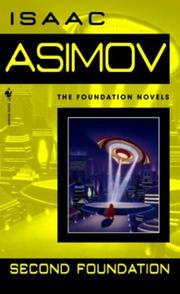
Second Foundation
2,060-word summary 9 min read 272 pages in the book
- First published
- 1953
- Publisher
- Gnome Press
- Pages
- 272
- ISBN
- 9780553293364
- Series
- Foundation (#3)
Reading options
What's inside (7 sections)
I came to this book at the end of the original trilogy, after Foundation and Foundation and Empire, and I was braced for a letdown. Third books that exist to explain the trick often feel thin. Second Foundation, published in 1953 by Gnome Press as the third volume of the Foundation series, surprised me. It is two shorter stories joined by the two ends of Seldon's riddle, and both of them are hunts for a group that does not want to be found. The first hunt is led by the strongest man alive. The second is led by a fourteen year old girl. The girl's half is better, and she is one of my favorite characters Asimov ever wrote.
A quick orientation in case you arrive fresh. Hari Seldon set up two Foundations at opposite ends of the galaxy to shorten the dark age after the Empire falls. The First Foundation on Terminus has scientists and ships. The Second Foundation is hidden, made of mentalics who can read and adjust minds, meant to guard Seldon's Plan in secret. At the end of the previous book the Mule, a mutant who can bend emotions to his will, conquered the First Foundation and scattered its leaders. Only Bayta Darell stopped him once, by seeing through him at the right moment. This book asks what happens next.
Search by the Mule
The first half follows the Mule himself, five or so years after his conquest. He rules from Kalgan now, tired and restless. His empire looks solid and feels hollow, because one threat remains. Somewhere out there is the Second Foundation, the one group whose mind powers might match his own. Until he finds it and breaks it, he cannot feel safe.
He sends two men to draw it out. Han Pritcher is a former Foundation captain who opposed the Mule, was Converted by emotional control into loyal service, and now serves with a heaviness he cannot explain. Bail Channis is young, quick, unConverted, risen fast, clever enough that the Mule half trusts him and half watches him. The Mule fits their ship with a device that lets him follow them through hyperspace, then lets them go.
Channis has a theory. Seldon said the Second Foundation lay at the other end of the galaxy, at Star's End. Channis argues the records point to Tazenda, a rim world with a certain arrogance about its importance. They fly there, landing first on Rossem, a cold farming world Tazenda controls. The Rossem governor receives them with plain hospitality that feels slightly rehearsed. Nothing glows. Nothing confesses.
Back on the ship Pritcher turns on Channis. He has decided the young man found too much too fast. He arrests him for treason and warns him the Mule is coming. The Mule arrives, and the scene flips twice in a few pages. First the Mule tells Pritcher that Channis is in fact an agent of the Second Foundation, planted or turned, and breaks Pritcher's Conversion in the process, leaving the older man dazed and free for the first time in years. Then the Mule tells Channis he has already sent ships to Tazenda and wrecked it, and demands the real location.
Channis, pressed by a stronger mind, gives up Rossem. Tazenda was only a mask, he says. Rossem is the true Second Foundation. For a moment the Mule believes he has won. Then the First Speaker of the Second Foundation steps into the room, and the whole hunt turns inside out.
The First Speaker explains the trap plainly. Channis did believe Rossem was the target, because the Second Foundation put that belief in him, knowing the Mule would read it there. Neither Tazenda nor Rossem is the Second Foundation. While the Mule chased shadows, agents left for Kalgan and the Foundation worlds to undo his Conversions. His fleet is too far away to stop them. Then, in the Mule's moment of despair, the First Speaker enters his mind and adjusts it. The Mule will go home, live out his short remaining life as a harmless despot, and stop hunting. He does. He dies a few years later of natural causes, and his empire starts coming apart before the body is cold.
What makes this half work is the sadness under the trick. The Mule is the most powerful man in the galaxy and the loneliest, a freakish outsider even among his servants. Asimov lets you feel that without forgiving the conquests.
Sixty years later
The second half jumps about sixty years forward. The Mule is long dead. His empire has broken up. The First Foundation on Terminus is independent again, proud, and nervous. It knows now that a Second Foundation exists with powers like the Mule's, and it hates the thought of being managed. A small secret group forms on Terminus to find the hidden Foundation and end its influence. Five men: Dr. Toran Darell, son of the Toran and Bayta Darell who faced the Mule; Pelleas Anthor, a student of mind science; Homir Munn, a librarian type who knows the Mule's records; old Dr. Elvett Semic; and Jole Turbor, who handles the group's contacts.
Their plan is simple. Too simple, as it turns out. They will send Munn to Kalgan, where the Mule's palace records may hold clues about where he searched and what he found. Upstairs, listening through a vent the way bright teenagers do, is Darell's fourteen year old daughter Arkady, who prefers that spelling to Arcadia. She hears enough to decide the adults are slow, and she acts.
Arkady is the engine of everything after this. She is clever with words, romantic about history, proud of being Bayta's granddaughter in a way she mentions often, and exactly as naive as a sheltered fourteen year old should be. Asimov writes her better than almost anyone else in his early work. The grown men around her scheme in abstractions. She wants to go, so she hides in Munn's luggage and goes.
Kalgan and the warlord
Kalgan has a new master, Lord Stettin, who styles himself First Citizen as the Mule did. He believes the Mule proved Seldon's Plan is dead and that Kalgan should take the Foundation's place as the seed of the next Empire. He keeps the Mule's palace, the Mule's titles, and a mistress named Callia who watches everything with soft eyes.
Munn gets access to the records and finds little. Stettin, who is vain but not stupid, decides the librarian is a spy and holds both Munn and Arkady. He also decides Arkady interests him personally, in a way that frightens her badly. With Callia's quiet help she slips away, runs for the spaceport while police close in, and talks her way onto a freighter bound for Trantor with a trading couple, Preem Palver and his wife. Palver is plain, kind, jokes about profits, and asks for nothing. Arkady, who has read too many thrillers, half suspects him for about a page before deciding he is safe.
Meanwhile Stettin declares war on the Foundation. It goes badly for him in the slow way Seldon predicted. His crews fight like men who expect the Plan to beat them. The Foundation's crews fight like men who expect it to save them. Expectation does half the work. Kalgan loses.
The war chapters are the weakest stretch, and I say that as a fan. Fleets move, messages arrive, morale is discussed as a force of physics. If you love psychohistory as mathematics, this sings. If you want people in rooms, you wait for Arkady.
Trantor, and a circle with no end
Stranded on Trantor, the old imperial capital, a vast world of ruins where farmers work metal fields around a shrinking dome, Arkady does the best thinking in the book. She cannot leave while the war runs. She cannot call home openly. She pieces together the riddle instead.
Seldon said the Second Foundation sits at the other end of the galaxy, at Star's End. Everyone assumed that meant the far rim from Terminus. Arkady turns the phrase over. A circle has no end, she realizes. The galaxy is a wheel. The opposite of the rim edge where Terminus sits is the center hub, the star all others once circled. That is Trantor. She sends her father a message through Palver with that hint folded in: a circle has no end.
Back on Terminus, Darell takes the hint and runs. He announces the Second Foundation is not on Kalgan or in the rim at all. It is on Terminus itself, hidden among them. He has also built a device that fills a room with mental static, painful to anyone with mind powers. He switches it on in front of the group. Pelleas Anthor doubles over. Under questioning Anthor gives up the rest of his local network, and the group rounds them up. Terminus celebrates. The hidden masters are caught. The Plan belongs to the First Foundation alone.
Darell even tests Arkady when she returns, afraid her message was planted in her by tampering. The tests come back clean. Father and daughter hold each other, relieved. The book lets them have that relief for a few pages. Then it pulls the floor away, kindly.
What really happened
The closing chapters belong to the Second Foundation, and they reframe everything. Anthor and his people on Terminus were volunteers for martyrdom. They let themselves be found, to convince the First Foundation it had won and stop it looking further. The war with Kalgan was encouraged for the same reason, to restore Terminus pride after the humiliation of the Mule years. Arkady's message was real, but her certainty was guided from birth. Agents adjusted her mind as a small child so she would one day point to Terminus and be believed, because tests would find no recent tampering.
And the true location was Trantor all along. The old capital, at the galaxy's center, socially the opposite end from Terminus, full of ruins where a few minds can hide among farmers. The kindly trader who carried Arkady's message, Preem Palver, is in fact the First Speaker himself. He guided her, protected her, delivered her hint, and let her believe every step was hers.
I love this ending and I understand readers who feel cheated by it. Every victory in the second half belongs to people who were allowed it. Darell's device works, and it caught only the people offered up to it. Stettin's war fails on schedule. Arkady's cleverness is real and also cultivated. Asimov wants you to sit with that discomfort. If guardians must lie to protect the Plan, is the Plan still Seldon's, or is it theirs?
The fair criticism is the usual Asimov bill. Conversations carry the weight that action carries in other writers. Women outside Arkady, Bayta in memory, and Callia get little room. The science of mind control is asserted more than shown. And the two halves barely touch, joined by theme rather than cast. None of that stopped me turning pages. Arkady running across Kalgan with police behind her, the First Speaker facing the Mule with nothing but timing, Palver counting profits while steering history: these scenes move.
Read the trilogy in order. Start with Foundation, then Foundation and Empire, then this. The Mule half assumes you fear him already. The Arkady half assumes you know what he cost. At 272 pages in the common paperback, with the 9780553293364 edition many readers own, it is the shortest of the three and the most rereadable, because the last twenty pages change the meaning of the two hundred before them.
One more note on how Asimov plays fair. The clue about Star's End is given to you in the same words the characters hear, and the double meaning is available from the start if you turn it slowly. Terminus sits on the rim, the newest star of the new order. Trantor sits at the hub, the oldest star of the old order. Both can be called an end, depending on whether you read the galaxy as a map or as a history. I missed it cleanly on my first pass and admired the construction on my second, which is exactly the response the structure wants. The book does not cheat. It tells you the answer early and trusts you to misread it with everyone else.
FAQ
When was Second Foundation published?
Gnome Press published it in 1953. The mass-market paperback most readers own runs 272 pages and the ISBN is 9780553293364.
Is it part of a series?
Yes. It is book three of the Foundation series, after Foundation and Foundation and Empire.
Do I need to read Foundation first?
Yes, start with Foundation. This book assumes you know Seldon, psychohistory, the Mule, and Terminus.
Similar books
More from Foundation first, then related titles.
Foundation
Seldon predicts the Empire will fall and seeds Terminus to cut the dark age to a thousand years.
2,706-word summary · 12 min read
Foundation and Empire
The Foundation faces a dying Empire and a mutant conqueror called the Mule who can bend minds.
2,026-word summary · 9 min read
Foundation's Edge
Exiled councilman Golan Trevize hunts for the Second Foundation and the lost world of Earth, and finds a planet with one mind waiting to change the galaxy.
2,335-word summary · 10 min read
Prelude to Foundation
A young Hari Seldon arrives on Trantor with a theory he cannot yet prove, and a hunt through the planet-city forces him to turn psychohistory into a real…
2,013-word summary · 9 min read
Heir to the Empire
Grand Admiral Thrawn returns from the Unknown Regions and outmaneuvers the New Republic while Luke, Leia, Han and smuggler Talon Karrde race him toward…
2,323-word summary · 10 min read
Hyperion
Seven pilgrims cross Hyperion telling tales of faith, war, and time while the Shrike waits at the Tombs.
1,996-word summary · 9 min read
The Caves of Steel
Detective Elijah Baley must solve a Spacer's murder in a domed New York, partnered with R. Daneel Olivaw, a humaniform robot built in the victim's image.
2,445-word summary · 11 min read

Heretics of Dune
Fifteen centuries after Leto II, the Bene Gesserit raise a new Duncan Idaho while the Honored Matres return and Rakis burns.
2,673-word summary · 12 min read

Carve the Mark
On a planet divided between conquered and conqueror, the tyrant's sister and a kidnapped oracle's son discover that their gifts make them useful to everyone…
2,340-word summary · 10 min read
Consider Phlebas
The first Culture novel follows a spy for the opposing side, a man hired to hunt a fugitive through a war between an anarchist post-scarcity utopia and a…
2,350-word summary · 10 min read
Network Effect
Murderbot's contract job turns into a rescue mission when a hijacked research ship and a colony of corrupted colonists appear.
2,256-word summary · 10 min read
Saga, Volume 3
Marko, Alana, and Hazel hide on the planet Quietus with the reclusive author who inspired their romance, while assassins and a prince close in.
1,989-word summary · 9 min read

Out of the Silent Planet
A Cambridge philologist is kidnapped and taken to Mars, where the natives are civilized and the humans are the dangerous invaders.
2,612-word summary · 12 min read
We Are Legion (We Are Bob)
A dead software engineer wakes up as a self-replicating space probe, clones himself into a squabbling fleet of Bobs, and tries to keep a ruined Earth alive.
2,357-word summary · 10 min read
We
In a city of glass ruled by the Benefactor, a state engineer building a spaceship falls for a woman who wants to tear the One State down.
2,247-word summary · 10 min read

The Illustrated Man
A tattooed drifter's moving pictures retell eighteen Bradbury stories of children, rockets, Mars and the last night of the world.
2,791-word summary · 12 min read
Nemesis Games
The Rocinante crew scatters across the solar system just as Marco Inaros and the Free Navy bombard Earth. The Expanse reaches its turning point.
2,506-word summary · 11 min read
A Connecticut Yankee in King Arthur's Court
Hank Morgan, a Connecticut factory man, wakes in King Arthur's England, rises to chief adviser, and rebuilds the kingdom until his own inventions turn on him.
2,193-word summary · 10 min read
The Day of the Triffids
Blinded survivors flee carnivorous plants after a meteor shower.
2,171-word summary · 10 min read
Ancillary Justice
A ship mind trapped in one human body hunts the emperor who betrayed her across frozen worlds.
2,595-word summary · 12 min read

A Canticle for Leibowitz
After nuclear war, monks save books across centuries while the world rebuilds and falls again.
2,381-word summary · 11 min read

Solaris
Kelvin reaches a silent station above Solaris and finds grief made solid when the ocean returns his dead wife Rheya, testing memory, science, and the limits of…
2,548-word summary · 11 min read

Cibola Burn
Settlers and a company fight over a new world while Holden tries to stop a war.
2,011-word summary · 9 min read

The Island of Doctor Moreau
Shipwrecked Prendick finds Doctor Moreau shaping beasts into men by pain on lost island.
2,137-word summary · 9 min read
The Fall of Hyperion
Keats persona Severn dreams pilgrims to the Time Tombs as Hegemony falls and TechnoCore war breaks the farcasters.
2,115-word summary · 9 min read
The Dispossessed: An Ambiguous Utopia
Physicist Shevek leaves anarchist Anarres for capitalist Urras to share time theory, finding walls both places.
2,288-word summary · 10 min read
A Wind in the Door
Meg must save Charles Wallace from a cosmic sickness by naming and loving what she fears, helped by a cherubim called Progo.
2,214-word summary · 10 min read
I Am Legend
Robert Neville holds one fortified house in empty Los Angeles by day, and faces what the plague left behind by night.
2,840-word summary · 13 min read
Children of Time
Humanity's ark ship Gilgamesh reaches a terraformed world, only to find intelligent spiders raised over millennia by a lost terraformer's virus.
2,976-word summary · 13 min read