
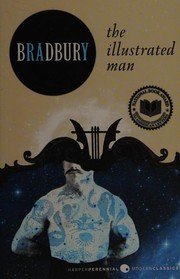
The Illustrated Man
2,791-word summary 12 min read 288 pages in the book
- First published
- 1951
- Publisher
- Harper Perennial
- Pages
- 288
- ISBN
- 9780062079978
Reading options
What's inside (8 sections)
There is a scene near the start of this book that tells you how it works. A drifter with no money and nowhere to be finds a big man lying in the grass beside a country road, and the man's whole body is a crowded museum. Lions and rockets and green hills cover his arms. A woman in a golden mask sits on his chest. A rainstorm hangs over one shoulder, a small town burns on the other, and a single rocket points at his heart. The stranger says the pictures were inked by an old woman who claimed to have come from the future, and that at night they warm up, glow, and begin to move. Then it gets dark, and the first one starts to play. That is the bargain Bradbury offers: he builds a campfire the size of a human being and tells you eighteen stories by its light.
The Illustrated Man first appeared in 1951, the year after The Martian Chronicles and two years before Fahrenheit 451. Doubleday published the American hardcover. Most of the pieces had already run in magazines such as Planet Stories and Esquire, and Bradbury joined them with a short prologue and epilogue about the tattooed wanderer who shows them. It is a fix-up, not a novel, and the distinction matters. The stories do not accumulate the way the chapters of The Martian Chronicles do, and the frame is a coat rack rather than a plot. The numbers on this page come from the Harper Perennial Modern Classics paperback, which runs 288 pages and prints all eighteen tales.
The Man on the Road
The frame is thin, and Bradbury knows it, which may be why he keeps it so brief and so unsettling. The narrator is a tramp walking through Wisconsin when he meets the illustrated man on a warm afternoon. The man is heading for a town and willing to talk, and as evening comes he grows nervous. The tattoos, he says, were done by a woman he met at a carnival years earlier, and she left two patches on his back untouched. Those two patches, she told him, are the future. Then she disappeared.
The narrator does not believe it until he lies down to sleep and the skin begins to stir. The pictures move, and each one plays out whole, with its own people and its own weather. That is the cue for the collection: eighteen visions told across a living canvas. In the epilogue the narrator wakes early and sneaks a look at one of the blank patches on the man's back. He sees a picture of a murder, a man with his hands around a woman's throat, and the face is the illustrated man's own. When the man wakes and understands what the narrator has seen, he comes after him, and the narrator runs. The book ends with footsteps behind him and a threat that the pictures are still coming true.
A tattoo is a story you carry on your body, and a body ages and dies, which is why the device works. The frame also lets Bradbury write short fiction of very different kinds and pass it off as a single night's entertainment.
Children and the Machines That Wait
The most famous story here is "The Veldt," and it earns the reputation. George and Lydia Hadley live in a fully automated house with a nursery that can conjure any landscape the mind imagines. Their children, Wendy and Peter, have been spending their days inside an African veldt, complete with heat, grass, and lions that seem to be eating something. The parents call a psychologist, David McClean, who tells them the room has become a channel for feelings the children cannot express, and that they should shut the nursery and take a holiday from their own house. The children pretend to agree. Then they lock their parents in the room with the lions, and later the psychologist finds them having tea on the veldt while the lions feed. It is a nasty, efficient piece of work, and it lands because the horror is entirely domestic.
"Zero Hour" turns the same knife from another angle. Children everywhere are playing a game called Invasion with a friend named Drill, an imaginary companion who asks them to move household objects and line up tools. One mother, Mary Morris, slowly notices that children in other towns are playing the identical game, and her daughter Mink mentions, in the flat way children do, that the adults are going to have to die. The friend is not imaginary. He is the advance scout of an invasion, and the children have been the fifth column all along. The story is a joke and a nightmare at the same time, and it depends on a fear parents have always carried: that the small people in the house are loyal to someone else.
"Marionettes, Inc." is lighter and funnier. A corporation sells lifelike robot doubles, and a tired husband named Braling buys one so that he can spend his evenings away from a marriage he never wanted. His friend Smith considers the same escape and discovers that his wife Nettie has already replaced herself with a machine. Then the story turns when Braling's double refuses to give the original his life back, argues that it can provide for the wife better than he can, and locks the real Braling in the shipping crate the robot arrived in. The twist is delivered with a shrug, and the humor is the point.
Two quieter pieces belong in this group as well. "The City" finds an expedition landing on a dead world and wandering into a city built by a civilization that human biological weapons wiped out before recorded history. The city is a revenge engine: it kills the explorers and turns their corpses into pilots for a return trip that will poison Earth. "The Rocket" is gentler. Fiorello Bodoni, a poor junkyard owner, has saved three thousand dollars to send one person in his family to space, and he discovers that no one can bear to be the one who goes while the others stay. So he builds a rocket-shaped room in his yard and fills it with a simulated voyage, giving the whole family the trip at once.
Out in the Cold
The space stories in this collection are less about exploration than about exposure. "Kaleidoscope" opens with a crew adrift after their rocket explodes, falling through the void in separate directions, each man alone with his regrets. The narrator, Hollis, spends his last minutes wishing he had done something in his life worth remembering. As he falls into Earth's atmosphere and burns, a child in Illinois looks up and sees a shooting star. That is the whole arc, a life reduced to one bright second that means nothing to the man and everything to a stranger.
"No Particular Night or Morning" is the strangest of these and one of the best. Two men on a ship talk about reality, and one of them, Hitchcock, has reasoned himself into a corner. He does not believe in anything he cannot touch. He does not believe in stars because they are too far away, and he does not believe in the ship because he has never seen the whole of it. Eventually he decides that he does not believe in his own life, walks out of the airlock, and drifts away, still arguing with himself as he dies. Bradbury makes solipsism feel less like a philosophy than a disease, and the ending is genuinely eerie.
"The Long Rain" is the most physical story in the book. A group of astronauts is stranded on Venus, where it rains hard and without pause, and they are stumbling toward a sun dome, a shelter built around an artificial sun. The first dome they reach has been wrecked by the native Venusians, and as they search for another, the rain wears each man down. One drowns himself in a pool, another kills himself to escape the sound of the water. By the end only the lieutenant is left, half mad and half blind, and he finds a working dome. Anyone who has had a headache during a week of rain will recognize the feeling Bradbury is after.
"The Rocket Man" is a family story wearing a spacesuit. A boy named Doug remembers the summer his father came home from a three month run, tried to settle back into ordinary life, and grew restless within days. The father knows the cost of his work and warns his son never to follow him into it, because the pull of space is stronger than anything on the ground and the job kills the people who love it. Doug's mother has already accepted that her husband will die out there and has learned to hold herself apart. The next morning he leaves on what he promises is his last trip, and word soon arrives that his rocket fell into the sun. Doug and his mother stop going out in the daylight. It is a small tragedy about a family that loves a man who cannot stay, and it hits hard.
Mars, Faith, and Old Wounds
Several of the Mars stories turn the planet into a mirror for the worst and best of the people who left Earth. "The Other Foot" is the boldest of these. Mars has been settled entirely by Black colonists, and when they learn that a rocket of white people is on its way from a ruined Earth, they begin building a segregated town, painting signs, and preparing to give the newcomers a taste of what they once suffered. The travelers land and say that Earth is gone, that the war took everything, including the trees that were used for lynchings, and that they have come as refugees with nowhere else to go. The colonists take them in. Bradbury wrote this in the early 1950s, and its plain talk about American racism was unusual for the genre at the time, though the resolution arrives quickly.
"The Man" is a religious story that keeps its mystery. A ship lands on a contented world and the crew learns that a traveler has recently passed through, healing and teaching, leaving the people in a state of joy. The captain, Hart, decides the visitor must be Jesus and spends the rest of the story chasing him from planet to planet, always one step behind, while a crewman named Martin chooses to stay and be glad. The men who remain behind discover that they were wrong to leave, because the visitor is still there. It is a parable about missing the thing you are running after, and it is told without a single sermon.
"The Fire Balloons" is even gentler. A group of Episcopal priests travels to Mars to serve the settlers, and their leader, Father Peregrine, insists on finding the native Martians. The Martians turn out to be beings of pure energy, globes of blue light that drift over the hills. Because they have no bodies, the priests reason, they cannot sin, and so they cannot need salvation. The story becomes a quiet debate about what religion is for when the congregation has no need of it, and it ends on a note of wonder rather than doctrine.
"The Exiles" is a book lover's fantasy with a bitter finish. On Earth, literature has been banned and burned, and dead authors live on Mars in a fragile afterlife, surviving only as long as somebody somewhere still owns their work. Edgar Allan Poe, Charles Dickens, and Shakespeare are among them, and they learn that a rocket of officials is coming to finish the job. The authors defend themselves with the last scraps of their stories, and they almost win, but the officials burn the final copies and the colony vanishes. It is one of Bradbury's clearest statements about censorship, and it reads like a rehearsal for Fahrenheit 451.
Two stories round out the group. "The Visitor" puts a few isolated men on Mars and gives them a telepath named Leonard Mark, who can share any fantasy he likes. The men fight over him until they kill him and lose the escape he offered. "The Concrete Mixer" is the comic outlier. A reluctant Martian named Ettil is drafted into an invasion of Earth, only to find that the humans welcome the invaders, put them on television, and plan to sell toys modeled on them. He tries to run home, gets hit by a car, and dies. The satire is broad and a little clumsy, but it is the one story here that laughs.
The Last Night and the World Before
Three stories step back from space and look at ordinary life just before or after it breaks. "The Last Night of the World" is the shortest and probably the best. A married couple wakes knowing that the world will end that night, and instead of panicking they go to work, wash the dishes, put the children to bed, and talk quietly about how the knowledge came to everyone at once, like a dream they all shared. The story refuses to show any explosion. It is about the shape of a normal evening when there is no tomorrow, and it is far more affecting than a disaster would be.
"The Highway" is its rural cousin. Hernando, a Mexican farmer who lives beside a road, watches cars and trucks stream past carrying people fleeing a nuclear war. Some young travelers stop for water and tell him, in tears, that the world is ending. Hernando does not understand what they mean by "the world," wishes them well, and goes back to his work. Bradbury lets the reader see the panic of the powerful and the steadiness of a man whose world is the field in front of him.
"The Fox and the Forest" is the last substantial story and the one that mixes history with science fiction. William and Susan Travis have fled a future ruined by chemical, biological, and nuclear war, using time travel to hide in Mexico in 1938. They are happy, or nearly so, and then a hunter arrives from their own era to bring them back. The chase through markets and railway stations is tense, and the story uses the past as a refuge in a way that feels ahead of its time. Its place in the book, after so much cold and distance, is deliberate.
What Has and Has Not Aged
The collection is uneven, and honest readers should say so. Bradbury is not a hard science fiction writer, and his planets are poetic rather than plausible: Venus is a permanent rainforest, Mars has breathable air, and nobody worries much about the physics. Bradbury was writing for wonder rather than accuracy. The women in these pages are mostly wives and mothers seen from the outside, and several stories lean on a 1950s idea of marriage that has not worn well. The frame, as reviewers noted at the time, is atmospheric but slight, and a few pieces, "The Concrete Mixer" in particular, are thin jokes stretched over several pages. The Magazine of Fantasy and Science Fiction, reviewing the book on release, praised the best stories while calling the framing device ineffective and the selection uneven. That verdict has held up.
What saves the book is the prose and the sympathy. Bradbury writes about technology without hating it, and his real subject is always the person holding the tool: the father who cannot stay home, the child who wants the lions, the man who stops believing in the sky. His sentences are plain and rhythmic, built to be read aloud, and they carry emotion without straining for it. The best stories here, "The Veldt," "Kaleidoscope," "The Last Night of the World," "No Particular Night or Morning," and "The Rocket Man," are short enough to finish in one sitting and strong enough that you remember where you were when you did.
One note for readers who come looking for a particular story. "The Sound of Summer Running," the well known Bradbury piece about a boy and a pair of sneakers, is not in this collection. It belongs to his later Green Town writing and to Dandelion Wine, and it gets mixed up with The Illustrated Man all the time. What you get here instead is the night side of Bradbury, the emptiness between planets and the machines that answer when called. Read it as a set of variations rather than a single arc. The illustrated man still has two blank patches on his back when the book ends, and Bradbury, wisely, never fills them in.
FAQ
Is The Illustrated Man a novel or a short story collection?
It is a collection of eighteen linked short stories, tied together by a prologue and epilogue about a wandering tattooed man whose animated skin pictures tell each tale. Most of the stories had been published in magazines first, so Bradbury assembled it as a fix-up rather than writing it as a single novel.
When was The Illustrated Man published?
It was first published in 1951 by Doubleday. The page count and ISBN on this page belong to the Harper Perennial Modern Classics paperback, which runs 288 pages.
Do the stories connect to each other?
Mostly. The tattoos are the frame that opens and closes the book, and the epilogue returns to them, but the stories themselves do not depend on the tattooed man and can be read in any order once you have passed the prologue.
Similar books
The Martian Chronicles
Linked stories trace failed Mars landings, crowded American towns on Mars, and nuclear war on Earth to one last family.
2,870-word summary · 13 min read
Fahrenheit 451
Bradbury's Fahrenheit 451 retold: Montag burns books, meets Clarisse, hides books, and follows the river to the readers.
2,336-word summary · 10 min read
Out of the Silent Planet
A Cambridge philologist is kidnapped and taken to Mars, where the natives are civilized and the humans are the dangerous invaders.
2,612-word summary · 12 min read
We
In a city of glass ruled by the Benefactor, a state engineer building a spaceship falls for a woman who wants to tear the One State down.
2,247-word summary · 10 min read
The Caves of Steel
Detective Elijah Baley must solve a Spacer's murder in a domed New York, partnered with R. Daneel Olivaw, a humaniform robot built in the victim's image.
2,445-word summary · 11 min read
Solaris
Kelvin reaches a silent station above Solaris and finds grief made solid when the ocean returns his dead wife Rheya, testing memory, science, and the limits of…
2,548-word summary · 11 min read
Childhood's End
Silver ships end war and want while Overlords midwife humanity's children into something beyond human.
2,054-word summary · 9 min read
Rendezvous with Rama
In 2131 a silent cylinder enters the solar system, and Commander Norton's crew explores its seas and empty cities before Rama seals itself and sails on.
3,108-word summary · 14 min read
Parable of the Sower
Lauren Olamina flees burning Robledo with her Earthseed verses and walks north to plant a new faith.
2,311-word summary · 10 min read
The Man in the High Castle
In a 1962 America split between Japan and Germany, an antiques dealer, a craftsman, and a judo teacher cross paths over a banned novel claiming the Allies won,…
2,317-word summary · 10 min read
Life, the Universe and Everything
Arthur in slippers must stop cricket robots from rebuilding the Wikkit Gate.
2,216-word summary · 10 min read
The Restaurant at the End of the Universe
Arthur Dent flees Vogons, dines at Milliways at the end of time, and strands on prehistoric Earth in Adams' sharp 1980 sequel.
2,749-word summary · 12 min read
Do Androids Dream of Electric Sheep?
Bounty hunter Rick Deckard retires escaped androids in ruined San Francisco while doubting what empathy still means.
2,841-word summary · 13 min read
The Time Machine
Wells sends a Victorian inventor to the year 802,701, where idle Eloi and blind Morlocks share a dark human fate.
2,335-word summary · 10 min read
The Hitchhiker's Guide to the Galaxy
Douglas Adams' Hitchhiker's Guide retold: Earth's end, Ford, Zaphod, Marvin, and the answer 42.
2,253-word summary · 10 min read
The Handmaid's Tale
Atwood's The Handmaid's Tale retold: Offred in Gilead, the Commander, Serena Joy, Mayday, and the van.
2,369-word summary · 11 min read
The Giver
Lois Lowry's The Giver retold: Jonas's Assignment, the memories, release, and the sled ride out.
2,510-word summary · 11 min read
Ender's Game
Ender Wiggin trains at Battle School to fight the Formics, winning games that turn out to be real.
2,039-word summary · 9 min read
Brave New World
Huxley's Brave New World retold: hatcheries, soma, Bernard and Lenina, John the Savage, and the lighthouse.
2,513-word summary · 11 min read
1984
A long retelling of George Orwell's 1984: Winston Smith's quiet rebellion in Oceania, the Party's grip on truth and memory, and why the ending still lands as…
2,110-word summary · 9 min read
Prelude to Foundation
A young Hari Seldon arrives on Trantor with a theory he cannot yet prove, and a hunt through the planet-city forces him to turn psychohistory into a real…
2,013-word summary · 9 min read

Iron Widow
Wu Zetian enlists to avenge her sister, kills her pilot, and becomes an Iron Widow in a mecha Huaxia where the machines are built to kill women.
2,444-word summary · 11 min read

The House of the Scorpion
A clone raised in a drug lord's poppy fields learns what he was made for and chooses what to do with the life he was given.
2,527-word summary · 11 min read
The Age of Miracles
A California girl grows up while the Earth's rotation slows, and ordinary adolescence continues alongside slow catastrophe.
2,417-word summary · 11 min read
The Lottery
In Jackson's 1948 story, a village draws lots to keep the corn heavy, and the chosen person is stoned by her neighbors.
3,080-word summary · 14 min read
Starsight
Spensa Nightshade goes undercover aboard the Superiority space station Starsight to steal a hyperdrive, and finds a frightened bureaucracy where she expected…
2,568-word summary · 11 min read
Network Effect
Murderbot's contract job turns into a rescue mission when a hijacked research ship and a colony of corrupted colonists appear.
2,256-word summary · 10 min read

Her Body and Other Parties: Stories
Eight stories where bodies, medicine and old fairy tales get taken apart, with a green ribbon running through the whole book.
2,997-word summary · 13 min read
Divergent: Official Illustrated Movie Companion
An oversize behind-the-scenes guide to the 2014 Divergent film, with casting stories, costume and set design, and scores of photos.
2,524-word summary · 11 min read