
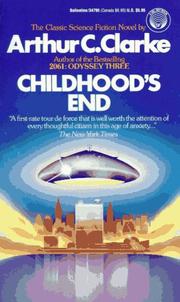
Childhood's End
2,054-word summary 9 min read 224 pages in the book
- First published
- 1953
- Publisher
- Del Rey
- Pages
- 224
- ISBN
- 9780345347954
Reading options
What's inside (10 sections)
I finally read Childhood's End because everyone calls it Clarke's best. Arthur C. Clarke published it in 1953 with Ballantine Books. My reading follows the 224 page Del Rey paperback. Vast ships appear over every city, benevolent Overlords end war and want, and humanity's children drift toward something beyond human. It is short, strange, and oddly moving for a book so cool in tone.
The ships come without warning. Silent, silver, over every capital. The Overlords speak through Secretary General Stormgren, a decent man chosen as go between. Their demands are few and startling. Unify Earth. End poverty. End war. They will govern indirectly, hidden in ships, through broadcasts and rare meetings. With little rebellion, humankind agrees, partly from fear and partly from relief. Someone competent is finally in charge.
The golden age with a cost
Decades pass in a blink of chapters. Poverty fades. Disease retreats. Work becomes optional. Art, science, and play flourish, then strangely stall. With no struggle, humans stop striving for creative greatness. A malaise settles, the kind that follows long Sundays. People live comfortably and feel empty. Clarke, who loved progress, diagnoses its absence with clinical sadness. Utopia without purpose is a waiting room.
Stormgren's thread carries the early book. He meets Karellen, the Supervisor for Earth, who refuses to show himself. Their conversations, polite and weighted, reveal an Overlord who admires humans while pitying them. Stormgren retires, kidnapped once by rebels who want to see the masters, and learns little except that the Overlords hide for a reason that is not shame but mercy. That restraint builds dread better than battles. What do they look like that seeing would wound.
Other viewpoint characters fill the middle. Rupert Boyce, a collector who hosts parties where a medium channels warnings. George Greggson and Jean Morrel, young lovers whose children will matter. Jan Rodricks, restless astronomer who stows away to see the Overlord home world. Each gets a few sharp chapters rather than full arcs. The book is history, not biography. People illustrate ages. Ages are the story.
The Overlords' reveal, when it finally comes, is famous and I will honor first time readers by keeping it brief. They look like humanity's image of devils, an evolutionary echo Clarke ties to the future rather than the past. Children scream. Adults adjust. The reveal matters less than its timing. They waited until humanity could bear it, which tells you they plan in centuries. That patience is the book's true alienness. Humans sprint. Overlords tend.
Children of a new mind
The last generation changes everything. Across Earth, children begin showing psychic abilities, shared dreams, and distance from parents. They gather in colonies, humming together, uninterested in toys or lessons. George and Jean's children, Jeffrey and Jennifer Anne, lead the shift. Parents watch their babies become strangers who love them the way adults love pets. Tenderly. Remotely. That parental grief, rendered in a few devastating scenes, is the book's emotional core. Evolution does not ask permission. It takes your kids.
Clarke handles the transformation without horror theatrics. No possessions, no gore. Just children who no longer need stories, then no longer need parents, then no longer need Earth. They join the Overmind, a vast group consciousness the Overlords themselves serve but can never join. The Overlords are midwives to something greater, brilliant and barren, ferrying species toward a unity they can witness but not enter. Karellen's final lament over a burning Earth is one of science fiction's great sad passages. We who failed in love, he says in effect, envy those who dissolve into it.
Jan Rodricks' voyage supplies the cosmic scale. Hidden aboard an Overlord ship, he travels to their world and sees wonders he can barely describe, then returns to an Earth years changed by relativity. His chapters, with their sense of smallness and awe, balance the domestic grief of the Greggsons. One man sees too much. Two parents lose everything. Both learn humanity was a chrysalis. Chrysalises do not survive butterflies, however beautiful.
What elevates the book past period piece is how it holds two truths. The golden age was real and good. Hunger ended. Cruelty lessened. And it was a nursery, not a home. Comfort prepared children to leave. Parents who enjoyed peace must watch it dissolve their line. That double vision, gratitude plus loss, gives the ending its ache. Clarke does not mock utopia. He mourns its purpose.
Dated pages worth naming
A 1953 novel carries 1953 with it. Gender roles are narrow. Women mostly marry and mother while men govern and voyage. Colonial attitudes color the early chapters, with white saviors guiding a unified Earth. Most jarring for modern readers is a racial slur used in a passage about the silliness of prejudice. Clarke meant to mock racism, but the word lands hard now regardless of intent. New readers should know it is there, brief and ugly, in a book otherwise humane.
Science dates too. Psychic powers as evolution, group minds as destiny, and physics that hand waves star travel will not satisfy hard SF purists. Clarke, later a skeptic who distanced himself from paranormal interests he held while writing, left the metaphysics vague on purpose. If you need rigorous worldbuilding, you will fidget. If you accept mythic logic, the story flows. Read it as parable with rockets, not textbook.
The prose is clear, cool, and efficient. Short chapters. Expository dialogue. Little interiority. That coolness suits Overlords but distances some readers from human grief. The Greggson chapters warm it just enough. A mother brushing a changed child's hair. A father building a useless swing. Those small acts carry more feeling than speeches about destiny. Clarke knew. He placed them carefully.
Length at 224 pages suits the vast scope. No bloat. Some transitions jump decades in a paragraph, which can dizzy. Trust the jumps. The book covers a century the way histories do, with representative scenes. The final pages, with Karellen watching Earth dissolve, read fast because awe pulls. You will finish in two sittings and stare at walls after.
Stormgren, Rodricks, and witnesses
Stormgren's kidnapping episode deserves closer look because it shows human resistance at its best and most futile. Rebels who reject Overlord rule snatch him to force a meeting with Karellen. Blindfolded, threatened, he refuses to help them kill what he does not understand. Karellen rescues him without visible effort, and Stormgren retires with the knowledge that opposition is theater. Some readers find this defeatist. I found it honest about power gaps. When ships hover over every city, rifles are gestures. Clarke, who lived through empire, knew the difference between noble futility and effective action. Stormgren chooses the latter by cooperating toward the best terms available.
Rupert Boyce's party scenes add satirical bite the book needs. Wealthy collectors gather to contact the dead while servants pour drinks, and a medium channels warnings about the Overlords that guests treat as entertainment. Those chapters mock elite curiosity that wants mystery without cost. Years later, when the warnings prove true, no guest remembers laughing. That amnesia stings. People treat prophecy as party game until it bills them. Clarke, a master of phone sized ironies, places these scenes early so their echo lands late.
Jan Rodricks carries the book's adventure gene. Denied space as a child when Overlords banned human spaceflight beyond the moon, he stows away on a supply ship with math, nerve, and luck. His voyage to the Overlord world and back, aged differently by relativity, gives readers the only alien vista in the book. Strange suns. Vast structures. Overlords at home, tender with their own young in ways that reframe their coldness toward us. They are not cruel. They are foster parents with favorites elsewhere. Jan returns to an Earth where everyone he knew aged decades. That price, paid for wonder, asks whether knowing is worth outliving. The book leaves the question open. Wonder costs. Pay or stay home.
The Greggson parents complete the witness set. George and Jean are ordinary, loving, and doomed to watch Jeffrey and Jennifer Anne drift into group mind. Their chapters contain the book's few sustained domestic scenes. Birthday parties where children stare past cake. Bedtimes where humming replaces stories. A final scene where parents are permitted to say goodbye to what their children were, knowing what they become will not remember. I wept quietly at that farewell, the only tears the cool book draws. Clarke earns them by restraint. No speeches. Just a mother brushing hair that no longer needs brushing.
Reading the ending closely
Karellen's final watch over dissolving Earth divides readers and deserves slow reading. The Overlords, barred from joining the Overmind, ferry humanity's children across a threshold they can not cross. Their service is magnificent and sterile. Karellen asks the last human witness what it looks like, this transcendence, and receives images of light and music that words fail. Then Earth melts like wax. That image, beautiful and terrible, refuses comfort about cosmic purpose. Evolution uses species the way readers use books. Finish and discard.
What comforts, if anything, is that the children do not suffer as they go. They play, sing, and merge with joy that frightens parents precisely because it excludes them. Clarke insists joy and loss can share a moment without canceling. The parents grieve. The children rejoice. Both are true. That doubleness is the book's final wisdom and its hardest for grieving readers to hold. Growth takes. Even welcome growth. The last page turns with Karellen alone, which is where the most powerful being in the story started. Alone, watching, unable to join. Power as isolation. That is Clarke's coldest equation, and it balances.
Golden age pleasures and emptiness
Clarke renders the utopia's pleasures with genuine fondness before diagnosing its costs. Free food. Cured disease. Leisure for art and sport. Those chapters read like travel brochures for paradise, and younger readers may wonder why anyone complains. Then he shows artists repeating old forms, scientists confirming known results, and athletes breaking records no one watches. Comfort without challenge starves the part of humans that grows through friction. That observation, written before affluence debates of our century, feels prescient about boredom in plenty. The book asks what struggle is for, then answers through children who leave struggle behind entirely.
Religion's fate under Overlords gets brief, sharp treatment. Faiths fade when suffering ebbs and overlords forbid cruelty done in gods' names. Churches empty without persecution. Clarke, an atheist with curiosity about mysticism, treats this neither as triumph nor tragedy but as data. Humans believed partly to explain pain. Remove pain's worst edges and pews thin. What replaces worship is vague spirituality around the coming children, cults that sense transformation without understanding. Those cults get one chilling chapter where desperate parents offer anything for normal kids. The scene warns how quickly fear becomes ritual when children change. Love panics into prayer.
Overlords as gardeners
Karellen's people deserve final sympathy as the book's most original invention. Vast, devil shaped, gentle, and barren of the transcendence they serve. They rescue species, raise children not their own, and watch playgrounds empty into light they can not enter. Their tragedy mirrors parents everywhere raised to a pitch only science fiction permits. Raise well. Release fully. Remain behind. Clarke, childless himself, imagines parenthood's essence without sentimentality. Care without keeping. That cold equation warms through Karellen's last words, envy and blessing braided. We envied your power to join. Farewell, our wild, beloved children.
Who should ascend
Give Childhood's End to science fiction readers who want classics, to Clarke fans who started with 2001 or Rama, to book clubs that like debating utopia costs. It suits readers comfortable with idea driven fiction and ambiguous transcendence. Do not give it to readers who need character intimacy throughout or hard physics. Pair it with Arthur C. Clarke's short story Guardian Angel, the 1946 seed, to see how a tale grew into a novel.
At 224 pages I read it across a weekend, marking Karellen lines. Humanity starts warring and ends dissolving into mind, guided by devils who were gardeners all along. That turn, feared and tender at once, is why the book endures as alien literature classic. The Overlords could not join what they served. Neither, finally, could we stay what we were. Growing up ends childhood. Clarke shows the bill.
FAQ
When was Childhood's End published?
Ballantine Books published it in August 1953. The Del Rey paperback runs 224 pages and the ISBN is 9780345347954.
Is it part of a series?
No. It stands alone, grown from Clarke's 1946 short story Guardian Angel.
Who leads the Overlords?
Karellen, Supervisor for Earth, who hides for decades before showing a devil shaped form.
Similar books
Out of the Silent Planet
A Cambridge philologist is kidnapped and taken to Mars, where the natives are civilized and the humans are the dangerous invaders.
2,612-word summary · 12 min read
Children of the Mind
Ender's children split across worlds as Jane faces shutdown and Lusitania flees.
2,532-word summary · 11 min read
Solaris
Kelvin reaches a silent station above Solaris and finds grief made solid when the ocean returns his dead wife Rheya, testing memory, science, and the limits of…
2,548-word summary · 11 min read
Xenocide
Lusitania faces a fleet with planet death while Ender, Jane, and families debate virus, souls, and law.
2,647-word summary · 12 min read
Speaker for the Dead
Ender speaks whole truths for alien deaths on a fenced colony where biology confuses murder.
1,992-word summary · 9 min read
Rendezvous with Rama
In 2131 a silent cylinder enters the solar system, and Commander Norton's crew explores its seas and empty cities before Rama seals itself and sails on.
3,108-word summary · 14 min read
Network Effect
Murderbot's contract job turns into a rescue mission when a hijacked research ship and a colony of corrupted colonists appear.
2,256-word summary · 10 min read
The Illustrated Man
A tattooed drifter's moving pictures retell eighteen Bradbury stories of children, rockets, Mars and the last night of the world.
2,791-word summary · 12 min read
A Canticle for Leibowitz
After nuclear war, monks save books across centuries while the world rebuilds and falls again.
2,381-word summary · 11 min read

The Island of Doctor Moreau
Shipwrecked Prendick finds Doctor Moreau shaping beasts into men by pain on lost island.
2,137-word summary · 9 min read
The Dispossessed: An Ambiguous Utopia
Physicist Shevek leaves anarchist Anarres for capitalist Urras to share time theory, finding walls both places.
2,288-word summary · 10 min read
Ringworld
Bored Louis Wu joins alien crew to explore a vast ring habitat around a star.
2,370-word summary · 11 min read
Contact
A radio astronomer catches prime numbers from Vega, helps build a strange machine, and returns with no proof but static.
2,763-word summary · 12 min read
The Long Way to a Small, Angry Planet
Runaway clerk Rosemary joins the Wayfarer crew for a year long tunnel job that tests family and love.
3,295-word summary · 15 min read
The Forever War
Drafted in 1997, physics student William Mandella fights Taurans across collapsars while centuries slip past back on Earth.
3,136-word summary · 14 min read
The Man in the High Castle
In a 1962 America split between Japan and Germany, an antiques dealer, a craftsman, and a judo teacher cross paths over a banned novel claiming the Allies won,…
2,317-word summary · 10 min read
Starship Troopers
Rico earns citizenship through Mobile Infantry drops against Bugs.
2,071-word summary · 9 min read
Life, the Universe and Everything
Arthur in slippers must stop cricket robots from rebuilding the Wikkit Gate.
2,216-word summary · 10 min read
Hyperion
Seven pilgrims cross Hyperion telling tales of faith, war, and time while the Shrike waits at the Tombs.
1,996-word summary · 9 min read
The Restaurant at the End of the Universe
Arthur Dent flees Vogons, dines at Milliways at the end of time, and strands on prehistoric Earth in Adams' sharp 1980 sequel.
2,749-word summary · 12 min read
Stranger in a Strange Land
A Mars-raised man lands on Earth, learns religion and love, and founds a church that shocks everyone.
2,725-word summary · 12 min read
Do Androids Dream of Electric Sheep?
Bounty hunter Rick Deckard retires escaped androids in ruined San Francisco while doubting what empathy still means.
2,841-word summary · 13 min read
The Hitchhiker's Guide to the Galaxy
Douglas Adams' Hitchhiker's Guide retold: Earth's end, Ford, Zaphod, Marvin, and the answer 42.
2,253-word summary · 10 min read
Ender's Game
Ender Wiggin trains at Battle School to fight the Formics, winning games that turn out to be real.
2,039-word summary · 9 min read
Brave New World
Huxley's Brave New World retold: hatcheries, soma, Bernard and Lenina, John the Savage, and the lighthouse.
2,513-word summary · 11 min read
2001: A Space Odyssey
A black slab nudges apes to tools, calls Floyd to the Moon, and pulls Bowman past HAL toward Saturn and a strange rebirth.
2,982-word summary · 13 min read
Rosencrantz and Guildenstern Are Dead
Stoppard's 1966 play retells Hamlet from the wings, where two minor courtiers wait, joke, and walk toward a death they cannot see.
2,021-word summary · 9 min read
Prelude to Foundation
A young Hari Seldon arrives on Trantor with a theory he cannot yet prove, and a hunt through the planet-city forces him to turn psychohistory into a real…
2,013-word summary · 9 min read
Foundation's Edge
Exiled councilman Golan Trevize hunts for the Second Foundation and the lost world of Earth, and finds a planet with one mind waiting to change the galaxy.
2,335-word summary · 10 min read

Fathers and Sons
Arkady brings the nihilist Bazarov home to his father's estate, and a generational argument turns into love, a duel, and an early death.
2,192-word summary · 10 min read