
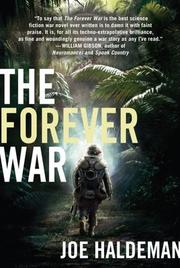
The Forever War
3,136-word summary 14 min read 288 pages in the book
- First published
- 1974
- Publisher
- St. Martin's Press
- Pages
- 288
- ISBN
- 9780312536633
- Series
- The Forever War (#1)
Reading options
What's inside (8 sections)
I picked up The Forever War because I kept seeing it shelved next to Starship Troopers, and I wanted to know why one book about powered armor reads like a recruiting poster and the other reads like a long sigh. Joe Haldeman published it in 1974 through St. Martin's Press, after writing it as his MFA thesis for the Iowa Writer's Workshop and running it as a serial in Analog Magazine. It went on to win the Nebula in 1975 and both the Hugo and the Locus in 1976. The edition I am working from is the 288 page St. Martin's Griffin paperback with ISBN 9780312536633, which includes the restored middle section and a foreword by John Scalzi.
Haldeman served in Vietnam. That fact sits behind every page. The hero, William Mandella, has a name that is almost an anagram of the author's own, and he studies physics just as Haldeman did. The woman Mandella loves, Marygay Potter, carries a name close to Haldeman's wife's maiden name. None of that would matter much if the book did not feel lived in, but it does. The training accidents feel like accidents. The boredom between battles feels like boredom. The homecomings feel like the worst part of the war, which is exactly what a lot of returning veterans said about coming back from Southeast Asia to an America that had moved on without them.
The setup is simple and cruel. Haldeman gives humanity collapsars, points in space where ships can jump thousands of light years in a split second, and then charges full price for using them. Getting to and from a collapsar means long runs at near light speed. Relativistic time effects do the rest. A soldier can fight for two years by his own calendar and come home to find that decades have passed on Earth. Do that a few times and you are a stranger everywhere. The enemy is the Taurans, a species blamed for destroying human colony ships. Whether they actually did it is a question the book holds back for a very long time.
Conscripted for being smart and healthy
The war finds Mandella in 1997. He is a physics student, bright and fit, which turns out to be terrible luck. The United Nations Exploratory Force wants elite troops for its revenge campaign, so it drafts people with IQs of 150 and above who are educated, healthy, and young. Being clever gets you a rifle instead of a deferment. Mandella reports with a sour awareness that none of his advantages will protect him. He can do the math on relativity. He knows what the math implies.
Training comes in two stages, first on Earth and then on a brutal cold planet called Charon, out past Pluto. A quick note, since readers sometimes trip on this: this Charon is not Pluto's moon. That moon had not been discovered yet when Haldeman wrote the book. This Charon is a fictional frozen world the army uses because it wants soldiers broken in by real cold and real danger. Recruits die during training. Live weapons, thin margins, instructors who treat safety briefings as suggestions. Haldeman does not stage these deaths as noble sacrifices. They read as waste, which is the point. The army needed bodies that could think, and it spent some of them before they ever saw an enemy.
Marygay Potter enters here, and she matters more than almost anyone else in the book. She is another recruit, sharp and steady, and she and Mandella pair off during the grind of training. Their relationship never plays like a standard war novel romance where the girl waits at home with letters. Marygay trains, freezes, shoots, and ships out alongside Mandella. They learn the same drills. They take the same risks. When the army later tries to split them up, the loss lands hard because she was never a symbol. She was a fellow soldier who happened to love him.
The suits deserve a mention because they are the detail most readers carry over from Heinlein comparisons. These are powered fighting suits, sealed and strong, with medical systems and weapons built in. Haldeman writes them the way someone writes about gear he actually wore: heavy, awkward, lifesaving, always slightly wrong. Seals chafe. Readouts lie at the worst moment. A suit keeps you alive on a world that wants you dead, and then it tries to kill you itself through malfunction or overheating or simple exhaustion. Soldiers name their complaints the way infantrymen always have. The technology is futuristic. The griping is eternal.
First blood, and it is not heroic
The first expedition goes out through the collapsars toward a planet orbiting Epsilon Aurigae, and what happens there sets the moral temperature for the whole novel. The humans have been given post hypnotic training, planted reflexes meant to turn on in combat. When contact with the Taurans finally happens, the programming fires and the humans massacre the aliens. The Taurans offer little resistance in that first encounter. It reads less like a battle and more like an execution the soldiers watched their own hands perform.
Haldeman does not let Mandella off with excuses. The men and women on the ground are shaken, and then they are ordered to move on as if shaking were unprofessional. That sequence stuck with me because it refuses the usual science fiction pleasure of the clean first victory. There is no tactical genius on display. There is conditioning, surprise, and killing at close range. Mandella survives. Survival starts to feel like an accusation.
The second battle corrects any idea that the war will be easy. The Taurans have better weapons now. Haldeman calls the effect future shock, and he means it literally. Because of time dilation, each side meets an enemy that has had decades or centuries to improve between engagements. You train against last war's guns and walk into next war's guns. Soldiers die learning lessons their replacements will also have to die learning, because by the time the lesson travels home, the guns have changed again. It is an arms race where the track itself keeps stretching.
That first tour lasts about two years for the soldiers living it. When they get back to Earth, the date is 2024. Mandella left in 1997. Twenty seven years went by while he aged two. Sit with that for a moment, because the whole novel grows out of it. Everyone he knew is older or gone. The culture kept walking. He did not get to walk with it.
You can never go back, and the book proves it
The homecoming chapters are my favorite part of the novel, and they are the reason the restored middle section matters. Early paperback editions, cut down for space by the original editor, dropped a whole novella's worth of material here, including a piece titled You Can Never Go Back. The 1997 Avon version Haldeman called definitive put it all back, and the St. Martin's Griffin edition I cite includes it. Read a pre 1991 copy and you get a shorter, stranger book. Read the full text and the middle lands like a second novel about defeat.
Earth in 2024 is crowded, poor in patches, and dangerous in ways Mandella did not expect. Overpopulation has driven rationing fights and class wars. Jobs are scarce. Weapons are easy to get. Whole cities feel like they are holding their breath. The strangest change, to Mandella at least, is sexual. To curb population growth, many nations officially encourage homosexuality, and the culture has shifted hard in that direction. Mandella and Marygay are heterosexuals in a world that now treats their orientation as old fashioned at best. Haldeman wrote this in the early seventies, and modern readers will find his handling blunt. Some passages read as clinical. Some read as if the author is working through his own confusion in public. But the story purpose is clear enough: the veterans are sexual minorities now on top of being temporal minorities, and fitting in gets harder from two directions at once.
Money adds insult. Military pay accrued over decades of Earth time has been eaten by inflation and strange economics, so the heroes come home neither rich nor honored. Mandella tries to find his family and finds instead how thin the thread has become. His mother is changed. His brother is gone down a path Mandella cannot follow. Conversations keep snagging on references he never learned. Slang, food, manners, the million small protocols that tell you that you belong somewhere. He misses all of them. Marygay has a parallel version of the same failure. They cling to each other because each is the only person who remembers the world the other came from.
So they do what alienated veterans in this universe do. They reenlist. It is not patriotism. The casualty rate is appalling and they know the military is a cold machine. It is that civilian life has no slot for them and the army at least feeds them and gives them somewhere to stand. The brass promises them instructor postings on Luna, safe jobs training recruits. Mandella and Marygay accept, grateful for any stable floor. When they arrive, the orders have changed. They are going back into combat command instead. The betrayal is bureaucratic rather than dramatic, a stamp on a form, which makes it feel more real than any villain speech would.
Commanding soldiers from a future he never met
This is where the novel turns truly strange, and where Haldeman's central trick pays off again and again. Mandella keeps surviving. Almost entirely through luck, as the book keeps insisting, he lives through tour after tour while centuries pile up on Earth. Each return takes him further from anything he recognizes. Promotions arrive through seniority rather than ambition. He becomes, by the objective calendar, the oldest surviving soldier in the war, a major and then more, a man whose experience is ancient history to the troops he leads.
Marygay gets separated from him by the ordinary cruelty of assignments. Different postings mean different time dilation, which means even if both of them live, they may never meet again. Their timelines fork. One of them could age ten years while the other ages a hundred. Haldeman stages this without melodrama. Orders come down. Ships leave. Math does the rest. Mandella briefly considers suicide when the loss settles in, and the scene works because it is quiet. He does not make a speech. He looks at the numbers and sees no path back to the one person who anchors him.
The troops he commands late in the war barely share his language. They speak a version of English so changed that Mandella sounds like a museum piece to them, and they had to learn twenty first century English just to take his orders. They are close to uniform in background, described as vaguely Polynesian in appearance after centuries of mixing and drift. And they are, nearly to a person, homosexual by orientation and culture. Mandella, a heterosexual relic, senses their dislike and assumes it comes from the friction of translation and from his difference. He may be right. He may also be misreading people whose world he cannot enter. Haldeman leaves that ambiguity hanging, which is honest. Old soldiers often cannot tell whether the young resent them or simply cannot see them.
Combat changes too. Late in the book, Mandella leads a strike force that has to fight inside a stasis field, a zone that shuts down electromagnetic radiation in anything not coated with special protection. Guns stop working. Sensors go blind. Energy weapons become expensive paperweights. So the soldiers go in with medieval weapons, spears and swords and arrows, wearing protective coatings, hacking at Taurans in a bubble where physics has been switched back eight hundred years. It sounds silly in summary. On the page it is terrifying, because all the distance of future war collapses into arm's length. You can hear the person you are killing. Haldeman, who knew what close combat does to people, writes these passages with a flat affect that makes them worse. No heroics. Just panting, slipping, and trying not to die in a field where nobody's radio works.
The longest war ends with a conversation
After more than a thousand years of Earth time, the war stops. The ending hinges on cloning. Humanity has, over the centuries, begun cloning itself into a collective species that calls itself simply Man. The Taurans turn out to be clones as well, a group mind shaped by shared biology. Once humans exist in a form that can actually perceive how Taurans think, communication becomes possible for the first time. And what they learn is devastating in its plainness.
The colony ships whose destruction started the war were not attacked. They were lost to accidents. People on Earth with reasons to want a war, money reasons, power reasons, used the disappearances as an excuse to start one. Every death after that, across a thousand years and countless worlds, grew out of a lie told to people who wanted a reason to fight. The Taurans never understood what humans wanted because humans never tried to learn what Taurans were. Two species killed each other across the stars over a misunderstanding neither side could name.
I will not pretend this revelation arrives with perfect logic. Readers who like hard answers about first causes may find it thin. Haldeman gestures at conspiracies and profiteers without giving them faces. But the emotional logic holds. Wars that start in confusion tend to continue through inertia. Each side's dead become the reason for the next attack. By the time anyone thinks to ask what the first dead died for, the answer has rotted away. Vietnam hangs over this without ever being named. So do all the wars that outlived their stated reasons.
Man, to its credit in the book's terms, keeps a fallback. Several colonies of old style heterosexual humans are maintained in case the collective experiment proves to be a mistake. Mandella, discharged as a leftover, travels to one of them. In the definitive text the colony is called Middle Finger, a name that tells you plenty about how its settlers feel toward the center of human civilization. And there, through a combination of planning and stubborn hope, Marygay is waiting. She was discharged much earlier and spent her years taking trips in space, using time dilation in reverse, aging slowly while the universe rushed past, holding herself in reserve for a man who might never come back. The epilogue is a small news item dated 3143 announcing the birth of a fine baby boy to Marygay Potter Mandella. After all that killing, the book closes on a birth notice. I found that corny and moving in equal measure, which seems like the response Haldeman wanted.
What holds up and what creaks
The combat writing holds up. Haldeman never shows off. His sentences about suits, jumps, and wounds are plain and specific, and the plainness makes horror land harder. The collapsar system remains one of the cleanest science fictional machines for producing tragedy. It needs no villain. Physics does the killing. Every jump costs years. Every victory expires before the news gets home. That is a better engine for an anti war novel than any evil empire, because nobody can resign from relativity.
Mandella as a narrator holds up too, at least for long stretches. He is tired without being dull, observant without pretending to understand everything. His romance with Marygay earns its weight because Haldeman lets them be competent together rather than decorative. Their separations hurt because the book showed us two people who worked as a team, not two beautiful faces exchanging vows.
What creaks is everything around sex and society, and readers should go in ready. The future's enforced homosexuality reads now like a seventies straight man's thought experiment, sometimes curious and sometimes clumsy. Gay readers have pointed out, fairly, that the book treats their lives as a symptom of social engineering rather than as lives. Women beyond Marygay get thin treatment. The Taurans stay blank for most of the book by design, but blankness kept up for two hundred pages starts to feel like a gap rather than a choice. And the episodic structure, a natural result of time skips, means some campaigns blur together. You will remember Charon, Epsilon Aurigae, the stasis field fight, and Middle Finger. The stops between may smear.
The prose itself is spare to the point of flatness in places. Haldeman rarely reaches for striking images. If you came to science fiction through lush stylists, his sentences may feel like field reports. I came to like the flatness. It suits a man filing accounts of things he would rather forget. But readers who want verbal music should adjust expectations. This is a book that trusts structure over sentences.
One more honest note. People often ask whether to read this or Starship Troopers first. Read both, but read Heinlein second if you can, or reread him after. Heinlein's 1959 novel argues that service earns citizenship and that the infantry builds men into citizens. Haldeman, who admired Heinlein's craft and said so, answered with a book where service earns estrangement and the infantry builds men into relics. Heinlein wrote back to congratulate him on the Nebula, and reportedly told him at the banquet that it might be the best future war story he had ever read. That generosity from a man whose ideas were being argued with tells you something about the field at its best. Disagreement as respect. A war story answered by a soldier who had seen a different war.
I finished the Griffin edition on a quiet weekend and sat with the birth notice at the end for a while. After a thousand year war caused by accident and sustained by stubbornness, one child gets born to two very old young people on a colony with a rude name. Haldeman does not claim this fixes anything. Man goes its collective way. The dead stay dead. But two people who learned to keep each other alive in powered suits get to try ordinary life at last, centuries late and right on time. For a book so cold about institutions, it is surprisingly tender about that. Keep the flat sentences, the dated edges, the smeared middle campaigns. They are the cost of the parts that still cut. When Mandella steps off the ship into a world that does not know him, and squares his shoulders for another briefing in a language he barely speaks, you understand exactly what the title means. The war never ends because the fighting stops. It ends, if it ends, when someone finally asks what it was for.
FAQ
What is the plot of The Forever War in brief?
It follows William Mandella from his drafting in 1997 through a war that lasts over a thousand years of Earth time, ending with his reunion with Marygay Potter on the colony called Middle Finger.
Is The Forever War about the Vietnam War?
Yes. Haldeman served in Vietnam, and the book channels that experience through Mandella, including the shock of coming home to a country that feels foreign. Heinlein still praised it and called it possibly the best future war story he had read.
Is The Forever War the first book in a series?
Yes, it opens The Forever War series. The direct sequel is Forever Free, and Forever Peace is a related book set in the same universe. Start here.
Similar books
More from The Forever War first, then related titles.
Childhood's End
Silver ships end war and want while Overlords midwife humanity's children into something beyond human.
2,054-word summary · 9 min read
Old Man's War
At 75, John Perry joins the army for a new body and a brutal war over colonies.
2,636-word summary · 12 min read
Slaughterhouse-Five
Billy Pilgrim slips through time from Dresden to Tralfamadore in Vonnegut's short antiwar classic.
2,722-word summary · 12 min read
Ender's Game
Ender Wiggin trains at Battle School to fight the Formics, winning games that turn out to be real.
2,039-word summary · 9 min read

Sophie's Choice
A young Southern writer in 1947 Brooklyn befriends a brilliant, unstable couple and slowly learns the story of the Polish Catholic woman at the center of their…
2,798-word summary · 12 min read
Leviathan
In an alternate 1914, a prince on the run and a girl disguised as a soldier meet aboard a living airship.
2,406-word summary · 11 min read
Consider Phlebas
The first Culture novel follows a spy for the opposing side, a man hired to hunt a fugitive through a war between an anarchist post-scarcity utopia and a…
2,350-word summary · 10 min read
Network Effect
Murderbot's contract job turns into a rescue mission when a hijacked research ship and a colony of corrupted colonists appear.
2,256-word summary · 10 min read
The Last of the Mohicans
During the French and Indian War, Hawkeye and two Mohican warriors try to save two British sisters from a Huron chief whose revenge will end the Mohican line.
2,017-word summary · 9 min read
The Ask and the Answer
Todd and Viola are separated in occupied Haven, where the Mayor's Ask tortures suspects and the Answer plants bombs in the name of freedom.
2,265-word summary · 10 min read
Out of the Silent Planet
A Cambridge philologist is kidnapped and taken to Mars, where the natives are civilized and the humans are the dangerous invaders.
2,612-word summary · 12 min read

Doctor Zhivago
A doctor and poet lives through revolution, war, and love in Pasternak's novel of private life under the pressure of Russian history.
2,213-word summary · 10 min read
We
In a city of glass ruled by the Benefactor, a state engineer building a spaceship falls for a woman who wants to tear the One State down.
2,247-word summary · 10 min read
The Illustrated Man
A tattooed drifter's moving pictures retell eighteen Bradbury stories of children, rockets, Mars and the last night of the world.
2,791-word summary · 12 min read
The Caves of Steel
Detective Elijah Baley must solve a Spacer's murder in a domed New York, partnered with R. Daneel Olivaw, a humaniform robot built in the victim's image.
2,445-word summary · 11 min read
A Connecticut Yankee in King Arthur's Court
Hank Morgan, a Connecticut factory man, wakes in King Arthur's England, rises to chief adviser, and rebuilds the kingdom until his own inventions turn on him.
2,193-word summary · 10 min read
The Rise of Nine
John, Six and Nine race to India to find Eight before the Mogs strike.
2,321-word summary · 10 min read
The Red Badge of Courage
Henry Fleming runs at Chancellorsville, then returns to stand.
2,486-word summary · 11 min read
The Day of the Triffids
Blinded survivors flee carnivorous plants after a meteor shower.
2,171-word summary · 10 min read
Children of the Mind
Ender's children split across worlds as Jane faces shutdown and Lusitania flees.
2,532-word summary · 11 min read

A Canticle for Leibowitz
After nuclear war, monks save books across centuries while the world rebuilds and falls again.
2,381-word summary · 11 min read

Solaris
Kelvin reaches a silent station above Solaris and finds grief made solid when the ocean returns his dead wife Rheya, testing memory, science, and the limits of…
2,548-word summary · 11 min read
Iron Gold
Ten years after victory, Darrow and new rebels face peace that feels like another war.
2,158-word summary · 10 min read
Cryptonomicon
Codebreakers in World War II and hackers in the 1990s chase gold, ciphers, and a secret data haven.
2,280-word summary · 10 min read

The Island of Doctor Moreau
Shipwrecked Prendick finds Doctor Moreau shaping beasts into men by pain on lost island.
2,137-word summary · 9 min read
The Dispossessed: An Ambiguous Utopia
Physicist Shevek leaves anarchist Anarres for capitalist Urras to share time theory, finding walls both places.
2,288-word summary · 10 min read

The Aeneid
Trojan Aeneas flees burning Troy for Italy, losing Dido and friends before warring to found a line that becomes Rome.
2,080-word summary · 9 min read
Ringworld
Bored Louis Wu joins alien crew to explore a vast ring habitat around a star.
2,370-word summary · 11 min read
Armada
Gamer Zack learns Armada game trains real defense against alien Europans.
2,004-word summary · 9 min read

A Wind in the Door
Meg must save Charles Wallace from a cosmic sickness by naming and loving what she fears, helped by a cherubim called Progo.
2,214-word summary · 10 min read