
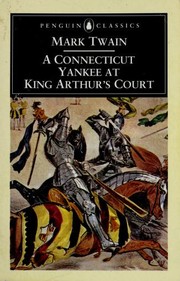
A Connecticut Yankee in King Arthur's Court
2,193-word summary 10 min read 575 pages in the book
- First published
- 1889
- Publisher
- Charles L. Webster and Company
- Pages
- 575
- ISBN
- 9780140430646
Reading options
What's inside (10 sections)
I picked this up right after Tom Sawyer and Huckleberry Finn, expecting more of the same riverbank humor. Mark Twain, a practical American, dropped into the age of knights. Jokes about armor and horses, a few laughs, done. The first half does give you that. Then the second half starts killing people in industrial quantities, and by the last page a man lies dying in a fever dream, reaching across thirteen centuries for a wife and child he will never see again. That swerve is why the book still gets argued over. It is a comedy that keeps its smile fixed while something ugly moves underneath.
The facts place it. It came out in 1889 from Charles L. Webster and Company, Twain's own publishing house, in a first edition of about 575 pages with illustrations by Daniel Carter Beard. Twain wrote most of it at his summer house in Elmira, New York and finished it in Hartford. The book opens with a frame: an unnamed narrator touring Warwick Castle meets a strange fellow who claims to be a knight and keeps slipping into odd talk. The stranger turns out to be Hank Morgan, and the narrator reads Hank's manuscript. That frame matters. It means the whole story is a document someone left behind, not a live adventure, and we are warned from the first pages that it ends badly.
A crowbar to the head
Hank Morgan is a nineteenth century factory man from East Hartford, Connecticut. He runs a Colt arms works with two thousand men under him, a boss who understands machinery, production, and how to move a schedule forward. During a scuffle a worker named Hercules cracks him on the skull with a crowbar. When Hank opens his eyes he is lying under an oak tree, and the countryside looks old in a way he cannot place. He meets Sir Kay, who challenges him to a joust. Hank, unarmed and unarmored, does the sensible thing and scampers up a tree. Kay takes him prisoner and drags him toward Camelot.
At court Hank is laughed at for his clothes and his talk. Merlin is the loudest of the mockers. Arthur, unimpressed, sentences the stranger to burn at the stake on the twenty first of June. Hank has one thin card to play, and he nearly fumbles it.
The eclipse and the Boss
Back in the nineteenth century Hank happened to learn about a solar eclipse visible in the year 528. Sitting in his cell, he sends a boy he renames Clarence to tell the king that he can blot out the sun. There is one problem. Hank believes the date is June the twentieth, but it is already the twenty first, the very day of the eclipse. As they tie him to the stake and light the wood, the sky goes dark on its own. The crowd falls to its knees. Hank, surprised as anyone, quickly takes credit, threatens worse, and bargains his way free.
From there he becomes the second most powerful man in Britain, feared and half worshipped. He gives himself a modest title, "The Boss," and a strange salary: a cut of any increase in the kingdom's wealth that his schemes produce. Merlin, who has lost his place at the king's side, begins telling anyone who will listen that the newcomer is a fraud. Hank answers with staged miracles. He builds a lightning rod, wires it to buried charges under Merlin's tower, announces that he will call fire from heaven, and lets nature do the rest. The tower falls, Merlin shrinks a little more, and the crowd believes harder.
Schools, factories, and a patent office
What I like about Hank is that he does not just perform magic. He starts building. Behind the backs of the nobility he sets up schools that teach modern English and modern thinking, factories that turn out tools and weapons, a telephone line, a telegraph, a patent office, newspapers, and training for young people he handpicks. He is quietly raising a generation that will not kneel to lords. His real project is not comfort. It is democracy, and he knows it has to be grown rather than announced.
The disguise does not always hold. He travels the country dressed as a commoner to see how ordinary people live, and Arthur, curious and a little guilty, comes with him. The king is hopeless at playing a peasant. He blurts out opinions about farming that no farmer would hold, and the two of them get run out of a village. Later they are captured, enslaved, and sold in London, and it falls to Lancelot and a band of knights on bicycles to rescue them. That stretch is one of the strangest and best in the book. Arthur sees, with his own eyes, what his laws do to the poor, and comes away changed.
The old order does not go quietly. Sir Sagramore challenges Hank to a duel to be fought after he returns from the quest for the Holy Grail. When the day comes, Hank beats him and several other knights with a lasso, a trick so far outside their world that it looks like sorcery. Merlin steals the lasso to help his side. Sagramore comes back for another round. This time Hank shoots him. When the rest of the knights charge together, he drops nine more with a revolver before the others break and run. It is funny for about a page. Then you notice what it is.
The quest with Sandy
Before the violence catches up, Hank goes on the kind of adventure the book is supposedly about. A wandering girl asks him to free her mistress and the lady's sisters from captivity. Hank can barely follow her speech, which is a wall of ornate medieval talk, so he renames her Sandy, short for the Demoiselle Alisande a la Carteloise, and sets off with her. They pass through the lands of Morgan le Fay, who keeps a gallery of her defeated enemies and has a taste for careless cruelty that turns Hank's stomach.
The great reveal of the quest is that the ogres and castles and captive princesses are really pigs in a pen, belonging to some swineherds. Sandy, who sees the world through story, still sees royalty. Hank buys the pigs to keep the peace and they move on. I laughed, then felt the point land. These people do not just live inside a myth. They cannot see past it, and Hank keeps colliding with that.
On the road they reach the Valley of Holiness, where a famous fountain has gone dry. Merlin has already tried and failed to fix it, then declared the spring cursed by a demon so he can save face. Hank brings in a pump and a crate of fireworks, gets the water flowing, and stages a demon banishment loud enough to satisfy everyone. Later he humiliates a so called prophet who claims to know what everyone in the world is doing, simply by telephoning ahead and knowing that the king is riding out to see the fountain. Magic, it turns out, is mostly better information.
The Boss against Merlin
The feud with Merlin runs under everything. The old wizard cannot beat Hank with spells, so he waits, and he works on the one thing Hank cannot control: the Church. Between the two men is a larger fight, the contest between a future built on knowledge and an institution built on fear. Hank's schools and factories chip away at the power of the priests, and the priests understand exactly what he is doing.
Three years on, Hank has married Sandy and they have a baby. Sandy, hearing her husband murmur a name in his sleep, christens the girl Hello Central, believing it must be the name of his lost love. It is actually how Hank used to greet the telephone operator back home. The misunderstanding is played for a laugh, and then the baby falls ill, and the laugh curdles. Doctors advise a sea voyage while the child recovers. It is a trap. The Church wants Hank out of the country, and he goes.
While Hank is away, the old story catches up with Camelot. Arthur learns of Guinevere's betrayal with Lancelot. The quarrel turns into war, and Arthur is killed by Mordred. The Church, now frightened of Hank's wealth and reach, places the land under an interdict, which turns the people against everything he built. He has taught them to want a freer life, and now they are told that life is a sin.
This is where Twain turns. The novel has been joking its way toward progress, and the last chapters take that hope and break it on the floor.
The Battle of the Sand Belt
Hank races home to a country in revolt. Clarence has gathered fifty two teenage cadets and fortified Merlin's Cave with a minefield, a wire fence carrying electric current, and a battery of Gatling guns. The Church sends an army of thirty thousand knights. The cadets hold the line and the guns do the rest. It is a slaughter, not a battle. The knights die in rows, and the rows pile into a wall that traps the defenders inside their own fortification.
Then the second killing starts. The corpses breed disease, and the sickness spreads through the cave. Hank, sickened by what he has done, goes out to help a wounded man and is stabbed in the side. The man he tried to save turns out to be Sir Meliagraunce. Hank survives the wound but is bedridden, and the fever takes the camp around him. Clarence finds Merlin leaning over the sleeping Hank, weaving a spell to make him sleep for thirteen hundred years. Merlin laughs himself half mad, wanders onto the electric wire, and is killed by the very invention that finished him. Clarence and the cadets, as far as we can tell, die where they sit.
The nineteenth century at the end
The frame closes the loop. The narrator, back in the present, finishes reading the manuscript and finds Hank dying in a hotel room, dreaming about Sandy and calling out for her. He tries to perform one last effect with his hand and dies before it is finished. The last line leaves him stranded: an abyss of thirteen centuries yawning between them, which he says is worse than death. A book that began with a joust and a tree ends with a man in a bed, a thousand years from the woman he loves and the child he lost.
What works and what does not
Fair warning about the middle. The quest with Sandy runs long, and her dialect, spelled out phonetically on almost every line, is a chore to read. Twain does it to show how foreign the past sounds to a modern ear, and he makes the joke, but it wears thin over dozens of pages. The Arthurian pastiche, lifted partly from Malory's Le Morte d'Arthur, can feel like a museum case that Twain keeps stopping to dust. If you want the plot to move, there are stretches where it does not.
The satire is sharper than the story in places. Twain is furious about inherited rank, about a Church that sells fear, about poor men told to be meek while their lords live off the work of their hands. He is also, and you have to sit with this, a believer in what he calls progress, and Hank's America comes into the past as a gift that turns out to be a gun. The book asks whether a clever man with good intentions should drag a people into the future whether they want it or not, and the bodies in the cave are Twain's answer. George Orwell hated the book for exactly this, calling it a flattery of the worst in American life. I would not go that far, but I see what he was pointing at. The hero never stops being sure he is right, and the book is honest enough to punish him for it while still mourning him.
There is also the matter of tone. The comedy and the horror do not always sit together comfortably. A chapter of slapstick can land right before a chapter of massacre, and the shift gives some readers whiplash. I think the whiplash is the point. Twain starts by laughing at the silly costumes of feudalism and ends by making you see its cruelty, and the swing from one to the other is the argument he is making.
Who should read it. If you like Twain's voice and you are willing to take the dark with the funny, this is one of his strangest and most interesting books, and it is a genuine ancestor of every time travel story where a modern person is thrown into the past. If you want a light adventure, know that the light does not last. Read the first half for fun, and read the last chapters slowly, because that is where a comic novel turns into something that still has teeth.
FAQ
When was A Connecticut Yankee in King Arthur's Court first published?
In 1889 by Charles L. Webster and Company, Mark Twain's own publishing house. The first edition ran about 575 pages with illustrations by Daniel Carter Beard.
What is A Connecticut Yankee in King Arthur's Court about?
A nineteenth century factory superintendent from Connecticut named Hank Morgan is knocked back in time to King Arthur's England. He becomes the king's chief adviser and tries to modernize the kingdom, which leads to his downfall.
Is the book a comedy or a dark story?
It is both. It opens as a broad satire of chivalry and medieval life, then turns very bleak in the final chapters, ending with the Battle of the Sand Belt and a dying Hank reaching for a family thirteen centuries away.
Similar books
Breakfast of Champions
A Pontiac dealer breaks down while a broke sci-fi writer brings the book that tells him others are robots.
2,013-word summary · 9 min read
The Adventures of Tom Sawyer
Tom Sawyer skips school, chases Becky Thatcher and sees Injun Joe kill in a graveyard on the Mississippi.
3,439-word summary · 15 min read
Out of the Silent Planet
A Cambridge philologist is kidnapped and taken to Mars, where the natives are civilized and the humans are the dangerous invaders.
2,612-word summary · 12 min read
We Are Legion (We Are Bob)
A dead software engineer wakes up as a self-replicating space probe, clones himself into a squabbling fleet of Bobs, and tries to keep a ruined Earth alive.
2,357-word summary · 10 min read
Redshirts
Ensigns realize they die to serve a bad TV show's narrative.
2,152-word summary · 10 min read
An Absolutely Remarkable Thing
Hank Green's An Absolutely Remarkable Thing follows artist April May after she and Andy film a giant Carl robot in New York that appears in cities worldwide…
2,699-word summary · 12 min read
The Island of Doctor Moreau
Shipwrecked Prendick finds Doctor Moreau shaping beasts into men by pain on lost island.
2,137-word summary · 9 min read
The Eyre Affair
Literary detective Thursday Next chases a villain who kidnaps Jane Eyre from her own novel in an alternate 1985 England.
1,929-word summary · 9 min read
Post Office
Chinaski drifts through postal shifts, cheap rooms, horse tracks and rough love in Bukowski's 1971 debut about work, drink and survival.
2,444-word summary · 11 min read
Mostly Harmless
Arthur makes sandwiches on Lamuella while Ford steals a Guide Mk II that wipes Earths across realities.
2,059-word summary · 9 min read
Mrs. Frisby and the Rats of NIMH
A widowed mouse races the spring plow to save her sick son Timothy, and finds help from the intelligent rats of NIMH hiding under the rosebush.
3,159-word summary · 14 min read
Pippi Longstocking
A super-strong nine-year-old lives alone in Villa Villekulla, upending school, circus and town rules with neighbors Tommy and Annika.
3,115-word summary · 14 min read
Timeline
Historians testing a quantum fax get stuck in 1357 France and must survive siege and swords.
2,109-word summary · 9 min read
Journey to the Center of the Earth
A professor, his nephew, and a guide climb into an Icelandic volcano to reach the center of the earth.
1,902-word summary · 8 min read
Life, the Universe and Everything
Arthur in slippers must stop cricket robots from rebuilding the Wikkit Gate.
2,216-word summary · 10 min read

Kindred
Dana pulled from 1976 to slave Maryland must save Rufus who owns her kin.
2,244-word summary · 10 min read
Twenty Thousand Leagues Under the Sea
A monster hunt finds Nemo submarine, and three captives tour seas they cannot leave.
2,022-word summary · 9 min read
The War of the Worlds
A Surrey writer watches Martians land in cylinders, march on London in tripods, and fall to Earth's smallest life.
2,667-word summary · 12 min read
The Restaurant at the End of the Universe
Arthur Dent flees Vogons, dines at Milliways at the end of time, and strands on prehistoric Earth in Adams' sharp 1980 sequel.
2,749-word summary · 12 min read
Gulliver's Travels
A ship's surgeon meets tiny Lilliputians, giant Brobdingnagians, Laputa's projectors, and rational horses in Swift's 1726 satire.
2,600-word summary · 12 min read
James and the Giant Peach
Lonely James escapes two cruel aunts inside a giant peach with huge insect friends, rolling to the sea and floating on gulls to New York City.
2,384-word summary · 11 min read
The Time Machine
Wells sends a Victorian inventor to the year 802,701, where idle Eloi and blind Morlocks share a dark human fate.
2,335-word summary · 10 min read
The Princess Bride
Buttercup loses Westley to pirates and is forced to marry Prince Humperdinck in Florin.
3,412-word summary · 15 min read
Catch-22
Yossarian tries to survive Pianosa bombing runs while the catch traps him.
3,764-word summary · 17 min read
A Wrinkle in Time
Meg Murry, Charles Wallace and Calvin tessar past Mrs Whatsit, Mrs Who and Mrs Which to Camazotz to free Mr Murry from IT.
2,055-word summary · 9 min read
The Hitchhiker's Guide to the Galaxy
Douglas Adams' Hitchhiker's Guide retold: Earth's end, Ford, Zaphod, Marvin, and the answer 42.
2,253-word summary · 10 min read
Slaughterhouse-Five
Billy Pilgrim slips through time from Dresden to Tralfamadore in Vonnegut's short antiwar classic.
2,722-word summary · 12 min read
Brave New World
Huxley's Brave New World retold: hatcheries, soma, Bernard and Lenina, John the Savage, and the lighthouse.
2,513-word summary · 11 min read
The Prince and the Pauper
Tom Canty and Prince Edward swap clothes in Tudor London and live each other's lives, from palace dinners to prison cells, until a hidden seal decides the…
2,979-word summary · 13 min read
The Adventures of Huckleberry Finn
Huck Finn fakes his death, floats the Mississippi with the runaway Jim, and tears up the letter that would betray him. Twain's river classic, its cons and…
2,605-word summary · 12 min read