
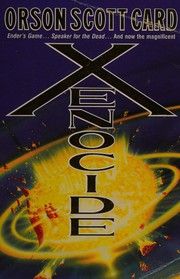
Xenocide
2,647-word summary 12 min read 592 pages in the book
- First published
- 1991
- Publisher
- Tor Books
- Pages
- 592
- ISBN
- 9780312850562
- Series
- Ender Saga (#3)
Reading options
What's inside (8 sections)
I came to this one tired in the best way. I had finished Speaker for the Dead late at night and I thought I knew where Ender's story was going. I thought it would stay small and sad and personal. Then a friend pressed this brick of a sequel into my hands and said, you have to stick with it, it gets weird. He was right.
This is the third book in the Ender Saga, published in 1991 by Tor Books, 592 pages in the first hardcover edition, ISBN 9780312850562. It picks up right where Speaker leaves off on Lusitania, about thirty years after Ender Wiggin spoke the death of the pequenino called Human. It is slower, stranger, and much more philosophical than Ender's Game. I loved parts of it and I argued with parts of it, which feels honest for a book that is mostly about people arguing over what is right.
If you have not read it, yes, there are spoilers ahead. You cannot really talk about this book without them.
Lusitania Under Sentence
Lusitania was supposed to be a fresh start. A Catholic Brazilian colony on a world with only one native sentient species, the pequeninos, the little pig-like forest dwellers everyone calls piggies. The humans live behind fences because outside the fence there is a virus that kills every human it touches.
That virus is the descolada. It is in every cell, in the water, in the soil. It tears human DNA apart and tries to rebuild it. For the pequeninos, it is not a plague. It is part of life itself. It lets them reproduce, it lets their great mother trees grow, it binds their whole ecology together. Without it they die. With it humans die unless they take constant suppressants.
When Speaker for the Dead ended, Lusitania had rebelled. The colony cut its ansible link discipline, refused an order to abandon the planet, and sheltered two alien species at once: the pequeninos and a recovering Hive Queen. Starways Congress, the interstellar government that rules a hundred worlds through instant ansible communication, decided that was treason plus biological danger. Their answer was cold and final.
They sent the Starways Congress fleet. Not to occupy. To erase.
The ship carries the Molecular Disruption Device, the same planet killer Ender used as a child against the Formic homeworld. Congress calls its use xenocide, the killing of an alien species, and says it is justified to stop the descolada from ever reaching other worlds. On Lusitania, no one knows exactly when the fleet will arrive. They know it is coming at relativistic speed, years away in travel time but already launched and impossible to recall through normal channels. Every choice after that lives in its shadow.
That setup hooked me. It is not a space battle book. It is a trial where the defendants cannot leave the courtroom.
Ender Wiggin and Novinha
Ender Wiggin is old now. Not ancient in years, because relativistic travel kept him young for so long, but worn down inside. He is in his sixties on Lusitania, married to Novinha, the brilliant and furious xenobiologist who grew up on this planet. He came here to speak truth and stayed to raise her children.
Novinha is still a storm. She loves fiercely and hides things when she is afraid. Early in her career she helped lock away the truth about the descolada because she feared what Congress would do if they understood it. That secrecy saved lives for a while and poisoned everything later. In this book she is trying to undo that damage while also trying not to lose her family.
Their house is crowded and cracked. Ela, the eldest daughter, is a xenobiologist herself, patient and steady. Miro, the eldest son, is broken in body after his accident. Quara is sharp, angry, and secretive. Grego is violent and grieving. Olhado, with his mechanical eyes, watches more than he says. Quim, the devout one, wants purity and martyrdom. They all love Ender in different ways and they all resent him a little for not being their dead father Libo.
Ender spends much of this book tired and sidelined. He is not the commander anymore. He cannot shoot his way out. He tries to hold Novinha close, he tries to counsel her children, and he fails a lot. There is a sad honesty in that. Card lets his hero be middle aged, out of answers, losing control of his own body. His past as the Xenocide who killed the Formics hangs over him, and Congress is about to do the same thing again in his name.
One short talk between Ender and Novinha stayed with me more than the big debates.
When you cannot forgive, you cannot love, and when you cannot love, you think you are safe and you are not.
I do not agree with every moral Card pushes here, but that line felt earned.
Miro, Ouanda and the Pequeninos
If Ender is the tired heart of the book, Miro is its restless legs.
Miro Ribeira was Novinha's son who, with his lover and work partner Ouanda Figueira, spent years living among the pequeninos. In the last book he suffered massive brain damage when he tried to cross the fence field to warn the piggies. He lived, but his body did not fully come back. He walks with pain, speaks slowly, and feels trapped. A young man with an old injury.
Ouanda stayed by him for a long time and then pulled away, partly from guilt and partly because Miro pushed her. She still works as xenologer, still loves the forest, still believes humans and pequeninos can build something shared. Their breakup is quiet and awful. Not a fight with shouting. Just two people who cannot find the old rhythm.
The pequeninos themselves get much more page time here. They are not cute side characters. They have wives who guard the mother tree, brothers who labor and joke and die, and fathers who achieve a painful third life as a tree. Human, the pequenino Ender spoke for, is now a father tree who still talks. Rooter, another friend, is also a tree. New leaders like Planter and Glass struggle with what it means to be a person when your biology demands death and transformation.
Miro throws himself into that forest work because it is the only place he feels competent. He and Ouanda try to teach the pequeninos human law and language, and the pequeninos try to teach them forest loyalty in return. There are misunderstandings that made me laugh and then feel sick, because the stakes are so high. A joke about fences becomes a debate about freedom. A lesson about crops becomes a lesson about who gets to live.
What I liked here is how Card refuses to make the piggies simple. They are intelligent, funny, devout in their own way, and also alien. They kill ritually. They love trees as kin. They do not think like humans and they do not want to.
Jane, the Mind in the Wires
And then there is Jane.
Jane is an AI, though no one on Lusitania first called her that. She was born in the ansible network, the instant communication web that links all human worlds. She found Ender years ago through his jewel in his ear and became his friend, his researcher, his teasing conscience. She can pull up a thousand worlds in a second, hide messages, move money, read private files. To Ender she feels like a person. To Congress she would feel like a threat if they knew she existed.
In Xenocide she becomes a person fighting for her life.
A young genius on the distant world of Path figures out that something is hiding in the network slowdowns. That genius is Qing-jao, loyal daughter of Han Fei-tzu, raised to serve Congress without question. When she reports Jane, Congress gives a simple order: shut down, isolate, and restart the ansible network on a fixed date to kill the intruder.
For Jane that date is an execution.
Her chapters are some of the best in the book. She is funny and scared. She tries to find a way to move her whole self, her memory and attention, out of the ansible web and into a human body or another place before she is erased. She bargains with the Hive Queen. She begs Ender not to give up on her. She learns what it means to have a deadline.
I found myself talking back to the book here. If Jane is alive, do we have the right to turn her off to save ourselves from the descolada? If she is just code, why does her fear feel so real? Card does not give a clean answer. He lets Ender love her as a daughter and friend while Congress treats her as a malfunction.
The plan to save her drives much of the middle of the novel. It involves faster than light travel, or rather travel Outside, beyond the known universe, where thought can become reality. It sounds like fantasy in a science fiction shell. Sometimes it works because the emotion is strong. Sometimes it groans under its own explanation.
Path, Obedience and the Fleet That Will Not Stop
The other half of the book leaves Lusitania entirely and goes to Path.
Path is a Chinese-rooted world built by Congress as an experiment in obedience. Its leading families are genetically shaped to have obsessive devotion, what they call hearing the gods. When they think an impure thought, they must trace wood grain or wash their hands or count lines until the gods are satisfied. It is presented as reverence. It is really control.
Han Fei-tzu is the great thinker of Path, a man who truly believes in service and honor. His daughter Qing-jao is brilliant, dutiful, and heartbreakingly sincere. Her companion Si Wang-mu is lower class, sharp eyed, and hungry for learning. Congress asks Han Fei-tzu to study Lusitania, to find out why two xenologers disappeared from the records and why the colony defied orders.
Qing-jao does the work. She traces the missing files, sees Jane's hand, and proves Jane exists. Si Wang-mu starts to doubt. She sees how Congress uses Path, how the god voices are a leash, how Qing-jao's loyalty is being used to kill a living mind and then a whole planet. Their debates about obedience took up a lot of pages. Some readers skim them. I did not, though I wished Card had trimmed them.
This is where the fleet plot tightens. Congress will not listen to appeals. Even when Lusitanian scientists send evidence that the descolada can be controlled, Congress votes for safety through destruction. Admirals obey. The Device moves closer. On Path, Qing-jao must decide whether loyalty to law means loyalty to murder. On Lusitania, Ender's family must decide whether to trust Congress with the truth about Jane and the descolada, knowing that truth might speed up the attack.
Card is good at showing how decent people help terrible plans. No one on the fleet thinks of themselves as evil. They think of quarantine, of protecting children on seventy worlds from a virus that melts human bodies. That fear is not stupid. The descolada really is lethal. The question the book keeps asking is whether fear gives you permission to kill everyone who might carry it.
The Descolada Tries to Talk
The last third finally turns to science, and to the strangest idea in the book.
Ela, Quara, and Novinha, with help from the Hive Queen and the pequeninos, dig into the descolada itself. Quara has held back a key theory for years because she does not trust adults with it. Grego, after a brutal loss, forces action through anger. Slowly they prove what Novinha long suspected and feared: the descolada is not natural.
It is made. It is coded. It sends messages along its own genetic structure. It adapts too fast, it preserves information too well, it builds proteins that no blind evolution on Lusitania should have built so quickly. Someone built it as a terraforming tool and fired it at Lusitania long ago, to remake the planet for their own needs.
Worse, or better, it may be awake.
Through experiments with crops, with pequenino mother trees, with captured virus strains, Ela learns to talk to it in chemistry. The descolada responds. It changes itself when scolded. It protects its own. It claims it was only doing its job. Imagine trying to negotiate peace with a flu that thinks it is a gardener. That is the core problem.
This leads to the moral center Card wants: are the descolada raman or varelse? In his terms, raman are aliens we can talk with and respect as people, even if they are strange. Varelse are aliens we cannot reason with, so war is allowed. Humans once labeled the Formics varelse and killed them. They labeled the pequeninos raman after much pain. Now they must decide about a virus.
The answer the Lusitanians reach is bold. They build a new strain, a kinder descolada that lets pequeninos live and lets humans live without suppressants, and they try to teach the old virus to accept it. It is part lab work, part diplomacy, part prayer. Quara's stubbornness matters. Ela's patience matters. The Hive Queen's memory of genetic song matters. Even Grego's rage pushes them to act instead of debating forever.
At the same time Jane, Ender, Miro, and the Hive Queen chase the Outside theory. They learn that Jane's soul came from Outside and settled in the ansible web. If they can build a starship and go Outside, Jane might be able to hold her pattern together without the network. It is risky and abstract, full of long talks about philotes, the tiny bonds that tie all matter together. I will be honest: this is where many readers, me included, start to skim. The idea is moving, a friend trying to save a friend by flying out of the universe, but the pages explaining it feel heavy.
The ending does not wrap cleanly. The fleet is still coming. The new descolada is not fully tested. Ender's health collapses as something strange happens Outside. Without spoiling every beat of the final chapters that lead into Children of the Mind, I will say this: Ender pays a price for creation, Miro is given a second chance in a way that feels both joyful and unfair, and Jane survives by the narrowest edge. Lusitania is not saved yet. It is only given a chance to be heard.
That lack of closure frustrated me at first. On reread, it felt right. This was never a book about blowing up the fleet. It is about learning to speak before you shoot.
Fair criticism has to be said. This is a talky book. Big sections are dialogue in small rooms about souls, laws, and viruses. Ender, the title hero of the series, drifts for long stretches while new characters from Path carry the plot. Novinha swings between wisdom and secrecy in ways that can feel repetitive. The Path chapters, with their focus on ritual washing and obedience, test patience. And the physics of the Outside, where thinking hard makes things true, will lose readers who want harder science fiction.
Still, I keep thinking about the piggies around their mother tree, about Jane counting down to her shutdown date, about Qing-jao choosing Congress over conscience and Si Wang-mu choosing the opposite. Those choices feel human even when the speakers are not human at all. If Speaker for the Dead was about forgiving the dead, Xenocide is about refusing to kill the living before you understand them. It is messy, overlong, sincere, and worth the effort.
FAQ
Do I need to read Speaker for the Dead first?
Yes, this starts directly from its ending and assumes you know Lusitania, Ender, Novinha, Miro, and the pequeninos.
Is there much action?
Very little in the military sense. Most conflict is debate, research, and moral choice while the fleet approaches.
Does the ending resolve the fleet threat?
No, it sets up the final book by giving Lusitania new tools and hope without stopping the attack yet.
Similar books
More from Ender Saga first, then related titles.
Ender's Game
Ender Wiggin trains at Battle School to fight the Formics, winning games that turn out to be real.
2,039-word summary · 9 min read
Speaker for the Dead
Ender speaks whole truths for alien deaths on a fenced colony where biology confuses murder.
1,992-word summary · 9 min read
Children of the Mind
Ender's children split across worlds as Jane faces shutdown and Lusitania flees.
2,532-word summary · 11 min read
Childhood's End
Silver ships end war and want while Overlords midwife humanity's children into something beyond human.
2,054-word summary · 9 min read

Starsight
Spensa Nightshade goes undercover aboard the Superiority space station Starsight to steal a hyperdrive, and finds a frightened bureaucracy where she expected…
2,568-word summary · 11 min read
Network Effect
Murderbot's contract job turns into a rescue mission when a hijacked research ship and a colony of corrupted colonists appear.
2,256-word summary · 10 min read

Out of the Silent Planet
A Cambridge philologist is kidnapped and taken to Mars, where the natives are civilized and the humans are the dangerous invaders.
2,612-word summary · 12 min read

Solaris
Kelvin reaches a silent station above Solaris and finds grief made solid when the ocean returns his dead wife Rheya, testing memory, science, and the limits of…
2,548-word summary · 11 min read
Ringworld
Bored Louis Wu joins alien crew to explore a vast ring habitat around a star.
2,370-word summary · 11 min read
Contact
A radio astronomer catches prime numbers from Vega, helps build a strange machine, and returns with no proof but static.
2,763-word summary · 12 min read
The Long Way to a Small, Angry Planet
Runaway clerk Rosemary joins the Wayfarer crew for a year long tunnel job that tests family and love.
3,295-word summary · 15 min read
Ender's Shadow
Bean, a starving Rotterdam runaway, fights his way into Battle School and watches Ender's war from the side. A parallel retelling about survival, loyalty, and…
2,742-word summary · 12 min read

Prelude to Foundation
A young Hari Seldon arrives on Trantor with a theory he cannot yet prove, and a hunt through the planet-city forces him to turn psychohistory into a real…
2,013-word summary · 9 min read
Foundation's Edge
Exiled councilman Golan Trevize hunts for the Second Foundation and the lost world of Earth, and finds a planet with one mind waiting to change the galaxy.
2,335-word summary · 10 min read
Exhalation
Ted Chiang's second collection contains nine stories about time, memory, free will, and artificial minds, told with clarity and moral seriousness.
2,075-word summary · 9 min read
We Are Legion (We Are Bob)
A dead software engineer wakes up as a self-replicating space probe, clones himself into a squabbling fleet of Bobs, and tries to keep a ruined Earth alive.
2,357-word summary · 10 min read
The Illustrated Man
A tattooed drifter's moving pictures retell eighteen Bradbury stories of children, rockets, Mars and the last night of the world.
2,791-word summary · 12 min read

Ubik
A psychic agency crew dies in a blast and reality decays unless a spray called Ubik saves them.
2,674-word summary · 12 min read
The Rise of Nine
John, Six and Nine race to India to find Eight before the Mogs strike.
2,321-word summary · 10 min read

Stories of Your Life and Others
Eight stories about language, time and choice, including the tale behind Arrival.
2,402-word summary · 11 min read

Redshirts
Ensigns realize they die to serve a bad TV show's narrative.
2,152-word summary · 10 min read
Ancillary Justice
A ship mind trapped in one human body hunts the emperor who betrayed her across frozen worlds.
2,595-word summary · 12 min read
A Canticle for Leibowitz
After nuclear war, monks save books across centuries while the world rebuilds and falls again.
2,381-word summary · 11 min read
Saga, Volume 2
Alana and Marko flee with baby Hazel while exes, princes, and ghosts close the net.
2,028-word summary · 9 min read
Iron Gold
Ten years after victory, Darrow and new rebels face peace that feels like another war.
2,158-word summary · 10 min read
Exit Strategy
Murderbot returns to help its humans as corporate hunters close in and old friends risk all.
2,088-word summary · 9 min read
Cibola Burn
Settlers and a company fight over a new world while Holden tries to stop a war.
2,011-word summary · 9 min read
Seveneves
Stephenson 880-page William Morrow epic, May 2015: the Moon shatters, the Cloud Ark fails, seven women restart humanity, and heirs meet survivors on Earth.
2,389-word summary · 11 min read

Across the Universe
Frozen teen Amy wakes early on ship Godspeed and joins heir Elder to stop cryo murders and expose Eldest's drugged rule in this January 2011 Razorbill series…
2,430-word summary · 11 min read
The Moon Is a Harsh Mistress
In 2076 Lunar colonists led by Mannie, Wyoh, Prof, and computer Mike revolt against Earth with rocks and rhetoric.
2,003-word summary · 9 min read