
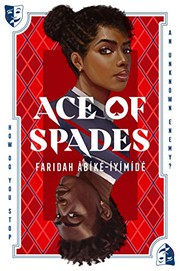
Ace of Spades
2,066-word summary 9 min read 432 pages in the book
- First published
- 2021
- Publisher
- Feiwel & Friends
- Pages
- 432
- ISBN
- 9781250800817
Reading options
What's inside (10 sections)
The first thing that struck me about this book is how quickly it makes the school feel like a trap. Niveus Private Academy has the usual furniture of an elite boarding school story: stone buildings, Latin mottos, a headmaster who talks about excellence, students whose parents own things. But from the opening assembly, when Devon Richards is named a senior prefect and Chiamaka Adebayo is named head prefect, the novel is already doing something else. It is showing two Black students being lifted up in public while the institution quietly prepares to destroy them.
Faridah Àbíké-Íyímídé published Ace of Spades in 2021, the year she turned twenty-two. It became a New York Times bestseller, was a finalist for the William C. Morris Award, and has since been banned in several Florida school districts. It is a young adult thriller, but the thriller machinery is doing argumentative work. The mystery is not only who is sending the texts. It is why the school needs them.
Two Students, Two Ways of Surviving
Devon and Chiamaka are the only Black students in their year. That fact is stated early and then made complicated for the rest of the book.
Devon is a scholarship student from a poor neighborhood. He lives with his mother and two younger half brothers, Eli and James. His father was incarcerated when Devon was a child, and Devon does not know the full story of what happened to him. He plays music, composes his own pieces, and wants to go to Juilliard. He keeps his head down, speaks carefully, and tries not to give anyone a reason to look at him twice. He is also gay, and deeply closeted. His mother is religious and has said things about gay people that make him afraid to tell her.
Chiamaka is rich, popular, and ambitious. She is head prefect, she is planning for medical school, and she has spent years building a reputation that protects her. She is also Black in a school that treats Blackness as a temporary decoration. She has learned to perform confidence so well that most people do not notice the effort. Her best friend is Jamie, a wealthy white boy she has slept with and still has feelings for. She thinks they are close. She is wrong about that in ways the book takes its time revealing.
Her family expects excellence, and their expectations are not only academic. Chiamaka's parents have given her a life of private tutors and nice clothes, and they have also given her a set of rules about how to behave in rooms where she is the only Black person. She loves them and she is exhausted by them. That tension is one of the more interesting things the novel does with her character, and it keeps her from becoming a simple rich-girl stereotype.
The dual point of view is the novel's best structural choice. Devon and Chiamaka barely speak to each other at the start. They are not friends, and they are not allies. They are two people running different survival strategies in the same hostile building. Devon tries to be invisible. Chiamaka tries to be indispensable. Both strategies fail.
The First Text
Aces announces itself with a mass message to the student body. The first leak is a photo of Devon kissing another boy. The whole school sees it. Devon's fear is not just embarrassment. He lives in a neighborhood where being out could get him hurt, and he has family reasons to be careful. The message is designed to isolate him, and it works.
Then Chiamaka is framed for theft. Aces texts the school about it. Someone plants evidence. Her reputation, the thing she has spent years building, starts to come apart. The pattern is clear: Aces is not playing a prank. Aces is targeting the two Black students, and the messages are timed to cause maximum damage.
The book is good at the texture of this kind of humiliation. The whispers in hallways. The way teachers look at Devon differently. The way Chiamaka's friends drift away. The way a school that talks constantly about community can become a machine for exclusion. Àbíké-Íyímídé writes the social details with a sharp eye: the group chats, the rumors, the way an institution protects itself by calling an attack a "prank" or a "misunderstanding."
The Aces messages themselves are well handled. They arrive as interruptions, usually in the middle of a scene, and they change the temperature of whatever is happening. The voice is theatrical and smug: "Hello, Niveus High. It's me. Who am I? That's not important. All you need to know is I'm here to divide and conquer." That line is a little too pleased with itself, but it fits a villain who wants an audience. The messages also show how quickly private information becomes public property in a school where everyone is connected and no one is responsible. A single photo can travel through an entire senior class before lunch.
The Investigation
Devon and Chiamaka eventually realize they have to work together. Neither of them trusts the other at first. Devon thinks Chiamaka is part of the world that is hurting him. Chiamaka thinks Devon is a stranger. Their alliance is slow and awkward, which makes it believable.
The book introduces a cast of suspects. There is Jamie, Chiamaka's best friend, who turns out to be far more calculating than she knew. There is Belle, the girl Jamie starts dating, who becomes an unexpected ally. There is Jack, Devon's only friend, whose loyalty is tested when Aces starts spreading rumors about him and his family. There is Terrell, a boy from Devon's past who reappears and becomes a romantic interest. There is Mr. Taylor, the music teacher Devon trusts. There is Headmaster Ward, who speaks in the language of diversity and progress while protecting the school's reputation.
The middle section is a sequence of leaks, accusations, and attempts to trace the messages. Some of it is tense. Some of it repeats the same beat: Aces sends something, the school reacts, Devon and Chiamaka try to contain the damage. The novel is long for a YA thriller, and the middle sags a little. But the accumulation matters, because the point is not a single revelation. The point is that the attacks keep coming and the institution keeps finding ways to make the victims responsible for their own humiliation.
The Reveal
The answer to "who is Aces" is the part that divides readers. Devon and Chiamaka discover that Aces is not one person. It is a tradition. The student body and faculty have been collaborating for decades to admit a small number of Black students, give them opportunities, and then destroy their reputations in senior year so they drop out or fail. The school's wealth is tied to institutions that go back to slavery and the Confederacy. The point is not just to keep Black students out. It is to make sure that the ones who get in do not leave with the same chances as everyone else.
This is a blunt allegory, and it is meant to be. Àbíké-Íyímídé is not interested in a single racist villain who can be expelled. She is interested in the way a school, a town, and a class system can coordinate without anyone writing a memo. The novel's thesis is that racism is not an exception in elite institutions. It is part of the business model.
The problem is that the mechanics strain credulity. A conspiracy involving generations of students, faculty, and alumni, complete with staged crimes and, it turns out, murders, would require a level of secrecy that is hard to believe. The book acknowledges this by making the conspiracy feel like a ritual, something people inherit rather than plan. But the reveal still arrives as a monologue, and the monologue is doing a lot of work that the plot has not quite earned.
The Fire
The climax is a live broadcast. Devon and Chiamaka plan to expose Headmaster Ward and the tradition in front of the school and the press. Ward, cornered, admits more than they expected, including the fact that students who did not drop out in previous years were killed. Then the school catches fire. The fire is not clearly explained. It may be an accident, or an act of desperation, or something else. The building burns. Students escape. Jamie dies in the fire, along with two others.
The fire is dramatic, and it gives the book the clean slate it wants. It also lets the institution off the hook in a way that bothered me. The people who built the system do not have to face a trial. The building that housed the tradition is gone. The survivors move on. The epilogue shows Devon ten years later, engaged to Terrell and working as a college professor. Chiamaka has graduated from Yale and become a doctor. They have founded a secret society to stop institutions like Niveus. Ward is dying, and Chiamaka visits him.
The epilogue is satisfying in the way a revenge fantasy is satisfying. It is less convincing as a portrait of how power actually works. The novel wants to say that the system is bigger than one school, and then it ends with the school in ashes and the heroes successful. Those two ideas sit uneasily together.
What Works
The voice is the strongest element. Devon's sections are careful and compressed. He notices everything and says little. Chiamaka's sections are sharper and more performative, because she is always aware of being watched. The two voices are distinct without being exaggerated.
The book is also good at the small mechanics of racism in a privileged setting. A teacher who praises Devon's "articulate" playing. A classmate who touches Chiamaka's hair. A diversity brochure that uses their faces. A headmaster who says the right words while protecting the school's donors. These details are more persuasive than the conspiracy plot, because they are recognizable.
The title is doing more than sounding cool. Aces is the name of the anonymous tormentor, but it is also a card-game image. The house always has an advantage. The deck is stacked. The students think they are playing a game of skill, and the school knows the game is rigged. That metaphor is a little on the nose, but it gives the book a clear visual language.
The romance is sweet, though rushed. Devon and Terrell have a history that is revealed in fragments, and their reunion is one of the warmer parts of the book. Chiamaka's relationship with Belle is more surprising, and it gives her a chance to be vulnerable rather than strategic. The novel is not primarily a romance, but the relationships keep the characters from becoming symbols.
What Doesn't
The pacing is uneven. The first third is tight. The middle repeats itself. The reveal is a long explanation, and the ending is abrupt. Some characters, especially the villains, are drawn in broad strokes. Jamie is a useful portrait of the privileged friend who was never really a friend, but his motives are thin. The faculty conspiracy is more effective as an idea than as a plot.
The book also has a tendency to explain its themes. A few scenes read like a lesson plan, with a character stating the meaning of the action right after the action happens. I understand why a YA novel might do this, but the best moments in the book trust the reader more.
Why It Lasts
Ace of Spades came out at a moment when a lot of readers were arguing about who gets to attend elite schools and what those schools owe the students they admit. The book turns that argument into a thriller, and the thriller form gives it energy. It is not a subtle novel, and it is not trying to be. It is angry, and the anger is organized.
I would recommend it to readers who liked The Hate U Give and One of Us Is Lying, and who want a book that takes the "prep school mystery" formula and asks who the mystery is for. It is uneven, and the ending is too neat, but the central image, two Black students being celebrated and hunted by the same institution, is one that stays with you.
FAQ
Is Ace of Spades based on a true story?
No, it is a novel, though it draws on real patterns of racism in elite schools and on the author's own experiences.
Who is Aces?
Aces turns out to be a tradition shared by students, faculty, and alumni rather than one person.
Is Ace of Spades appropriate for younger teens?
It is marketed as young adult and deals with racism, outing, sexual content, and violence, so it suits mature middle and high school readers.
Similar books
The Vanishing Stair
Stevie Bell returns to Ellingham Academy under a secret bargain, chasing the truth about a 1936 kidnapping while a new death makes the school feel smaller and…
2,026-word summary · 9 min read
Truly Devious
True crime buff Stevie Bell arrives at Ellingham to solve its 1936 kidnapping as present murder strikes.
2,072-word summary · 9 min read
Wilder Girls
At a quarantined boarding school off Maine, three girls with strange mutations search for a missing friend and learn what the adults have hidden.
2,594-word summary · 12 min read
Cross My Heart and Hope to Spy
Cammie Morgan returns to Gallagher Academy for a second year of spy training, only to fall for a boy from a rival spy school and hunt a mole in her own school.
2,567-word summary · 11 min read

I Kissed Shara Wheeler
Shara Wheeler kisses her rival Chloe Green at prom and disappears, leaving a scavenger hunt that forces Chloe to rethink everything she knew about her.
2,083-word summary · 9 min read
Last Night at the Telegraph Club
The 2021 National Book Award winner follows Lily Hu, a Chinese American teenager in 1954 San Francisco, as she falls for Kath and learns what it costs to be…
2,336-word summary · 10 min read
When No One Is Watching
Sydney Green watches her Brooklyn block's Black residents vanish one by one in Cole's Edgar-winning thriller about gentrification as a crime scene.
2,165-word summary · 10 min read
Razorblade Tears
Two ex-con fathers, one Black and one white, hunt their murdered sons' killers in a Richmond that never gave the boys a fair shake.
2,880-word summary · 13 min read
The Reappearance of Rachel Price
Bel films a doc when her missing mother walks back after years.
2,254-word summary · 10 min read
Killer Instinct
Teen profiler Cassie Hobbes rejoins the FBI Naturals to stop a copycat repeating Dean Redding father murders.
2,600-word summary · 12 min read

Kill Joy
Pip hosts a 1920s murder mystery party with her friends, solves the fake case, and feels a real scare that points toward A Good Girl's Guide to Murder.
2,537-word summary · 11 min read
The Cousins
Three cousins work at their rich grandmother island resort while digging into why their parents were cut off.
2,565-word summary · 11 min read
Sadie
Sadie hunts sister killer while podcast chases her in split narrative thriller.
2,091-word summary · 9 min read
Reconstructing Amelia
A grieving lawyer mother reopens her teen daughter's alleged suicide at an elite Brooklyn school, uncovering bullying and secrets.
2,032-word summary · 9 min read
Two Can Keep a Secret
Twins new to Echo Ridge dig into aunt's murder as homecoming threats return.
2,078-word summary · 9 min read
Five Survive
Six teens on spring break get a flat tire, a red dot sight, and one ultimatum in an RV.
2,867-word summary · 13 min read

The Unbecoming of Mara Dyer
Sole survivor of a collapse that killed her friends, Mara Dyer moves to Miami, where visions that come true suggest her grief hides something darker.
2,152-word summary · 10 min read
The Naturals
Teen profiler Cassie Hobbes joins an FBI program for gifted teens and hunts a killer tied to her past.
2,401-word summary · 11 min read
The Lying Game
Isa returns to Salten with her baby when bones surface in the marsh and force four school friends to face what they buried.
2,277-word summary · 10 min read
I'd Tell You I Love You, But Then I'd Have to Kill You
Cammie Morgan trains at a secret spy school and falls for a town boy she can never tell the truth.
2,179-word summary · 10 min read
Pretty Little Liars
Four girls get texts from dead Alison a year after she vanished, and secrets start leaking.
1,922-word summary · 9 min read
One of Us Is Next
A year after Simon's death, a copycat texter drags Maeve, Knox and Phoebe into a cruel Truth or Dare game in Bayview.
2,348-word summary · 10 min read
As Good As Dead
Pip faces online threats and a stalker as she investigates a serial case in the trilogy finale.
2,962-word summary · 13 min read
Good Girl, Bad Blood
Pip swears off sleuthing, then podcasts a missing friend case that tests fame and cost.
2,011-word summary · 9 min read
We Were Liars
Cadence Sinclair returns to Beechwood Island after an accident she cannot recall, chasing summers with Johnny, Mirren and Gat toward the truth.
1,923-word summary · 9 min read
One of Us Is Lying
Five Bayview teens enter detention and Simon dies, leaving Bronwyn Nate Addy and Cooper suspects.
3,158-word summary · 14 min read
A Good Girl's Guide to Murder
Pip reopens a closed murder case for a school project and finds the town wanted it shut.
2,621-word summary · 12 min read

What She Knew
Rachel lets her eight-year-old son run ahead in a Bristol park, and the nine-day search turns her into a suspect in the public eye.
2,952-word summary · 13 min read

The Beach House
A young valet is beaten to death at a Hamptons party, and his law-student brother spends a year building a case against the family that covered it up.
2,049-word summary · 9 min read

Six Years
A professor who promised to forget the woman he loved sees her husband's obituary and discovers that the wedding, the marriage, and the woman herself may never…
2,076-word summary · 9 min read