
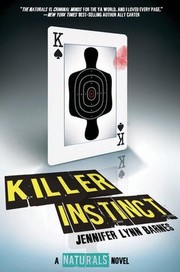
Killer Instinct
2,600-word summary 12 min read 375 pages in the book
- First published
- 2014
- Publisher
- Disney-Hyperion
- Pages
- 375
- ISBN
- 9781423168324
- Series
- The Naturals (#2)
Reading options
What's inside (8 sections)
I came into this one straight off the end of The Naturals, which had left me up too late and jumpy around a quiet house. I had liked the first book enough to order the second within a day, mostly because I wanted to know what would happen with Dean and his father. I expected a slower middle book. What I got was messier in a good way, more focused on the team living together and more uncomfortable around Dean family history. I read it across three evenings.
This is the second book in The Naturals series by Jennifer Lynn Barnes, published in 2014 by Disney-Hyperion. The edition cited here runs 375 pages. It picks up with seventeen year old Cassie Hobbes still living in the Virginia house with the other Naturals teens and still trying to make profiling feel like a skill instead of a reflex she cannot shut off. If the first book was about Cassie learning that her mother case was tied to the program, this one is about what happens when the past belongs to someone else in the house and Cassie has to help read it without breaking trust.
Cassie still profiles because she cannot help it. She notices shoes, hands, the way someone holds a cup when stalling. After what happened with Locke, she trusts her own reads less, which felt true to me. She second guesses. She replays. She sleeps badly and covers it with routine. The house is supposed to be for cold cases, but everyone knows the line between practice and live work got crossed last time and could be crossed again.
Coming back to Cassie and the house
The early chapters settle back into Quantico house routine. Briggs sets rules about curfew and files. The teens share a kitchen and argue about food and who left markers out. Sloane writes numbers on windows. Lia says the blunt thing nobody else will say. Michael watches moods shift and teases to keep things light. Dean stays a little apart, polite but closed.
Barnes uses these pages to remind you how Cassie reads. She walks into a room and sorts people by habit. A boy tapping his thumb is impatient, not nervous. A girl who answers too fast has rehearsed. It shows profiling as attention plus memory, built from years watching her mother work a room as a psychic performer and then watching strangers after her mother was killed.
One small detail stayed with me. Cassie still carries her mother red lipstick shade in her bag and still hesitates to wear it. In the first book Lia gave her a tube as a peace offering. Here Cassie looks at it when rattled. It is a private check. Am I doing this for Mom, or for me, or for the person in front of me.
The house dynamic has shifted. Michael told Cassie he would wait while she sorted out feelings. He tries to keep that promise, but the strain shows when she turns toward Dean. Lia pushes at Cassie on purpose, testing whether grief made her softer or harder. Sloane latches onto Cassie as a safe person and asks for clear plans when everything feels loud. The classes matter less here than the way the five cover for each other when adults are watching.
New murders that copy Daniel Redding
The case that breaks routine involves murders that follow the pattern of Daniel Redding, Dean father. Daniel Redding is in prison for killing women years earlier, with a careful method and a particular way of choosing victims. Now new bodies show up with details that match too closely for coincidence. Dates spaced a certain way. Victim type overlapping. Scene arrangement that looks studied rather than impulsive.
Briggs does not want the teens near live work after Locke. That resolve lasts about as long as you would expect. The FBI needs fresh eyes on an old pattern. Agent Veronica Sterling comes in to run point on the behavioral side. She is sharp, controlled, and far less warm than Briggs. She watches Cassie the way Locke used to watch, which puts Cassie on edge for reasons she cannot fully explain.
Sterling brings files and photos and asks for reads. Not conclusions, just observations. What do you see in the spacing. What does the location suggest about comfort. Sloane starts pulling timelines and maps. Lia flags where witness statements wobble. Michael notes where grief looks performed instead of felt. Cassie and Dean are asked to walk the scenes on paper, step by step, as the offender might have moved.
What makes this section creepy is not gore. Barnes keeps crime scene detail present but not soaked. It is the deliberateness. The copycat studied. He or she learned the older murders well enough to repeat choices that were never in newspapers. That means access, either to files or to someone who knew. Cassie circles that point in her notes. A copy is also a message. It says I know your work. It says look at me.
I had a hard time keeping every victim straight, because names and towns blur when you read fast. The pattern stayed clear though. The killer takes women who fit a type, controls the scene, leaves the body where it will be found on a schedule. There is no frenzy. That calm is what scares Dean most, I think. He recognizes the shape of it from childhood, from living with a man who could be patient and ordinary and then not.
Cassie and Dean cannot stay neutral
Dean Redding was the quiet center of book one. Here he is the reason for the case, and it hollows him out. His father killed until he was caught. Dean grew up in that house, learned to watch for signs, and still blames himself for not seeing sooner. Now someone is using his father script. Other agents stare. Dean tries to go still and professional, which Cassie reads at once as fear held tight.
Cassie wants to help without treating Dean like evidence. That is harder than it sounds. Every time she profiles the copycat, she is also profiling Daniel Redding, which means she is profiling Dean family. She catches herself watching Dean hands when he talks about his father. He catches her doing it once in the kitchen and leaves the room. They do not talk about it until much later, and that delay felt honest.
There are scenes that carry the tension without pushing romance too hard. A car ride where Dean drives too fast and then slows down without being asked. A training room where they are supposed to read each other and both refuse to go first. A hallway at night where Cassie hears Dean pacing and does not knock, because she knows company would make it worse. I appreciated that restraint. The first book leaned on kisses and dares. This one lets attraction sit inside worry.
Michael complicates it, though not in a cruel way. He likes Cassie and he is good at naming feelings, including his own. He tells her he sees where her attention goes. He does not threaten Dean or guilt Cassie. I felt for him in those pages. He is the kid who reads the room perfectly and still cannot change what the room wants.
My complaint is that the triangle takes up a lot of air in the middle. Feelings affect judgment, and judgment is the job. But two hallway checks could have been shorter.
Sterling pushes the team onto live work
Veronica Sterling is the adult who changes the temperature. Briggs recruited the teens and feels paternal about limits. Sterling treats them like junior analysts who should produce. She is not unkind. She is exact. She asks follow up questions. She corrects sloppy logic in front of everyone. Lia bristles. Sloane tries harder to please her. Michael goes quiet in a way Cassie notices.
Sterling worked cases around the original Redding murders and carries frustration that the full story never settled. She believes structure will keep the teens safe. Work the files. Do not freelance. Report every contact. She says this clearly, and then the case pulls them out from behind desks anyway, because a live copycat does not wait for classroom hours.
Briggs and Sterling disagree about how close to let Cassie and Dean get to new material. Briggs worries about trauma and blowback. Sterling argues their reads are sharpest when they can stand where the offender stood, even on paper. Both have a point, which I liked. The books could easily make adults either obstacles or saviors. Here they argue like coworkers with different scars.
One procedural stretch worked for me. Sterling has the team build a day by day board. Where was each victim last seen. What was moved and what was left. Sloane handles numbers and intervals. Cassie and Dean narrate movement. Michael tracks emotional logic. Lia tests alibis for soft spots. It is slow work, with coffee going cold and markers squeaking, and it earns the later break.
What strains belief is how often these minors end up near sensitive material. Even with handlers present, the idea that the FBI would keep using teens after Locke betrayal is shaky. Barnes tries to cover it with secrecy and special permission, but my common sense kept poking through. I went along because the team scenes are fun, but part of me kept thinking a real program would have been shut down for review.
Michael, Lia and Sloane carry their parts
I was glad this book gives the other three more to do. Michael gets interview work because he can tell when sadness is real and when it is shaped for an audience. He sits in on witness talks and signals to Sterling when to press and when to ease off. He also watches Dean for Cassie, not as a spy but as a friend who knows Dean will hide a spiral. There is a moment where Michael tells Cassie that Dean slept maybe two hours, and he says it flat, without jealousy. That landed for me.
Lia is still the lie spotter, but Barnes lets her be vulnerable in flashes. Lia lies herself sometimes to keep control, and she knows Cassie knows. Lia will catch a witness in a small false detail and then look to Cassie to decide whether it matters. I liked the push and pull where Lia calls out a too smooth condolence and Cassie has to slow her down, because being right about a lie is not the same as being right about murder.
Sloane is my favorite again. She pulls intervals between murders, maps distances, checks road access. She covers a window with dates and stares until a gap looks wrong. When she finds it, she does not shout. She tugs Cassie sleeve and whispers. That small habit says more about trust than any speech.
The best team scene happens late at the kitchen table, long after curfew. No Sterling, no Briggs. Just the five with files they probably should not have spread out, plus snacks Sloane hoarded. Michael says the copycat seems excited, not calm, underneath the careful scenes. Lia says someone lied about timing. Sloane says the intervals are tightening, which means control is slipping or confidence is growing. Dean says his father never hurried, which means this is not worship, it is argument. I believed this scene. Tired kids, low voices, a house that creaks.
If I have a gripe, it is that Lia and Sloane fade during the final movement while focus narrows to Cassie and Dean. They do the brain work, then wait by phones. I wanted Sloane on the radio during the end run, or Lia listening in to flag a lie live. Barnes keeps them safe at home, which makes sense for adults in charge, but it costs some payoff after building their skills so well.
What the copycat wanted and how it breaks
The copycat turns out to be someone who learned the Redding file from close up and wanted to pull Dean back into that orbit. The motive is not money or random rage. It is fixation. The killer wants to prove understanding of Daniel Redding method, wants credit from people who know the difference between a close copy and a sloppy one, and wants Dean and Cassie to look. Being seen by profilers is part of the reward. That is why details that never made papers show up again.
Barnes plants access clues fairly. Who handled paper. Who knew which town. Who could sit in on interviews without raising alarms. Who asked about Dean father with too much interest and too little feeling. I caught one of them early and missed another entirely, which is about my usual hit rate for this series. On reread of my notes, the missed clue was there in a throwaway line about driving routes. I appreciated that it was logistics, not a last page confession with no setup.
The final confrontation moves to an isolated place where help is far and phones are unreliable. Cassie ends up face to face with the copycat while Dean is nearby but not close enough to stop everything at once. She does what she did with Locke in book one, but with a difference. Then she stalled by naming grief. Here she stalls by naming pattern. She talks through what the killer changed and what was kept, forcing attention to choices. Profiling aloud keeps the person listening a beat longer. It also keeps Cassie thinking instead of freezing.
People get hurt. Nobody walks away clean. Dean has to face that someone used his father story to get to him, which reopens shame he thought he had boxed. Cassie has to face that being good at reading killers makes her useful bait, whether she volunteers or not. The team closes ranks after, but not with speeches. Lia checks locks twice. Sloane counts breaths with Cassie again, the way she did after Locke. Michael gives Cassie space without pretending it does not sting.
The reveal works on motive but leans on proximity. That this person could study Redding, circle the program, and steer events without Sterling or Briggs catching on sooner asks a lot. Briggs especially looks a step slow here. I also thought the middle sags around the second round of file review. One montage of photos and maps would have done the work of two. And while I buy Cassie and Dean bond, I worried at times that care reads as therapy. She cannot fix his past by profiling it correctly.
Still, I closed the book satisfied and a little sad. The house feels more lived in. Sterling adds friction the adults needed. Did it deepen the people while moving the larger story. This one did, for me. Cassie trusts her gift more and her judgment less, which is an interesting place to leave her. Dean let someone in without getting to control how they used what they learned.
I am going on to the third book because Sloane deserves a case where numbers save someone in real time. If you are reading in order, pay attention to driving routes, to who volunteers for interviews, to interval gaps on Sloane board. Those are the tells that matter here. And watch the lipstick moment near the end. What Cassie decides says more than any profile she writes about herself.
Cassie growth here is less about solving and more about asking whether her reads help the people she loves.
FAQ
Is Killer Instinct the second book in The Naturals series?
Yes. It was published in 2014 by Disney-Hyperion as The Naturals book 2, with 375 pages and ISBN 9781423168324, continuing Cassie Hobbes story after The Naturals.
Who are the main teens and adults in this book?
Cassie, Dean, Michael, Lia and Sloane return in the Quantico house, with Agents Briggs and Veronica Sterling running the copycat case tied to Dean father Daniel Redding.
Is Killer Instinct appropriate for younger teens?
It is written for young adults with murder scene detail and talk of serial killing but little explicit romance. Sensitive readers should expect tense confrontations and discussion of family violence.
Similar books
More from The Naturals first, then related titles.

The Naturals
Teen profiler Cassie Hobbes joins an FBI program for gifted teens and hunts a killer tied to her past.
2,401-word summary · 11 min read

Kill Joy
Pip hosts a 1920s murder mystery party with her friends, solves the fake case, and feels a real scare that points toward A Good Girl's Guide to Murder.
2,537-word summary · 11 min read
As Good As Dead
Pip faces online threats and a stalker as she investigates a serial case in the trilogy finale.
2,962-word summary · 13 min read

Good Girl, Bad Blood
Pip swears off sleuthing, then podcasts a missing friend case that tests fame and cost.
2,011-word summary · 9 min read

One of Us Is Lying
Five Bayview teens enter detention and Simon dies, leaving Bronwyn Nate Addy and Cooper suspects.
3,158-word summary · 14 min read

A Good Girl's Guide to Murder
Pip reopens a closed murder case for a school project and finds the town wanted it shut.
2,621-word summary · 12 min read

What She Knew
Rachel lets her eight-year-old son run ahead in a Bristol park, and the nine-day search turns her into a suspect in the public eye.
2,952-word summary · 13 min read

The Beach House
A young valet is beaten to death at a Hamptons party, and his law-student brother spends a year building a case against the family that covered it up.
2,049-word summary · 9 min read

Six Years
A professor who promised to forget the woman he loved sees her husband's obituary and discovers that the wedding, the marriage, and the woman herself may never…
2,076-word summary · 9 min read

The Trespasser
A Dublin Murder Squad detective investigates a staged dinner-party killing and finds a cover-up that reaches into her own department.
2,051-word summary · 9 min read

Rules of Prey
Minneapolis detective Lucas Davenport hunts a killer who leaves a new rule at every scene and treats murder as a game of wits.
1,914-word summary · 9 min read

Ace of Spades
Two Black seniors at an elite academy are celebrated by day and hunted by an anonymous texter in this YA thriller about institutional racism.
2,066-word summary · 9 min read

The Late Show
Exiled to the LAPD night shift after accusing her supervisor, Renée Ballard keeps two cases that were meant to be handed off at dawn: a brutal assault and a…
2,563-word summary · 11 min read

4th of July
Lindsay Boxer shoots two armed teenagers in self-defense, faces a wrongful-death trial, and spends her leave chasing a string of throat-slashing murders in…
2,192-word summary · 10 min read

The Camel Club
Four Washington misfits witness a murder on Roosevelt Island and stumble into a conspiracy that reaches the Oval Office, with a hostage president and a nuclear…
2,354-word summary · 10 min read

61 Hours
A bus crash strands Jack Reacher in a snowbound South Dakota town where a drug gang, a corrupt police force, and a single witness are on a collision course.
2,227-word summary · 10 min read

The Last Mile
Melvin Mars is hours from execution for his parents' murder when another man confesses, and FBI cold case detective Amos Decker goes looking for the trap.
2,746-word summary · 12 min read

Still Missing
A realtor is abducted at a Vancouver Island open house and held for more than a year. Told through therapy sessions, the novel follows her escape and the hunt…
2,466-word summary · 11 min read

Bad Luck and Trouble
A deposit of $1,030 summons Jack Reacher back to his old army unit, which is being picked off one name at a time.
2,366-word summary · 11 min read

3rd Degree
The third Women's Murder Club novel follows a San Francisco terror cell and a three-day killing schedule, and it costs the club a member.
2,685-word summary · 12 min read

Worth Dying For
Reacher stops for one night in rural Nebraska and finds a family that runs the county, a missing girl and a shipment worth killing for.
2,021-word summary · 9 min read

The Vanishing Stair
Stevie Bell returns to Ellingham Academy under a secret bargain, chasing the truth about a 1936 kidnapping while a new death makes the school feel smaller and…
2,026-word summary · 9 min read

Say You're Sorry
A widowed prosecutor defends the teenager accused of killing her babysitter, uncovering a small town's secrets and a killer hiding in plain sight.
2,116-word summary · 9 min read

Finlay Donovan Knocks 'Em Dead
Someone has put a contract on Finlay Donovan's ex-husband, and the novelist and her nanny have to find the hitman before the school pickup.
1,990-word summary · 9 min read

Echo Burning
Reacher hitches a ride with a Texas woman who wants her abusive husband killed, then has to prove she did not murder him when he comes home.
2,209-word summary · 10 min read
The Survivors
Kieran Elliott returns to Evelyn Bay twelve years after a storm killed his brother, and a young woman's murder forces the town to face what it has concealed.
2,571-word summary · 11 min read

Girl, Forgotten
A rookie US marshal guards a judge with a stalker and ends up reopening the 1982 prom-night murder of the judge's pregnant daughter.
2,111-word summary · 9 min read

The Woods
Twenty years after two teenagers were murdered and two vanished at summer camp, prosecutor Paul Copeland identifies a fresh corpse as one of the missing.
2,490-word summary · 11 min read

The Redbreast
Harry Hole chases an ageing sniper through modern Oslo while two Norwegian volunteers on the Eastern Front carry a fifty-year-old betrayal toward a royal…
2,453-word summary · 11 min read

The Poet
A crime reporter investigates his twin brother's apparent suicide and uncovers a killer who leaves Edgar Allan Poe quotes behind, in the novel that took…
2,020-word summary · 9 min read