
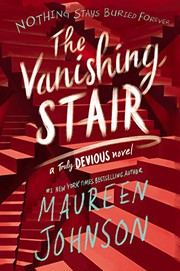
The Vanishing Stair
2,026-word summary 9 min read 400 pages in the book
- First published
- 2019
- Publisher
- Katherine Tegen Books
- Pages
- 400
- ISBN
- 9780062338099
- Series
- Truly Devious (#2)
Reading options
What's inside (9 sections)
The first Truly Devious book ended with a murder, a disappearance, and a very deliberate cliffhanger, so I picked up The Vanishing Stair expecting answers. What I got was a middle book that is more interested in the questions than in the answers, and a heroine who is starting to understand that solving a crime is not the same thing as repairing the damage around it. It is a tense, quick read. It is also a book that withholds, sometimes elegantly and sometimes just because it can.
Back to Ellingham
Stevie Bell is a true-crime obsessive who got into Ellingham Academy because she wanted to solve the school's founding mystery. In 1936, Albert Ellingham's wife, Iris, and daughter, Alice, were kidnapped. A student named Dottie Epstein died. Alice was never found. The case became a national obsession, complete with a taunting ransom letter signed "Truly Devious." Stevie has spent years reading about it. In the first book, she also had to deal with a present-day murder: Hayes Major, a student, was killed, and Ellie Walker disappeared.
At the start of The Vanishing Stair, Stevie is back home in Pittsburgh. Her parents pulled her out of Ellingham after the murder, and she is miserable. She has a tea tin that belonged to Ellie, and inside it are photographs of two students dressed as Bonnie and Clyde, an unfinished poem called "The Ballad of Frankie and Edward," and a cut-out word: "US." The word looks like it was made by the same person who made the Truly Devious letter. Stevie wants to know who Frankie and Edward were and how their game connects to the 1936 kidnapping.
Senator Edward King visits her family. King is David's father, and David is the boy Stevie kissed at Ellingham. The senator is charming in public and cold in private, and he wants Stevie to return to school. He also wants something: David has been acting out, and King wants Stevie to keep an eye on him. Stevie agrees because she wants to go back. She does not tell David about the arrangement, which is the kind of decision that looks reasonable in the moment and becomes a betrayal later.
The school with cameras
Ellingham is not the same place. There are new security cameras, a new security chief named Larry, and a general atmosphere of adults pretending that everything is under control. Charles Scott, the head of the school, arranges for Stevie to work with Dr. Irene Fenton, a professor from the University of Vermont who is revising a book about the Ellingham case. Fenton has boxes of documents, photographs, and objects, and she wants Stevie to help verify them. She also insists on working without phones or laptops, which gives the investigation an old-fashioned, tactile quality.
Fenton's nephew, Hunter, is friendly and suspicious in equal measure. He warns Stevie that his aunt may be chasing the ten-million-dollar reward that Albert Ellingham offered for information leading to Alice. The will has conditions: the person who finds Alice cannot have been involved in the kidnapping and cannot be on the school board. Hunter's warning plants the idea that Fenton is not a neutral scholar. She is a woman with a financial motive, and Stevie has to weigh that against the fact that Fenton is also the only adult taking the case seriously.
Stevie's friends are still there. Janelle is steady and smart. Nate is anxious, funny, and more perceptive than he lets on. David is erratic, angry, and increasingly difficult to reach. He releases squirrels into the library as a distraction, helps Stevie search Ellie's old room, and then pulls away. His father's attention is a poison in the book. David is trying to become a person his father cannot use, and he is not very good at it yet.
The 1936 story
The novel alternates between Stevie's investigation and the 1930s. The historical sections are the best part of the book. Francis Crane is a wealthy sixteen-year-old student who likes crime, chemistry, and secrets. She and her boyfriend, Edward Davenport, decide to become the next Bonnie and Clyde. After hearing an FBI agent talk about how cut-out letters make a message memorable, they compose the Truly Devious letter as a prank. They want to give Albert Ellingham a taste of his own medicine. They wear gloves and mail it from Burlington. They have no idea that a real kidnapping is about to make their joke look like a confession.
On the night Dottie disappears, Francis sees Miss Nelson, the housemistress of Minerva House, looking alarmed. Francis uses a hidden passage beneath the spiral staircase and meets Edward in the tunnel. They follow Albert to the unfinished gymnasium and overhear him tell Miss Nelson that Iris and Alice have been kidnapped. Albert gives her a gun. The flashbacks also reveal that Albert and Miss Nelson were having an affair. Francis is sent home before she can retrieve the prank materials, and she never comes back. Edward dies by suicide in Paris in 1940.
Johnson is good at the texture of the period: the clothes, the telephones, the casual cruelty of the rich, the way a school can be both a sanctuary and a surveillance state. The 1930s sections also do something the present-day sections struggle to do. They make the mystery feel like it happened to people rather than to a set of clues. Francis is reckless and privileged, but she is also a girl who realizes too late that her game has consequences.
The tunnel
On Halloween, Stevie connects one of Albert's riddles to the spiral staircase in Minerva House. The riddle says "Always on a staircase but never on a stair." With David's help, she finds a hidden entrance. Nate keeps watch. Stevie and David go into the tunnel, and David tells her about his father, the violence in his family, and the way King has used him. They kiss in the dark.
Then they find Ellie's body. She is in a branching passage, decomposed, with black garbage bags nearby. She had entered through a hatch in the Great House basement, become trapped, and died there. It is a horrible, mundane death. Ellie was not murdered by a mastermind. She was a girl in a tunnel who could not get out.
The discovery changes the emotional weather of the book. Stevie has been treating the case as a puzzle, and Ellie's body makes the puzzle literal: a person she knew, in a place she walked past every day. David tells Stevie and Nate to go back to their rooms and says he will take responsibility. He is trying to protect them, and he is also trying to control the story. Larry finds the fake moustache Stevie dropped and tells her he knows she was in the tunnel. He does not report her, but he warns her.
The bargain comes out
David figures out that Stevie has been watching him for his father. He is furious, and the fight is ugly. Stevie tries to explain that she needed to get back to school, that she did not mean to betray him, that the arrangement was about the case. David does not care about her reasons. He has been treated as a project by his father for years, and now his girlfriend has been doing the same thing.
He responds by paying other teenagers to beat him while someone films it, then uploading the video. It is a performative act of self-destruction, and it is hard to watch. Stevie wants to help, and he will not let her. Larry leaves the school. Hunter keeps warning Stevie about Fenton. The present-day plot becomes a series of closed doors.
This is where the book's middle-book nature is most visible. David's arc is compelling, but it is also frustrating in a way that feels designed to keep him unavailable until the next book. Stevie makes some of the same mistakes she made in the first book, and the adults continue to withhold information for reasons that are not always convincing. The investigation relies on a few convenient discoveries. A hidden passage, a riddle, a recording: Johnson is good at making these feel earned, but the seams show if you look closely.
The boat and the wire
The historical plot reaches Albert's last day. He places legal documents in his desk, including the reward offer for Alice. He wants the offer publicized so that people everywhere will search for his daughter. His secretary, Robert Mackenzie, thinks the plan is dangerous. Albert then invites George Marsh, the former detective who worked on the case, onto his boat. He tells Marsh that the boat is rigged to explode and demands the truth.
Marsh confesses. He had gambling debts. He planned the kidnapping for ransom and hired criminals to carry it out. The plan went wrong. Dottie saw him and recognized him as the "attic man," a term her uncle used for police officers who get the drop on criminals. When she tried to run, she fell and cracked her head. The hired criminals demanded a larger share and killed Iris against Marsh's wishes. Marsh says he knows where Alice is. Then the boat explodes, killing both men. The novel leaves the cause ambiguous. It could have been Albert's device or Marsh's cigarette.
In the present, Stevie finds the phrase "It was on the wire" in Mackenzie's notes and realizes it may refer to a wire recorder. She finds a miniature machine in a dollhouse replica of the Great House, then an old recorder in the attic. Janelle repairs it, and the recording preserves Albert's interview with Dottie. Dottie talks about "attic men," and a marked passage in her Sherlock Holmes book compares the brain to "a little empty attic." The clues come together, and Stevie has a breakthrough about Marsh's identity.
She calls Fenton. Fenton answers in a slurred, frightened voice and says, "The kid is there!" before the line goes dead. Stevie calls Larry, who checks Fenton's house and finds it burned. Fenton is dead. Hunter was found inside, and Larry does not know his condition. The novel ends with Stevie holding a major piece of the historical puzzle while the present-day danger is still unresolved.
What works and what does not
The best thing about The Vanishing Stair is its sense of place. Ellingham is a school built on a fortune, a mystery, and a lot of hidden architecture. Johnson makes the tunnels, the archives, the spiral staircase, and the snow feel real. The 1930s sections have a melancholy that the present-day sections sometimes lack, because the past is finished and the present is still a cliffhanger.
The weakest thing is the pacing of the present-day mystery. Stevie is a great detective in theory, but she spends a lot of this book waiting for adults to give her access. The reveal of Ellie's body is powerful, and then the plot has to pause while David self-destructs. The book is more interested in Stevie's relationships than in the mechanics of the crime, which is fine, but the balance tilts. I wanted more of Fenton, more of the documents, and more of the historical case.
The ending is a cliffhanger, and that is a real limitation. It does not resolve the present-day threat. It does not tell us what happened to Alice. It sets up the third book and stops. If you are reading the series straight through, that is fine. If you are reading this one on its own, it will feel incomplete.
Still, I enjoyed it. It is a smart, atmospheric middle book with a strong historical thread and a heroine who is allowed to be awkward, obsessed, and wrong. It does not have the freshness of the first book, but it deepens the mystery and raises the emotional stakes. I would recommend it to anyone who read Truly Devious and wanted to know what was in the tunnel. The answer is worse than you expect, and the book knows it.
FAQ
Do I need to read Truly Devious first?
Yes. The Vanishing Stair is a direct sequel and picks up after the first book's cliffhanger.
Does The Vanishing Stair solve the mystery?
Partly. The case continues in The Hand on the Wall, the third book.
Who is Stevie Bell?
A true-crime obsessed student at Ellingham Academy who is trying to solve the school's 1936 kidnapping.
Similar books
More from Truly Devious first, then related titles.
Truly Devious
True crime buff Stevie Bell arrives at Ellingham to solve its 1936 kidnapping as present murder strikes.
2,072-word summary · 9 min read

Ace of Spades
Two Black seniors at an elite academy are celebrated by day and hunted by an anonymous texter in this YA thriller about institutional racism.
2,066-word summary · 9 min read

The Trespasser
A Dublin Murder Squad detective investigates a staged dinner-party killing and finds a cover-up that reaches into her own department.
2,051-word summary · 9 min read

Rules of Prey
Minneapolis detective Lucas Davenport hunts a killer who leaves a new rule at every scene and treats murder as a game of wits.
1,914-word summary · 9 min read

The Late Show
Exiled to the LAPD night shift after accusing her supervisor, Renée Ballard keeps two cases that were meant to be handed off at dawn: a brutal assault and a…
2,563-word summary · 11 min read

Cross My Heart and Hope to Spy
Cammie Morgan returns to Gallagher Academy for a second year of spy training, only to fall for a boy from a rival spy school and hunt a mole in her own school.
2,567-word summary · 11 min read

3rd Degree
The third Women's Murder Club novel follows a San Francisco terror cell and a three-day killing schedule, and it costs the club a member.
2,685-word summary · 12 min read
Finlay Donovan Knocks 'Em Dead
Someone has put a contract on Finlay Donovan's ex-husband, and the novelist and her nanny have to find the hitman before the school pickup.
1,990-word summary · 9 min read

The Redbreast
Harry Hole chases an ageing sniper through modern Oslo while two Norwegian volunteers on the Eastern Front carry a fifty-year-old betrayal toward a royal…
2,453-word summary · 11 min read

Broken Harbor
A family is found slaughtered in a half-built Dublin estate where no one broke in, and star detective Scorcher Kennedy must explain the holes in the walls.
2,308-word summary · 10 min read
The Reappearance of Rachel Price
Bel films a doc when her missing mother walks back after years.
2,254-word summary · 10 min read
Cruel & Unusual
Scarpetta links an execution to a boy's murder while someone steals bodies.
2,533-word summary · 11 min read

The Man in the Brown Suit
Anne Beddingfeld sees a Tube death in London and chases a paper clue to South Africa, diamonds, and the hidden Colonel.
2,292-word summary · 10 min read
Killer Instinct
Teen profiler Cassie Hobbes rejoins the FBI Naturals to stop a copycat repeating Dean Redding father murders.
2,600-word summary · 12 min read

2nd Chance
Lindsay Boxer and the Women's Murder Club hunt the Chimera killer after a church shooting in San Francisco.
2,572-word summary · 11 min read
The Bat
Oslo detective Harry Hole aids Sydney police after a young Norwegian woman is murdered and finds a wider pattern. Grief, drink, and a lost partner shape the…
2,766-word summary · 12 min read

Kill Joy
Pip hosts a 1920s murder mystery party with her friends, solves the fake case, and feels a real scare that points toward A Good Girl's Guide to Murder.
2,537-word summary · 11 min read
Troubled Blood
Strike and Robin take a year long cold case: doctor Margot Bamborough vanished in 1974, with a nurse hiding more.
2,211-word summary · 10 min read
The Cousins
Three cousins work at their rich grandmother island resort while digging into why their parents were cut off.
2,565-word summary · 11 min read

Sadie
Sadie hunts sister killer while podcast chases her in split narrative thriller.
2,091-word summary · 9 min read

Reconstructing Amelia
A grieving lawyer mother reopens her teen daughter's alleged suicide at an elite Brooklyn school, uncovering bullying and secrets.
2,032-word summary · 9 min read
Holly
Grieving detective Holly Gibney takes a missing-girl case in 2021 and traces it to two polite retired professors with a basement secret.
2,607-word summary · 12 min read

Faithful Place
Undercover Frank Mackey returns to Faithful Place when lost love Rosie suitcase is found.
2,161-word summary · 10 min read
The First Time I Saw Him
Five years after Owen vanished, Hannah and Bailey have rebuilt in California until Owen walks into her exhibition and danger returns.
2,407-word summary · 11 min read
End of Watch
A dying Bill Hodges and Holly Gibney face Brady Hartsfield again, as rigged game consoles push hurt teens toward suicide.
2,923-word summary · 13 min read

Two Can Keep a Secret
Twins new to Echo Ridge dig into aunt's murder as homecoming threats return.
2,078-word summary · 9 min read
Finders Keepers
A boy finds a murdered writer's notebooks while the killer leaves prison hunting them and Hodges closes in.
2,157-word summary · 10 min read

The Sanatorium
A detective on leave joins her brother's engagement trip at a remote Alpine hotel, and a storm traps everyone inside with a killer.
2,346-word summary · 10 min read
The Likeness
A detective poses as her murdered double and moves in with four graduate students to find the killer.
2,751-word summary · 12 min read
Five Survive
Six teens on spring break get a flat tire, a red dot sight, and one ultimatum in an RV.
2,867-word summary · 13 min read