
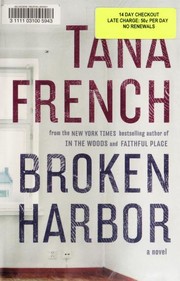
Broken Harbor
2,308-word summary 10 min read 464 pages in the book
- First published
- 2012
- Publisher
- Viking
- Pages
- 464
- ISBN
- 9780670023653
- Series
- Dublin Murder Squad (#4)
Reading options
What's inside (10 sections)
- The case that comes with a house attached
- A ghost estate and its one perfect family
- Scorcher, Richie, and the rules that do not survive contact
- The man in the empty house with binoculars
- The evidence in the wrong hands
- What Jenny told him in the hospital
- Evidence, mercy, and the end of a career
- Why the book still ends the way it does
- Key takeaways
- FAQ
The case that comes with a house attached
I almost skipped this one. Mick Kennedy, the detective the murder squad calls Scorcher, spends much of Faithful Place making himself a nuisance to better people, and the idea of three hundred pages inside his head did not appeal to me. I am glad I relented, because Broken Harbor, published by Viking in 2012, is the fourth Dublin Murder Squad novel and one of the most quietly devastating books French has written. It is also the one where her method becomes clear. Each book hands the narration to someone who was a supporting player in the last one, and the person you distrusted gets a chance to explain himself. Scorcher's explanation is the book.
The case, in his telling, should have been his dream case. A couple and their two children are attacked in their home on a half-built housing estate outside Dublin. The father, Pat, and the two children, Emma and Jack, are dead. The mother, Jenny, is in intensive care, barely alive. A star detective with the highest solve rate in the squad gets the headline case, hands it to the media clean, and moves on. That is the plan. The house has other ideas.
A ghost estate and its one perfect family
The estate is called Ocean View. It was marketed at the height of the boom as luxury living on the coast, and then the money ran out. Most of the houses never got finished. The ones that did stand among half-built shells, scaffolding and cement dust and empty windows. The Spains bought in early, at the top, with a mortgage that swallowed them. The area used to be called Broken Harbour, and anyone who grew up around Dublin knows what happened to places like this when the crash came.
The house itself is the novel's real crime scene. Scorcher walks through it and keeps finding things that contradict each other. The parents were stabbed, the children suffocated. There is no forced entry. The family was so fastidious that the bathroom shelves are lined up like a store display, and yet there are holes smashed in the interior walls of nearly every room, gouged out with something heavy, done in a hurry. Half a dozen baby monitors sit pointed at those holes. Someone in this house was watching for something. Files have been erased from the family computer, and the deletions were careful.
Jenny's sister Fiona found the bodies. She tells Scorcher that Jenny had been frightened for months. There had been break-ins, or something like them. Nothing taken, but objects moved, a back door unlocked in the morning that had been locked at night. Jenny's version, told to Fiona, was a shadowy intruder who slipped past every lock in the house. And Jenny, when she could talk at all, kept saying the same name over and over. Pat. She wanted Pat.
Scorcher does not believe in mysterious intruders. He tells Richie Curran, the rookie assigned to him, that the best explanation is usually the simplest, that victims tend to invite their own murders into the house. He believes people reap what they sow. He is building, quietly, the story of a man who lost everything in the crash and took his family before he took himself. Pat Spain, the head of the household, the protector, the one who was supposed to keep the locks and the money and the walls holding. The simplest explanation fits the recession, and Scorcher, who needs a clean solve after the worst mistake of his career, wants it to fit.
Scorcher, Richie, and the rules that do not survive contact
The partnership is the heart of the first half. Richie is working class, Dublin to his bones, and earnest in the way that rookies are in stories like this. Scorcher teaches him a system: separate the case from your life, keep your compartments neat, decide what story the evidence tells and refuse to feel sorry for anyone who contradicts it. It is a cop's survival kit, and it works right up until it doesn't.
Scorcher's compartments were already crowded before the case arrived. His sister Dina is mentally ill, and the sight of Broken Harbour on the news sends her off the rails again. She turns up at headquarters in a state, and Scorcher takes her home and lets her sleep on his couch and pretends this is a normal thing for a man to handle. The novel withholds the reason for her reaction until much later, and the reason is the reason the case was never going to be clean: the Kennedy family used to caravan at Broken Harbour every summer, and the place is where their mother walked into the sea. She took Dina with her, a small child, and let go at the last moment. Scorcher grew up with that. He built the compartments on that foundation. A case set at Broken Harbour was always going to knock through the walls.
The man in the empty house with binoculars
The intruder, or something like him, turns out to exist. Across the estate, in one of the abandoned shells, Scorcher and Richie find a hide. A sleeping bag. Binoculars. A clear and patient view of the Spain house. Someone was watching the family, and whoever it was had a schedule.
A stakeout catches the watcher returning: Conor Brennan. He is an old friend of the Spains, Emma's godfather, in the photographs on their walls in happier years. The friendship broke apart over the house itself. Conor had been derisive about the purchase, skeptical of the whole dream, and the Spains stopped speaking to him for it. Then the crash came, and the economy confirmed Conor right in the most expensive way possible. Richie and Scorcher interview him, and Conor confesses to the murders. Just like that. He says he did it.
Richie does not believe it. The confession is too smooth, too eager, shaped like what a broken man thinks the police want. The holes in the walls bother him. He asks Scorcher for a parallel line of investigation, and Scorcher, indulging the rookie, agrees. The computer tech comes back with Pat Spain's internet history. Pat had been posting on wildlife forums, asking about an animal that had gotten into his house. The posts start reasonable and get worse, then worse, and the replies from the forums get quieter. Pat described sounds in the walls, scratch marks, food going missing, and a creature that was too quick to see. Forum strangers told him to call an exterminator or a doctor. Then, in the last posts, Pat confessed. No exterminator could find it because there was nothing to find. He was making the holes himself. He had been hearing an animal for months, and eventually the only animal in the house was the story he was telling about it.
Scorcher has the answer to one question and no answer for another. Pat Spain spent his final months hunting something that did not exist while his wife kept the family fed on almost nothing and answered the door with a smile. The recession did not kill the Spains. Something in the walls did, and the walls were in Pat's head.
The evidence in the wrong hands
Then Richie finds the thing that solves the case and destroys it. Searching Conor's apartment, he finds a woman's fingernail with a fiber from one of Emma's pillows caught on it. The nail matches Jenny. The fiber takes her upstairs. Jenny is the murderer.
Richie hides it. He does not tell Scorcher. His reasoning, dragged out of him later, is almost unbearable in its gentleness: Jenny is going to die either way. If she is convicted and locked up, she will hang herself at the first opportunity. If she is not, she will do it at home. He decides it is more humane to let her go, and he says so, and he says it after Scorcher learns that Dina has been sleeping over at Richie's flat, and that Dina walked off with the bag that held the nail. The chain of custody is broken. The evidence is inadmissible. The famous solve rate of Mick Kennedy has just lost its centerpiece, and his sister helped lose it, and the rookie he was teaching is the reason why.
Scorcher tells Richie he is going back to uniform. He does it without shouting, which is worse.
What Jenny told him in the hospital
Scorcher goes to the hospital and sits with Jenny. He tells her, first, that she has not been cautioned, nothing she says can be used, and she understands him perfectly. Then he asks, and she tells him the whole thing. The months of Pat's animal. The dizzy spells she had been having, the missing pockets of memory, the way she kept the house perfect because the perfect house was the only thing holding the family inside the story of itself. The night it ended. Emma woke up crying, terrified of Daddy's animal. Jenny went downstairs to deal with Pat and found him waiting inside a kitchen cabinet with a weapon, using himself as bait, hunting a creature that only existed because he needed it to. She made a decision in that moment that she describes to Scorcher without decoration. She needed to get the children out, and the only way out of that house was through all of them, so she went upstairs and suffocated Emma and Jack in their beds, then came back down and stabbed Pat while telling him they had to hurry, that they had to go find the children. When he died, she tried to finish the job on herself and discovered she did not have the strength to cut deep enough into her own wrist. That is where Conor found her, because Conor had been in the hide, watching, and he came when the commotion started. He tried to call an ambulance. She screamed at him not to, begged him to help her die instead, and he tried, and he could not. He failed to kill her, which is the last mercy and the last cruelty of the night.
There is no tidy why in any of it. Dina, who has spent the book asking questions nobody can answer, has a line about madness that Scorcher repeats: there is no why. The book does not argue with her. Pat's animal, Jenny's missing memory, the mortgage, the estate half-built around a family that kept its shelves straight while the walls came open: none of it adds up to a motive, only to a night.
Evidence, mercy, and the end of a career
Fiona has figured out what her sister did. She is the one who found the bodies, and she knows Jenny better than anyone alive. Scorcher talks to her in the last stretch of the book, and what he proposes is the coldest thing he has ever done. The inadmissible nail cannot convict Jenny on its own, so Scorcher asks Fiona to help him fabricate the case. Manufacture what is missing. Make sure the conviction lands. His argument is Richie's argument with none of the warmth: if Jenny walks, she dies, and if she is locked up, she has a chance at something that resembles a life. Fiona agrees.
They do it. Jenny is going to be convicted of murdering her children, which is true, using evidence that is partly lies, which is not, and the state of that arithmetic is the book's final discomfort. Scorcher does not get to enjoy it. He sits with what he has done and decides he cannot stay. The star of the Dublin Murder Squad resigns from it, his professional integrity spent on the one case where he decided he could not afford to keep it. Where he goes from there is left open. Dina is still ill. Richie is still in uniform. The dead are still dead, and the why still does not exist.
Why the book still ends the way it does
Broken Harbor carries a few faults. It is long, and the middle stretches repeat the same emotional beat a few times too many, the Spains' mounting debts and broken dreams recounted in scenes that blur into each other, and the minor characters around the estate never get enough room to become more than scenery. French also asks you to accept that a set of professional investigators would misread the physical evidence as long as they do. The mystery's two directions, family annihilation versus outside intruder, are kept alive by a certain amount of narrative nursing.
What the book gets right is bigger than its plot. The setting carries the theme: a ghost estate is a promise that outlived its believers, and the Spains are a family doing the same thing one room at a time. Scorcher's final compromises do not feel like a thriller twist so much as the bill arriving for the way he spent thirty years looking at people. And the central question, the one Dina raises and nobody can answer, is left standing in the middle of the room. Why does a woman kill her children because a man heard an animal in a wall that was never there? The book refuses the tidy version, and the refusal is the point.
Read it after Faithful Place, ideally in a quiet week, because the last hundred pages do not let you put it down in a good way. If you want your crime novels to end with the detective's conscience intact, this is not that book. If you want to see what the form can do when the solution matters less than the price of finding it, French left one of the best examples on the shelf.
FAQ
Is Broken Harbor part of a series?
Yes. It is Dublin Murder Squad #4, published in 2012 by Viking. Scorcher Kennedy first appeared as a supporting character in Faithful Place, and the book reads fine on its own.
Who killed the Spain family?
Jenny Spain killed her husband and children. She describes the whole night in a hospital interview, and the fingernail evidence that proves it is mishandled before it can be used at trial.
How does Scorcher's story end?
Scorcher and Jenny's sister Fiona fabricate evidence so Jenny will be convicted and kept from suicide, and Scorcher resigns from the murder squad afterward.
Similar books
More from Dublin Murder Squad first, then related titles.
In the Woods
A detective investigates a girl's murder in the woods where his own friends vanished twenty years earlier.
2,773-word summary · 12 min read
The Likeness
A detective poses as her murdered double and moves in with four graduate students to find the killer.
2,751-word summary · 12 min read
Faithful Place
Undercover Frank Mackey returns to Faithful Place when lost love Rosie suitcase is found.
2,161-word summary · 10 min read

The Trespasser
A Dublin Murder Squad detective investigates a staged dinner-party killing and finds a cover-up that reaches into her own department.
2,051-word summary · 9 min read

Rules of Prey
Minneapolis detective Lucas Davenport hunts a killer who leaves a new rule at every scene and treats murder as a game of wits.
1,914-word summary · 9 min read

The Late Show
Exiled to the LAPD night shift after accusing her supervisor, Renée Ballard keeps two cases that were meant to be handed off at dawn: a brutal assault and a…
2,563-word summary · 11 min read

3rd Degree
The third Women's Murder Club novel follows a San Francisco terror cell and a three-day killing schedule, and it costs the club a member.
2,685-word summary · 12 min read

The Redbreast
Harry Hole chases an ageing sniper through modern Oslo while two Norwegian volunteers on the Eastern Front carry a fifty-year-old betrayal toward a royal…
2,453-word summary · 11 min read
Cruel & Unusual
Scarpetta links an execution to a boy's murder while someone steals bodies.
2,533-word summary · 11 min read
The Man in the Brown Suit
Anne Beddingfeld sees a Tube death in London and chases a paper clue to South Africa, diamonds, and the hidden Colonel.
2,292-word summary · 10 min read

2nd Chance
Lindsay Boxer and the Women's Murder Club hunt the Chimera killer after a church shooting in San Francisco.
2,572-word summary · 11 min read
The Bat
Oslo detective Harry Hole aids Sydney police after a young Norwegian woman is murdered and finds a wider pattern. Grief, drink, and a lost partner shape the…
2,766-word summary · 12 min read
Troubled Blood
Strike and Robin take a year long cold case: doctor Margot Bamborough vanished in 1974, with a nurse hiding more.
2,211-word summary · 10 min read
Holly
Grieving detective Holly Gibney takes a missing-girl case in 2021 and traces it to two polite retired professors with a basement secret.
2,607-word summary · 12 min read
End of Watch
A dying Bill Hodges and Holly Gibney face Brady Hartsfield again, as rigged game consoles push hurt teens toward suicide.
2,923-word summary · 13 min read
Finders Keepers
A boy finds a murdered writer's notebooks while the killer leaves prison hunting them and Hodges closes in.
2,157-word summary · 10 min read
Career of Evil
A severed leg delivered to Robin forces Strike to face four men from his past as a London killer stalks, testing the agency and her wedding plans ahead.
2,887-word summary · 13 min read
The Silkworm
A missing novelist and a cruel manuscript pull Strike and Robin into London publishing.
3,583-word summary · 16 min read
Mr. Mercedes
Retired Hodges hunts Mercedes killer Brady Hartsfield concert plot.
2,281-word summary · 10 min read
Kiss the Girls
Cross hunts Casanova kidnapping women including niece Naomi.
2,397-word summary · 11 min read
1st to Die
Lindsay, Claire, Cindy and Jill hunt a honeymoon killer terrorizing San Francisco.
2,536-word summary · 11 min read
Along Came a Spider
Detective Alex Cross hunts Gary Soneji after two children vanish from a Washington school and a Lindbergh echo grows.
2,523-word summary · 11 min read
The Cuckoo's Calling
Broke detective Strike and temp Robin investigate a supermodel's fatal fall in London.
2,006-word summary · 9 min read
The Witch Elm
Toby Hennessy has always been lucky, until a beating leaves his memory full of holes and a skull turns up in the garden of the family home. A stand-alone novel…
2,021-word summary · 9 min read
The Searcher
A retired Chicago cop seeks quiet in rural Ireland until a local kid pulls him into the hunt for a missing brother.
2,859-word summary · 13 min read
The Keeper
Retired cop Cal Hooper faces one last killing in his Irish village.
2,129-word summary · 9 min read

What She Knew
Rachel lets her eight-year-old son run ahead in a Bristol park, and the nine-day search turns her into a suspect in the public eye.
2,952-word summary · 13 min read

The Beach House
A young valet is beaten to death at a Hamptons party, and his law-student brother spends a year building a case against the family that covered it up.
2,049-word summary · 9 min read

Six Years
A professor who promised to forget the woman he loved sees her husband's obituary and discovers that the wedding, the marriage, and the woman herself may never…
2,076-word summary · 9 min read

How the Light Gets In
Gamache investigates the murder of the last Ouellet quintuplet while the Sûreté he served is dismantled from inside by the man who took his protégé.
2,279-word summary · 10 min read