
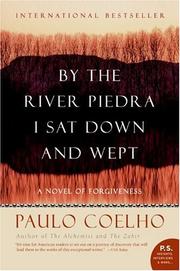
By the River Piedra I Sat Down and Wept
2,845-word summary 13 min read 208 pages in the book
- First published
- 1994
- Publisher
- HarperOne
- Pages
- 208
- ISBN
- 9780061122095
- Original title
- Na Margem do Rio Piedra Eu Sentei e Chorei
Reading options
What's inside (9 sections)
- Madrid, and a lecture about the feminine face of God
- Bilbao, a rusty medal, and a man in the rain
- San Martín de Unx and the house in Saint-Savin
- The Other, and a night she stops lying to herself
- The monastery at Piedra, a tunnel, and a confession
- A night in the cold, and the river
- What holds up, what doesn't
- Key takeaways
- FAQ
I picked this one up expecting The Alchemist with different scenery and found something narrower, more private, and much harder to defend. By the River Piedra I Sat Down and Wept is Paulo Coelho's 1994 novel, first published in Portuguese as Na Margem do Rio Piedra Eu Sentei e Chorei. Alan R. Clarke's English translation followed in 1996, and the edition I read is the 2006 HarperOne paperback, 208 pages that cover exactly one week of December 1993.
The title echoes Psalm 137, the exile song: by the rivers of Babylon we sat down and wept. Coelho moves the riverbank from Babylon to rural Spain and puts a twenty-nine-year-old woman named Pilar there, writing out the story of a love affair that broke her open. Legend says the river Piedra is so cold that everything falling into it, leaves and insects and the feathers of birds, turns to stone, and she plans to toss her pages in when she is done. That single image holds the book together: grief, memory, and the wish to be rid of both.
What follows is the whole story, ending included.
Madrid, and a lecture about the feminine face of God
Pilar is from Soria, a small town whose only famous poet said that roads are made to be traveled. She is studying law in Zaragoza, working as a salesgirl to pay for her courses, and she lost the scholarship competition she had organized her life around. Her one vivid thread to the past is a childhood friend who left Soria when they were young, wrote her letters from all over the world, and then started writing about God. He mentioned a seminary, which alarmed her enough that she wrote back urging him to live a little first, then tore the letter up.
A letter arrives inviting her to a lecture he is giving in Madrid. She takes the four-hour bus ride, mostly to hear his voice again. The room is full, which surprises her, and the woman beside her says he is giving people back what was stolen from them, religion. Someone calls him a seminarian, which Pilar knows cannot be right.
He speaks about magic moments, the daily instant when a yes or a no can change a life, and about the cowardice of burying your talents in a cave. He is good onstage, maybe too good. When he reaches her after the crowd thins, he blushes and turns back into the boy she remembers. Over coffee she asks what the woman meant. He explains that the great religions are all masculine, that men wrote the dogmas and men run the churches, and that he believes in the feminine side of God. Then a strange young woman named Brida takes her arm and marches her across Madrid to the Plaza de Cibeles, where a statue of Cybele stands among traffic. Brida prays to the moon, talks about the Great Mother and the women burned for knowing her, and then reads Pilar like a card: you are going to fall in love, and suffer. Do not let him lose his way.
By the end of the night Pilar has agreed to ride with him to Bilbao the next morning for a second lecture. She tells herself she is just being friendly.
Bilbao, a rusty medal, and a man in the rain
The drive to Bilbao starts badly. He asks polite questions he does not listen to, silence fills the car, and Pilar announces she wants to be dropped at the bus station. He keeps driving and eventually asks her to stay for the evening's conference. In the hotel he gets a room with two beds. In a café before the talk he hands her a small red pouch. Inside is an old rusty medal, Our Lady of Grace on one side, the Sacred Heart on the other. Hers. She lost it as a child at the hermitage of San Satúrio and asked him to find it. He did find it, but he had been on the verge of telling her something he had rehearsed for weeks, and his nerve failed. So he kept the medal, promising to return it only when he could finish the sentence. Almost twenty years later, he finishes it. I love you.
Pilar does not know what to do with that. She spends the evening at his lecture and then at a dinner with his followers, drinking more than she has in a year, telling him that what he feels is nostalgia for a hometown girl. He answers that he is going to fight for her love. Walking back to the hotel in the rain, singing a tango about lunatics who invented love, Pilar has almost decided to enjoy herself when a soaked stranger steps in front of them, kneels on the pavement, and begs for help. It's his son. The night ends with Pilar back at the hotel alone; her friend does not return until dawn.
That night establishes the second engine of the book. The man she remembers is now a healer, or something close to it, and his reputation walks into rooms before he does.
San Martín de Unx and the house in Saint-Savin
They drive south through Navarra the next morning, past olive groves, and he makes her feel the rounded stones on the roadside, smoothed by centuries of pilgrims and laborers. A medieval village appears on a hill, San Martín de Unx, with a chapel Pilar wants to see. The old caretaker refuses them, closing time. Pilar backs off. Her friend pushes the door open anyway and tells her the caretaker was casting them in a play about his own frustrations, and that she should be careful about roles in other people's scripts.
At lunch she snaps at him. He stays calm. Then they cross into France and drive into fog, up to a village in the Pyrenees called Saint-Savin, where he wants to show her a house. They rent a room from a couple, borrow a bottle of wine and two glasses, and sit on the edge of a well in the plaza while the fog goes yellow under the streetlamp. Pilar confesses she has lost her faith. She prayed, suffered, loved badly, and God did not answer. He says he lost his faith too, then recovered it, and tells her about Bernadette, the girl at Lourdes in 1858 who was told, I am the Immaculate Conception, and dug in the mud until a spring appeared. He also tells her a small story that will matter later, about a man who realized he had been living his whole life as the Other, the voice that teaches us what we should be like rather than what we are, and who finally threw it out of his house.
Then comes a silence neither of them wants to break. Pilar notices it only when he walks off to buy a second bottle. It is not the awkward silence of the drive. It is the other kind, the kind two people fall into when they have stopped explaining themselves.
The Other, and a night she stops lying to herself
He calls the inner voice of fear and caution the Other, and he prescribes an exercise: imagine the person you would be if you were not afraid. One night in Saint-Savin, alone in her room, Pilar tries it. She pictures a woman who is curious and joyful, who drinks the water of life thirstily and believes in her own dreams, and she sees the Other clearly for the first time, fragile and exhausted and busy guarding her against a future built from past wounds. The Other leaves the room. Pilar falls asleep in love and finally admits it.
The next days are the best ones. They walk in the snow, eat in villages, and visit a church where Pilar's faith quietly comes back, which she tells him and he receives like a gift. He also tells her his own history. He spent four years in a monastery near Saint-Savin, studied with the Charismatics, and discovered through their practices that he could heal, that God or something would work through the laying on of his hands. People started lining up at the gates. His superior supported him. And two months earlier he had come to Saint-Savin with that superior to inventory a house left to the seminary, which is how he found the village and began what he calls the inventory of his own soul.
On the night of December eighth they attend a gathering of the faithful in a cathedral, priests speaking in tongues, people weeping and declaring cures. The woman next to Pilar cries out that someone with a sick daughter-in-law is being cured. Pilar, who came to watch, finds herself speaking in tongues too, the words arriving easier than she expected. Then morning comes, and he is gone. Just a note saying he has gone to the seminary. The Other instantly explains: he chose God, of course he did. A country priest arrives at the house looking for him, short and heavy and gently impious, and tells her the young man is not at the seminary at all. On the road they meet a woman who kisses the priest's hands and says the young man cured her husband. The priest corrects her: the Virgin cured her husband, the lad was only an instrument. Then he tells her, more or less, what she already suspects: the gift is a terrible burden, and its owner is deciding his whole future this morning, if she lets him.
The priest drives her up the mountain where her friend is praying. Pilar refuses to go to him. She will not be the woman who takes the miracle worker away from the sick. She goes back to Saint-Savin and sits in the dark house until he walks in that night, tired and calm, and neither of them says the true thing.
The monastery at Piedra, a tunnel, and a confession
On their last full day Pilar asks to go to the monastery at Piedra, a place they explored as children, now half ruin and half hotel. The church has lost its roof and the statues have lost their heads, all except Saint Teresa of Avila, whom nobody dared to touch even when soldiers stabled horses in the nave. They walk the canyon where the river breaks into dozens of waterfalls and arrive at the biggest one, which Pilar still remembers is called the Horse's Tail. It hides a huge grotto, and the old monks cut a tunnel so you can walk through the darkness into the cavern behind the falling water.
At the edge of the emerald lake, with the last sun coming through the waterfall, he tells her everything he has been circling for a week. What the gift cost, what it is for, and what he has decided. He asked the Virgin for a miracle, he says: he asked her to take the gift back. He put his hands on the earth, as the tongues had instructed the night before, and felt the power return to the Mother. He has already cancelled his presentation in Barcelona. He wants to get a job in Zaragoza, marry her, live quietly, serve God the way Joseph did, anonymously. He needs her more than he needs miracles.
Pilar is not moved. She is horrified. She loves the man who heals people, who talks to the Virgin, who walked into that frozen village with a mission. She has just been given back her faith, partly through him, and now he wants to trade his gift for a house with white curtains and a regular life, and she cannot bear to be the reason. So she climbs back through the tunnel alone, in the dark, thinking about the sick who will stay sick and the lives he will not save.
A night in the cold, and the river
That is the book's real crisis, and not the one I expected. The obstacle was never God versus love. It is Pilar's refusal to be loved at that price, plus the Other whispering that she is unworthy of it. She walks out of the monastery at midnight, tries to hitchhike to Zaragoza, fails, and ends up lying on the frozen ground of the monastery gardens, so cold and so defeated that she thinks dying would be reasonable. She is found near morning by a watchman, who forces hot liquid down her throat.
She wakes in an old convent nearby, being nursed by a woman who asks no questions and feeds her bread and coffee. Pilar tells her about the church they passed the day before, where boys with guitars played flamenco for a congregation that turned out to be a funeral, joy and grief in one room. The woman listens, then points out that Pilar saw only the sad ending and forgot the happiness inside. She gives Pilar paper and a pen and tells her to write everything down and throw it in the river, because the river turns whatever it receives to stone. Love perseveres, the woman says at the door. It is men who change.
Pilar writes for days on the riverbank. Then the epilogue: a car arrives. He sits beside her in silence for a morning while she finishes her manuscript, then says he searched Zaragoza and Soria and came back because the convent woman told him where she was. He tells her he will sit with her, and if she goes home he will sleep in front of her house, and if she goes away he will follow until she sends him off, because he has to love her for the rest of his life. She hands him the pages instead of answering. He reads all afternoon. Thank you, he says when he gives them back. And forgive me. And then he asks if she knows Psalm 137, the psalm of exiles who hang up their harps because they cannot play the music their hearts want. He quotes its turn, the promise never to forget Jerusalem, and tells her she returned his dream to him. She asks whether his gift has come back. He doesn't know, he says, but the Goddess keeps giving him second chances, and this is one. Our chance, she corrects, and he agrees. Our path. Then he pulls her to her feet and says the last line of the novel: Get your things. Dreams mean work.
What holds up, what doesn't
The structure is better than the book's reputation suggests. The dated diary chapters, December fourth through tenth, with Pilar writing the whole thing from the riverbank in the frame, give the story a real spine, and her first-person voice is the best thing in it: guarded, sardonic, observant, aware that she is not the interesting one in the room. The invention of the Other is genuinely useful, an unglamorous name for the voice that talks us out of our lives, and the exercise she tries in Saint-Savin is the one scene I have thought about since finishing.
The problems are equally real. The man has no name and barely any interiority; he is a delivery system for wisdom, and when he is not explaining the feminine face of God or the mechanics of his gift, the book does not know what to do with him. Brida, the padre, and the convent woman all exist to say true things at Pilar, and you can hear the author behind them. The dialogue runs on aphorism. People do not converse so much as emit epigrams, and after a hundred pages the pattern wears thin. The theology is asserted, not argued, and its gender talk, men hunted while women stayed in the cave, will read as essentialist now, and slightly embarrassing. The middle also repeats itself: the same conversation about fear and surrender in a bar, then a church, then a snowbank.
None of that makes the book worthless. It makes it a particular kind of book: a parable about surrender, written at the pitch of a love letter, with two settings, high and higher. Readers who want psychological realism or moral ambiguity will find the people thin and the wisdom prepackaged. Readers who have ever been the cautious one, the Pilar who plans and postpones and calls it prudence, may find the Other staring back at them from the corner of the room. Coelho wrote this five years after The Alchemist, and it shares that book's faith that desire is information and risk is holy, but the cost lands on a woman's heart and a man's gift rather than a shepherd's treasure map. Whether he earns the ending depends on how much of yourself you bring to the riverbank. I brought enough that the final line, about dreams meaning work, landed less like a slogan and more like a bill coming due.
FAQ
What is By the River Piedra I Sat Down and Wept about?
Pilar, a law student from Soria studying in Zaragoza, spends one week traveling through Spain and France with her childhood friend, now a rumored healer, and has to decide what claim love and his gift have on him.
Why is the book called By the River Piedra I Sat Down and Wept?
The title echoes Psalm 137, the exile psalm about sitting down and weeping by the rivers of Babylon. Pilar writes her account on the bank of the river Piedra, whose legend says everything falling into it turns to stone.
Is By the River Piedra I Sat Down and Wept connected to The Alchemist?
They are separate novels by the same author, published five years apart. Piedra is a love story that shares The Alchemist's belief that desire points somewhere and risk is holy, but it prices both higher.
Similar books

Alone With You in the Ether
Two people in Chicago agree to six conversations, and the experiment becomes a love affair that is also a study of bipolar disorder, obsession, and the shape…
2,713-word summary · 12 min read
The Dharma Bums
Ray Smith rides freight trains, climbs Matterhorn Peak and argues about Zen with the poet Japhy Ryder in Kerouac's 1958 road novel.
2,729-word summary · 12 min read
The Marriage Plot
At Brown in 1982, Madeleine loves Austen while torn between brilliant Leonard and steady Mitchell.
2,804-word summary · 12 min read
How to Stop Time
Tom Hazard, aging one year in fifteen, hides behind new identities until a London classroom and a lost daughter force him to live.
2,597-word summary · 12 min read
The Prophet
A prophet delayed twelve years answers his city on love, work, sorrow and freedom before his ship sails.
2,852-word summary · 13 min read
Eleven Minutes
Maria leaves Brazil for Geneva in Coelho 2003 novel, works as a dancer then as a prostitute, and meets painter Ralf Hart while testing sex against love.
2,639-word summary · 12 min read
Veronika Decides to Die
After a failed suicide attempt, a young woman in a Slovenian asylum learns she has days to live and starts to want them.
2,224-word summary · 10 min read

The Japanese Lover
A Polish refugee and the son of a Japanese gardener fall in love in San Francisco in 1939, then keep the affair secret for nearly seventy years.
2,286-word summary · 10 min read
Memories of My Melancholy Whores
A ninety-year-old journalist pays for a night with a teenage girl, cannot go through with it, and discovers love for the first time in García Márquez's late…
2,101-word summary · 9 min read

Fathers and Sons
Arkady brings the nihilist Bazarov home to his father's estate, and a generational argument turns into love, a duel, and an early death.
2,192-word summary · 10 min read

The Chosen
A shattered pair of glasses in a 1944 Brooklyn softball game starts a friendship between a Hasidic boy and his Orthodox neighbor, and their fathers pull them…
2,443-word summary · 11 min read
On Chesil Beach
Two newlyweds spend one terrible night on Chesil Beach in 1962, and the rest of their lives is decided by it.
2,456-word summary · 11 min read

Ivanhoe
A disinherited Saxon knight, a great tournament, a besieged castle and a trial by combat. Scott's most famous novel, set in England in 1194.
2,834-word summary · 13 min read
Euphoria
Three anthropologists in 1930s New Guinea turn fieldwork into a love triangle, and a real history breathes behind them.
2,048-word summary · 9 min read
Eligible
Austen's Bennet sisters move to modern Cincinnati, where marriage is a reality show and the house is losing its value.
2,293-word summary · 10 min read

Big Swiss
A transcriptionist for a sex coach falls for one of his clients, the tall Swiss gynecologist she calls Big Swiss, in a funny novel about work and secrets.
2,523-word summary · 11 min read
This Is How You Lose Her
Yunior cycles through love affairs and betrayals in nine linked stories, tracing the damage he does and the family history behind it.
2,195-word summary · 10 min read
The Road Less Traveled: A New Psychology of Love, Traditional Values and Spiritual Growth
M. Scott Peck argues that maturity begins with accepting difficulty, then builds discipline, love, and spiritual growth through honest, often painful work.
2,200-word summary · 10 min read
The Birth of Venus
A Florentine merchant's daughter trains as an artist, marries a man who hides a secret, and survives Savonarola's bonfire of the vanities.
2,404-word summary · 11 min read
The Bridges of Madison County
A four-day affair between an Iowa farm wife and a photographer asks what a brief happiness is worth against family duty.
2,487-word summary · 11 min read

The Little Paris Bookshop
A Paris bookseller who prescribes novels as medicine finally opens a twenty one year old letter from his lost love and sails south through France to find her.
2,050-word summary · 9 min read
The Exception to the Rule
A typoed Valentine's email turns into yearly notes between two strangers who wonder if they should meet.
2,226-word summary · 10 min read
The Buried Giant
An old couple crosses a misty post Arthur Britain searching for a son.
2,593-word summary · 12 min read
The Accidental Tourist
Grieving Macon writes travel guides for haters of travel, then Muriel intrudes.
2,252-word summary · 10 min read
I Capture the Castle
Cassandra journals six months of love and money trouble in a castle.
2,402-word summary · 11 min read
God Is Not Great
Hitchens argues religion poisons life across history and texts.
2,545-word summary · 11 min read

Drive Your Plow Over the Bones of the Dead
An old woman in Poland blames animal revenge for murdered hunters.
2,597-word summary · 12 min read
A Canticle for Leibowitz
After nuclear war, monks save books across centuries while the world rebuilds and falls again.
2,381-word summary · 11 min read

The Fall
A fallen Paris lawyer confesses in an Amsterdam bar, tracing guilt from Paris success to a bridge he failed to face.
2,220-word summary · 10 min read
The Celestine Prophecy
A restless American chases a missing manuscript through Peru and learns Nine Insights about coincidence, energy, and how people vie for attention.
2,599-word summary · 12 min read