
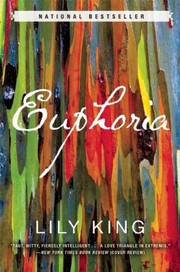
Euphoria
2,048-word summary 9 min read 272 pages in the book
- First published
- 2014
- Publisher
- Atlantic Monthly Press
- Pages
- 272
- ISBN
- 9780802122551
Reading options
What's inside (9 sections)
I read Euphoria in a week in the middle of a long job and kept stopping to look things up, which is a compliment and also the book's warning label. It is 272 pages, published by Atlantic Monthly Press on June 3, 2014, ISBN 9780802122551, and it is set in 1933 in the Territory of New Guinea, on and around the Sepik River, where three anthropologists are doing fieldwork that goes wrong in every way fieldwork can go wrong.
One housekeeping note before the retelling, because it trips people up. There is an HBO series called Euphoria, and it has nothing to do with this novel. The show premiered in 2019, was created by Sam Levinson, and is based on an Israeli miniseries; it is a contemporary story about teenagers and addiction. Lily King's book is 1930s anthropology, and it is not the source of the show. The name collision is pure coincidence.
Bankson alone with the Kiona
The book opens with a man who has given up. Andrew Bankson has been in the field for years, working on an isolated group he calls the Kiona, and his fieldwork is going nowhere. He is lonely, his research is stalled, and he has recently tried to kill himself and failed. His mother writes to him constantly, anxious for reports from the field, and his father and his brothers are dead, so the fieldwork is also the last family business he has. Then, at a party, he falls in with two people who pull him back into motion: Nell Stone and her husband Fen.
Nell is the famous one. She is an American anthropologist who has already published a celebrated book about children in the South Pacific, and she walks around with the gravity of somebody whose career is also a cause. Fen is Australian, loud, magnetic, quick to learn languages by being thrown into them, and dangerous in a way that takes a while to show. The two have just come out of a place called the Mumbanyo, a group King describes as bloodthirsty, and they are emotionally and physically scraped. What they want is a new discovery. What Bankson wants is a reason to keep going. He has exactly that to offer: a group a few hours away by river that he has not managed to work with, the Tam, who are artistic and female-dominated, and who interest him far more than the Kiona do.
Three people and one river
The next thing that happens is that the three of them travel together, and the travel is the whole novel in miniature. King sets them on a boat and a river and lets them rub against each other for a few hundred pages, and the rubbing is the point. Each of them is a different kind of anthropologist. Fen is a doer, a body in the culture, a man who learns a word by walking into the room where it matters. Nell is a thinker, an empath, a woman who believes language gets in the way of understanding people. Bankson is a theorist, more interested in the discipline itself than in the people he is supposedly studying, and more interested still, eventually, in one of the people in the boat.
Nell's journal entries run through the book, and they are where her private doubts end up. She wants a child, and she has miscarried more than once, and that wanting sits under the fieldwork like a stone in a shoe. Fen's envy of her reputation is the other live wire. He is after a flute he heard while they were with the Mumbanyo, and he believes that securing it is the key to his glory, and he cannot let the quest go. Bankson, meanwhile, has a seizure in the field, falls ill, and is nursed by Fen, which is one of the book's quietest and most telling arrangements: the man who resents him becomes the man who takes care of him.
King is also writing about the ethics of what they are doing, and she is not squeamish about it. These three are observers with power, writing up other people's lives for careers, in a territory where the people they study have no say in any of it. The book keeps that in frame without turning it into a lecture. The San Francisco Chronicle praised it for the dignity and wit with which the New Guinean characters are drawn, and for the way the novel's real subject, the moral contradictions of Western anthropology, comes through the behavior of three people rather than through argument.
The triangle and the boy
Then the love triangle does what love triangles do. Bankson falls for Nell, and the book is honest about the mess of it: desire, guilt, the bad arithmetic of who owes what to whom, Fen's discovery and rage. Fen's violence, which has been sitting under the charm all along, comes out. There is a boy, a local boy, who goes with Fen to look for the flute, and the boy does not come back. Bankson understands that they have to leave, and the three of them make for Sydney, and Nell and Fen sail for New York.
The ending is the part I still think about. Bankson asks Nell to stay with him and she says no. Later, thinking about going back to her, he learns that she died on the boat to New York, under circumstances that are never made entirely clean. Helen, Nell's friend and earlier lover, turns up after that, and she is the one who hands Bankson Nell's diary. So the book ends with a man reading a dead woman's notes about him, and it does not tell you what to do with that.
Reading it
The book moves the way the river moves, which is to say it does not hurry and it does not stop. There is a long stretch of travel by river, then weeks of fieldwork with the Tam, then the collapse, then a very short run for the coast. The middle is dense in the way a good travel book is dense, full of small practical things, meals, heat, insects, the specific tiredness of being somewhere you did not choose. King gives the peoples of the river their own presence on the page, through customs, rituals and the daily business of a village, rather than using them as scenery for the three of them.
If you are the kind of reader who wants the anthropology to be the atmosphere, this is not that book. If you want the reverse, a love triangle carried at a temperature just above freezing and shot through with sentences about how it is possible to know people and still take from them, it is very much that book. The paperback from Grove Press, dated April 4, 2015, runs 288 pages.
The manner of the thing
King's method here is restraint, and it is easier to admire than to warm to. She keeps the sentences short and the temperature low. The New Guinea setting is never lush for its own sake. Where other writers would have reached for heat and color, King gives you a boat ride, a bad meal, a note in a journal. The Washington Post put it well, noting that King has always written coolly about intense emotions, and that here the coolness is deliberate. NPR called the result atmospheric and sensual and an intellectual tour de force. The Salon called her sinewy and disciplined. It won the 2014 Kirkus Prize for Fiction and the New England Book Award, and it was a finalist for the National Book Critics Circle Award.
The research is heavy but worn lightly. King worked on it for six years, read Mead, read the people along the Sepik, and gave the groups she needed to invent her own names. There is a deliberate looseness in the history: the three characters are imagined versions of the anthropologist Margaret Mead, her second husband Reo Fortune, and Gregory Bateson, who was the third man in that famous and complicated circle, and King moves them around freely. Ron Charles in the Washington Post called the book a work of ferocious restraint that resists loading itself with research, and noted that it presumes some familiarity with Mead's life for context. That is a real condition of entry. You will feel the gap if you know the history, and you will not miss it if you do not.
Two more things about the writing, because they explain the form. King drafted the novel entirely in pencil, which she said took the pressure off getting it right the first time. And she wrote a first draft in Nell's point of view before deciding the story worked better from Bankson's, which is why the narration mostly sits with the man who is looking back at what happened.
Where it falls short
The love triangle is the part I would warn you about. King is good at the middle of it, the flirtation, the awkwardness, the way two people who respect each other wreck something that was going fine. But the shape itself, three brilliant people in a jungle, is a shape the twentieth century has used many times, and for stretches the book reads like a rerun. Publishers Weekly enjoyed the triangle sections and said plainly that King's prose was the real event, which is a polite way of saying that the plot is serviceable and the sentences are the reason to stay.
The distance is the second problem. King holds the characters at arm's length, which suits the coolness of the enterprise and also makes it hard to feel very much for any of them, including the woman who dies. Nell in particular stays more concept than person for long stretches. There are passages of talk about the discipline, and about the difficulty of knowing people, that are interesting and that also stop the book dead.
The slowest stretch is the one about Helen's book, the manuscript her friend has written, and readers who like their novels to move tend to single it out as the point where the book sits down and refuses to get up. It is also where King is most directly the novelist who has done the reading, and the prose turns instructional for a page or two.
And the ending is compressed to the point of being nearly abrupt. After two hundred pages of slow travel, the last movement arrives fast, with a death, a boat and a diary, and a lot of the interpretive work is left for the reader. Publishers Weekly said the last pages feel like the briefest, purest euphoria, which is a generous way of saying that the release is so sudden it barely registers. I would rather have another eighty pages of the middle than the third act this book actually has. Readers who want a love story with a happy or at least a mournful ending will finish this one unsatisfied. Readers who want to watch a person study another person for two hundred pages and come away understanding less than they started with will be in exactly the right place.
Who it is for
Give it to readers of literary fiction who like their novels short and their research woven in rather than appended. Give it to anyone who has read Margaret Mead and wants a novelist's version of that world. Skip it if you need the New Guinea of it to be vivid, because King deliberately declines that, and skip it if the words "love triangle" make you stop.
I have read it twice and talked about it more than I expected to. What stays with me is not the triangle but the honesty about the work. These three people go into somebody else's world with notebooks, and the novel insists on the fact that the notebook is also a weapon, and that the people in it have names, and that the people writing it up will be remembered for what they took. That is a sharper argument than most novels of ideas make, and 272 pages is enough to make it. King closes without a lesson attached, which is the kindest thing she could have done.
FAQ
Is Euphoria by Lily King the same story as the HBO series?
No. The HBO series Euphoria premiered in 2019 and is a contemporary drama about teenagers and addiction, based on an Israeli miniseries. The novel is a 2014 historical novel about three anthropologists in 1930s New Guinea and is not the source of the show.
When was Euphoria published and how long is it?
Atlantic Monthly Press published it on June 3, 2014. The hardcover runs 272 pages and the ISBN is 9780802122551. A Grove Press paperback followed in April 2015.
Is Euphoria based on real people and events?
Yes. It was inspired by the life of the anthropologist Margaret Mead, and the three main characters are invented versions of Mead, her second husband Reo Fortune, and Gregory Bateson. King changed names, places and outcomes as she went.
Similar books

Violeta
A woman born in 1920 writes her life story to her grandson, from one pandemic to another, through wealth, ruin, passion, and dictatorship in South America.
2,555-word summary · 11 min read

Ivanhoe
A disinherited Saxon knight, a great tournament, a besieged castle and a trial by combat. Scott's most famous novel, set in England in 1194.
2,834-word summary · 13 min read
Wide Sargasso Sea
Jean Rhys gives the first Mrs. Rochester a Caribbean childhood, a marriage built on money and suspicion, and a voice that Charlotte Bronte left in the attic.
2,021-word summary · 9 min read
The English Patient
In a ruined Italian villa in 1945, a burned man, a nurse, a thief, and a sapper trade pasts shaped by desert love and war.
2,006-word summary · 9 min read
Daughter of Fortune
Eliza Sommers flees Chile for California gold rush San Francisco, disguised and searching for her lover, finding freedom with Tao Chi'en.
2,009-word summary · 9 min read
Brooklyn
Eilis Lacey leaves Enniscorthy for Brooklyn boarding house work, love with Tony, then a home death forces divided choice.
2,143-word summary · 10 min read
Half of a Yellow Sun
Ugwu, Olanna and Richard are pulled from Nsukka comfort into the Biafran war, where love and hunger test every loyalty.
2,973-word summary · 13 min read
How to Stop Time
Tom Hazard, aging one year in fifteen, hides behind new identities until a London classroom and a lost daughter force him to live.
2,597-word summary · 12 min read
Things Fall Apart
Proud Igbo wrestler Okonkwo rises in 1890s Umuofia, then loses standing through hard exile, a son's conversion, and British missionaries and courts remaking…
2,518-word summary · 11 min read
Snow Flower and the Secret Fan
Footbound Lily and Snow Flower share laotong bond through 19th century Hunan hardship.
2,557-word summary · 11 min read
My Brilliant Friend
Elena and Lila grow up in 1950s Naples bound by rivalry and love.
2,584-word summary · 11 min read
The Song of Achilles
Song of Achilles retold: Patroclus and Achilles from boys to Troy, love and war in Miller prose.
1,925-word summary · 9 min read
Writers & Lovers
A broke waitress in Boston grieves her mother, finishes a novel, and chooses between two men.
2,473-word summary · 11 min read
The Stationery Shop
Two teenagers fall in love in a Tehran stationery shop in 1953, are separated by the coup and a family deception, and meet again sixty years later.
2,024-word summary · 9 min read

The Japanese Lover
A Polish refugee and the son of a Japanese gardener fall in love in San Francisco in 1939, then keep the affair secret for nearly seventy years.
2,286-word summary · 10 min read

Anatomy: A Love Story
In 1817 Edinburgh, a noblewoman who wants to be a surgeon disguises herself to study anatomy and falls for the grave robber who supplies her with bodies.
2,031-word summary · 9 min read
Alone With You in the Ether
Two people in Chicago agree to six conversations, and the experiment becomes a love affair that is also a study of bipolar disorder, obsession, and the shape…
2,713-word summary · 12 min read

The Shadow Sister
Star D'Apliese steps out of her sister's shadow and follows a bookshop clue into the Edwardian life of Flora MacNichol, a woman who gave up love for duty.
2,260-word summary · 10 min read
The Only Woman in the Room
A novel about Hedy Lamarr's escape from an arms-dealer husband, her Hollywood career, and the frequency-hopping patent the Navy ignored.
2,067-word summary · 9 min read

Mrs. Everything
Two Jewish sisters in Detroit grow up, apart and together, across seven decades of American life, from the 1950s to the 2016 election.
2,362-word summary · 10 min read
The Valley of Horses
Exiled from the Clan, Ayla survives alone in a hidden valley, tames a horse and a cave lion, and nurses a wounded stranger back to life.
2,311-word summary · 10 min read

Sophie's Choice
A young Southern writer in 1947 Brooklyn befriends a brilliant, unstable couple and slowly learns the story of the Polish Catholic woman at the center of their…
2,798-word summary · 12 min read
The Lowland
Two brothers grow up beside a marshy lowland in Calcutta, and the choices of the younger one draw the older into a life of duty, distance, and quiet grief that…
2,213-word summary · 10 min read
Between Sisters
Estranged sisters Meghann and Claire reunite in Washington when Claire announces a rushed wedding, then face their mother's desertion and a medical crisis.
2,467-word summary · 11 min read
The Storyteller's Secret
A New York journalist goes to India to learn why her grandmother loved a British officer, and why a family servant kept the truth for forty years.
2,270-word summary · 10 min read
Stones from the River
Trudi Montag is born a dwarf in a small German river town in 1915 and grows up to keep the town's library and its secrets, from the First World War to the…
2,818-word summary · 13 min read
Origins
Stefan's diary of 1864 and 1888: how he and Damon fell for Katherine, became vampires, and went looking for a killer in London.
2,056-word summary · 9 min read
On Chesil Beach
Two newlyweds spend one terrible night on Chesil Beach in 1962, and the rest of their lives is decided by it.
2,456-word summary · 11 min read

Last Night at the Telegraph Club
The 2021 National Book Award winner follows Lily Hu, a Chinese American teenager in 1954 San Francisco, as she falls for Kath and learns what it costs to be…
2,336-word summary · 10 min read
Eligible
Austen's Bennet sisters move to modern Cincinnati, where marriage is a reality show and the house is losing its value.
2,293-word summary · 10 min read