
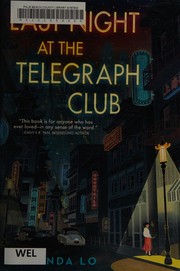
Last Night at the Telegraph Club
2,336-word summary 10 min read 416 pages in the book
- First published
- 2021
- Publisher
- Dutton Books for Young Readers
- Pages
- 416
- ISBN
- 9780525555254
Reading options
What's inside (9 sections)
I read a lot of young adult books, and most of them are about a secret. Somebody is hiding something from a parent, a boyfriend, a whole town. Last Night at the Telegraph Club has that structure, but the secret it is really about belongs to the United States in 1954, and that makes the book much heavier than its blurb suggests. I went in expecting a tender first-love story with a period backdrop and got a novel where the politics and the romance are the same plot, straining against each other. It is not a light book. It is also one of the most carefully made ones I have read this year, and it won the 2021 National Book Award for Young People's Literature.
Dutton Books for Young Readers published it on 19 January 2021. The edition runs 416 pages and carries the ISBN 9780525555254. It is a standalone novel with no series. Malinda Lo followed it in October 2022 with A Scatter of Light, a companion book about a different character in 2013 San Francisco, which is not a sequel and not a series volume. Lo is a former LGBT media journalist who grew up in a Chinese American family near Boulder, and by the time this book appeared she had written six novels.
A boyish advertisement in the Chronicle
The novel opens with Lily Hu at thirteen, at a Miss Chinatown pageant in 1950, staring at a group of Chinese girls in bathing suits and high heels who look, as she puts it, so American. She watches them and feels as though she is doing something improper. Then the story jumps ahead to September 1954, when Lily is seventeen, a senior, and living above her father's medical practice on Clay Street at the edge of Chinatown.
She is good at math. She wants to work on rockets, ideally as a computer at the Jet Propulsion Laboratory, which is exactly what her Aunt Judy Fong does, so Lily has a role model who made it into a laboratory as a woman in a field that did not want women. She also collects clippings: pictures of Katharine Hepburn, of women pilots, and of Tommy Andrews. Tommy Andrews is a male impersonator, a woman who performs in a suit, and the advertisement for her says she is making a world premiere at the Telegraph Club, 462 Broadway.
Kathleen Miller enters in Advanced Math. Kath is white, a year or so younger than Lily, and wants to be a pilot. She has already been to the club. The two girls start talking about the ad and about a pulp novel Lily picks up in a drugstore just outside the neighbourhood, called Strange Season, about two women in love, which she reads and puts back on the shelf. Lily describes the moment as feeling as if she had cracked the last part of a code she had been puzzling over for a long time without knowing it.
Shirley Lum, Lily's best friend since childhood, also appears. Shirley's family owns the Eastern Pearl restaurant, and Shirley is the sensible one, the one headed for the Miss Chinatown title. She also has a secret of her own. Will, another Chinatown boy, asks Lily to the fall dance, and Lily panics and hides in a bathroom to get away from him.
The club on Broadway
Kath gets hold of a false identification so the two of them can get past the door as minors, and Lily does not love the document. Nothing has been more frightening to her than what the piece of paper implies about who she is.
The Telegraph Club itself is Lo's invention, but it is modeled closely on the real lesbian bars of North Beach: Mona's 440, Mona's Candlelight, and Tommy's Place, which sat on Broadway and Columbus Avenue and was raided by San Francisco police on 8 September 1954, when Grace Miller and Joyce Van de Veer, the women who held the licences for the bars, were arrested on charges of serving alcohol to minors. Lo researched the bars through the GLBT Historical Society, and wrote about them in a series of essays on her blog. The real Tommy Vasu, who ran Tommy's Place, was a short-haired lesbian in suits who drove a Cadillac around North Beach.
Inside, Lily learns the vocabulary. There are butches and femmes, and when Kath is called a baby butch Lily understands that it is a compliment. Tommy Andrews sings, and Lily realizes that the person in the photograph is a woman of flesh and blood, which frightens her more than the fantasy did. Lana, Tommy's girlfriend, is warm and watchful. Shirley is the one who warns Lily about Kath, and it is Shirley who will later reject her.
The girls also meet Claire and Paula, who have driven in from San Mateo. Lily is the only Chinese American in the room, and the microaggressions start immediately: a white woman who cannot place her, comments about her English, a question about whether she is a tourist. Lo lets Lily notice these moments without letting the women who deliver them become villains, because ignorance is more useful to her than malice. By the end of the evening Lily has been handed a vocabulary for herself and has also learned that the lesbian community is not a safe harbor from racism.
The Red Scare at home
Interleaved with Lily's story are dated chapters from her mother Grace, from her father Joseph, and from Aunt Judy, and they are where the novel's real argument lives. Joseph came to San Francisco in 1932 to attend medical school and married Grace in 1936, when Chinese Exclusion still made naturalization impossible for him. When Japan invaded China and then Pearl Harbor brought the United States into the war, his enlistment in the army became the only legal route for him to keep his family together, and it is where his citizenship comes from. Lo based him on her own grandfather.
That citizenship is now in danger. The FBI has taken Joseph's papers because he refused to name one of his patients as a Communist. The patient in question is Calvin, the older brother of the boy who asked Lily to the dance, and the suspicion around him is doing real damage to Lily's family. When the parents pull Lily aside about a picnic she attended, they tell her it was organized by Man Ts'ing, the Chinese American Democratic Youth League, and they tell her to stay away from such gatherings. Joseph tells the FBI that people are afraid of things they do not understand and that the family needs to show that they are Americans first.
None of this is background color. It is the reason Lily's secret is not just hers. If she is caught at the Telegraph Club, the evidence lands on a father who is already one interrogation away from losing everything.
The fear of the bomb runs underneath the rest of it. Lily sits through duck-and-cover air raid drills at school, which are preparation for a possible Russian invasion, and the McCarthy hearings are peaking in the year the novel is set. Grace's rules are strict: Lily is supposed to be a proper, thoroughly Americanized Chinese daughter, and the emphasis on looking American is not vanity but insurance.
Tommy and Lana's apartment
The relationship develops slowly and in stages. Over drinks at Tommy and Lana's apartment on Castle Street, Lily grows drunk and disoriented and starts to understand why people ask whether she and Kath are together. Tommy says something that makes Kath worry, and on the walk home Kath asks Lily whether she has feelings for Tommy. Lily says no. The kiss happens there, on the street, and it is the first thing in the novel that Lily does not talk herself out of.
They start meeting in a locked classroom at school. They sneak out to the club on New Year's Eve. They talk about the difference between how the women at the club discuss the feds and how Lily's parents discuss them, and Lily notices that a Chinese male impersonator makes her feel immediately proud in a way that has nothing to do with the white women around her. On a trip to Sutro's with Shirley, the two girls are mistaken for Japanese, and the racism in that scene is not subtle.
Shirley warns Lily away from Kath, and when Lily does not take the advice, Shirley rejects her. The friendship that has anchored Lily's life in Chinatown comes apart over this, and the breach is not repaired by any speech about fairness. What holds the two girls together at the height of it is that neither of them will lie.
Then the club is raided.
The raid and the train to Pasadena
The night goes wrong fast. Lily and Kath are separated in the middle of a police raid, and Kath does not show up at their meeting place. The next morning Lily's father is reading a newspaper whose front page headline says Teen-Age Girls Recruited at Sex Deviate Bar. Kath is arrested. Shirley comes to tell Lily that she was seen leaving the club and that she should say it was a mistake so she can still go out with Will. Lily refuses.
She tells her mother. Grace does not believe her at first, and then, like Shirley, says it was a mistake and that they can fix it. She offers an ultimatum, and Lily walks out. Her mother slaps her. Lily goes to Tommy and Lana's apartment and stays there. Aunt Judy arrives the next day, having tracked down Kath's address and the address of Tommy and Lana's, and takes Lily home to Pasadena.
The scene that carries the moral argument of the novel is the one where Grace corners her daughter and asks whether what Lily feels is something she is willing to be named for. Lily's answer is not to lie. Her father would not name his patient, so she will not pretend that the feeling is a phase. The same logic runs through the rest of the book, and at the end of it she is still working out what the country that has made her afraid is supposed to mean.
One year later
The epilogue is short and hopeful without being neat. A year has passed. Kath has a job fixing planes. Lily is at UCLA. They find each other and they say they love each other, and that is where the book stops.
Several threads stay loose on purpose. Joseph never gets his citizenship papers back. The fate of Tommy and Lana, and of the club itself, is left open. Kath's family never appears as a full portrait: Lily reaches Kath's sister and little else, and the reviewers who complain that Kath is thin on the page point at exactly that. Lo put the closure for Lily and Kath in A Scatter of Light instead, which readers who wanted the resolution inside this book have been unhappy about since publication.
The book was also caught up in a fight that has nothing to do with the story. The American Library Association's most challenged books list for 2025, published in April 2026, put it fifth in the country with 23 challenges, after removals in Texas and by the South Carolina State Board of Education.
What works and what does not
The period work is superb, and it is not decoration. Lo published a series of research essays about the bars, about male impersonation, about the Chinese American experience of the Red Scare, and the book reads like it was built from primary sources rather than atmosphere. Real streets, real businesses, the actual history of anti-Chinese law. Chinese words appear in characters with footnotes, a choice Lo made partly because romanization was not yet standardized in the 1950s. The National Book Award judges described a novel in which sapphic romance flashes against fear and intolerance, and Sarah Waters, who knows this period and this genre, called Lo's writing restrained yet luscious.
The other half of the praise is for the politics, which are woven in so tightly that the romance sometimes slows down. The School Library Journal published a review with no star rating and said that an abundance of detail weighs down the plot, that the world-building is heavy-handed at times, and that the romance is the slowest of burns. Readers who want a queer coming-of-age story with a working plot will find the middle third slow going, and the interstitial chapters about Lily's parents and aunt interrupt the forward motion at exactly the wrong moments. Kath is also a thin character beside Lily. She wants to fly, she is already out, and she gets very little interior life of her own.
The ending is bittersweet, and readers who want a happy ending are not going to get one here. Lily is separated from Kath, sent to Pasadena, and reunited a year later without any of the family objections having been solved. The epilogue, as School Library Journal put it, is devastatingly realistic for its time but shimmers with a gloss of hope.
This is a book for readers who want historical fiction that treats its period as a real place rather than a mood, and who are willing to be patient with a first love that takes five months and 416 pages to arrive. It is also for readers who want to see a Chinese American family under the Red Scare and a teenage girl trying to be brave in a country that made her afraid. It is not a book for anyone looking for a breezy summer read or a story where everything ends well. Lo has written something rarer than that: a love story and a political history braided so tightly you cannot pull one thread out without losing the other.
FAQ
Is Last Night at the Telegraph Club suitable for younger teens?
It is published as young adult fiction for readers around fourteen and up, and it includes sexual content, underage drinking, period racial slurs, and a police raid that parents have written about.
Does Last Night at the Telegraph Club have a happy ending?
Not a conventional one. Lily is separated from Kath and sent to Pasadena, and the epilogue reunites them a year later without resolving what their families think. Fuller closure comes in the 2022 companion novel A Scatter of Light.
Do I need to read A Scatter of Light to understand this book?
No. It is a companion novel with a different protagonist set in 2013 San Francisco, not a sequel or a series volume. It adds a note of closure for Lily and Kath.
Similar books

Anatomy: A Love Story
In 1817 Edinburgh, a noblewoman who wants to be a surgeon disguises herself to study anatomy and falls for the grave robber who supplies her with bodies.
2,031-word summary · 9 min read

I Kissed Shara Wheeler
Shara Wheeler kisses her rival Chloe Green at prom and disappears, leaving a scavenger hunt that forces Chloe to rethink everything she knew about her.
2,083-word summary · 9 min read
The Gentleman's Guide to Vice and Virtue
Bisexual heir Monty flees across Europe with his crush Percy and sister Felicity after stealing a dangerous box.
2,724-word summary · 12 min read
Stalking Jack the Ripper
Lord's daughter Audrey Rose studies corpses in secret while the Ripper works Whitechapel beside Thomas.
2,030-word summary · 9 min read

Ace of Spades
Two Black seniors at an elite academy are celebrated by day and hunted by an anonymous texter in this YA thriller about institutional racism.
2,066-word summary · 9 min read
Cross My Heart and Hope to Spy
Cammie Morgan returns to Gallagher Academy for a second year of spy training, only to fall for a boy from a rival spy school and hunt a mole in her own school.
2,567-word summary · 11 min read
The First to Die at the End
On the night Death-Cast launches, a boy with a bad heart meets a model with everything ahead of him, and one of them gets the call.
2,908-word summary · 13 min read

Origins
Stefan's diary of 1864 and 1888: how he and Damon fell for Katherine, became vampires, and went looking for a killer in London.
2,056-word summary · 9 min read
The Diviners
In 1920s New York, Evie O'Neill's ability to read objects pulls her into an occult investigation that awakens something far older and more dangerous.
2,045-word summary · 9 min read
Paranormalcy
A teenage agent who can see through glamour falls for a shape-shifter and learns the agency she works for is hiding her true nature.
2,041-word summary · 9 min read
House of Salt and Sorrows
Annaleigh Thaumas investigates her sister's death in a cursed island manor where the balls are illusions and the sea god is always listening.
2,025-word summary · 9 min read
Cemetery Boys
A trans brujo in East Los Angeles summons the ghost of a boy who refuses to move on, and together they uncover a murder hidden beneath Día de los Muertos.
1,997-word summary · 9 min read

Aristotle and Dante Dive into the Waters of the World
Ari and Dante return for senior year in El Paso, navigating first love, AIDS, family grief, and the cost of being openly gay in 1987 Texas.
2,188-word summary · 10 min read
The Evolution of Mara Dyer
Back in Miami after the asylum collapse, Mara Dyer is treated at Horizons while Jude, who should be dead, stalks her. Noah stays close as the experiments…
2,577-word summary · 11 min read
The Brothers Hawthorne
Jameson infiltrates an underground London gambling club for the father he never knew while Grayson protects his half-sisters in Phoenix from a dead man's…
2,019-word summary · 9 min read
Wayward Son
Simon and Baz road trip America after the war to decide what normal means.
2,505-word summary · 11 min read
Loveless
Georgia starts university sure she wants love, then learns she is aro-ace.
2,539-word summary · 11 min read
Grave Mercy
Convent assassin Ismae spares Gavriel and hunts traitors in Brittany.
2,357-word summary · 10 min read
Fingersmith
A thief plots to cheat an heiress, then the scheme flips twice in Victorian London.
2,532-word summary · 11 min read
Chain of Gold
Cordelia and James hunt demons in Edwardian London while hearts tangle.
2,364-word summary · 11 min read
The House at Riverton
In 1999, ninety eight year old maid Grace Bradley tapes the truth about a 1924 shooting at Riverton Manor, poet Robbie Hunter, two sisters and a lie held for…
2,433-word summary · 11 min read
Queen of Air and Darkness
Emma and Julian face the Cohort, Thule, and the parabatai curse in Cassandra Clare's 880-page Dark Artifices finale of love, Faerie bargains, battle, weddings,…
2,653-word summary · 12 min read

Belladonna
Poison-immune orphan Signa Farrow hunts a gothic killer at Thorn Grove with Death as ally and suitor, while cousin Blythe fades and her ghost mother asks for…
2,868-word summary · 13 min read
Across the Universe
Frozen teen Amy wakes early on ship Godspeed and joins heir Elder to stop cryo murders and expose Eldest's drugged rule in this January 2011 Razorbill series…
2,430-word summary · 11 min read
The Seven Sisters
Maia follows Pa Salt clue from Geneva to Rio and Christ the Redeemer.
2,210-word summary · 10 min read
Nick and Charlie: A Heartstopper Novella
Nick is off to university and Charlie is staying behind. One last summer to decide if first love can survive distance.
2,329-word summary · 10 min read
Lord of Shadows
Emma and Julian face faerie war and forbidden love as the Cohort rises.
2,496-word summary · 11 min read
Blue Bloods
At an elite Manhattan school, Schuyler Van Alen learns she is a forbidden half-vampire as someone starts killing her kind.
2,725-word summary · 12 min read
What If It's Us
Two teens meet by chance at a New York post office and try to turn missed connection into first love.
2,033-word summary · 9 min read
Heartstopper: Volume Five
Nick and Charlie face exams and university distance while holding on.
2,057-word summary · 9 min read