
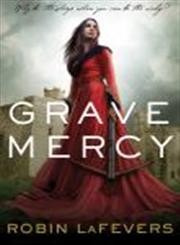
Grave Mercy
2,357-word summary 10 min read 549 pages in the book
- First published
- 2012
- Publisher
- Houghton Mifflin
- Pages
- 549
- ISBN
- 9780547628349
- Series
- His Fair Assassin (#1)
Reading options
What's inside (8 sections)
I picked up Grave Mercy because the premise sounded almost silly: assassin nuns in fifteenth century Brittany. I expected something light, a romance in habits with a few poisoned chalices. What I found instead was a long, earnest book, 549 pages in the 2012 Houghton Mifflin edition, that takes both halves of its premise seriously. The nunnery is a real political machine with its own theology. The Brittany is a real country about to be swallowed. And the girl at the center, Ismae Rienne, has the kind of voice that keeps you reading past the point where a more cynical book would have lost you.
The story opens with Ismae as good as sold. She is seventeen, the daughter of a peasant who never wanted her. Before she was born, her mother drank poison to end the pregnancy. Ismae lived, and the poison left her with a great scarred mark down her back and a reputation in her village as something unnatural. Her father beats her and then marries her off to an older brute named Guillo, a man who wants a wife the way other men want a mule. On her wedding night, or close enough that the terror of it fills those early pages, Ismae runs. A hedge priest who knows more than he should helps her reach the one place that will take a girl like her: the convent of St. Mortain.
Why be the sheep, when you can be the wolf?
That line is printed on the cover, and it is basically the book's thesis in one sentence. At St. Mortain, girls sired by Death himself are trained as his handmaidens. They learn weapons, letters, stealth, and poison. Ismae, immune to every poison the sisters feed her, settles in with a relief that is almost painful to read. For the first time someone tells her that the thing that made her a monster at home makes her holy here. She makes friends, real ones: Annith, gentle and devout, the best archer of them all, who dreams of serving Mortain in a secluded, contemplative way; and Sybella, sharp tongued and angry, whose past holds worse than anything Ismae suffered. The three girls together give the book its warmest chapters, and LaFevers is smart enough to let them be funny with each other between lessons in killing.
The convent of St. Mortain
The theology of the convent is the most interesting invention in the book, so it is worth laying out. Brittany in 1485 is officially Christian, but the old gods of the region have not entirely died. Mortain, god of Death, is still honored in quiet corners, and his convent claims that some girls are his daughters in truth, fathered by him on mortal women. The mark on Ismae's back is read as proof. The sisters teach that Mortain marks certain souls for death, and that a trained handmaiden can read those signs and carry out the sentence. Murder becomes liturgy. That is a dark idea for a young adult book, and to her credit LaFevers never quite lets the reader get comfortable with it. The older nuns speak of it as settled doctrine. The girls repeat it the way convent girls repeat anything. But the book keeps placing small cracks in the wall from early on.
Sister Vereda, the ancient seeress shut away in her cell, sees things the abbess would rather she did not mention. The abbess herself, the reverend mother, rules the convent with a politician's instincts, and Ismae is slow to notice how often doctrine bends to convenience. Lessons fill these chapters: knives, lies, dancing, court manners, the properties of herbs that heal and herbs that stop a heart. Ismae throws herself into all of it. She wants to be worthy of the god who claimed her. There is something touching and a little alarming in how completely she gives herself to the place, and the book understands both feelings at once.
First blood
Ismae does not stay a student forever. After three years of training she is sent out on contracts, and these early kills are where the book starts asking its real questions. Her first targets are the kind of men the reader is primed to hate: a brute who beats his household, a man whose crimes the narrative lays out plainly. The kills go as planned. But around the edges, Ismae notices things. The reasons the convent gives for a death do not always line up with what she sees on the ground. Some targets seem chosen for political convenience rather than guilt. A fellow sister hints that questions are not welcome.
I liked these chapters more than I expected, because they show Ismae thinking instead of just obeying. She has spent her whole life being told what she is: demon child, wife, handmaiden. Each assignment forces her to decide whether the convent's word is enough to kill on. She tells herself it is. She keeps telling herself it is. The repetition is the point. LaFevers writes faith as a habit that has to be renewed with effort, not as a switch that flips once, and Ismae's effort starts showing strain well before the main plot arrives.
There is also a quieter thread here about her body and her fear. Ismae flinches at men's hands, even kind ones. She has decided she will never marry, never lie with a man, and the convent suits that decision. The book treats this with patience. Nobody lectures her out of it. Her healing, such as it is, happens through work and friendship first, which felt honest to me.
Into the high court of Brittany
The main assignment takes Ismae out of the convent and into the high court of Brittany, and the book changes shape entirely. The duchy is in crisis. The old duke is dead or dying, and his heir is Anne, a girl of about eight, clever and stubborn and surrounded by men who want to use her. France presses at the borders. A forced marriage to a French ally, the lord d'Albret, hangs over everything. Regent councils argue. The court at the palace is all silk and smiles with knives underneath, and Ismae is planted in the middle of it under a cover that puts her close to power and close to gossip.
Her task, as the abbess frames it, is to protect the duchess from the traitors circling her. A fortune in bribes is flowing. Someone at court is selling Brittany to the French. Ismae must find the leak, and the convent gives her a list of the marked that includes a name she cannot make sense of: Gavriel Duval, the duchess's own illegitimate half brother, one of the few men at court who seems genuinely devoted to Anne's safety.
The court chapters are dense with names and councils. Chancellor Crunard, smooth and powerful, manages the regency's business and Anne's marriage prospects. Marshal Rieux commands soldiers. Captain Dunois holds the duchess's guard. Ladies like Madame Dinan run the household machinery. French agents drift through like smoke. Ismae attends feasts, learns to dress and simper, listens at doors, and tries to map who profits if Brittany falls. If you love court intrigue, this stretch will feed you well. If you came for assassinations, be warned: there are long passages where the deadliest weapon is a seating chart.
Anne herself is the best drawn child ruler I have met in recent fantasy. She is young, clever, grieving a father, and determined to be taken seriously by men three times her age. Ismae's scenes with her have a warmth the council scenes lack: a frightened girl practicing signatures, asking blunt questions about loyalty that cut through court polish. Protecting her gives Ismae's mission emotional weight beyond politics. Every rumor of a forced marriage lands like a threat to a person, not a position. LaFevers clearly admires the historical Anne, and it shows in the care here.
Gavriel Duval and the order to kill
Gavriel Duval is the book's great complication, and the reason the story works as a romance. He is a bastard son of the old duke, a soldier with a blunt manner and a reputation for roughness that the court calls the Beast. Ismae is ordered to kill him. She watches him instead. She watches him with Anne, patient and protective with a frightened child who has every reason to trust no one. She watches him with his men, fair and unsentimental. She watches him refuse the easy bribes and flatteries that everyone else at court swims in. And she cannot do it. She spares him, hiding her failure from the convent, and that single disobedience becomes the hinge of the whole novel.
What follows is my favorite part of the book: an alliance built on mutual suspicion that slowly turns into trust. Duval knows Ismae is hiding something. Ismae knows Duval is hiding something. They circle each other through ambushes, warnings, and a very good scene of a hunt gone wrong, trading information in pieces. He saves her life. She saves his. The romance builds the way it should in a book like this, through shared danger and conversation rather than declarations. Duval is decent without being soft, and the book lets him be wrong sometimes, which matters, because a perfect man would have flattened the tension.
Daily life under cover gives these chapters texture the councils lack. Ismae learns to lace gowns she could once only have stolen, to simper through dances while counting exits, to trade gossip with ladies who would have her hanged if they knew her errand. A few scenes of the duchess's household at meals and at prayer do more for the setting than any council debate. LaFevers clearly enjoys this material, and Ismae's stiffness in company, slowly easing into competence, makes her likable in a way the flawless assassin of the early chapters never quite was.
Together they narrow the field of suspects. Money points one way, troop movements another. The duchess's council is rotten somewhere near the top, and every time Ismae reports to the convent, her orders seem designed to protect the convent's own position rather than Anne. The question sharpens: is she serving Death, or is she serving the abbess's politics with Death's name stamped on top? When she finally admits she spared Duval, the fallout is severe, and the convent's response tells her everything she needs to know about the difference between faith and obedience.
What the abbess is not saying
The last third of the book pulls the convent plot and the court plot together, and I will keep the details light because the reveals land better unspoiled. The broad shape is this: the traitor at court is exactly who the careful reader will suspect by page four hundred, a man who has been selling Brittany while preaching its defense, and his exposure requires Ismae to act without the convent's blessing and against its explicit orders. At the same time, the abbess's own game comes into focus. The convent has been placing its daughters, shaping successions, and calling it god's will. Sister Vereda's warnings, Sybella's bitterness, and Annith's quiet doubts all snap into a single picture. Mortain may be real. The institution that claims to speak for him is run by a woman playing the same game as every chancellor.
Ismae's answer is the emotional climax of the novel, and it is better than the political one. She does not abandon Mortain. She redefines what serving him means: not blind killing on marked orders, but justice weighed by her own conscience, with mercy as part of the doctrine rather than a failure of it. The book stages this at an altar of Arduinna, in a scene with genuine strangeness, cold water and old stone and a god who may or may not be listening. Ismae walks out changed. She chooses Duval, not as a rescue but as a partner. She chooses Anne, not as an assignment but as a girl worth defending. And she leaves the convent's certainty behind without leaving her faith, which is a harder and more interesting ending than simple rebellion.
The political ending is satisfying on its own terms: traitors named, the duchess's position steadied for now, Brittany given breathing room. Readers should know history well enough to feel the shadow over it. The real Anne of Brittany's story did not end with a convent girl's victory, and LaFevers knows it. The book lets the moment stand without pretending the future is safe.
Who will love this book, and who will not
Let me be honest about the faults, because they are real and they will decide whether this book is for you. The middle is slow. There are councils, and then there are councils about councils, and at some point the names of minor lords start blurring together. Ismae's immunity to poison, dramatically useful early, removes a whole category of tension later; you never fear for her at a banquet, only for the people around her. Some of the dialogue has a modern bluntness that sits oddly in jeweled 1485 gowns. And the romance, though well built, hits familiar beats: the misunderstanding, the rescue, the wounded hero insisting he is not good.
But the strengths outweigh all of that for the right reader. Ismae's voice is the book's engine, angry and tender by turns, and her growth from obedient weapon to moral agent is earned page by page. The sisterhood of the convent feels lived in. Little Anne is written as a real child, not a symbol, which makes every threat against her land harder. And the historical texture, the food and clothes and saints' days layered over older pagan stone, gives the fantasy its weight. If you like historical fantasy with a strong romance thread, start here, then continue with Dark Triumph, which follows Sybella into even darker country. Readers who want grim politics without romance, or fast kills without councils, should look elsewhere. For everyone else, the convent doors are open, and Mortain is waiting to see if you are sheep or wolf.
FAQ
Is Grave Mercy part of a series?
Yes. It is the first book of the His Fair Assassin series, published by Houghton Mifflin in 2012, followed by Dark Triumph and Mortal Heart.
Is the romance suitable for younger teens?
The book is marketed as young adult and the romance stays fairly chaste, but it includes killing, poison, and mentions of abuse, so it suits older young adult readers best.
Similar books
More from His Fair Assassin first, then related titles.

Chain of Gold
Cordelia and James hunt demons in Edwardian London while hearts tangle.
2,364-word summary · 11 min read

Queen of Shadows
Celaena returns to Rifthold as Aelin to free magic, face Arobynn and the Valg, and reunite with Rowan and Chaol.
4,447-word summary · 20 min read

Throne of Glass
Throne of Glass book 1 retold: Celaena out of Endovier, the contest, Dorian, Chaol, and the castle tests.
1,926-word summary · 9 min read

Crown of Midnight
Crown of Midnight, the second Throne of Glass book, follows Celaena as the King's Champion, a faked death, Nehemia's murder, and her return to Endovier.
2,255-word summary · 10 min read

Anatomy: A Love Story
In 1817 Edinburgh, a noblewoman who wants to be a surgeon disguises herself to study anatomy and falls for the grave robber who supplies her with bodies.
2,031-word summary · 9 min read

Vow of Thieves
Kazi and Jase return to Tor's Watch to find it occupied, and their marriage is tested by captivity, betrayal, and a war for the town of Hell's Mouth.
2,059-word summary · 9 min read

The Lost Sisters
Taryn Duarte writes a letter to her twin, Jude, explaining how she fell for Locke and why she stayed silent while he used them both.
1,914-word summary · 9 min read

Archenemies
Nova steals for the Anarchists while Adrian hides his Sentinel identity, and a serum that erases prodigy powers puts them both at risk.
2,485-word summary · 11 min read

The Siren
Saved from a shipwreck in 1930, Kahlen becomes a siren who sings men to their deaths for the Ocean, until a boy in a college library makes her want a life she…
2,369-word summary · 11 min read

Cruel Beauty
A girl raised to kill the demon prince who rules her cursed land instead falls in love with him, in a retelling that mixes Beauty and the Beast with Bluebeard…
2,669-word summary · 12 min read

Demonglass
Sophie Mercer spends the summer at the Council's English estate, where two new demons, a suspicious host, and Archer's return complicate her plan to remove her…
2,771-word summary · 12 min read

Born at Midnight
Kylie Galen is sent to a camp for troubled teens and discovers it is a haven for vampires, werewolves, and witches, and that she may be something stranger…
2,310-word summary · 10 min read

The Rose & the Dagger
Shahrzad is pulled from her Caliph husband and left in a desert camp of rebels, needing to break his curse and end a war before it ends her.
2,520-word summary · 11 min read

Origins
Stefan's diary of 1864 and 1888: how he and Damon fell for Katherine, became vampires, and went looking for a killer in London.
2,056-word summary · 9 min read

Last Night at the Telegraph Club
The 2021 National Book Award winner follows Lily Hu, a Chinese American teenager in 1954 San Francisco, as she falls for Kath and learns what it costs to be…
2,336-word summary · 10 min read

We Hunt the Flame
In a fractured Arabia-inspired world, a disguised huntress and a prince-assassin race to find a magic-restoring book and confront an ancient evil.
2,195-word summary · 10 min read

Stars Above: A Lunar Chronicles Collection
Nine Lunar Chronicles stories fill in the histories of Cinder, Wolf, Thorne, Cress, Winter, and Jacin, and end with a wedding after the war.
2,230-word summary · 10 min read

Lore
Lore Perseous, the last of a hunted bloodline, is pulled back into the Agon when a wounded Athena offers her revenge against the god who killed her family.
2,188-word summary · 10 min read
House of Salt and Sorrows
Annaleigh Thaumas investigates her sister's death in a cursed island manor where the balls are illusions and the sea god is always listening.
2,025-word summary · 9 min read


Cemetery Boys
A trans brujo in East Los Angeles summons the ghost of a boy who refuses to move on, and together they uncover a murder hidden beneath Día de los Muertos.
1,997-word summary · 9 min read

Blue Moon
Ever Bloom tries to save her immortal boyfriend, Damen, from a mysterious illness while a new student named Roman quietly takes control of her school and her…
1,998-word summary · 9 min read
An Enchantment of Ravens
Isobel, a mortal artist in the fairy town of Whimsy, paints a portrait of the autumn prince and falls in love with him, breaking the laws of her craft.
2,087-word summary · 9 min read

Switched
A Minnesota teenager who can make people obey her discovers she is a changeling troll princess, and the hidden kingdom she came from wants her back.
2,131-word summary · 9 min read

A Reaper at the Gates
The Martial capital falls to an army of ghosts, Elias becomes the Soul Catcher, and Laia and Helene pay brutal prices as the Nightbringer moves to free the…
1,991-word summary · 9 min read

Fable
Abandoned on a lawless island at fourteen, Fable spends four years diving for gems to buy passage off it, straight into the cutthroat trade of the Narrows.
2,320-word summary · 10 min read

World After
Penryn wakes from near-death to find her altered sister Paige hunted as a monster, and follows her into the angels' scorpion factory and Uriel's coup.
2,213-word summary · 10 min read

The Prison Healer
Kiva, a teenage healer in a death prison, volunteers to face four elemental trials for a dying rebel queen, and the truths she uncovers change everything.
2,062-word summary · 9 min read

The Indigo Spell
Sydney Sage hunts an aging witch, learns forbidden magic, and finally admits she loves Adrian, while the Alchemist tattoo on her cheek may be controlling her.
2,604-word summary · 12 min read

Emerald Green
Gwyneth must close the blood circle that will crown an immortal tyrant, and the prophecy says her death is the final lock.
2,044-word summary · 9 min read