
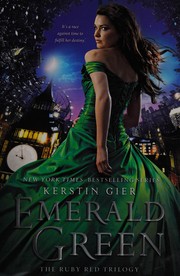
Emerald Green
2,044-word summary 9 min read 464 pages in the book
- First published
- 2010
- Publisher
- Henry Holt and Co.
- Pages
- 464
- ISBN
- 9780805092677
- Original title
- Smaragdgrün
- Series
- Precious Stone Trilogy (#3)
Reading options
What's inside (10 sections)
The Precious Stone Trilogy signs off with a finale that is darker than its first two books and, in places, more moving than I expected from a series that began as a light time travel romp. Emerald Green picks up with Gwyneth Shepherd heartbroken, cut off from the lodge, and finally in possession of a secret weapon, and it spends most of its length tightening a trap that was set before she was born. If Ruby Red was about a girl discovering she was special, and Sapphire Blue was about that girl learning that everyone around her was lying, Emerald Green is about the bill coming due.
One thing to say up front: this is not a standalone. It resolves plot threads from both earlier books, including the stolen chronograph, the prophecy, the identity of the Count of Saint-Germain, and Gwyneth's parentage. Reading it first would be like starting a mystery at the confession.
Gwyneth on her own
The book opens with Gwyneth estranged from the lodge. She has stopped trusting the Guardians who trained her, she is still furious at Gideon for the kiss that she believes was part of an assignment, and she only has a small circle she can rely on: her best friend Lesley, her great aunt Maddy, the butler Mr. Bernhard, and her pet gargoyle ghost Xemerius. She is also still using the second chronograph, the one she and Lesley found hidden in the walls of her house, to visit Lucy and Paul in the past every night. Those visits are the emotional core of her isolation. The two fugitives are the only adults who have told her anything close to the truth.
Gideon, meanwhile, has been given the Count's memoirs by Paul, with the condition that he protect Gwyneth. He reads them and finds prophecy after prophecy suggesting that Gwyneth's love for him will lead to her death. That is the engine of his behavior across the book. He is not being cruel for the sake of drama. He is a teenage boy who has been told that he will get the girl he loves killed, and he handles it the way nearly every teenager would, badly.
The first chronograph and the ball
The plot turns when Raphael, Gideon's younger brother, works out that coordinates written in Lord Montrose's copy of The Green Rider point to Gwyneth's own house, and Xemerius discovers a treasure chest hidden behind an ancestor's painting. Mr. Bernhard admits he hid it years ago on her grandfather's orders. When they open it, Lucas identifies the contents as the first chronograph, the original device, and Gwyneth realizes that with it in her hands she can travel through time whenever she chooses instead of waiting for the lodge to send her.
That freedom does not last. Charlotte, still nursing her hurt about being passed over as the Ruby, reports her suspicions to the lodge, and the Guardians raid the house. They do not find the chronograph, because Mr. Bernhard has moved it, but the raid is a violation that changes Charlotte. When Gideon's flat is also broken into and Raphael is knocked cold, Charlotte starts to question the people she has been serving, and her arc from jealous cousin to genuine ally is one of the nicer reversals in the trilogy.
The eighteenth century ball at Gwyneth's school, which used to be the house of James's wealthy father, is the middle set piece. The plan is to draw out the traitor among the Guardians by making him think he has a chance to kill Gwyneth. It half works. Gwyneth and Gideon dance, the tension between them thawing, and Gwyneth even warns James about the illness that will kill him, which she can do because she has met him across several jumps. But the plan goes wrong. Lord Alastair wounds Gwyneth with a sword, and for a few pages the book lets you believe she has actually died. She wakes up fine, but Gideon has been shouting that she was killed and nobody believes him, which is the first hint that Gwyneth is not an ordinary traveler.
The traitor turns out to be Lord Alcott, paid off by Lord Alastair along with Lady Lavinia to help move the Count's plan forward. Lavinia is sent away, and Alcott and Alastair are exposed. The lodge's Inner Circle is rotten from the top.
The price of the philosopher's stone
Then Gideon tells Gwyneth the truth that the whole series has been building toward. Completing the blood circle in the chronograph will produce the Philosopher's Stone, which the lodge claims will cure disease and save humanity. But the final blood required is Gwyneth's, and the prophecy demands that she die to give it, and that she be killed specifically by Gideon, the Diamond. The timing is precise. Her blood is the twelfth and last, and her death is the lock.
This is where the novel becomes genuinely grim. The Count of Saint-Germain, the founder of the lodge and the architect of the circle, has been promising a cure while actually engineering immortality for himself. Gwyneth, who has spent three books being told she is the most important person in the world, learns that she is important as a sacrifice.
The reveal that Mr. Whitman, the man who has taken over the lodge and purged the staff, is the Count, arrives while Gwyneth is in the past. The Count poisons her and then discovers, when she wakes up in the present, that she cannot be killed against her will. She is immortal already, because she was born to two travelers, and immortality is her birthright rather than a prize. That flips the trap. The Count cannot simply murder her to complete the circle. He needs her to choose to die, so he threatens the people she loves, foremost among them Gideon.
Bonfire Night 1786
The climax takes place on Bonfire Night in 1786 at the Count's estate, where the circle is to be closed. Gwyneth goes as the Count demands, with the chronograph. Charlotte, now trustworthy, slips Gideon a key so he can escape his cell. Gideon cannot stop the Count from drawing his blood. The circle closes. Gwyneth and Gideon are both shot, and they die.
That is not the end. Gwyneth wakes up, immortal, and discovers something new: she can make deliberate time jumps without the chronograph. She returns to Bonfire Night, better prepared and trained in Krav Maga, and defeats the Count. She heals Gideon's fatal wounds with the newly made elixir. The Count is then arrested by the Guardians in the present, and both Gwyneth and Gideon are left alive and unaging, which resolves the romance in a way that is, if you think about it, a little unnerving. Two teenagers will now watch everyone they love grow old and die while they stay sixteen.
Family, prophecy, and what the series was really about
The parentage reveal lands here, and it reorganizes everything. Gwyneth's biological parents are Lucy and Paul, the renegade travelers who stole the chronograph and hid in the past. Grace raised her as her own and falsified the birth record, which is why the lodge spent years training Charlotte and why Gwyneth grew up thinking she was ordinary. Lucy and Paul did not run away to betray the circle. They ran because they had figured out what closing it would do, and they spent years trying to protect a daughter they could not raise.
That reframes the trilogy. The adults who look like villains, the fugitives and the liar mother, were the ones telling the truth, and the respectable adults running the lodge were building a machine to make an immortal tyrant. It is a familiar fantasy shape, but Gier handles it with unusual patience, seeding the clues across three books so the reveal feels earned rather than announced.
The romance also resolves on its own terms. Gideon's protectiveness has been misread by Gwyneth for most of the trilogy, and the book lets them actually say what they mean for once. Their final choice, to keep the immortality that fell into their laps, is presented as romantic rather than as a problem, though the novel is honest enough that you can see the cost.
Xemerius, Rakoczy, and the odd corners
For all the gloom, the book keeps the comic texture that made the earlier volumes fun. Xemerius, the sarcastic gargoyle spirit, is Gwyneth's only companion during the lonely stretches, and his running commentary on her love life does a lot to keep the tone from tipping entirely into tragedy. He is also, usefully, a witness nobody else can see, which makes him a genuine plot asset rather than pure comic relief.
Rakoczy is the stranger thread. He appears as a heavy-drinking companion of the Count, and it is he who gives Gwyneth the poisoned drink in the past. The trilogy never fully explains him, which is one of its looser threads. He reads like a figure out of the Count's older, stranger world, and his loyalty shows how far the lodge's influence reaches into the past. The same goes for the agents and contacts the Count activates across every institution, business, and secret service, a detail that makes the conspiracy feel bigger than a handful of Guardians in London.
Dr. White deserves a mention as well. On the surface he is the lodge doctor, unremarkable and bureaucratic. In practice he is one of the people who quietly covers for Gwyneth, buys her time, and knows more than he lets on, and his small act of courage in the final confrontation is what turns the tide. The trilogy rewards attention to characters like him, Charlotte, and Mr. Bernhard, who look like obstacles and turn out to be allies.
What the ending is really saying
It is worth sitting with the finale rather than rushing past it. Gwyneth and Gideon defeat the Count, but the victory does not undo the price. They became immortal by accident of birth and by drinking a substance meant to crown a tyrant. The Philosopher's Stone, promised as a cure for humanity's diseases, is not shared with anyone. The lodge is reformed but not dismantled. The happy ending is happy for the two people at the center and ambiguous for everyone else, and the novel does not interrogate that, which is both its charm and its limitation.
What the trilogy chooses instead is a simpler resolution: the value of truth between people who love each other. Gwyneth's whole journey is about being kept in the dark by adults who mean well and adults who do not, and the ending is her finally standing inside the full picture and acting on it herself. She trains, she goes back, she overrides the prophecy, and she saves the boy she loves. For a series that spent so long making her a pawn, that is the arc that matters.
What works and what sags
The best of Emerald Green is the plotting. Everything set up in the two earlier books pays off, from the hidden chest to the traitor among the Guardians to the meaning of the prophecy. Gier is very good at the drip of information, and the middle act, with its ball and its betrayal, is the strongest sustained sequence in the series. Charlotte's turn and Mr. Bernhard's sincerity give the story warmth without softening it.
The flaws are mostly pacing and tone. The time travel logic gets loose when the plot needs it, with the rules of elapsing bending to let Gwyneth do whatever the scene requires, and the Count's plan has a few rickety joints if you inspect it closely. The book also leans hard on recap in its early chapters, which makes the opening feel like a review session. And the ending, with two immortal teenagers grinning at each other, brushes past the sadness it just created.
None of that ruins the finale. As a conclusion to a trilogy, it delivers the twist, the sacrifice, and the rescue, and it gives Gwyneth the one thing she wanted all along, which is to be told the truth. If you have read the first two, this is the payoff, and it is worth the wait.
FAQ
Should I read the Precious Stone Trilogy in order?
Yes. Emerald Green is the third and final book, and it resolves the chronograph, the prophecy, the Count, and Gwyneth's parentage. Start with Ruby Red and Sapphire Blue.
When was Emerald Green first published?
It was first published as Smaragdgrün in 2010, with the English translation by Anthea Bell released by Henry Holt and Co. in October 2013. It is book 3 in the trilogy.
Do Gwyneth and Gideon end up together in Emerald Green?
Yes. They reconcile, both survive the finale, and they are both left immortal, able to stay together as the series closes.
Similar books
More from Precious Stone Trilogy first, then related titles.
Ruby Red
Gwyneth finds she carries the time travel gene, not her cousin, and is paired with Gideon for dangerous jumps.
3,040-word summary · 14 min read
Sapphire Blue
Gwyneth trains with Gideon for new jumps while Lucy and Paul warn the circle must stay open.
2,218-word summary · 10 min read

Vow of Thieves
Kazi and Jase return to Tor's Watch to find it occupied, and their marriage is tested by captivity, betrayal, and a war for the town of Hell's Mouth.
2,059-word summary · 9 min read
The Lost Sisters
Taryn Duarte writes a letter to her twin, Jude, explaining how she fell for Locke and why she stayed silent while he used them both.
1,914-word summary · 9 min read

Archenemies
Nova steals for the Anarchists while Adrian hides his Sentinel identity, and a serum that erases prodigy powers puts them both at risk.
2,485-word summary · 11 min read

The Siren
Saved from a shipwreck in 1930, Kahlen becomes a siren who sings men to their deaths for the Ocean, until a boy in a college library makes her want a life she…
2,369-word summary · 11 min read
Cruel Beauty
A girl raised to kill the demon prince who rules her cursed land instead falls in love with him, in a retelling that mixes Beauty and the Beast with Bluebeard…
2,669-word summary · 12 min read
Demonglass
Sophie Mercer spends the summer at the Council's English estate, where two new demons, a suspicious host, and Archer's return complicate her plan to remove her…
2,771-word summary · 12 min read

Born at Midnight
Kylie Galen is sent to a camp for troubled teens and discovers it is a haven for vampires, werewolves, and witches, and that she may be something stranger…
2,310-word summary · 10 min read

The Rose & the Dagger
Shahrzad is pulled from her Caliph husband and left in a desert camp of rebels, needing to break his curse and end a war before it ends her.
2,520-word summary · 11 min read

We Hunt the Flame
In a fractured Arabia-inspired world, a disguised huntress and a prince-assassin race to find a magic-restoring book and confront an ancient evil.
2,195-word summary · 10 min read
Stars Above: A Lunar Chronicles Collection
Nine Lunar Chronicles stories fill in the histories of Cinder, Wolf, Thorne, Cress, Winter, and Jacin, and end with a wedding after the war.
2,230-word summary · 10 min read
Lore
Lore Perseous, the last of a hunted bloodline, is pulled back into the Agon when a wounded Athena offers her revenge against the god who killed her family.
2,188-word summary · 10 min read
House of Salt and Sorrows
Annaleigh Thaumas investigates her sister's death in a cursed island manor where the balls are illusions and the sea god is always listening.
2,025-word summary · 9 min read
Cemetery Boys
A trans brujo in East Los Angeles summons the ghost of a boy who refuses to move on, and together they uncover a murder hidden beneath Día de los Muertos.
1,997-word summary · 9 min read
Blue Moon
Ever Bloom tries to save her immortal boyfriend, Damen, from a mysterious illness while a new student named Roman quietly takes control of her school and her…
1,998-word summary · 9 min read
An Enchantment of Ravens
Isobel, a mortal artist in the fairy town of Whimsy, paints a portrait of the autumn prince and falls in love with him, breaking the laws of her craft.
2,087-word summary · 9 min read
Switched
A Minnesota teenager who can make people obey her discovers she is a changeling troll princess, and the hidden kingdom she came from wants her back.
2,131-word summary · 9 min read
A Reaper at the Gates
The Martial capital falls to an army of ghosts, Elias becomes the Soul Catcher, and Laia and Helene pay brutal prices as the Nightbringer moves to free the…
1,991-word summary · 9 min read
Fable
Abandoned on a lawless island at fourteen, Fable spends four years diving for gems to buy passage off it, straight into the cutthroat trade of the Narrows.
2,320-word summary · 10 min read
World After
Penryn wakes from near-death to find her altered sister Paige hunted as a monster, and follows her into the angels' scorpion factory and Uriel's coup.
2,213-word summary · 10 min read
The Prison Healer
Kiva, a teenage healer in a death prison, volunteers to face four elemental trials for a dying rebel queen, and the truths she uncovers change everything.
2,062-word summary · 9 min read

The Indigo Spell
Sydney Sage hunts an aging witch, learns forbidden magic, and finally admits she loves Adrian, while the Alchemist tattoo on her cheek may be controlling her.
2,604-word summary · 12 min read
Beautiful Chaos
Ethan Wate is losing himself piece by piece as the broken Order of Things demands a sacrifice, and the answer may be the last person anyone expected.
2,068-word summary · 9 min read
Wayward Son
Simon and Baz road trip America after the war to decide what normal means.
2,505-word summary · 11 min read
This Savage Song
Monster hunter Kate meets August, a monster who plays violin.
2,574-word summary · 11 min read
These Hollow Vows
Brie trades with the Unseelie to save her sister and steals for a prince.
2,384-word summary · 11 min read

The Winner's Curse
An aristocratic girl buys a slave who is secretly a prince plotting rebellion.
2,124-word summary · 9 min read
The Scorpio Races
Two riders risk deadly water horses in an island race for money and freedom.
2,352-word summary · 10 min read