
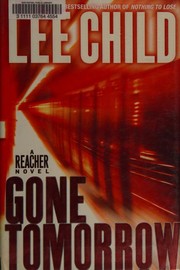
Gone Tomorrow
2,308-word summary 10 min read 421 pages in the book
- First published
- 2009
- Publisher
- Delacorte Press
- Pages
- 421
- ISBN
- 9780385340571
- Series
- Jack Reacher (#13)
Reading options
What's inside (8 sections)
I picked up Gone Tomorrow because I had stalled on the Reacher books around book ten and someone told me thirteen was the strange one. The one set almost entirely in New York. The one Reacher tells himself. Lee Child published it in 2009 with Delacorte Press. The first US hardcover runs 421 pages. It is Jack Reacher book 13. I started it late at night, which was a mistake, because the first forty pages happen around 2 a.m. on a subway car and they put you right there under the lights.
Reacher is riding uptown with nothing to do. He is out of the Army, no luggage, no phone, no fixed address. He does what he always does on public transport. He watches people. Years earlier an Israeli captain taught him a checklist for spotting suicide bombers. Eleven points for a woman. Heavy coat when the weather does not call for it. Staring without blinking. Controlled breathing. No bags that fit the setting, or one bag clutched too hard. Reacher runs through it as a game to pass the time.
There are only five other people in the car. Most of them fail the list right away. Then there is the woman across from him. Black coat, too warm for the night. Tense hands. Eyes fixed. Short panting breaths she tries to hide. Reacher keeps telling himself it cannot be real. Who would bomb a nearly empty car at 2 a.m. between stations. Still, point after point lines up.
He decides he has to do something. He cannot clear the car. He walks over, stops about six feet away, says he is a cop and asks if she needs help. He asks to see her hands. She shows an empty left hand. He asks what is in her bag. She pulls a .357 Magnum revolver and points it at his chest.
That pause is awful. The train is rattling toward Grand Central. Reacher is doing the math about the lurch when the brakes hit, how he might move sideways. Before he can move, she turns the gun on herself and fires.
No bomb. No vest. He unzips her coat after. Nothing. He uses the intercom to report it. Police lock the platform down.
That opening works because Child stays very close to procedure. Reacher notes times, distances, coat weight, hand position. I believed a tired ex military policeman would act exactly that way. I also felt sick, because you realize fast that Reacher may have caused what he tried to stop.
Locked in Midtown South
The cops who catch the case are NYPD detectives Theresa Lee and Docherty. Lee is calm, smart, tired in the way city detectives get tired. Docherty is blunter. They take Reacher to a small office in Grand Central, then to Midtown South. They lock him in an interview room. They ask the same questions three ways.
Reacher gives them the checklist story. Lee calls it a false positive. A suicidal woman read as a bomber. She is not cruel about it. She just wants the paperwork clean.
But things do not stay simple. Only a few witnesses are listed. Reacher is held longer than a witness should be held. After about two hours three men in suits arrive from Washington. They will not give names. They cite the Patriot Act. They ask if Susan, that is the dead woman, gave Reacher anything. A note. A drive. A parcel. Anything passed hand to hand.
Reacher has nothing to give them. He never touched her except after. The feds do not believe him. They warn him off in the polite federal way that is not polite at all.
He learns her name in bits. Susan Mark. She lived in Annandale, Virginia. She worked as a civilian clerk for the Army Human Resources Command at the Pentagon. That job matters. It means personnel files. Assignments. Old service records. The kind of paper that can ruin a career if pulled at the wrong time.
Her brother shows up. Jacob Mark, called Jake, a cop from New Jersey. He is sure his sister was not suicidal. He says she divorced, went back to Mark from Molina, raised a kid alone, worked a steady federal job. She had reasons to live. Reacher feels the guilt settle. If he had sat still, would she have gotten off at the next stop and lived another day.
Jake and Reacher start asking around together. That partnership gives the middle of the book its warmth. Jake knows local police habits. Reacher knows Army habits.
I liked Lee here too. She could have been background. Instead Child gives her a full case load, a boss who wants the file closed. She keeps helping Reacher when helping him puts her job at risk.
Susan Mark and the missing boy
Jake tells Reacher about Peter Molina. Peter is Susan son from her marriage. Star high school player, then a football player for the University of Southern California. Big, fast, photographed in the papers. Right around the time Susan died in New York, Peter vanished off campus. No classes. No practice. No calls home.
Reacher hates cases with missing kids. You can tell. He keeps coming back to the timeline. Susan left Washington, drove north, ended up on a New York subway at 2 a.m. with a loaded revolver in her bag. That is not a commute. That is a mission. She was going to meet someone, or kill someone.
He and Jake piece together her last day. She took the car. She hit traffic on the New Jersey Turnpike and lost hours. She missed a midnight deadline. That detail sticks. Midnight deadlines belong to exchanges and blackmail, not to mothers visiting sons.
Reacher theorizes she was being forced to steal something from Pentagon computers. Someone had Peter and said fetch this file or the boy dies. Susan fetched it, loaded it onto a memory stick, wiped the original, drove north to trade.
Only the trade never happened. She was late. Whoever held Peter did not grant extra time. They sent her proof on her phone. A video of Peter being tortured and killed.
Susan threw her phone and the memory stick out the car window onto the highway median. Then she kept driving into the city. Reacher thinks she went from courier to avenger in that hour. She still had the gun. She went looking for the woman who ordered it.
That reading makes the subway scene land differently. Susan was not afraid because she carried a bomb. She was afraid because she thought he was police closing in before she could settle accounts. When he said he was a cop, she heard arrest and failure. She chose to end it rather than be stopped.
It is bleak. It also fits what Jake said about his sister. Not suicidal in the ordinary sense. Driven to a point where death looked cleaner than living with what she had just seen.
Sansom and the Hoths
The name that keeps surfacing is John Sansom. Congressman from North Carolina. Running for Senate. Former soldier with medals for quiet work in the 1980s that no press release fully explains. Handsome in the veteran candidate way. Talks about service, duty, moving forward.
Reacher goes to look at him up close. He rides down to a fundraiser, stands in the crowd, watches how Sansom moves, who guards him. On the way back to New York Reacher picks up a tail. He loses the tail the Reacher way and takes his phone.
The phone leads to Lila Hoth and her mother Svetlana Hoth. They are staying in a hotel under soft cover. Lila says she is the widow of a rich Russian. She says her father and her brother died during the Soviet war in Afghanistan. She says Sansom and American special forces ambushed her father, stole his prized sniper rifle, left him helpless. She says Mujahideen fighters then tortured the old man to death while Svetlana was forced to listen outside a Soviet base.
It is a strong story. Too strong, in a way. Lila cries at the right spots. Svetlana stays silent and lets her daughter talk. They ask Reacher for help finding records to prove Sansom was there. They say Susan Mark was helping them as a researcher before she died.
Reacher half believes them. I half believed them too on first read. Child plants just enough paper. Old Soviet files. A rifle with a known stock and scope. A US team operating where it officially was not.
Then the cracks show. Their English slips in odd places. Their timeline wobbles when Lee checks hotels and flights. They do not act like grieving family hiring a clerk. They act like handlers who lost a courier.
The turn, when it comes, is harsh. Lila and Svetlana are not victims hunting truth. Lila trained and fought with Mujahideen as a young woman. She is now tied to Al Qaeda networks. What they really want is to bury something, not expose it.
The Hoths killed to get Pentagon material about Sansom time in Afghanistan. They killed Peter Molina to force Susan to steal it.
This is where the book is strongest and weakest at once. Strongest because the geopolitics feel adult. Weakest because Child has to explain 1980s Afghanistan, US aid channels, Soviet records, Senate politics, all while Reacher is being chased through Manhattan. Some chapters turn talky. I skimmed a little during the second Sansom briefing.
Still, Sansom himself is well drawn. Not a villain, not a hero. A politician who did rough work young, made a cold choice, now wants office. His aide Springfield sticks close and cleans up. You can see why feds want the file to vanish and why the Hoths want it to vanish for different reasons.
What was on the stick
The missing file is not a troop list or a bank account. It is a photograph from 1983. Young John Sansom and a fellow American named Springfield grin beside Osama bin Laden. At the time they were sent as envoys under Reagan policy to meet Mujahideen leaders fighting the Soviets. Aid, handshakes, photos for the record.
Twenty six years later that photo is poison for everyone. For Sansom, it ends a Senate run. For Al Qaeda, it shames the founder shown smiling with Americans. Both sides want it gone.
Susan stole the image file from the classified archive, put it on a small memory stick, deleted the source. She drove to deliver it. Traffic killed the plan. After Peter death she tossed the stick and phone onto the Turnpike median.
Reacher figures the toss site by mapping her route, her time, toll logs, phone tower ranges Lee begs off other desks.
Feds later recover the stick from the median. They say traffic crushed it. Data unreadable. Case closed. Lee predicts exactly that before it happens.
I found that ending honest rather than cynical. Child does not pretend one drifter beats Washington. He lets Reacher solve the human part and lose the political part.
The last room
The final forty pages drop the politics and go physical. Reacher tracks the Hoths to a building where they are holding with guards. He goes in alone because Lee cannot get backup in time. He has a gun with limited rounds.
He clears rooms floor by floor. No fancy moves. Elbows, knees, weight, doors. He thinks all guards are down, then finds one more man and uses his last bullet.
He reaches Lila and Svetlana with an empty gun. They make him strip to his boxers at gunpoint. They put the gun aside and pick up knives. They plan to cut him apart the way Peter was cut apart. They tell him so, calmly, in accented English.
Reacher has a small knife taped to his lower back. Size and reach matter in knife fights, and Reacher is huge, but Child does not make it easy. He kills Svetlana first. He and Lila tear at each other across a small room until he gets her throat and ends it.
He tapes a wound shut with duct tape before he passes out.
He wakes in hospital with Lee, Jake and Sansom around the bed. Charges against Reacher and the detectives are dropped. Jake sits quiet. His sister and nephew are gone.
Reacher leaves New York once he can walk. He reflects that his act on the subway stopped Susan from killing Lila that night. The book does not answer if that makes him guilty. It leaves him on the road with the question.
I admired that refusal. A lesser thriller would end with Reacher sure he did right. Child lets him stay unsure.
If I have a larger criticism, it is that the last fight stretches belief a bit. Reacher survives wounds that would put most men down for weeks. Also the Hoths putting down a loaded gun to use knives feels staged to give Reacher a chance.
Still, Gone Tomorrow earns its place high in the series for me. It uses New York well, not as postcard but as trains and precincts and hotels. It treats Susan as a person, not a prop. And the first person voice fits a story about guilt.
How it sits in the series
Killing Floor introduced Reacher as a drifter with a toothbrush. Gone Tomorrow finds him older, still drifting, still counting. The tone is darker.
At 421 pages it is not bloated. The subway chapters move fast. The Washington history chapters move slower.
For new readers, you can start here. The Susan Mark case is self contained. For longtime readers, this is essential because it shows Reacher doubting his own instincts. Here he spends three hundred pages asking if he killed a woman by trying to save a train.
FAQ
When was Gone Tomorrow published?
Delacorte Press published Gone Tomorrow in 2009. The first US hardcover runs 421 pages and is listed as Jack Reacher book 13.
Is Gone Tomorrow part of the Jack Reacher series?
Yes. Gone Tomorrow is Jack Reacher book 13. It is told in first person by Reacher and follows the New York subway death of Pentagon clerk Susan Mark.
Why did Susan Mark kill herself on the subway?
Susan missed a midnight exchange deadline on the New Jersey Turnpike, then received video showing her son Peter had been killed. She threw away the memory stick and went to New York planning revenge before Reacher stopped her.
Similar books
More from Jack Reacher first, then related titles.

Killing Floor
Ex-military policeman Jack Reacher is arrested for murder in Margrave, Georgia, then learns the victim was his brother.
2,872-word summary · 13 min read
Tripwire
In Key West, Jack Reacher follows a murdered detective's trail to New York, an old mentor's files, and a loan shark stealing a dead soldier's name.
2,688-word summary · 12 min read
Running Blind
Jack Reacher must catch a killer who murders women with no forced entry and no trace.
2,008-word summary · 9 min read

Echo Burning
Reacher hitches a ride with a Texas woman who wants her abusive husband killed, then has to prove she did not murder him when he comes home.
2,209-word summary · 10 min read

Without Fail
Reacher is asked to test vice presidential security by planning to kill.
2,084-word summary · 9 min read
Persuader
Reacher goes undercover in a Maine crime family to find a missing DEA agent and the man he once failed to kill, and Lee Child keeps the whole thing tight,…
2,278-word summary · 10 min read

The Enemy
In January 1990, MP major Jack Reacher investigates a dead general, a stolen briefcase, and three murders tied to an Army power struggle.
2,123-word summary · 9 min read

One Shot
Six shots, five dead in Indiana, and James Barr asks for Jack Reacher. Reacher leaves Miami to test the proof in this 2005 Delacorte Press thriller, 376 pages,…
2,972-word summary · 13 min read

Bad Luck and Trouble
A deposit of $1,030 summons Jack Reacher back to his old army unit, which is being picked off one name at a time.
2,366-word summary · 11 min read

61 Hours
A bus crash strands Jack Reacher in a snowbound South Dakota town where a drug gang, a corrupt police force, and a single witness are on a collision course.
2,227-word summary · 10 min read

Worth Dying For
Reacher stops for one night in rural Nebraska and finds a family that runs the county, a missing girl and a shipment worth killing for.
2,021-word summary · 9 min read

The Affair
In 1997, Reacher goes undercover in a Mississippi town where a murder near an army base collides with a senator's power. The case that ends his military career.
2,039-word summary · 9 min read

Six Years
A professor who promised to forget the woman he loved sees her husband's obituary and discovers that the wedding, the marriage, and the woman herself may never…
2,076-word summary · 9 min read
Absolute Power
A thief watches the president kill, then runs with a lawyer who believes him.
2,401-word summary · 11 min read

The Partner
A Biloxi lawyer fakes his death, steals $90 million, and hides in Brazil until hired muscle drags him home to trial.
2,221-word summary · 10 min read

The Pelican Brief
Law student Darby Shaw writes a brief on murdered justices and becomes a target, fleeing with a reporter.
2,994-word summary · 13 min read

What She Knew
Rachel lets her eight-year-old son run ahead in a Bristol park, and the nine-day search turns her into a suspect in the public eye.
2,952-word summary · 13 min read

The Beach House
A young valet is beaten to death at a Hamptons party, and his law-student brother spends a year building a case against the family that covered it up.
2,049-word summary · 9 min read

Rules of Prey
Minneapolis detective Lucas Davenport hunts a killer who leaves a new rule at every scene and treats murder as a game of wits.
1,914-word summary · 9 min read

4th of July
Lindsay Boxer shoots two armed teenagers in self-defense, faces a wrongful-death trial, and spends her leave chasing a string of throat-slashing murders in…
2,192-word summary · 10 min read

The Camel Club
Four Washington misfits witness a murder on Roosevelt Island and stumble into a conspiracy that reaches the Oval Office, with a hostage president and a nuclear…
2,354-word summary · 10 min read
The Rooster Bar
Three law students buried in debt discover their for-profit law school is a scam, and decide the only way out is to con their way into practicing law before…
2,837-word summary · 13 min read
The Troop
A Boy Scout troop on a Canadian island takes in a stranger who cannot stop eating, and the worm inside him turns a camping trip into a war.
2,457-word summary · 11 min read

Still Missing
A realtor is abducted at a Vancouver Island open house and held for more than a year. Told through therapy sessions, the novel follows her escape and the hunt…
2,466-word summary · 11 min read

3rd Degree
The third Women's Murder Club novel follows a San Francisco terror cell and a three-day killing schedule, and it costs the club a member.
2,685-word summary · 12 min read

The Ex
Cassie thinks her new boyfriend's ex is the woman harassing her, but Freida McFadden's thriller keeps rearranging who the ex actually is.
2,103-word summary · 9 min read

Say You're Sorry
A widowed prosecutor defends the teenager accused of killing her babysitter, uncovering a small town's secrets and a killer hiding in plain sight.
2,116-word summary · 9 min read

The Drowning Woman
Living in her car in Seattle, Lee saves a wealthy stranger from drowning. The friendship that follows draws her into abuse, murder, and a plan to disappear.
2,578-word summary · 11 min read

Girl, Forgotten
A rookie US marshal guards a judge with a stalker and ends up reopening the 1982 prom-night murder of the judge's pregnant daughter.
2,111-word summary · 9 min read
When No One Is Watching
Sydney Green watches her Brooklyn block's Black residents vanish one by one in Cole's Edgar-winning thriller about gentrification as a crime scene.
2,165-word summary · 10 min read