
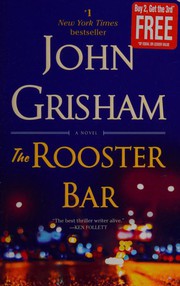
The Rooster Bar
2,837-word summary 13 min read 368 pages in the book
- First published
- 2017
- Publisher
- Vintage
- Pages
- 368
- ISBN
- 9781101967690
Reading options
What's inside (13 sections)
- The setup, which is the good part
- Gordon, and the thing that sets it off
- The scheme, and its internal logic
- The target, and how Grisham handles it
- Mark, and the protagonist problem
- The pace, and Grisham's craft
- Where it goes wrong
- The ending, and what it is saying
- The politics underneath
- Compared to his other work
- Should you read it
- Key takeaways
- FAQ
Grisham has spent most of his career writing about lawyers, and specifically about the parts of the legal system that make good stories, the courtroom reversals, the small-town corruption, the moments where a decent person with a law degree manages to do something useful against long odds. The Rooster Bar is different, and I mean that as a compliment. It is about people who want very badly to become lawyers and cannot afford to, and the system that has figured out how to profit from that desire. The villain here is not a person with a gavel. It is a business model, and Grisham has said he got the idea after reading an article called The Law-School Scam in The Atlantic.
I came to this one expecting a standard Grisham, competent and propulsive and not particularly interested in anything beyond the next twist. What I found was something more cynical than usual, and more angry, in a way that surprised me. The anger is aimed at a specific target, the for-profit law school, and while the book is not a work of investigative journalism, it is clear that Grisham had been reading the reporting and had decided the story was worth telling through a thriller.
The setup, which is the good part
Three third-year law students are the heart of the book. Mark Frazier is the narrator. Todd Lucero is his roommate and partner in crime. Zola Maal is the third, and she is the one who first connects the dots. They attend Foggy Bottom Law School, a third-tier Washington establishment with a reputation as a diploma mill, and they are not exceptional. They are, in fact, exactly the kind of students the institution wants, which is to say, people with ambitions and limited options and a tolerance for debt.
The school itself is Grisham's invention, but it is assembled from real components. Foggy Bottom is owned by an investor named Hinds Rackley, who runs a network of schools, law firms, and banks that keeps students trapped in a cycle of debt while he makes millions. The arrangement is not illegal, which is precisely the point. The mechanism is laid out plainly in the early chapters, and it is more disturbing than anything in the thriller that follows.
What makes the setup work is that it gives the protagonists a grievance the reader shares. These are not criminals by temperament. They are people who were told a reasonable-sounding thing, that a law degree is a path to stability, and who discovered too late that the path had been rigged. Grisham is careful to make their anger legible before he lets them do anything illegal, so that when the criminal turn comes, the reader has already decided, at some level, that the system started it.
Gordon, and the thing that sets it off
The novel's real inciting incident is not a scheme but a death. Zola has a boyfriend, Gordon Tanner, whose bipolar disorder is worsening. He stops taking his medication. In his mania he becomes convinced he has uncovered enough evidence of Rackley's operation to bring a class-action lawsuit that would at least expose the fraud, and he starts collecting that evidence with an intensity that frightens the people around him.
Then Gordon gets drunk, flees the apartment, is arrested for driving under the influence. Mark and Todd bail him out, with the help of a professional street lawyer named Darrell Crowley, and Mark goes looking for Gordon's doctor. Before he can find him, Gordon escapes again and commits suicide by jumping off a bridge.
This is the hinge of the whole book, and it does two things at once. It hands the students Gordon's evidence, which becomes their leverage later. And it gives Mark a guilt he cannot put down, since Gordon's family and friends blame him, and the blame lands. Mark's promised job at a D.C. firm is withdrawn. He and Todd drop out. The scheme that follows is born out of despair as much as out of anger, and Grisham is careful to keep that distinction visible for as long as he can.
The scheme, and its internal logic
Mark and Todd get jobs at the Rooster Bar, a pub owned by a man named Maynard who is also Todd's boss. Mark persuades Maynard to lease them some office space, and together with Zola they set up an unlicensed firm they call Upshaw, Parker and Lane. Inspired by Crowley, who has apparently made a living doing this, they decide to pose as lawyers under assumed identities and work the D.C. courts for clients, arguing that they can get rich while avoiding their creditors and their school, so long as no one discovers what they are doing.
The scheme has a satisfying mechanical quality, which is a Grisham strength. You watch them work out the details, the fake credentials, the borrowed identities, the careful avoidance of anyone who would recognize them. There is a pleasure in watching competence applied to a problem, and the book delivers that pleasure reliably. It is the same pleasure that makes heist films work, and the novel is honest enough to acknowledge the parallel.
The complication, and there has to be one, comes from Mark's own overreach. He takes a case for a man named Ramon Taper, whose newborn son died because of hospital negligence, and an expert tells him the case is sound. It is not. Another lawyer, Jeffrey Corbett, reveals that the statute of limitations ran out long ago, which means Mark and his fake firm can now be sued for malpractice by their own client. Mark's solution, telling the opposing lawyer Edwin Mossberg that he is not actually a lawyer so the suit will be dropped, works and also exposes him, because Mossberg passes the information to the D.C. bar.
This is where the book is at its most Grisham. A man digs a hole, and then digs a second hole to escape the first, and the reader watches the arithmetic of it with the specific dread that comes from knowing the protagonist is not as clever as he believes.
The target, and how Grisham handles it
The most interesting thing about The Rooster Bar is its institutional critique, and here it is doing something Grisham rarely attempts. He is not writing about a bad individual, a corrupt judge or a bent prosecutor. He is writing about a system that produces bad outcomes while everyone involved behaves, individually, within the rules. That is a harder thing to dramatize, and the book succeeds unevenly at it.
Rackley's model is real enough to be recognizable. The aggressive recruiting. The reliance on federal loan money that flows regardless of outcomes. The employment statistics that are technically accurate and substantively misleading. The bar passage rates that an institution would rather obscure than improve. All of this has been documented in the reporting Grisham drew on, and it is the reason the first third of the book is its strongest stretch.
What the novel does well is show how the incentives produce the behavior without anyone needing to be a monster. Rackley is a businessman optimizing a portfolio. The school is an institution surviving. Every decision that harms students is downstream of a constraint rather than of malice. This is a more sophisticated portrait of institutional failure than Grisham usually offers.
The limitation is that the critique never quite becomes an argument. The book is clear that the model is predatory. It is less clear about what should replace it, and the reform it gestures toward arrives without much support from the preceding narrative. A reader wanting a policy book will be frustrated. A reader wanting a thriller that happens to be angry about something real will be satisfied.
Mark, and the protagonist problem
Mark Frazier is a competent vessel and not much more, and it is worth being precise about that. Grisham's narrators are often thin figures through whom the plot moves, and Mark is a pronounced version of the type. He has a grievance, he has a temper that occasionally produces decisions, and he has a guilt about Gordon that gives him something to carry. Beyond that, he is difficult to distinguish from Todd in his own narration, and for long stretches the voice could belong to either of them.
This matters more than it might elsewhere because the novel's moral weight rests on the reader's willingness to follow Mark through choices that are, at minimum, indefensible. He commits fraud. He lies to people who trust him, including a grieving client. He makes a series of decisions that escalate in a way the book does not fully interrogate. A stronger protagonist would have made those choices more interesting, and the flatness here means the reader observes them rather than inhabits them.
Zola is the more interesting figure and the book does not give her enough room. She is the one who sees the situation most clearly, she is the one who hesitates longest before joining, and she is the one whose life outside the scheme carries the most weight. Her thread involving her parents, who are immigrants extorted by corrupt officials in Senegal, is the closest the book comes to a genuine emotional register, and it is dispatched efficiently rather than explored.
The pace, and Grisham's craft
For all its structural problems, the book moves, and it is worth being clear that this is a real skill rather than a minor one. Grisham writes short chapters, each ending on a small hook, and he has an unerring sense of when the reader's attention will start to drift. I read the middle section in a single sitting without noticing the time pass, which is not something I can say about every thriller I pick up.
The prose is functional to the point of invisibility, which is what this kind of book requires. There are no lyrical passages, no attempts at grandeur. Grisham gives you the information you need and moves on, and the discipline of that is underrated. A thriller that pauses to be beautiful is a thriller that stops working.
The dialogue is sharper than usual here, and the banter between the three friends is the book's most reliable pleasure. They talk the way people talk when they are young and out of options and trying to make a bad situation funny, and those scenes do more to earn the reader's sympathy than any amount of narration about debt could.
Where it goes wrong
The later stretch is where the trouble starts, and the trouble is structural. Having established a distinctive premise, a for-profit law school that extracts money from people who cannot afford to lose it, Grisham converts the back half into a more conventional caper about defrauding a bank. The three decide to invent thousands of fake clients and route them through firms involved in a massive settlement that Rackley's outfit, Swift Bank, will have to pay, betting they can make enough to flee the country before the bar's investigation catches up.
This is a livelier plot and a duller book. The shift replaces a genuinely interesting problem, what does a profession owe the people it gates, with a straightforward question about whether they will get away with it. Grisham handles the mechanics well, but the material is thinner, and the anger that powered the opening is nowhere in evidence.
The Senegal thread, which arrives in the middle of all this, is tonally abrupt. Zola's parents are being extorted, she has to fly there, she uses firm money to hire a well-connected local lawyer. It is plausible as plot and it does not sit comfortably next to the caper, which is playing for a different kind of tension entirely.
The ending, and what it is saying
The resolution is the most Grisham thing in the novel, and I mean that both as praise and as complaint. The three are exposed in stages, the bar investigation closes in, the police arrest Mark and Todd for practicing without licenses, and a trial approaches at which Crowley, Ramon, and a collection of their former clients cause a scene that lays bare the extent of the misconduct.
Rather than face it, Mark and Todd set up a hedge fund in the Caribbean, obtain fake passports, and leave the United States. Mark uses the money to pay off his law school debt and to take care of his family, which is a nice gesture and also an admission that the whole exercise was, at bottom, about escaping a debt they should never have been saddled with. Indicted on racketeering charges, the three assume false identities, reunite in Senegal, and buy a bar, which they name the Rooster Bar.
The irony is deliberate and it is the book's best joke. They have become the thing the law school pretended to offer, small business owners with a modest life, and they have had to commit federal crimes to get there. There is something genuinely bleak in that, and I suspect Grisham knows it. The system that failed them produced, as its final product, three people who can never go home.
The politics underneath
There is a political dimension to The Rooster Bar that the book keeps mostly subterranean, and it is worth surfacing. The predatory for-profit education model Grisham attacks is, in the real world, a matter of bipartisan concern, and the federal loan apparatus that enables it is a genuinely hard problem with no easy villain. To his credit, Grisham does not turn this into a partisan exercise. The critique is aimed at a business model rather than at a party.
What the book does not address, and what a sharper treatment would have, is the demand side of the question. The students who enroll in these programs are responding to genuine signals, real barriers to entry in a profession that guards its credentials, and a legitimate desire for mobility. Grisham is sympathetic to them in a way that occasionally shades into condescension, and the novel never quite reckons with the fact that the students are making rational choices inside a badly designed system.
There is also a quieter point about class that the book gestures at without developing. Mark, Todd, and Zola are not wealthy. Their access to the profession depends on money they do not have, and the institution that exploits them is exploiting exactly that. A novel willing to sit with that would have been a better one, and Grisham's instinct to keep things moving prevents it.
Compared to his other work
Readers who know Grisham primarily from The Firm or The Pelican Brief will find this a more grounded and less glamorous book. There are no exotic locales, no beautiful apartments, no sense that lawyering is a glamorous profession. This is a book about debt and desperation and the specific humiliation of being sold a bill of goods by an institution you trusted, and the smallness of the world it depicts is part of its point.
It is closer in spirit to his more recent social thrillers, which have tended to take institutional failure as their subject rather than individual villainy. There is a sense of a writer in his sixties looking around at the country and finding material that is less fun to write about than courtroom reversals but more worth the effort.
The comparison that most interested me was with his earlier novels about young lawyers in trouble, which shared the setup but not the anger. The Rooster Bar is a meaner book, and the meanness is directed at systems rather than at individuals, which makes it a more mature one even as it makes it a less satisfying one on a scene-by-scene basis.
Should you read it
If you want a Grisham that does what Grisham does reliably, short chapters, propulsive plotting, a tidy if unremarkable resolution, this will do. It delivers the goods in the way a well-made commercial novel is supposed to deliver goods, and I read it quickly and without regret.
If you want the institutional critique, read the first third, and then honestly you can stop. The best material in the book is the patient account of how a for-profit law school extracts money from people who cannot afford to lose it, and the caper that follows is a considerable comedown from that opening.
I finished it with a slightly odd feeling, which was that the book's most interesting idea had been used as a premise rather than as a subject. Grisham found a genuinely important story, one about how an entire profession's gatekeeping produces a market for exploitation, and then he wrote a thriller around it instead of writing about it. The thriller is fine. The story deserved better, and I suspect Grisham knows it, because the anger in the early chapters is real in a way the plot never quite matches.
FAQ
Is The Rooster Bar based on a true story?
It is fiction, though Grisham has said he was inspired by The Atlantic magazine's 2014 article The Law-School Scam, which documented for-profit law schools recruiting students unlikely to ever pass the bar.
Is The Rooster Bar part of a series?
No. It is a standalone thriller, not part of the Jake Brigance or Theodore Boone series.
How does The Rooster Bar compare to Grisham's other novels?
It is faster and more cynical than his courtroom books, closer to a crime caper than a legal procedural, and it focuses on law students rather than practicing attorneys.
Similar books
The Partner
A Biloxi lawyer fakes his death, steals $90 million, and hides in Brazil until hired muscle drags him home to trial.
2,221-word summary · 10 min read
The Pelican Brief
Law student Darby Shaw writes a brief on murdered justices and becomes a target, fleeing with a reporter.
2,994-word summary · 13 min read
The Broker
A disgraced Washington lobbyist is pardoned and hidden in Bologna, where the CIA uses him as bait to find out who wants a stolen satellite.
2,211-word summary · 10 min read
Gray Mountain
A Manhattan associate furloughed after the financial crash takes a year of unpaid legal aid work in Appalachian coal country, and finds the case of her life…
2,026-word summary · 9 min read
The Racketeer
A jailed lawyer trades a judge murder secret for freedom and revenge.
2,434-word summary · 11 min read
The Judge's List
Lacy Stoltz hunts a sitting judge who murders off his list.
2,513-word summary · 11 min read
The Testament
John Grisham's The Testament sends washed-up lawyer Nate O'Riley to the Brazil Pantanal to find missionary heir Rachel Lane and settle her…
2,731-word summary · 12 min read
The Rainmaker
Broke rookie Rudy Baylor sues an insurer over a denied transplant and faces Leo Drummond at trial.
3,040-word summary · 14 min read
The Firm
Young lawyer Mitch joins a Memphis firm with great pay, then learns clients die and the FBI watches.
2,079-word summary · 9 min read

The Beach House
A young valet is beaten to death at a Hamptons party, and his law-student brother spends a year building a case against the family that covered it up.
2,049-word summary · 9 min read

Six Years
A professor who promised to forget the woman he loved sees her husband's obituary and discovers that the wedding, the marriage, and the woman herself may never…
2,076-word summary · 9 min read

4th of July
Lindsay Boxer shoots two armed teenagers in self-defense, faces a wrongful-death trial, and spends her leave chasing a string of throat-slashing murders in…
2,192-word summary · 10 min read
When No One Is Watching
Sydney Green watches her Brooklyn block's Black residents vanish one by one in Cole's Edgar-winning thriller about gentrification as a crime scene.
2,165-word summary · 10 min read
Gone Tomorrow
Reacher stops a suicide bomber on the subway, then hunts her handlers.
2,308-word summary · 10 min read
Absolute Power
A thief watches the president kill, then runs with a lawyer who believes him.
2,401-word summary · 11 min read
The President Is Missing
President Jonathan Duncan faces impeachment over a secret call while a virus called Dark Ages threatens to erase American data in this 2018 Clinton and…
2,324-word summary · 10 min read
Before the Fall
A private jet falls off Martha's Vineyard. A painter and a small boy survive, then face grief and the news cycle.
2,185-word summary · 10 min read
Tell No One
Harlan Coben's Tell No One fully retold: Beck, his wife's murder eight years back, a tell no one email, and a run from police. A 2001 Delacorte standalone with…
3,579-word summary · 16 min read
Inferno
Dan Brown's Inferno retold: Robert Langdon wakes in Florence with lost memory, follows Dante's clues with Sienna Brooks from Palazzo Vecchio to Venice and…
2,395-word summary · 11 min read
The Da Vinci Code
Dan Brown's The Da Vinci Code retold: a Louvre murder, Sophie Neveu, the Grail cryptex, and the chase to Rosslyn.
2,590-word summary · 12 min read
Angels & Demons
Dan Brown's Angels & Demons explained: a murdered physicist, the Illuminati, four missing cardinals, and Robert Langdon racing through Rome to stop an…
2,548-word summary · 11 min read
The Brethren
Three disgraced judges run a blackmail scam from a federal prison and accidentally trap a presidential candidate, pulling the CIA into their scheme.
1,967-word summary · 9 min read
The Guardians
A innocence lawyer reopens a prison murder where the wrong man waits on death row.
2,564-word summary · 11 min read
The Street Lawyer
Michael Brock survives a hostage morning at his rich D.C. firm, then quits for a street clinic after learning a buried eviction file cost a mother and kids…
2,745-word summary · 12 min read
The Whistler
A Florida judicial investigator takes a bribery tip that leads to a crooked judge, a tribal casino, and murder.
2,935-word summary · 13 min read
The Client
Eleven-year-old Mark Sway learns a mob secret in Memphis and hires lawyer Reggie Love for one dollar.
2,536-word summary · 11 min read

What She Knew
Rachel lets her eight-year-old son run ahead in a Bristol park, and the nine-day search turns her into a suspect in the public eye.
2,952-word summary · 13 min read

Rules of Prey
Minneapolis detective Lucas Davenport hunts a killer who leaves a new rule at every scene and treats murder as a game of wits.
1,914-word summary · 9 min read
The Camel Club
Four Washington misfits witness a murder on Roosevelt Island and stumble into a conspiracy that reaches the Oval Office, with a hostage president and a nuclear…
2,354-word summary · 10 min read
Sleeping Giants
A girl falls into a field and lands in a giant metal hand. Years later a secret team assembles the rest of the machine, and it chooses its own pilots.
2,466-word summary · 11 min read