
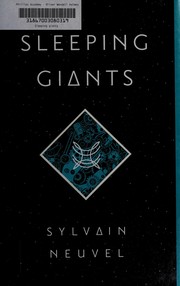
Sleeping Giants
2,466-word summary 11 min read 304 pages in the book
- First published
- 2016
- Publisher
- Del Rey
- Pages
- 304
- ISBN
- 9781101886694
- Series
- Themis Files (#1)
Reading options
What's inside (10 sections)
The first thing I noticed about this book is how quiet the apocalypse is. A girl falls through a hole in a South Dakota field, and instead of a monster or a meteor, she lands in a giant metal hand. That image stayed with me long after the plot had moved on to fighter jets and secret bunkers. Sylvain Neuvel built his whole novel around that contrast: the discovery of something impossible, described in the flat, procedural language of people trying to manage it. Published by Del Rey in 2016, Sleeping Giants is the first book in the Themis Files, and it reads less like a conventional science fiction novel than like a stack of classified documents someone leaked to you.
That is the formal gamble of the book, and it is the reason people either love it or bounce off it. There is no narrator in the usual sense. The story arrives through interview transcripts, journal entries, news reports, military chatter, and the occasional chat log. The most important voice belongs to a man who is never named. He is enormously wealthy, connected in ways he never fully explains, and he conducts interviews with almost everyone else in the book. He asks the questions the reader wants asked, and he withholds just enough that you keep turning pages to find out what he already knows. The result is a thriller made of conversations, which sounds dull until you realize that Neuvel is very good at writing people who are hiding things from each other.
The girl in the hole
Rose Franklin is eleven years old when she falls. She is riding her bike near her family's farm in Deadwood, South Dakota, the ground gives way, and she drops into darkness. When rescuers reach her, she is sitting in the palm of a hand made of a metal nobody can identify. The hand is enormous, maybe the size of a small car, and it is not attached to anything. The town treats it as a miracle and then as a nuisance. The government takes it. Rose grows up, becomes a physicist, and spends her adult life trying to get back to the question that has defined her.
The unnamed interviewer finds her years later and offers her the thing she has wanted since childhood: a chance to lead a project devoted to the hand and to the search for the rest of the body. He has money, access, and a habit of appearing when he is least expected. Rose accepts. She is not naive exactly, but she is hungry, and the book is honest about how much a person will overlook when someone finally takes their obsession seriously.
The early sections are the strongest. Neuvel uses the interview form to let Rose tell her own story in retrospect, which creates a strange double vision. She knows more than she is saying, and the interviewer knows more than she does. You are reading a confession and an interrogation at the same time. The hand itself is described with real care: the seams, the metal, the faint markings that might be writing. It feels engineered rather than magical, which makes the mystery more unsettling.
Assembling the team
The project needs people who can do things Rose cannot. The first is Kara Resnik, an army helicopter pilot who survives a crash in Turkey. The crash site happens to be where the robot's forearm surfaces, and Kara is recruited partly because she was there and partly because she is exactly the kind of stubborn, competent person the project needs. Her co-pilot, Ryan Mitchell, comes with her. Ryan is a good soldier and a jealous man, and the book makes his jealousy clear early without ever turning him into a cartoon.
The second recruit is Vincent Couture, a young linguist who is pulled out of a graduate program because he can see patterns in the markings on the metal. Vincent is the most ordinary person in the book, and that is his function. He is not a warrior or a genius administrator. He is a guy who is good at languages and who finds himself in a room with people who can move armies. His sections are where the novel's humor lives, and also where its sense of scale lands. He keeps noticing how absurd it is that the fate of the world is being decided in meetings.
The parts are scattered. A hand in South Dakota, a forearm in Turkey, an upper arm somewhere else, legs, a torso, a head. Each recovery is a small political crisis, because the United States is digging up allied and non-allied territory and refusing to explain why. Neuvel handles this with news clippings and official statements, which is one of the smartest choices in the book. You see the discovery from the outside, as a rumor, and then from the inside, as a logistics problem. The gap between those two views is where the tension lives.
The team assembles the robot in a facility that is never given a satisfying name. It is a hangar, a lab, and a prison all at once. The machine is humanoid and enormous, and the book is careful to make it feel heavy. When it moves, things break. When it stands, the ground complains. That physicality matters, because the novel is ultimately about a weapon that nobody fully understands.
The machine chooses its pilots
The central science fiction idea is simple and effective. The robot is not controlled by a joystick. It has a cockpit inside the torso, and the head and legs respond to specific people. Kara puts on the headset and the head accepts her. Ryan tries the legs and is rejected. Vincent tries, almost by accident, and the legs accept him. That rejection is the hinge of the plot. Ryan has spent his life being the guy who flies the machine, and now the machine has looked at him and said no.
Neuvel does not make Ryan a secret villain. He makes him a man with a wound. He loves Kara, or thinks he does, and he watches her grow close to Vincent, who is softer, funnier, and suddenly essential to the project. The resentment builds in small scenes: a look, a silence, a joke that lands wrong. Then Ryan steals a truck and hits Vincent. The scene is shocking because it is so mundane. There is no laser, no monster. Just a man in a vehicle deciding to remove a rival.
Vincent's legs are crushed. The project's response is the most chilling part of the book. Rather than let him lose the legs, the interviewer forces a surgeon to rebuild them with titanium, and the new knees are inverted to match the robot's anatomy. Vincent wakes up in a body that has been redesigned for a machine he did not ask to pilot. The book does not linger on the horror of that, but it should. It is the moment where the project stops being a scientific expedition and becomes something closer to an ownership claim.
Kara and Vincent grow closer after the accident. Their relationship is tentative and a little sad, two people who have been given a strange job and no manual for the rest of their lives. Ryan is kept around, which strains credibility, but the novel needs him for the final act. He is the human cost of the machine, and he is also the proof that the project's secrecy is corrosive.
The test, the death, and Denver
The robot is finally assembled, and Kara and Vincent decide to see what it can do. This is where the book's pacing changes. Up to this point, the story has been a slow accumulation of interviews and fragments. Then the machine takes a step, and the novel becomes a disaster movie. The test goes wrong. Rose is killed. Part of the facility is destroyed, and so is a chunk of the Denver airport. The secret is out.
The Denver sequence is exciting, but it is also where the book's limitations show. Neuvel has spent so much time building the mystery that the action feels rushed. Rose's death is a genuine shock, partly because she is the character we have spent the most time with, and partly because the book has been treating her as the narrator of her own story. Killing her offscreen, in a report, is a bold choice. It also leaves a hole in the novel that the rest of the book never quite fills.
The world reacts the way you would expect. Governments demand access. The project is denounced. The interviewer, who has been pulling strings from the beginning, is forced to give up control of the robot. The machine is presented to the world as a shared asset, which is a polite way of saying that everyone wants it and nobody trusts anyone. The political sections are sketched rather than dramatized, but they move the story forward.
Puerto Rico, Alyssa, and the turn
The second half relocates the project to Puerto Rico and introduces Alyssa, a scientist who takes over the day-to-day running of the site. Alyssa is the best villain in the book. She is brilliant, cold, and completely without scruples. Where the interviewer is a mystery, Alyssa is a diagnosis. She experiments on Kara and Vincent to find out why the machine responds to them. She treats their bodies as equipment. She is also, we learn, a woman with a past in the Balkan wars, and the book uses that past to explain her without excusing her.
The robot is used to attack the coast of Korea, which is a sentence I did not expect to write about a novel that begins with a girl falling into a field. The attack is not a war, exactly. It is a demonstration, and it goes wrong in the way demonstrations do. The United States government threatens the project with treason. Alyssa disappears. Ryan, who has been sidelined, helps Kara and Vincent escape. The book ends with the team scattered and the machine in the hands of people who should not have it.
The epilogue is the part everyone talks about. Rose Franklin wakes up on the side of a road with no memory of the project. She is younger than she should be. She remembers her childhood, her parents, the hand, but not the years since. The novel does not explain this. It is a hook for the sequel, and it works as a hook, but it also confirms that Sleeping Giants is less a standalone novel than the first episode of a longer story.
What the book is actually about
Under the alien machine and the military intrigue, Neuvel is writing about trust. Every relationship in the book is a negotiation over information. The interviewer trusts Rose enough to fund her but not enough to tell her the whole truth. Kara trusts Vincent but not Ryan. Ryan trusts nobody. Alyssa trusts only her own curiosity. The robot is a test of whether humans can cooperate, and the answer is mostly no.
There is also a quieter theme about bodies. Vincent's legs are rebuilt to fit the machine. Kara's body is studied and sampled. Rose's body is destroyed and then returned, altered. The novel is full of people whose physical selves are being reshaped by the project, and it never quite reckons with what that means. That is a criticism, but it is also the reason the book lingers. The images are stronger than the arguments.
The epistolary form is the other big idea. By telling the story through documents, Neuvel makes the reader an investigator. You are always aware that someone selected these transcripts and put them in this order. The interviewer is the editor, and the book is his case file. That framing is clever, and it gives the novel a distinctive voice, but it also keeps the characters at arm's length. Rose, Kara, and Vincent are vivid in their own sections and flat when they are being discussed by others. The book knows this, I think, and uses it to create a sense of isolation. These people are alone even when they are in the same room.
Where it stumbles
The biggest problem is the ending. The move to Puerto Rico introduces a new villain, a new setting, and a new political crisis in the last third, and none of them get enough room. Alyssa is fascinating, but she arrives late and exits early. The Korean attack is a huge event that is described in a few pages. The final revelation about the alien civilization is saved for a conversation between two people we barely know. The book is clearly setting up a series, but it spends too much of its ending on setup.
The characters also suffer from the format. Kara is tough and funny, but we rarely see her alone. Vincent is charming, but his interior life is mostly inferred. Ryan's jealousy is well seeded, but his turn to violence happens so fast that it feels like a plot requirement rather than a psychological inevitability. Rose is the most fully realized person in the book, and she is dead for most of it.
The prose is clean and functional, which is right for the documentary style, but it means there are few sentences you would underline for their beauty. This is a book of ideas and structure, not of language. If you come to science fiction for lush worldbuilding or deep character study, you may find it thin. If you come for a fast, clever puzzle with a great central image and a genuinely unsettling political edge, it delivers.
Who should read it
Sleeping Giants is for readers who like their science fiction with a procedural streak: think The Andromeda Strain by way of a leak of government emails. It is also a good book for people who are tired of chosen-one narratives. Nobody in this novel is special in a mystical sense. They are special because a machine decided they were, and that is much worse. The book is at its best when it is asking what people will do to be the one who gets to touch the alien thing. The answer, in almost every case, is something they cannot take back.
I finished it in two sittings, which is the highest compliment I can give a thriller. I also finished it with a list of questions, which is the highest compliment I can give a first book in a series. The hand in the field is a perfect opening. The novel never quite lives up to it, but it gets close enough that I want to know what happens next.
FAQ
Is Sleeping Giants told as a normal novel?
No. It is told through interviews, transcripts, journal entries, news reports, and other documents, with a nameless interviewer as the main connective voice.
Does Sleeping Giants explain where the robot came from?
It hints that an alien civilization left the machine on Earth thousands of years ago as a test, but the full explanation is left for the later books.
Is Sleeping Giants the first book in a series?
Yes. It is the first book of the Themis Files, followed by Waking Gods and Only Human.
Similar books
More from Themis Files first, then related titles.

Six Years
A professor who promised to forget the woman he loved sees her husband's obituary and discovers that the wedding, the marriage, and the woman herself may never…
2,076-word summary · 9 min read

Authority
The new director of the Southern Reach takes over an agency that is hiding the truth about Area X, and the building starts to change around him.
2,029-word summary · 9 min read

The Camel Club
Four Washington misfits witness a murder on Roosevelt Island and stumble into a conspiracy that reaches the Oval Office, with a hostage president and a nuclear…
2,354-word summary · 10 min read
When No One Is Watching
Sydney Green watches her Brooklyn block's Black residents vanish one by one in Cole's Edgar-winning thriller about gentrification as a crime scene.
2,165-word summary · 10 min read
Altered Carbon
Kovacs wakes in a new sleeve to solve a rich man's own murder.
2,231-word summary · 10 min read
Before the Fall
A private jet falls off Martha's Vineyard. A painter and a small boy survive, then face grief and the news cycle.
2,185-word summary · 10 min read
Pines
A Secret Service agent wakes hurt in Wayward Pines, Idaho, hunting two missing agents, and finds a town that will not let him leave.
2,452-word summary · 11 min read
Tell No One
Harlan Coben's Tell No One fully retold: Beck, his wife's murder eight years back, a tell no one email, and a run from police. A 2001 Delacorte standalone with…
3,579-word summary · 16 min read
Sphere
A Navy team finds a centuries-old spacecraft on the Pacific floor, and psychologist Norman Johnson faces what its sphere wakes in minds.
2,275-word summary · 10 min read
Recursion
False pasts feel truer than true ones as a memory chair lets the grieving rewrite deaths.
1,995-word summary · 9 min read
Leviathan Wakes
A destroyed ice hauler, a missing heiress, and an alien growth pull a crew and a tired detective toward war across the solar system.
3,653-word summary · 16 min read
Origin
Robert Langdon chases Edmond Kirsch's lost discovery through Bilbao and Barcelona to answer where we come from and where we are going.
2,604-word summary · 12 min read
Inferno
Dan Brown's Inferno retold: Robert Langdon wakes in Florence with lost memory, follows Dante's clues with Sienna Brooks from Palazzo Vecchio to Venice and…
2,395-word summary · 11 min read
The Lost Symbol
Langdon races through Washington to save Solomon from a tattooed killer seeking an ancient Masonic secret.
2,145-word summary · 10 min read
The Da Vinci Code
Dan Brown's The Da Vinci Code retold: a Louvre murder, Sophie Neveu, the Grail cryptex, and the chase to Rosslyn.
2,590-word summary · 12 min read

Angels & Demons
Dan Brown's Angels & Demons explained: a murdered physicist, the Illuminati, four missing cardinals, and Robert Langdon racing through Rome to stop an…
2,548-word summary · 11 min read

What She Knew
Rachel lets her eight-year-old son run ahead in a Bristol park, and the nine-day search turns her into a suspect in the public eye.
2,952-word summary · 13 min read

The Beach House
A young valet is beaten to death at a Hamptons party, and his law-student brother spends a year building a case against the family that covered it up.
2,049-word summary · 9 min read

The Trespasser
A Dublin Murder Squad detective investigates a staged dinner-party killing and finds a cover-up that reaches into her own department.
2,051-word summary · 9 min read

Rules of Prey
Minneapolis detective Lucas Davenport hunts a killer who leaves a new rule at every scene and treats murder as a game of wits.
1,914-word summary · 9 min read

Ace of Spades
Two Black seniors at an elite academy are celebrated by day and hunted by an anonymous texter in this YA thriller about institutional racism.
2,066-word summary · 9 min read

The Late Show
Exiled to the LAPD night shift after accusing her supervisor, Renée Ballard keeps two cases that were meant to be handed off at dawn: a brutal assault and a…
2,563-word summary · 11 min read
The First Fifteen Lives of Harry August
Harry August dies and is born again into the same life, again and again, until a warning from a child tells him the world is ending faster with each pass.
2,189-word summary · 10 min read

Night Film
A disgraced journalist investigates the death of a reclusive horror director's daughter, following a red coat through hospitals, secret clubs, and a family…
2,690-word summary · 12 min read

4th of July
Lindsay Boxer shoots two armed teenagers in self-defense, faces a wrongful-death trial, and spends her leave chasing a string of throat-slashing murders in…
2,192-word summary · 10 min read

61 Hours
A bus crash strands Jack Reacher in a snowbound South Dakota town where a drug gang, a corrupt police force, and a single witness are on a collision course.
2,227-word summary · 10 min read
The Rooster Bar
Three law students buried in debt discover their for-profit law school is a scam, and decide the only way out is to con their way into practicing law before…
2,837-word summary · 13 min read
The Last Mile
Melvin Mars is hours from execution for his parents' murder when another man confesses, and FBI cold case detective Amos Decker goes looking for the trap.
2,746-word summary · 12 min read

Still Missing
A realtor is abducted at a Vancouver Island open house and held for more than a year. Told through therapy sessions, the novel follows her escape and the hunt…
2,466-word summary · 11 min read

Bad Luck and Trouble
A deposit of $1,030 summons Jack Reacher back to his old army unit, which is being picked off one name at a time.
2,366-word summary · 11 min read