
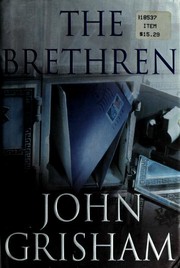
The Brethren
1,967-word summary 9 min read 366 pages in the book
- First published
- 2000
- Publisher
- Doubleday
- Pages
- 366
- ISBN
- 9780385497466
Reading options
What's inside (2 sections)
The Brethren is a John Grisham novel with no hero. That is the first thing you need to know. There is no young lawyer fighting a corrupt corporation. There is no innocent client. There are three disgraced judges running a blackmail scheme from a federal prison camp, a drunken lawyer who helps them, a CIA director who is engineering a presidential election, and a congressman who is hiding a secret that could destroy his career. Everyone in the book is guilty of something. The pleasure of reading it comes from watching them try to outmaneuver each other.
Grisham published the novel in 2000. It was a bestseller, and it is one of his darker books. The tone is cynical, but it is also very funny in a dry, deadpan way. The setting is Trumble, a minimum-security federal prison in northern Florida. The three judges are Joe Roy Spicer, Finn Yarber, and Hatlee Beech. Spicer was sent to prison for grand theft. Yarber for tax evasion. Beech for vehicular homicide while driving drunk. They are not sympathetic. They are smart, bored, and angry, and they have decided to spend their remaining years getting rich.
They call themselves the Brethren. They meet in the prison law library, where they advise other inmates and settle disputes. They walk the track in their boxer shorts. They complain about the food. They also run a mail scam. They place personal ads in magazines for gay men, pretending to be young, vulnerable men looking for love. When a man responds, they build a relationship through letters. Then they ask for money. If the man hesitates, they threaten to expose him. It is a cruel scheme, and it works. The judges are not gay. They are not young. They are not vulnerable. They are predators who have found a group of people who are easy to hurt because they are already hiding.
Their lawyer is Trevor Carson, a man who spends more time at Pete's Bar and Grill than he does in his office. Carson handles the mail, collects the money, and deposits it in a Bahamian bank account. He takes a third of the profits. He also hires private detectives to investigate the victims, so the judges know who is worth blackmailing. Carson is not a good lawyer, but he is a useful one. He is also a drunk, which makes him easy to manipulate.
The second plotline is about Aaron Lake. Lake is a fifty-three-year-old congressman from Arizona. He is a widower, a hawk on defense, and a man with no obvious path to the presidency. That changes when Teddy Maynard, the director of the CIA, decides that Lake is the candidate he wants. Maynard believes that the United States needs to double its military budget, and he believes that Lake is the man who can sell that idea to the public. So Maynard does what a powerful, unscrupulous intelligence director can do. He arranges the money, the consultants, and the strategy. He even stages a terrorist attack on an American embassy in Cairo to create the fear that will make voters want a strong leader. Lake does not know that he is being handled. He thinks he is running his own campaign.
The two plots collide when the Brethren hook Lake in their scam. Lake is closeted, and he has responded to one of their ads under a pseudonym. The Brethren do not know who he is at first. They just know that he is rich and careful. Then they find out. Suddenly, they have a hold over a presidential candidate. They do not want money anymore. They want their sentences commuted. They want out of prison.
That is the crisis that drives the second half of the book. The CIA discovers that Lake is being blackmailed. Maynard cannot allow the scandal to surface, because it would destroy his candidate and his plan. He also cannot allow the Brethren to keep operating, because they might talk. So he sends a man into Trumble to negotiate. The man tells the Brethren that the CIA knows about the scam. He offers them a deal: a pardon from the outgoing president, in exchange for their silence and their promise to leave the country. The Brethren accept. Carson is killed by CIA agents in the Caribbean before he can cause trouble. The judges are released, and they go to Europe, where they start the scam again.
Lake wins the election. Maynard, still protecting his investment, finds him a suitable First Lady. The book ends with the judges in Europe, the candidate in the White House, and the CIA director satisfied that the world is working the way he wants it to. There is no justice. There is no comeuppance. There is just a system that protects itself.
The prison setting is used well. Trumble is a minimum-security camp, which means it is not a hellhole. It is a place where people play tennis, eat decent food, and complain about the heat. That makes the judges' scheme feel more plausible. They are not desperate. They are comfortable, bored, and entitled. They have lost their power, but they have not lost their sense of superiority. They still believe they are smarter than everyone else, and the scam proves that they are. The book's portrait of prison life is not grim. It is ordinary, which is somehow worse. The men have adjusted to captivity, and they have found a way to make it profitable.
The political subplot is the more frightening half of the book. Teddy Maynard is not a villain who twirls a mustache. He is a bureaucrat who believes that the ends justify the means. He wants a president who will increase military spending, and he is willing to manipulate the election, stage a terrorist attack, and kill a lawyer to get one. The scary thing is not that he is evil. The scary thing is that he is competent. He knows how to use the system, and the system does not stop him. The book was published in 2000, but its portrait of a security state that operates outside the law feels very current. The names have changed. The machinery has not.
The Brethren's scam is also a commentary on the way power works. They target closeted gay men because they know that those men have something to lose. They use the threat of exposure to extract money and favors. It is a form of violence that does not require a weapon. The judges understand that shame is a more reliable lever than fear. The book is not sympathetic to the victims, exactly, but it does show how the closet can be used against people. That is a sharp observation, and it gives the scam a social dimension beyond simple greed.
The ending is deliberately unsatisfying. The judges get away. Lake becomes president. Maynard gets what he wants. There is no moment where the truth comes out and the bad guys are punished. That is the point. The book is not a fantasy of justice. It is a study of how power protects itself. The only consolation is that the judges are still the same petty, arguing men they were in prison. They have escaped the consequences of their actions, but they have not escaped themselves. That is a small comfort, and the book knows it.
What makes The Brethren interesting is the way it uses genre. It is a legal thriller, but the legal system is not a source of justice. It is a source of procedure, and procedure can be gamed. The judges know how to game it because they spent their careers inside it. The CIA knows how to game it because it has more power than the law. The only people who do not know how to game it are the victims, and they are the ones who get hurt. The book is not subtle about this, but it is effective.
The characters are drawn with a satirical edge. The Brethren are awful, but they are also funny. They argue about the scam like a group of old men arguing about a card game. They are petty, vain, and competitive. They are also intelligent, and their intelligence makes them more dangerous than a group of ordinary criminals. Maynard is a more frightening figure because he believes he is doing the right thing. He is not a cartoon villain. He is a bureaucrat with a vision, and he is willing to sacrifice anyone to achieve it. Lake is the weakest character, because he is mostly a blank. He is a vessel for other people's ambitions, and the book does not give him enough interiority to make his fate matter.
The plotting is expert. Grisham is very good at moving between storylines, dropping information at the right moment, and building tension through small details. The mail scam is plausible. The political manipulation is plausible. The way the two plots converge is clever. The prose is plain and fast. Grisham does not waste time on description. He gives you enough to see the room, and then he moves on. That makes the book easy to read, even when the subject matter is ugly.
The weaknesses are the weaknesses of Grisham's weaker novels. The ending is abrupt. The female characters are thin. The moral is stated rather than dramatized. Some readers will find the cynicism exhausting. There is no one to root for, and that can make the book feel hollow. The Brethren are entertaining, but they are also cruel, and the book sometimes seems to enjoy their cruelty more than it should. The political satire is dated in some ways, but the idea of a powerful intelligence agency manipulating an election feels more relevant now than it did in 2000.
I would recommend The Brethren to readers who like Grisham's darker, less heroic books. It is not as good as The Firm or A Time to Kill, but it is better than many of his later thrillers. It is a book about the way power works, and about the way people justify their own corruption. It is also a book about boredom. The judges are not driven by ideology or revenge. They are driven by the need to fill their days. That is a very human motive, and it makes them more believable than a group of master criminals. They are not masterminds. They are old men with too much time and too little conscience.
The title is ironic. The Brethren are not brothers in any meaningful sense. They are three men who happen to be in the same place at the same time, and they tolerate each other because it is useful. They share a scam, not a bond. When one of them is threatened, the others calculate the risk. When one of them is killed, the others move on. The book is not interested in loyalty. It is interested in self-interest, and it shows how easily self-interest can be dressed up as friendship. That is the real con at the heart of the novel. The mail scam is just the visible one.
The final image of the judges in Europe, starting their scam again, is a good one. They have escaped punishment, but they have not changed. They will keep doing what they do until they are caught or until they die. The world will keep letting them, because the world is run by people like Maynard, who care more about order than justice. That is a bleak message, but it is delivered with enough wit to make it go down easily. It is not a comforting book. It is a clever one, and sometimes that is what you want.
FAQ
Who are the Brethren?
They are three former judges serving time at Trumble, a minimum-security federal prison in Florida.
What is the scam in The Brethren?
The judges place personal ads pretending to be young gay men, then blackmail the wealthy men who respond.
Does The Brethren have a hero?
No. The novel is unusual for Grisham because every major character is corrupt, self-interested, or both.
Similar books
The Broker
A disgraced Washington lobbyist is pardoned and hidden in Bologna, where the CIA uses him as bait to find out who wants a stolen satellite.
2,211-word summary · 10 min read
Gray Mountain
A Manhattan associate furloughed after the financial crash takes a year of unpaid legal aid work in Appalachian coal country, and finds the case of her life…
2,026-word summary · 9 min read
The Racketeer
A jailed lawyer trades a judge murder secret for freedom and revenge.
2,434-word summary · 11 min read
The Judge's List
Lacy Stoltz hunts a sitting judge who murders off his list.
2,513-word summary · 11 min read

The Guardians
A innocence lawyer reopens a prison murder where the wrong man waits on death row.
2,564-word summary · 11 min read
The Street Lawyer
Michael Brock survives a hostage morning at his rich D.C. firm, then quits for a street clinic after learning a buried eviction file cost a mother and kids…
2,745-word summary · 12 min read

The Partner
A Biloxi lawyer fakes his death, steals $90 million, and hides in Brazil until hired muscle drags him home to trial.
2,221-word summary · 10 min read
The Whistler
A Florida judicial investigator takes a bribery tip that leads to a crooked judge, a tribal casino, and murder.
2,935-word summary · 13 min read
The Rainmaker
Broke rookie Rudy Baylor sues an insurer over a denied transplant and faces Leo Drummond at trial.
3,040-word summary · 14 min read
The Pelican Brief
Law student Darby Shaw writes a brief on murdered justices and becomes a target, fleeing with a reporter.
2,994-word summary · 13 min read
The Firm
Young lawyer Mitch joins a Memphis firm with great pay, then learns clients die and the FBI watches.
2,079-word summary · 9 min read

The Beach House
A young valet is beaten to death at a Hamptons party, and his law-student brother spends a year building a case against the family that covered it up.
2,049-word summary · 9 min read

4th of July
Lindsay Boxer shoots two armed teenagers in self-defense, faces a wrongful-death trial, and spends her leave chasing a string of throat-slashing murders in…
2,192-word summary · 10 min read

The Camel Club
Four Washington misfits witness a murder on Roosevelt Island and stumble into a conspiracy that reaches the Oval Office, with a hostage president and a nuclear…
2,354-word summary · 10 min read
Absolute Power
A thief watches the president kill, then runs with a lawyer who believes him.
2,401-word summary · 11 min read
Presumed Innocent
Rusty Sabich must solve coworker Carolyn Polhemus's murder while hiding his affair with her, then stands accused himself in Turow's 1987 Kindle County debut.
2,726-word summary · 12 min read
The Rooster Bar
Three law students buried in debt discover their for-profit law school is a scam, and decide the only way out is to con their way into practicing law before…
2,837-word summary · 13 min read
The Last Juror
A young editor buys a dying Mississippi paper and covers the murder trial that defines his town for a decade. Grisham's small-town novel about race, juries,…
2,528-word summary · 11 min read
The Testament
John Grisham's The Testament sends washed-up lawyer Nate O'Riley to the Brazil Pantanal to find missionary heir Rachel Lane and settle her…
2,731-word summary · 12 min read
Sycamore Row
Jake Brigance returns to defend a contested will that leaves a fortune to a Black housekeeper in racially tense Clanton.
2,017-word summary · 9 min read
The Chamber
Young Chicago lawyer Adam Hall defends his grandfather Sam Cayhall on Mississippi death row as a gas chamber date nears.
2,828-word summary · 13 min read
Camino Island
A Princeton manuscript heist pulls a blocked young writer into spying on a charming Florida bookstore owner who may hold the loot.
2,984-word summary · 13 min read
The Runaway Jury
A tobacco trial in Biloxi is quietly rigged from inside the jury box and by a woman offering to sell the verdict.
2,920-word summary · 13 min read

The Client
Eleven-year-old Mark Sway learns a mob secret in Memphis and hires lawyer Reggie Love for one dollar.
2,536-word summary · 11 min read
A Time to Kill
Lawyer Jake Brigance defends a father who killed his daughter's attackers.
2,064-word summary · 9 min read

What She Knew
Rachel lets her eight-year-old son run ahead in a Bristol park, and the nine-day search turns her into a suspect in the public eye.
2,952-word summary · 13 min read

Six Years
A professor who promised to forget the woman he loved sees her husband's obituary and discovers that the wedding, the marriage, and the woman herself may never…
2,076-word summary · 9 min read

The Trespasser
A Dublin Murder Squad detective investigates a staged dinner-party killing and finds a cover-up that reaches into her own department.
2,051-word summary · 9 min read

Rules of Prey
Minneapolis detective Lucas Davenport hunts a killer who leaves a new rule at every scene and treats murder as a game of wits.
1,914-word summary · 9 min read

The Late Show
Exiled to the LAPD night shift after accusing her supervisor, Renée Ballard keeps two cases that were meant to be handed off at dawn: a brutal assault and a…
2,563-word summary · 11 min read