
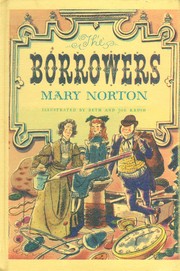
The Borrowers
2,164-word summary 10 min read 180 pages in the book
- First published
- 1952
- Publisher
- Harcourt Brace
- Pages
- 180
- ISBN
- 9780152099909
- Series
- The Borrowers (#1)
Reading options
What's inside (12 sections)
My mother read The Borrowers aloud to me when I was seven, and I remember two things about it. The first was the pleasure of the tiny objects: a postage stamp used as a painting, a spool used as a table, a hatpin used as a spear. The second was the fear. The scene where the housekeeper lifts the floorboards and looks down at the Clock family stayed with me longer than any of the cozy details. I reread the book as an adult and found that the fear was not a child's misreading. The Borrowers is a charming book with a genuinely unsettling ending.
Mary Norton published it in 1952. J. M. Dent brought out the first edition in the United Kingdom, with illustrations by Diana L. Stanley. Harcourt, Brace published the American edition in 1953, illustrated by Beth and Joe Krush. The edition I used is the Harcourt reprint, which runs 180 pages and carries the ISBN 9780152099909. The first edition was 159 pages. The novel won the Carnegie Medal in 1952, and in 2007 it was named one of the top ten Carnegie winners of all time. It is the first of five books about the Borrowers.
The house and the Clock family
The story begins with a frame. Kate is staying in an old house and crocheting a quilt with her aunt, Mrs May. Kate complains that her crochet supplies keep disappearing. Mrs May tells her about the Borrowers, tiny people who live secretly in houses and borrow what they need from the human beings, or "human beans," who live there. Mrs May says she knows the story is true because her younger brother once befriended a Borrower girl named Arrietty.
The main story is set in the same house, which is modeled on Norton's childhood home, The Cedars. Arrietty Clock lives with her father, Pod, and her mother, Homily, under the floor beneath a grandfather clock. The Borrowers take their surnames from their homes. The Clocks are one of several families who once lived in the house, along with the Overmantels, the Rain-Pipes, the Harpsichords, and the Bell-Pulls. Most of them have emigrated or died out. The house is old, the family that owns it is absent, and the Borrowers' world is shrinking.
Pod is a shoemaker. He makes button boots from beads and kid gloves, and he goes borrowing at night through the passages behind the walls. Homily keeps the house, worries about appearances, and dreams of a better life. Arrietty is fourteen, curious, literate, and restless. She has never been outside except to look through a grating. She knows the world from books, which is both an advantage and a danger. She understands that the Borrowers may be the last of their kind, and she wants to know if there is anyone else out there.
The domestic details are the book's great pleasure. The Clocks live in a miniature apartment furnished with borrowed objects. A blotter becomes a carpet. A spool becomes a table. A thimble becomes a pot. The Borrowers are not magical. They are resourceful, and their resourcefulness is a form of dignity. Norton makes the reader feel the scale of their world. A mouse is a monster. A cat is a dragon. A human being is a god who can destroy everything without noticing.
Arrietty's education
Arrietty is the engine of the plot because she asks questions that the adults have learned not to ask. She wants to know where the Borrowers came from, whether there are others, and why they cannot live openly. Her parents answer with warnings and half-truths. They are trying to protect her, but their protection is also a form of confinement.
Pod takes her borrowing for the first time, and she sees the garden. The scene is a small adventure and a revelation. Arrietty has read about the outdoors, but reading is not the same as standing in it. She meets the Boy, who is staying with his great-aunt while recovering from an illness. He has been sent from India, speaks two languages, and is slow to learn English. He is lonely, curious, and careless in the way that children with power often are.
Arrietty and the Boy make a bargain. He will bring her books from the house if she will read to him. The arrangement is touching and dangerous. Arrietty wants stories. The Boy wants company. Neither of them understands the risk. The Borrowers survive by being invisible, and Arrietty's friendship makes them visible.
The Boy
The Boy is one of Norton's best creations because he is not a villain. He genuinely likes Arrietty. He brings her gifts, listens to her, and tries to help. He also treats her world as a game. He gives the Clocks dollhouse furniture from the nursery, which is a fortune to them and a trivial theft to him. He does not understand that his generosity makes them dependent. He does not understand that his attention is a beacon.
The novel is careful about the difference between kindness and responsibility. The Boy is kind, but he is not responsible. He cannot protect the Borrowers from the adults in the house, and he cannot take them with him when he leaves. His friendship changes their lives and then ends. That is a realistic portrait of childhood relationships, and it is also a quiet indictment of privilege.
The Boy's sister is the young Mrs May in the frame story. She grows up hearing his stories and half believing them. The novel's final twist involves her, and it changes the meaning of everything that came before.
Mrs Driver and the danger
Mrs Driver is the housekeeper, and she is the novel's antagonist. She is not evil in a fairy-tale way. She is suspicious, tired, and resentful of the Boy, whom she sees as spoiled and dishonest. When she catches him trying to open a curio cabinet full of valuable miniatures, she assumes he is stealing. Her suspicion is reasonable. Her response is not.
She finds the Borrowers' home by following the light of their candle through the floorboards. She peers under the floor and sees them. Her reaction is horror and disgust. She locks the Boy in his room so he cannot warn them. She hires a rat catcher to fumigate the house. The fumigation is the book's most frightening sequence. The Borrowers are trapped in their home while poison is pumped into the walls. They escape through the grating, but the reader does not see where they go.
Driver's cruelty is rooted in class. She is a servant who has spent her life cleaning up after people with more money and less sense. The Borrowers are another mess to be exterminated. Norton does not excuse her, but she gives her a psychology. That is what makes the danger feel real. The worst threats in the book are not monsters. They are ordinary people doing their jobs.
The ending
The Boy breaks open the grating to give the Borrowers an escape route. He waits for them to come out, but the cab arrives to take him to the ship. Driver drags him away. The Borrowers' fate is left unknown. Mrs May later visits the house and leaves small gifts at a badger sett where Arrietty's relatives were supposed to live. The gifts disappear. She finds a miniature memoranda book containing the story of the Borrowers. Kate is delighted because the book proves the Borrowers survived.
Then Mrs May points out that the handwriting in the book is identical to her brother's. The implication is devastating. The story may have been invented by the Boy. The Borrowers may never have existed. Or the Boy may have written the book from Arrietty's account, which would still leave their fate unknown. The novel refuses to resolve the ambiguity. It ends on a note of doubt that is unusual in children's fiction.
The ending is also a refugee story. The Clocks are displaced from their home by a threat they cannot fight. They escape into a world that is vast and dangerous. The book does not tell us whether they find safety. That uncertainty is the point. Norton understands that survival is not guaranteed, even for characters we love.
What the book is really about
On the surface, The Borrowers is a fantasy about tiny people. Underneath, it is a book about scarcity, class, and extinction. The Borrowers are a dwindling community in a house that no longer supports them. Their numbers are falling. Their relatives have emigrated. Arrietty realizes that she may never meet another Borrower her age. The book is full of references to families who have disappeared, and the tone is elegiac.
The Borrowers are also a metaphor for anyone who lives on the margins of a wealthy society. They survive by taking what is left over, by staying out of sight, and by maintaining a culture that the dominant society does not recognize. Norton does not make the metaphor heavy. She lets the story do the work. A child can read it as an adventure. An adult can read it as a study of displacement.
The novel is also about the ethics of borrowing. The Borrowers take things that do not belong to them. They justify it by need and by scale. A human being will not miss a spool or a stamp. But the Borrowers' entire economy depends on the existence of a wealthy household. When the household changes, they are vulnerable. The book does not moralize about this. It simply shows how fragile a life built on other people's abundance can be.
The sequels
Norton wrote four sequels: The Borrowers Afield, The Borrowers Afloat, The Borrowers Aloft, and The Borrowers Avenged. They follow the Clocks as they search for a new home and encounter other Borrower families. The first sequel answers some of the questions left open by the original, but it also changes the tone. The later books are more adventurous and less elegiac. The first book remains the best, because it has the tightest structure and the most powerful ending.
The novel has been adapted several times, including a 1973 television film, a 1992 BBC series, a 1997 feature film with John Goodman, a 2011 television film, and a 2025 animated series. The adaptations tend to soften the ending and emphasize the cozy details. That is understandable. The book's ambiguity is hard to sell to a family audience. But the ambiguity is what makes it last.
What works and what does not
The world-building is superb. Norton thinks through the practical details of miniature life: how the Borrowers get water, how they cook, how they make clothes, how they move through the walls. The details are inventive without being whimsical. They feel like solutions to real problems.
The characters are vivid. Pod is cautious and competent. Homily is anxious and proud. Arrietty is brave and impatient. The Boy is kind and careless. Mrs Driver is cruel and understandable. Even the minor characters, like the Overmantels and the Rain-Pipes, have distinct personalities and social roles.
The prose is clear and precise. Norton writes for children without talking down to them. She uses long sentences and rich vocabulary, and she trusts the reader to keep up. The book is a pleasure to read aloud.
What does not work
The frame story is dated. Kate and Mrs May are pleasant but thin, and the device of the aunt telling the story feels old-fashioned. The novel takes a while to get to the Borrowers, and modern children may lose patience.
The pacing is slow in the middle. The borrowing expeditions are charming, but they repeat similar beats. The plot does not really begin until Mrs Driver discovers the Borrowers, which is late in the book.
The class politics are ambivalent. The Borrowers are genteel and proud, and Homily's snobbery is played for comedy. The book does not challenge the idea that some people are more deserving than others. It simply transfers the English class system to a miniature world. That is interesting, but it is not critical.
Who it is for
This is a book for children who like miniature worlds and quiet adventures. It is for adults who remember reading it and want to see whether it holds up. It is also for readers who are interested in the history of children's fantasy. The Borrowers is one of the founding texts of the genre, and it is still worth reading.
It is not a fast-paced book, and it is not a comforting one. The ending is ambiguous, and the threat is real. That is why it lasts. Norton wrote a story about small people in a big house, and she made the small people matter. When the floorboards open, the reader feels the same fear that Arrietty feels. That is the mark of a book that has earned its place.
FAQ
Is The Borrowers for children?
Yes. It is a children's fantasy novel, though its ending is darker and more ambiguous than many young readers expect.
What happens at the end of The Borrowers?
The Clocks escape through a grating after the house is fumigated, but their fate is left open, and the frame story suggests the tale may have been invented.
Is The Borrowers the first book in a series?
Yes. It is the first of five books, followed by The Borrowers Afield.
Similar books
More from The Borrowers first, then related titles.
The Stonekeeper
After their father's death, Emily and Navin chase a monster into a hidden world to save their mother, and Emily's great-grandfather's amulet offers power at a…
2,753-word summary · 12 min read
Charlie and the Great Glass Elevator
Charlie and Wonka overshoot Earth in the glass elevator, meet alien Knids, then risk age pills and Minusland.
2,514-word summary · 11 min read
Stuart Little
A two-inch boy in a New York family befriends a canary, loses her, and drives off alone to find her.
2,591-word summary · 12 min read
The Neverending Story
Bastian steals a book about Fantastica dying and learns he must name and wish to save it.
1,941-word summary · 9 min read
From the Mixed-Up Files of Mrs. Basil E. Frankweiler
Claudia and Jamie run away to the Met, chase whether a 225 dollar Angel is a Michelangelo, and trade secrets with Mrs. Frankweiler.
2,774-word summary · 12 min read
Tuck Everlasting
Winnie Foster meets the immortal Tuck family in the woods and must decide whether to drink from their spring.
2,750-word summary · 12 min read
The Silver Chair
Eustace and Jill retold: four signs, a lost prince, Puddleglum the Marsh-wiggle, giants at Harfang, and the Lady below.
2,940-word summary · 13 min read
The Phantom Tollbooth
A bored boy drives a toy car through a magic tollbooth into the Kingdom of Wisdom and learns to care about words, numbers and time.
2,765-word summary · 12 min read
The Last Battle
Lewis ends Narnia: Shift ape false Aslan, King Tirian last stand, Jill and Eustace at Stable Hill, and a morning beyond the world.
3,037-word summary · 13 min read
The Horse and His Boy
Shasta and Bree flee Calormen to Narnia with Aravis and Hwin.
2,594-word summary · 12 min read
Peter Pan
Wendy, John and Michael fly to Neverland with Peter, face Hook, and learn what growing up costs.
2,502-word summary · 11 min read
The Witches
A boy and his grandmother face the Grand High Witch's plan to turn England's children into mice.
2,738-word summary · 12 min read
The Wonderful Wizard of Oz
Dorothy is carried to Oz by a cyclone and walks the yellow brick road with Scarecrow, Tin Woodman, and Lion.
3,297-word summary · 15 min read
The Voyage of the Dawn Treader
Lewis sends Lucy, Edmund and Eustace aboard Caspian's Dawn Treader to find seven lost lords, past dragon gold, dark dreams and the world's edge.
2,330-word summary · 10 min read
Prince Caspian
The Pevensies return to ruins at Cair Paravel and help Caspian take back Narnia from Miraz.
2,304-word summary · 10 min read
James and the Giant Peach
Lonely James escapes two cruel aunts inside a giant peach with huge insect friends, rolling to the sea and floating on gulls to New York City.
2,384-word summary · 11 min read
The Magician's Nephew
C. S. Lewis's Narnia origin story retold: Digory and Polly, the Wood between the Worlds, the waking of Jadis in Charn, Aslan's singing creation, and the apple…
2,528-word summary · 11 min read
The Lion, the Witch and the Wardrobe
C. S. Lewis's Narnia opener retold: four Pevensies, the White Witch's winter, Aslan's sacrifice, and the crowning at Cair Paravel.
2,502-word summary · 11 min read

The Long Winter
Dakota Territory, 1880: seven months of blizzards cut a town off from the railroad, and a family survives on twisted hay, ground wheat, and a dangerous wheat…
2,210-word summary · 10 min read
Ship of Magic
A sentient ship wakes when her captain dies, and the family that owns her starts to come apart over who gets to sail her.
2,026-word summary · 9 min read

Make Way for Ducklings
A pair of mallards raise eight ducklings on the Charles River and lead them across Boston to the Public Garden, with a little help from a friendly policeman.
2,044-word summary · 9 min read

The Field Guide
Three siblings move into a creepy Maine estate, anger a brownie, and find a forbidden guide to the fairy world in the first Spiderwick book.
2,033-word summary · 9 min read

Little Town on the Prairie
In the spring after the Long Winter, fifteen-year-old Laura sews shirts, studies for a teaching certificate, and helps send her blind sister Mary to college.
2,071-word summary · 9 min read
Amelia Bedelia
A literal-minded housekeeper follows her employer's list to disastrous and funny effect in the 1963 picture book that made wordplay a children's staple.
2,038-word summary · 9 min read
The Sword of Shannara
A young half-Elf and a company of companions set out to recover a magic sword before the Warlock Lord destroys the Four Lands.
2,474-word summary · 11 min read
Sideways Stories from Wayside School
Thirty stories, one class per floor, and a teacher who turns students into apples: Louis Sachar's absurd school classic.
2,045-word summary · 9 min read
Saga, Volume 3
Marko, Alana, and Hazel hide on the planet Quietus with the reclusive author who inspired their romance, while assassins and a prince close in.
1,989-word summary · 9 min read

Old Yeller
Travis Coates takes in a stray yellow dog that protects his family on the Texas frontier, and learns about loyalty and loss.
2,165-word summary · 10 min read
On the Banks of Plum Creek
The Ingalls family trades their horses for a dugout on Plum Creek and bets a single wheat harvest on a house above ground, in Wilder's fourth Little House book.
2,090-word summary · 9 min read
The Swiss Family Robinson
Shipwrecked Robinsons build treehouses and tame island beasts.
2,400-word summary · 11 min read