
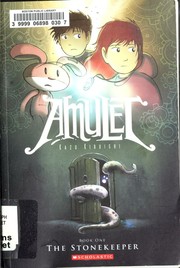
The Stonekeeper
2,753-word summary 12 min read 192 pages in the book
- First published
- 2008
- Publisher
- Graphix
- Pages
- 192
- ISBN
- 9780439846813
- Series
- Amulet (#1)
Reading options
What's inside (9 sections)
The pitch I heard from a school librarian was that The Stonekeeper never stays on her shelves, and the book earns the line. Kazu Kibuishi's first Amulet volume is a chase scene with a death at the start and a giant walking house at the end, and it fits all of that into 192 full-color pages. Graphix, Scholastic's graphic novel imprint, published it in January 2008, and it became the first of nine volumes. None of that explains why kids pass it around. Kids pass it around because the monster is terrifying and the heroine is ten feet tall in the panels that matter.
A crash, a move, and a house full of secrets
The book opens with a prologue that has almost no narration. Emily Hayes is in the car with her parents, David and Karen, driving to pick up her little brother Navin, and the panels are wide and ordinary: wet road, seat belts, a conversation about being late. Then the car leaves the road. It comes to rest against a tree on a slope, with David pinned under the dashboard. Karen pulls Emily free. The two of them try to pull David out, and the car slides over the edge with him still inside. Kibuishi gives the moment two silent panels and then moves on. It is the most efficient storytelling in the book, and it sets the rule for everything after it: the art will carry what the words cannot.
Two years later, Karen is a widow who cannot afford the city anymore, so she moves Emily and Navin to Norlen, a small town where her family owns an old house. The house belonged to her grandfather, Silas Charnon. Karen calls him a puzzle maker. He disappeared years ago, she says, after locking himself inside one day and never coming out. The place is boarded up, dusty, and full of strange devices. Emily is at the age where she has decided school is a waste of time and she would rather teach herself from Silas's books. Karen answers that it is better to lead a normal life. It is the kind of line a parent says while standing in a house with a talking basement, and the book lets you feel the irony without commenting on it.
While poking around Silas's study, Emily finds the amulet. It is hidden in the furniture, tucked into a spot that opens when her hand touches it, and it is just a dark stone on a cord until Navin helps her tie it on. The cord ties itself while they are arguing. They agree not to tell their mother, and at the edge of the page, something dark slips out of frame. If you are reading the series for the first time, that little shadow matters later. If you are reading with a kid, it is the first thing they will point at.
The door in the basement
That night, the amulet speaks. Emily hears a voice in her head warning her that her family is in danger, and minutes later something starts making noise downstairs. Karen takes a flashlight to check on it. That is the last ordinary decision in the book. Something with tentacles takes her through a door in the basement wall that has no business being there, and when Emily and Navin run after her, the steps behind them vanish one at a time. Kibuishi draws the disappearing staircase from below, so the kids are already falling by the time you turn the page. Alledia, the world under the house, gets its introduction through a child's panic rather than a map. There are no maps for a while. There is just the dark and a voice telling Emily where to put her feet.
The kids catch up to their mother in a cavern, and it goes badly. The creature, which the book calls an arachnopod, has Karen tangled in its body. Navin gets swallowed whole. Emily's amulet flares, and the burst knocks her free, though she could not tell you how she did it. Then, impossibly, Karen shoves Navin back out through a gap in the creature's side, and the arachnopod retreats with her still inside. Two children are alone underground. Their mother is gone, the monster is gone, and the stone around Emily's neck has started giving helpful directions in a voice that sounds patient. Emily follows it because the alternative is standing still.
The journey across the cavern is where the art starts showing off. At one point the kids step onto giant mushroom caps and drift down a shaft like parachutists, and a bird with a cone for a beak starts pecking a hole in Navin's mushroom, which would drop him into nothing. Emily blasts the bird with the stone. It is the first time she uses the amulet on purpose, and the panels hold on her face right after, because the power feels good and she knows it feels good. That beat of self-awareness is a small thing that a lesser book would skip.
They come out at a lake with a house on a pillar of rock in the middle of it, and a figure in a rowboat. Before anyone can say hello, an elf with a stone amulet of his own attacks them. The elf gets stunned by a ray gun fired from a big humanoid machine, and the figure in the boat rows the kids across the water. On the far shore, the figure opens his cloak and turns out to be a small pink robot rabbit named Miskit, who was piloting the big machine from inside it. Miskit works for Silas Charnon. The house on the pillar is Silas's house. The great-grandfather who locked himself in and never came out has been living in a cavern under his own basement for years, and he is dying.
Silas and the stone's offer
The house is called the Charnon House, and it is full of robots. Cogsley, Morrie, Bottle, and a scattered crew of metal helpers keep the place running, and they treat Miskit like a foreman. Silas himself is in bed, ancient and failing, and he has clearly been holding on long enough to meet Emily. What he tells her reframes the book. The amulet is not a souvenir. It is a stonekeeper's tool, and stonekeepers are part of the machinery of this world. With it, Silas says, Emily could rule Alledia. That part she does not care about. Then he mentions the other thing the stone might do: turn back time. Emily is twelve. Her father has been dead for two years. Watch her hands in that panel.
Silas does not push her either way. He asks her to choose, keep the stone or leave it, and then he dies. The lights go out across the house, the robots slump where they stand, and the whole place goes quiet and cold around two kids and a body. This is the darkest page in the book, and it is doing structural work: it makes the amulet's offer arrive exactly when Emily is most alone. The voice tells her to accept her role. Navin, who has disliked the stone since the basement, tells her not to. Emily accepts anyway, and the house wakes up around them, robots straightening, lights coming on, Miskit visibly relieved.
It is worth pausing on how well the book handles that choice. Emily is not tricked into power and she is not chosen by destiny against her will. She is offered a way to save her mother, with a darker promise underneath it, and she takes it while her little brother watches her do it. Later volumes spend a lot of time on whether the stone is good for her. The Stonekeeper plants that question in a single scene between a deathbed and a power switch, and it never has to explain the theme out loud. Navin's distrust matters too. He is the reader's common sense, and from this point on he is the one who notices when the voice sounds less like a guide and more like a recruiter.
The Albatross and the vitamin darts
The robots find Karen with a scanner. She is out there somewhere in the tunnels, inside a moving monster, and the heroes have one aircraft, a little machine called the Albatross. Miskit flies them into a passage lined with rakers, which are exactly what they sound like, and the sequence plays like a classic chase: Navin at the controls, Miskit on the gun, rakers peeling off the walls. When one of them knocks the gun loose, Emily uses the stone to shove the creatures back, and the panels give her a full page to look powerful on. It is a great action scene, and it is also the book's quiet argument that Navin and Emily have to work together. He drives. She fights. Nobody says a word about teamwork.
They catch up to a pack of arachnopods and spot Karen inside one of them, and this is where the rescue goes sideways in a way that has stuck with readers for almost two decades. The plan is to harpoon the creature and sedate it with tranquilizer darts. Miskit fires. The creature does not slow down, and Miskit slowly realizes he grabbed a case of vitamin supplements instead. It plays as comedy for about three panels. Then the arachnopod stings Karen and escapes, the Albatross crash-lands in the forest, and the joke curdles into the reason their mother is dying. It is a smart piece of tonal control, and it shows Kibuishi's instinct for putting the funny beat next to the awful one so the awful one lands harder.
Trellis and the kill order
Emily climbs the slope alone and finds the arachnopod just as the elf from the lake tears it in half with his own stone. His name is Trellis. He is the son of the Elf King, and he wants Emily's help to kill him. He is not entirely himself, either. A dark presence called Sybrian has its hooks in him, using him the way the voice uses Emily's stone. Trellis takes Karen hostage, then tries to take over Emily's mind, and Emily, who has been using the amulet for about a day, fights him off and breaks Sybrian's hold in the process.
Trellis ends up on his knees in front of her, defenseless, and this is the moment the book has been building toward whether readers notice or not. The voice in the amulet tells Emily to kill him. The panels go red at the edges. She is twelve, she is exhausted, her mother is lying poisoned ten feet away, and the thing around her neck, the guide she has trusted since the basement, is asking her to execute a beaten boy. Emily refuses. She tells Trellis to stay away from her family, and she lets him walk away. The voice does not get a rebuttal panel. Kibuishi just moves on, and the reader is left to notice what almost happened.
That refusal is the best scene in the book, and it is the reason the series has somewhere to go. A weaker version of this story ends with Emily blasting the elf and feeling fine about it. This one ends the confrontation with Emily learning that her power has opinions of its own, and that she is not going to obey them. Everything the later volumes do with the amulet and its voice grows from this small act of mercy in a forest.
A house that stands up
Back at the Charnon House, the robots diagnose Karen. The sting carried a poison, and she will not wake up without an antidote. The nearest place that might have one is the port town of Kanalis, which is a long way across the surface. Then the final reveal arrives, and it is a good one: the house is also a machine. It stands up, water sheeting off its roof, and walks out of the cavern through the hole in the ground above it, carrying the whole cast like a ship. The last pages watch it stride across the world toward the city, with Emily in a window, and that is where the book ends. No victory, no resolution, just a direction of travel.
As an ending, that works better for some readers than others. It is a first act and it knows it, and a kid who has been waiting for Emily to get her mother to safety will be frustrated in exactly the way that sells volume two. An adult reading The Stonekeeper as a standalone will find threads everywhere and knots nowhere: the Elf King never appears on the page, Trellis is a threat for two scenes and then gone, and the amulet's real nature is still a shadow. That is a real criticism of the book as a novel, and it is also the honest shape of a serial.
What works, what wobbles
The art is the main event, and it holds up. The book often gets shelved next to manga, and the pages show why: widescreen establishing shots, tight reaction panels, sound effects lettered into the scenery, dialogue trimmed until the pictures have to work. Kibuishi is not afraid of wordless stretches. The prologue, the disappearing stairs, the mushroom descent, and the house rising from the ground all run long without captions, and the color does the emotional work, dusty browns and grays at home, wet blues underground, warm lantern light around the robots. A parent reading this aloud will notice there is not much to read aloud, which is the point. It is a book built to be looked at.
There are wobbles. A few reviewers have noted that Emily, Karen, and Navin have very similar faces, which can make a crowded panel harder to parse than it should be, and I saw what they meant on a second pass. The middle act, with its tunnel, its darts, and its crash, moves so fast that the geography of the rescue is hard to hold in your head. Reviewers at the time felt it. A School Library Journal review described a sense of déjà vu in some scenes and called the book "serviceable, but not extraordinary," and a later review of the first three volumes thought the storyline was, in its words, "a little too drawn out and chaotic." Those are fair notes on a debut that is still learning how much story fits into 192 pages.
The praise was just as real. Booklist called the action sequences exciting and flagged the dark elements as worth knowing about, which is the trade this summary is making with you too. Kirkus Reviews called Kibuishi "a dab hand at portraying freaky monsters," which is true from the very first arachnopod. A kid reviewer at The Guardian said they could not stop reading it. The book landed on YALSA's 2009 Best Books for Young Adults list, won the Rhode Island Children's Book Award in 2010, and picked up young readers' choice awards from the Pacific Northwest and Oregon library associations in 2011. For a book about a girl and a rock, that is a serious trophy case.
So who should read it? Middle grade readers, roughly eight to twelve, and the many adults who keep a shelf of comics next to their novels. Fans of kids descending into strange worlds will feel at home immediately. It is not a good pick for a reader who scares easily, because the father dies in the first four pages and the arachnopod is the stuff of genuine bedtime negotiations. It is also not for anyone who needs a complete story in one volume, for the reasons above. But for the right reader, it is 192 pages that disappear in an evening, and the voice, the mercy scene, and the house standing up will all still be there in the morning.
The Amulet series has nine volumes now, so Emily's story is finished somewhere out past the horizon of this one. The Stonekeeper is the promise, not the payoff: a promise about a brother and sister, a stone that wants things, and a world that keeps getting bigger. Read it in one sitting, with a kid if you can borrow one, and keep the second volume within reach, because the last page does not let you off the hook and it is not trying to.
FAQ
What age is The Stonekeeper appropriate for?
It is aimed at middle grade readers, roughly ages eight to twelve, but the father's death and the arachnopod scenes make it scarier than most books for that age.
Is The Stonekeeper the first Amulet book?
Yes. It is book one of nine, followed by The Stonekeeper's Curse, and the series concluded with Waverider.
Who published The Stonekeeper and when?
Graphix, Scholastic's graphic novel imprint, published it in January 2008. The paperback runs 192 pages with ISBN 9780439846813.
Similar books
More from Amulet first, then related titles.
The Field Guide
Three siblings move into a creepy Maine estate, anger a brownie, and find a forbidden guide to the fairy world in the first Spiderwick book.
2,033-word summary · 9 min read

The Indian in the Cupboard
Omri learns a key turns plastic Little Bear into a live Iroquois man.
2,228-word summary · 10 min read
Magyk
A baby found in snow, a lost seventh son, and a run for the Marram Marshes as Marcia Overstrand shields two children from DomDaniel.
2,604-word summary · 12 min read
Rise of the Evening Star
Kendra and Seth return to Fablehaven as the Society of the Evening Star closes in, with a traitor inside the house and a demon prison key at stake.
2,874-word summary · 13 min read
Fablehaven
Kendra and Seth spend the summer with their grandfather and learn his woods hide Fablehaven, a preserve for fairies, satyrs and darker things.
2,949-word summary · 13 min read

Bone, Vol. 1: Out from Boneville
Three cartoon cousins are run out of Boneville, separated by locusts, and dropped into a valley where rat creatures and an old grudge are waiting.
2,155-word summary · 10 min read
Secrets of the Dragon Sanctuary
Kendra is replaced by a plant copy and held by the Society, while Seth steals a unicorn horn so the family can enter a dragon sanctuary.
2,590-word summary · 12 min read
The Time Paradox
When his mother falls ill with a fairy disease, Artemis Fowl travels back in time to find the extinct lemur that can cure her and confronts his younger self.
2,601-word summary · 12 min read
Grip of the Shadow Plague
A plague turns Fablehaven's creatures of light into shadows while Kendra hunts an artifact in Arizona and Seth races to find the cause.
2,131-word summary · 9 min read
The Borrowers
A family of tiny people live under the floorboards of an English house, borrowing what they need until a lonely boy and a suspicious housekeeper change…
2,164-word summary · 10 min read
Saga, Volume 3
Marko, Alana, and Hazel hide on the planet Quietus with the reclusive author who inspired their romance, while assassins and a prince close in.
1,989-word summary · 9 min read

The Girl Who Drank the Moon
A witch who secretly rescues the town's sacrificed babies accidentally enmagicks one with moonlight, and the girl grows up with a power she cannot name.
2,078-word summary · 9 min read

Into the Wild
Housecat Rusty joins ThunderClan and learns clan law before war.
2,597-word summary · 12 min read
Gregor the Overlander
Gregor follows Boots down a grate into the Underland and a war prophecy.
2,516-word summary · 11 min read
The Miraculous Journey of Edward Tulane
A china rabbit lost at sea learns to love through owners kind and cruel across many years.
2,002-word summary · 9 min read
The Demigod Files
Three Percy Jackson side quests plus camp maps, cabin guides, interviews, and god profiles set before the final battle.
2,498-word summary · 11 min read
Princess Academy
Miri leaves her Mount Eskel quarry home for Princess Academy, where quarry songs, books, and a bandit siege shape her fight for fair trade, a school, and a…
2,441-word summary · 11 min read
The Silver Chair
Eustace and Jill retold: four signs, a lost prince, Puddleglum the Marsh-wiggle, giants at Harfang, and the Lady below.
2,940-word summary · 13 min read
The Witches
A boy and his grandmother face the Grand High Witch's plan to turn England's children into mice.
2,738-word summary · 12 min read
The Wonderful Wizard of Oz
Dorothy is carried to Oz by a cyclone and walks the yellow brick road with Scarecrow, Tin Woodman, and Lion.
3,297-word summary · 15 min read
The Lion, the Witch and the Wardrobe
C. S. Lewis's Narnia opener retold: four Pevensies, the White Witch's winter, Aslan's sacrifice, and the crowning at Cair Paravel.
2,502-word summary · 11 min read

The Blinding Knife
Kip trains to join the Blackguard while the Prism hides his true identity, loses his colors, and fights a war against a rogue drafter who wants to birth a god.
2,049-word summary · 9 min read
Ship of Magic
A sentient ship wakes when her captain dies, and the family that owns her starts to come apart over who gets to sail her.
2,026-word summary · 9 min read

Inkdeath
The final Inkworld novel sends Mo into the land of the dead, leaves Meggie choosing between two boys, and ends the Adderhead's immortality with three written…
2,062-word summary · 9 min read
Dawnshard
Rysn sails toward forbidden Akinah to save her dying larkin and finds a Dawnshard guarded by the Sleepless.
3,229-word summary · 14 min read
The Icebound Land
Captured and enslaved in Skandia, Will fights a drug that erases him while Halt and Horace cut a bloody road through Gallica to bring him home.
2,088-word summary · 9 min read

Lioness Rampant
Alanna searches for the Dominion Jewel with the Shang Dragon, then returns to Tortall to face Duke Roger at Jonathan's coronation.
2,478-word summary · 11 min read
Hard Luck
Rowley has a girlfriend, so Greg turns to a Magic 8 Ball, a family Easter hunt and the school yearbook for answers.
2,586-word summary · 11 min read
Witches Abroad
Three Lancre witches fly to Genua to stop a fairy godmother from forcing a servant girl into a storybook marriage, and find a city arranged around a happy…
2,651-word summary · 12 min read

The Golem's Eye
Two years after The Amulet of Samarkand, Nathaniel is a rising bureaucrat, Bartimaeus is his unwilling servant again, and something made of clay is tearing…
2,299-word summary · 10 min read