
Reading options
What's inside (9 sections)
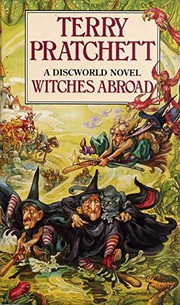
The will is the first joke. Desiderata Hollow, a witch from Lancre, dies and leaves Magrat Garlick a magic wand and a job: fairy godmother to a servant girl in Genua who must not marry the Duc. The letter says to go and not to bring Granny Weatherwax or Nanny Ogg. They come. That is the engine of Witches Abroad, the twelfth Discworld novel and the third Witches book. Pratchett published it in 1991; the Corgi paperback runs to 286 pages. It is a travelogue, a fairy-tale parody, and an argument about why people love stories.
A wand that only does pumpkins
Magrat inherits the wand but not the instructions. Every spell she attempts turns into a pumpkin. Fairy godmothering looks like wish fulfilment and is actually a craft with settings, tolerances, and a great deal of trial and error.
Emberella already has another fairy godmother, and Lady Lilith de Tempscire is not interested in sharing. She is the power behind the Duc, a ruler who is not quite what he appears to be, and she has arranged Genua so that the Cinderella pattern completes itself on Samedi Nuit Mort, the last night of carnival. Servant girl meets prince, slipper fits, wedding follows, everybody lives happily ever after.
Pratchett's Discworld runs on narrative causality. Stories are grooves worn into reality by repetition and belief, and enough people believing the shape of a tale makes the tale want to happen again. An evil witch who goes into an oven will die because that is the shape. Lily understands this better than anyone, and she has decided that the groove is a road and she is the one laying it. Granny understands it too, which is why she is uneasy from the start. She does not dislike stories. She dislikes what they do to the people inside them.
The road out of Lancre
The middle of the book is the journey, and it is deliberately episodic. The witches fly, walk, sail, and fall from one borrowed fairy tale into the next. In the dwarf mines they meet suspicious dwarfs and geological bread. On an underground river they meet a thin, grey, gurgling creature who climbs onto a log and announces that it is his birthday. It is a Gollum joke, complete with the hiss.
Then there is Überwald, where a village lives under a vampire. The vampire makes the mistake of turning into a bat near Greebo. Nanny Ogg's one-eyed tomcat is not a familiar in the helpful sense. He is a fat, scarred, unrepentant killer, and he eats the vampire in mid-air. The village is freed by a cat who does not understand the concept of a villain, only of prey. Later, Greebo is turned into a man for the ball, and the result is a swaggering, leather-clad, appallingly confident human with the manners of a tomcat.
The riverboat section is one of the best sustained set pieces. They travel down the Vieux River on a floating palace, Nanny gambles away the party's money and provisions, and Granny has to win it back at cards. Granny does not cheat, exactly. She plays as if the rules are a suggestion and the other players are furniture.
After the river there is a bull run, a wolf forced into the role of the Big Bad Wolf, and a farmhouse that drops out of a tornado onto Nanny's head. The house is a Wizard of Oz gag, and Nanny survives because her hat has willow reinforcement. The red boots are noticed. A group of dwarfs arrives to ask whether they can have them.
The wolf is where the comedy sharpens. Granny looks into his mind and finds a creature who has been remade by story, forced to be a monster, and wants it to stop. She gives him that. It is a small scene, easy to miss between the jokes, and it establishes what is at stake. Lily bends people into parts, and the parts do not care whether the people survive them. The road to Genua is a theme park of European folklore, except that the rides are real and the people on them cannot get off.
Genua, where the story is being kept
Genua is New Orleans with a Disney park grafted onto it, and Pratchett has fun with the mismatch. There is a swamp, a river, a carnival, a palace, and a great deal of food. There is also a police state run by a woman who believes that happiness can be enforced. The toymaker is arrested for not being jolly enough, for not whistling at his work, and for not telling stories to children. An innkeeper is in trouble for being thin. Citizens are expected to smile in the correct manner and play their assigned roles. Breaking character is punished with a cell, not a fine.
This is the book's best idea. A city where everyone must be happy is a city where nobody is allowed to be sad, and a city where nobody is allowed to be sad is a city where nobody is allowed to be honest.
The witches split up on arrival. Magrat goes to find Emberella. Granny and Nanny find Mrs Gogol, a voodoo witch who lives in a hut on duck legs in the swamp. Mrs Gogol smokes a pipe, cooks like a goddess, and keeps a zombie named Baron Saturday to do the heavy lifting. She also keeps Legba, a black rooster who is more than a rooster, and who is the only creature in the book that Greebo treats with caution.
Baron Saturday is the former ruler of Genua. He was killed by the Duc, or by the people behind the Duc, and Mrs Gogol brought him back. He is dignified, courteous, and dead, which makes him one of the more sensible characters in the novel. Ella, the servant girl, is their daughter, though she does not know it. She is practical, angry, and entirely uninterested in being rescued by a story. When Magrat meets her, Ella has already worked out that the two sisters watching the house are not her sisters at all. They are snakes, given human shape by Lily.
Two godmothers and one family secret
Lily is revealed as Granny's older sister, and the reveal lands because the book has been planting it since the first mirror. Lily Weatherwax left home at thirteen, after years of rows and canings, and went out into the world to make stories happen. She was the bad one, or she was treated as the bad one, which amounts to the same thing. She was vain, wilful, and fond of mirrors.
The name is a joke in two languages: Lilith de Tempscire sounds elegant and foreign, but Tempscire is a French rendering of Weatherwax.
Granny's resentment is the emotional centre of the novel. Because Lily was the bad one, Granny had to be the good one. She had to stay, behave, and be respectable, while Lily got the adventures and the husbands and the mirrors. Granny is not sorry about being good. She is furious that the choice was made for her by someone else's abdication. The line about having to be the good one turns a fairy-tale sibling rivalry into something recognisable: the responsible child watching the reckless one get all the stories.
Lily's magic comes from mirrors. One mirror can steal a soul; two facing each other can multiply the theft. She can step through reflective surfaces and watch people through them. The palace is full of glass, and Lily is always partly somewhere else, which makes her hard to confront and, in the end, easy to trap.
The plan to stop the ball is a mess. Magrat destroys the dress, Nanny gets the coachmen drunk, and Magrat turns the coach into a pumpkin. Lily turns it back, adding mice and footmen for good measure. The witches fly ahead, turn Greebo into a man, and send him to stop the coach. He does, joyfully, by attacking the horses and anyone else within reach. Ella escapes into the swamp, but she knows that if she misses the ball, Lily will come looking for her.
So Granny hypnotises Magrat into taking Ella's place. Magrat is nervous, self-doubting, and convinced that everyone can see through her. Under hypnosis she becomes calm and dangerously convincing. The glass slippers do not fit, which is the first sign that the story is being run on props rather than truth.
The ball, the slipper, and the frog
The ball is the best-constructed sequence in the book. Nanny and Granny steal clothes from guests, Nanny meets Casanunda, and Granny dances with a colonel who tries to lead and quickly learns better. Casanunda is a dwarf, a soldier of fortune, and the Disc's second-greatest lover. He is also a liar, and cheerfully admits it. When Nanny asks whether that is true, he says no. He carries a stepladder and pursues her with cheerful persistence.
Magrat dances with the Duc and is nearly lost. The story is working on her. The Duc is handsome, attentive, and wearing dark glasses. Granny knows the shape cannot be broken until midnight, so Nanny and Casanunda climb the clock tower and speed up the mechanism. The clock strikes twelve. Magrat comes out of the trance, sees the Duc's eyes, and runs. She loses a slipper on the stairs. The Duc picks it up.
Granny smashes the slipper. It is a wonderful piece of applied headology: if the story needs the shoe, remove the shoe. But there is a second slipper, and the Duc has it, and Lily is not stupid. The witches are caught and thrown into a dungeon. Nanny tries the remaining slipper on and finds that it fits her perfectly, which proves that the glass-slipper test is a con. A story that can fit two women was never about destiny. It was about casting.
The rescue comes from Casanunda, Legba, and Baron Saturday, who makes a hole in the wall because he is dead and has stopped being polite. They return to the ball. Baron Saturday arrives in his top hat and tailcoat, and the room goes quiet. The Duc orders him killed. Lily throws magic at the Baron and it does nothing, because he is powered by something older than her arrangements. She panics and pulls all her magic back into herself, which releases the spell holding the Duc in human form. He becomes a frog. Baron Saturday steps on him.
That is the end of the Cinderella plot. The prince is a frog, the glass slipper is a prop, and the happy ending is a squashed amphibian on a ballroom floor. Lily runs. Mrs Gogol wants to kill her and produces a voodoo doll. Granny refuses to let her. This is family, and Granny will deal with it herself. Mrs Gogol stabs the doll. Granny puts her arm into a burning torch. The doll catches fire. It is a contest of belief, and Granny wins by being willing to burn herself.
Then she goes after Lily.
The mirror and the long way home
Lily is waiting in a room full of mirrors. She threatens Nanny and Magrat, and tells Granny to admit that she has won and let her start again. Granny says she has won. Then she steps off the parapet. It looks like a surrender and a suicide. It is neither. It is a trick to make Lily think the fight is over, and to get Nanny and Magrat away from the confrontation.
The real confrontation is between two sisters and a sheet of glass. Granny breaks a mirror. The symmetry Lily has built her power on collapses. The other mirror reaches for Lily and pulls her in. Granny grabs for her and cuts her arms to ribbons on the broken glass. Nanny and Magrat find her bleeding on the floor, which is the closest the book comes to letting Granny be simply human.
Inside the mirror world, both sisters are surrounded by infinite reflections. Death arrives, because Death always arrives, and explains the rule: each of them can leave when she finds the reflection that is real. Lily cannot choose. She has spent her life becoming roles, titles, and other people's stories, and there is no single Lily left to point at. Granny looks at herself, taps her chest, and says, in effect, this one. She knows which woman is real because she has never pretended to be anyone else. Lily stays in the glass, searching.
That is a better ending than a duel. Lily is not killed. She is imprisoned in the thing she used to escape herself. The punishment fits the crime, and it is sad rather than triumphant.
The aftermath is brisk. Ella is Baron Saturday's daughter and therefore the rightful ruler of Genua. She becomes Duchess, and her first act is to cancel the ball and go to the carnival. Baron Saturday is claimed by Death. Mrs Gogol goes back to her swamp. Magrat throws the wand into the water.
Granny finally shows Magrat how the wand works: there are dials on the side. It was never about wishing hard enough. It was about technique, practice, and knowing which setting does what. Magrat throws it away anyway. The witches go home the long way, so they can see the elephant.
What works and what creaks
Witches Abroad is one of the best-loved Witches books, and it is easy to see why. Granny and Nanny are at their best abroad, because foreignness gives them something to push against. Nanny's cheerfully terrible attempts at foreign languages, Granny's refusal to be impressed by anything, and Magrat's attempts to be a grown-up while being treated like a child are reliable comic engines. The mirror ending is one of Pratchett's cleanest pieces of image-making.
It also creaks. The first two-thirds are a travelogue, and the travelogue is episodic by design. Some stops are stronger than others, and the Genua plot does not properly start until the last hundred pages. If you want a tight mystery or a plot that clicks into place, this is not that book. It is a series of riffs with a destination, and the riffs are funnier than the destination is surprising.
Lily is the bigger problem. She is a wonderful image (the elegant godmother, the mirror maze, the foreign name that is just Weatherwax in a dress) but a thin character. We learn what she does and what she wants, and almost nothing about what it felt like to be her. The book is so interested in Granny's resentment that Lily becomes the occasion for it rather than a person in her own right.
The running joke about Magrat being a wet hen also wears. It is funny the first dozen times, and then it starts to feel like the book agrees with Granny. Magrat gets moments of competence, but she spends a lot of the novel being managed, hypnotised, or told she is not ready. Her choice to throw the wand away is a real decision, but the narrative has spent so long belittling her that it feels less like growth than resignation.
None of that stopped me enjoying it. The best way to read Witches Abroad is as a holiday book about the stories people take with them when they travel, and the ones they impose on the places they visit. It is not the tightest Discworld novel, and it is not the one to hand a newcomer who wants plot. It is the one to hand someone who has already met Granny and wants to see what happens when she meets a story she cannot bully, a sister she cannot forgive, and a mirror that will not show her anything she does not already know.
FAQ
Do I need to read the earlier Discworld novels first?
No. Witches Abroad is the third book about Granny, Nanny, and Magrat, but it stands alone and explains what you need. It does help to know the witches already, since much of the pleasure is watching them bounce off each other.
Is Witches Abroad a direct Cinderella retelling?
It uses Cinderella as its main frame, but it also pulls in The Wizard of Oz, Little Red Riding Hood, and a dozen other stories. The point is how those patterns force people into roles.
Why is the book called Witches Abroad?
Most of it takes place outside Lancre, as the witches travel to Genua. Pratchett uses the journey to parody how stories and folklore travel between cultures.
Similar books
More from Discworld first, then related titles.
The Color of Magic
A failed wizard guides a tourist across a flat world on a turtle, with comic fantasy chaos.
2,032-word summary · 9 min read
The Light Fantastic
Rincewind and Twoflower fall off the world while wizards race a red star.
1,974-word summary · 9 min read
Equal Rites
A dying wizard passes his staff to a baby girl, and Granny Weatherwax escorts Esk to Unseen University in Pratchett's third Discworld book.
2,871-word summary · 13 min read
Mort
Death hires apprentice Mort in this 1987 Discworld comedy, where a spared princess splits reality and duty bends for love, with no Rincewind.
2,386-word summary · 11 min read
Sourcery
A dying wizard hides his soul in a staff, his eighth son becomes a sourcerer strong enough to break the world, and Rincewind is sent to stop him with a sock.…
2,404-word summary · 11 min read
Wyrd Sisters
Three Lancre witches rescue a murdered king's baby, hide Lancre's future, and trap a guilty duke with a play in Ankh-Morpork.
3,085-word summary · 14 min read
Guards! Guards!
A drunk captain, his last two guards, and an earnest recruit face a summoned dragon in Ankh-Morpork in Pratchett's funny eighth Discworld book.
2,307-word summary · 10 min read
Reaper Man
Death gets fired and farms while Windle Poons refuses to die.
2,579-word summary · 11 min read
Small Gods
God Om trapped as a tortoise must convince novice Brutha to save Omnia from its own church.
2,063-word summary · 9 min read
Men at Arms
The City Watch gets new recruits and a murder case when the Disc's only handgun turns up in Ankh-Morpork, in the fifteenth Discworld novel.
2,216-word summary · 10 min read
Hogfather
Death fills in for a missing Father Christmas, Susan Sto Helit hunts the Hogfather, and the twentieth Discworld novel turns Santa into a management problem.
2,871-word summary · 13 min read
Night Watch
Vimes is thrown back in time and must train his young self through a revolution.
2,003-word summary · 9 min read
The Wee Free Men
Nine-year-old Tiffany Aching teams with the Nac Mac Feegle to rescue her brother from the Fairy Queen.
2,600-word summary · 12 min read
Going Postal
A hanged con artist must revive Ankh-Morpork's dead Post Office and outwit a murderous rival in Pratchett's 33rd Discworld novel.
2,228-word summary · 10 min read
Nettle & Bone
Marra, a princess in a convent, leaves to save her abused sister, but first she must finish three impossible tasks: a bone dog, a nettle cloak, moonlight in a…
2,061-word summary · 9 min read

The Blinding Knife
Kip trains to join the Blackguard while the Prism hides his true identity, loses his colors, and fights a war against a rogue drafter who wants to birth a god.
2,049-word summary · 9 min read

Inkdeath
The final Inkworld novel sends Mo into the land of the dead, leaves Meggie choosing between two boys, and ends the Adderhead's immortality with three written…
2,062-word summary · 9 min read
Dawnshard
Rysn sails toward forbidden Akinah to save her dying larkin and finds a Dawnshard guarded by the Sleepless.
3,229-word summary · 14 min read

The Field Guide
Three siblings move into a creepy Maine estate, anger a brownie, and find a forbidden guide to the fairy world in the first Spiderwick book.
2,033-word summary · 9 min read
The Once and Future Witches
Three estranged sisters bring witchcraft back to an 1893 city where magic hides in nursery rhymes and the fight for the vote is also a fight for power.
2,132-word summary · 9 min read

Secrets of the Dragon Sanctuary
Kendra is replaced by a plant copy and held by the Society, while Seth steals a unicorn horn so the family can enter a dragon sanctuary.
2,590-word summary · 12 min read

Lioness Rampant
Alanna searches for the Dominion Jewel with the Shang Dragon, then returns to Tortall to face Duke Roger at Jonathan's coronation.
2,478-word summary · 11 min read
The Time Paradox
When his mother falls ill with a fairy disease, Artemis Fowl travels back in time to find the extinct lemur that can cure her and confronts his younger self.
2,601-word summary · 12 min read

The Golem's Eye
Two years after The Amulet of Samarkand, Nathaniel is a rising bureaucrat, Bartimaeus is his unwilling servant again, and something made of clay is tearing…
2,299-word summary · 10 min read

Magician's Gambit
Garion and his companions cross haunted Maragor and the caves beneath Rak Cthol to recover the Orb of Aldur.
2,391-word summary · 11 min read

Homeland
Drizzt Do'Urden is born into the cruel drow city of Menzoberranzan, where his father teaches him to fight and to doubt everything his family believes.
2,303-word summary · 10 min read
Enchanters' End Game
Garion marches toward Torak while Ce'Nedra leads the West's army in the final Belgariad volume, where prophecy and war meet.
2,557-word summary · 11 min read

Grip of the Shadow Plague
A plague turns Fablehaven's creatures of light into shadows while Kendra hunts an artifact in Arizona and Seth races to find the cause.
2,131-word summary · 9 min read

The Rose & the Dagger
Shahrzad is pulled from her Caliph husband and left in a desert camp of rebels, needing to break his curse and end a war before it ends her.
2,520-word summary · 11 min read

The Queen of the Tearling
Nineteen-year-old Kelsea leaves the woods to take her throne, ends a shipment of human captives, and draws the Red Queen's revenge.
2,357-word summary · 10 min read