
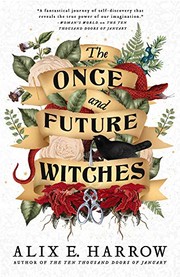
The Once and Future Witches
2,132-word summary 9 min read 528 pages in the book
- First published
- 2020
- Publisher
- Redhook
- Pages
- 528
- ISBN
- 9780316422048
Reading options
What's inside (10 sections)
I picked this up expecting a cozy story about witches and suffrage and got something with teeth. Alix E. Harrow's second novel, published by Redhook in 2020, is set in an 1893 America where magic is real, illegal, and mostly the property of women who have learned to hide it in nursery rhymes. It is a big book, 528 pages in the hardcover, and it is angry in a way that sneaks up on you. The first hundred pages feel like a fairy tale. By the end, people are burning.
Three sisters and a tower
The Eastwood sisters have not spoken in seven years. Agnes Amaranth, the middle sister, works at a cotton mill in New Salem and is pregnant by a man who wants to marry her. Beatrice Belladonna, the eldest, is a librarian at Salem College, quietly brilliant and quietly miserable. James Juniper, the youngest, arrives in town at seventeen with a limp, a dead father, and a murder charge hanging over her. She is also the one who still believes the old stories.
The sisters were raised by their grandmother, Mama Mags, who taught them that magic has three parts: the will, the words, and the way. The will is desire. The words are the spell. The way is the shape you give it, a gesture, an herb, a fire. When Mama Mags died, the sisters scattered. Agnes stayed and tried to be respectable. Bella buried herself in books. Juniper ran.
Then Bella finds a strange verse in a first edition of Grimm and whispers it in St. George's Square. A black tower rises out of the ground. The sisters are reunited whether they like it or not, and the town notices.
That tower is the novel's central image. It is a reminder that the witches were not wiped out, only pushed underground. Their magic survives in the rhymes children chant while skipping rope, in the stories mothers tell to keep daughters close, in the parts of women's lives that men have decided are not important. Harrow is not subtle about this. She wants you to see the nursery rhyme as a survival strategy.
The sisters' childhood is the wound under the story. Their father was violent. Juniper killed him, or believes she did, and the novel takes its time revealing what actually happened in the barn the night the sisters scattered. Agnes left to build a respectable life and has been punishing herself for it ever since. Bella left to become a scholar and has been hiding in other people's books. None of them escaped cleanly. The magic they inherited from Mama Mags is tied to that house, that fire, and that father, which is why the reunion is so volatile. They are not just estranged sisters. They are three different attempts to survive the same man.
Harrow structures the book around the Maiden, the Mother, and the Crone, and she assigns each sister a role that fits and chafes at once. Juniper is the Maiden, reckless and furious. Agnes is the Mother, pregnant and practical. Bella is the Crone, though she is too young for the label, because she is the one who reads and remembers. The roles are a spell and a cage, and the novel's best emotional work comes from the sisters refusing to stay inside them.
The will, the words, and the way
The magic system is one of the book's great pleasures. Spells are built from ordinary domestic things: a pinch of salt, a braided cord, a rhyme with the right rhythm. The sisters each have a different relationship to it. Agnes is practical and precise. Bella is scholarly and hungry. Juniper is reckless and full of raw power. When they work together, they are stronger than any of them alone, which is the thesis of the novel in one sentence.
Harrow uses the history of American witchcraft and the history of the women's suffrage movement as the same story. New Salem is a city where women are expected to be grateful for small freedoms and where the men who run things are terrified of women gathering. The suffrage meetings are held in church basements and parlors. The witches meet in the same rooms. The novel keeps blurring the line between political organizing and spellcasting, and that blur is the point.
The villain is Gideon Hill, a charming politician who wants to be mayor and then something more. He is not a cartoon. He is patient, well dressed, and very good at making women feel that their anger is the problem. He also has a secret that the sisters uncover slowly. The city's founding story, the one about the Last Three witches who were burned at Avalon, is not the whole truth. Hill was there. He has been there for a very long time.
Building a movement
The middle of the novel is about coalition. Juniper joins the suffragists and immediately gets them thrown out of their own meeting for insisting that witchcraft and the vote are the same fight. The sisters form the Sisters of Avalon, a small coven that grows into something larger. They meet Jennie Lind, a labor organizer, and Cleopatra Quinn, a Black journalist whose family history goes back to Tituba.
Cleo is one of the best characters in the book. She is smart, guarded, and funny, and her relationship with Bella is the emotional center of the second half. Harrow does not treat race as a side note. Cleo's magic comes from a different tradition, and the white suffragists are not sure they want her in the room. The novel is honest about the ways the suffrage movement excluded Black women, even as it imagines a version of the movement that could be better.
The set pieces in this stretch are wonderful. The sisters turn a statue of St. George into a bronze pig. They grow a golden apple tree in a graveyard. They fill a factory with vines. Each act is a piece of political theater and a piece of magic, and the city reacts like a city would, with gossip, panic, and violence. Harrow has a gift for the image that is both beautiful and a little ridiculous, and she knows it.
The prose is lush. Too lush for some readers, I suspect. Harrow loves a sentence that curls, and she loves a list of three things, and she returns to certain phrases (the will, the words, the way) often enough that they become a refrain. I liked the music of it. I also skimmed a few paragraphs in the middle when the sisters were explaining their feelings to each other again.
Avalon and the truth about Hill
The last third is where the fairy tale turns into a thriller. The sisters perform a ritual in three locations at once. Bella, as the Crone, works in Old Salem. Agnes, as the Mother, works in New Salem. Juniper, as the Maiden, works in the Deeps, the underground prison where the city keeps its inconvenient women. They use crone's tears, mother's milk, and maiden's blood. The tower of Avalon returns, and the sisters finally learn what happened to the witches who were burned.
The answer is worse than they expected. Gideon Hill is George of Hyll, a witch who betrayed his own people and has been hopping from body to body for centuries. He did not destroy the witches because he hated magic. He destroyed them because he wanted to own it. He has been stealing women's power, and their wills, for generations. The novel's politics become very literal here. The villain is not just a man who wants to be mayor. He is the system that keeps taking women's labor and calling it his own.
Hill wins the election anyway. He institutes witch trials. He kidnaps Agnes's daughter, Eve, who is born in the middle of the chaos and who is the most powerful thing in the book. The sisters have to decide what they are willing to burn to get her back. Agnes confronts Hill in City Hall and stabs at his eye. Her hawk familiar, Pan, claws his face. It is the first proof that he can be hurt.
The climax is a public execution that becomes a riot. The sisters are tied to a scaffold. August Lee, Agnes's friend and the woman she loves, uses a water spell to keep the fire from touching them. The crowd joins in. Women in pointed hats put the guards to sleep, rust the chains, and free the prisoners. Bella's light spell spreads through the crowd. Hill's stolen shadows go back to their owners, and his withered true body is exposed. Grace Wiggin, the daughter he adopted and used, strangles him with her sash.
The fire and the baby
The final sacrifice is Juniper's. Hill's soul tries to jump into Eve, and Juniper catches it. She binds it to herself, climbs back into the pyre, and speaks the unbinding spell. Her crow, Corvus, finishes the words as she dies. It is a gorgeous, terrible scene, and it earns the book's length. The sisters have spent the whole novel trying to protect each other, and Juniper's choice is the one act of protection that none of them can argue with.
Then Harrow does something I did not expect. She brings Juniper back. Bella uses a rose-petal ring from Cleo, and the witches chant a version of "Ring around the roses" that turns the old plague rhyme into a resurrection spell. Juniper returns, changed. She does not need food or sleep. She is tied to Avalon now. The epilogue, set a year later, scatters the sisters: Agnes and August raising Eve in Chicago, Bella and Cleo in New Orleans, Juniper back at the family farm teaching magic to women who need it.
I have seen readers complain that the resurrection undercuts the sacrifice. I understand the complaint. I also think Harrow knows what she is doing. The book is called The Once and Future Witches. It is a story about women who refuse to stay dead, who pass their magic down, who come back in rhymes and stories and daughters. Juniper's return is not a cheat. It is the thesis.
What the book is angry about
The anger is the best thing in it. Harrow is furious about the way women's knowledge has been dismissed as superstition, about the way labor is extracted and credit stolen, about the way the suffrage movement sold out Black women, about the way men like Hill can smile while taking everything. The fantasy lets her make those arguments without a lecture. When a woman whispers a nursery rhyme and a tower rises, the metaphor is not hidden. It is the whole point.
The novel is also about sisters, in the literal and the political sense. The Eastwood sisters spend years hurting each other because they were taught to compete for scarce love. The coven they build is an alternative to that scarcity. It says that power is not a pie. It can be shared. That is a simple idea, and the book makes it feel hard won.
The limits
It is too long. The middle sags. The villain's exposition goes on. Some of the sisterly arguments repeat the same beat: one sister withholds something, another feels betrayed, they reconcile, then do it again. Harrow's prose is beautiful, but it can also be relentless, and a few chapters could lose ten pages each without hurting the story.
The history is more feeling than fact. Real suffragists were not witches, and the book knows that, but it flattens some of the differences between the fight for the vote and the fight for magic. Readers who want a rigorous historical novel will be frustrated. Readers who want a myth about why the fight mattered will be satisfied.
Should you read it
If you liked The Ten Thousand Doors of January, this is bigger and angrier and more uneven. If you like historical fantasy with a strong voice and a clear politics, it is one of the best examples of the form. If you want something fast and light, it is not that. It is a doorstop with a heart.
I would read it for the sisters, for Cleo and Bella, for the image of a black tower growing in a town square, and for the ending, which is one of the few fantasy climaxes I have read that actually feels like a crowd. It is a book about who gets to tell the story, and it is not shy about grabbing the pen. I closed it wanting to read a history of the suffrage movement, which is probably the highest compliment I can pay a fantasy novel.
FAQ
Is The Once and Future Witches part of a series?
No. It is a standalone novel, though Alix E. Harrow's earlier book The Ten Thousand Doors of January shares its interest in stories and portals.
What is the magic system based on?
Spells need the will, the words, and the way. The words often come from nursery rhymes and fairy tales, which is how women passed magic down while it was illegal.
Does the book deal with racism and queer relationships?
Yes. Cleopatra Quinn is a Black journalist whose magic comes from Tituba's tradition, and her relationship with Bella is central. The novel also criticizes the suffrage movement's exclusion of Black women.
Similar books
Ariadne
A Cretan princess helps Theseus kill the Minotaur, is abandoned on Naxos, and rebuilds her life while her sister faces tragedy in Athens.
2,350-word summary · 10 min read
Witches Abroad
Three Lancre witches fly to Genua to stop a fairy godmother from forcing a servant girl into a storybook marriage, and find a city arranged around a happy…
2,651-word summary · 12 min read
Nettle & Bone
Marra, a princess in a convent, leaves to save her abused sister, but first she must finish three impossible tasks: a bone dog, a nettle cloak, moonlight in a…
2,061-word summary · 9 min read
The Girl in the Tower
Vasya rides out disguised as a boy, rescues kidnapped girls, and rejoins her siblings in Moscow, where a hidden sorcerer and the Grand Prince's court close in.
2,801-word summary · 12 min read

The Indigo Spell
Sydney Sage hunts an aging witch, learns forbidden magic, and finally admits she loves Adrian, while the Alchemist tattoo on her cheek may be controlling her.
2,604-word summary · 12 min read
The Girl Who Drank the Moon
A witch who secretly rescues the town's sacrificed babies accidentally enmagicks one with moonlight, and the girl grows up with a power she cannot name.
2,078-word summary · 9 min read

Rebel Angels
Gemma returns to the realms to bind magic while facing Circe and London season.
2,708-word summary · 12 min read
Three Dark Crowns
Three triplet queens must kill each other for the crown, but love and gifts get in the way.
2,134-word summary · 9 min read
Wyrd Sisters
Three Lancre witches rescue a murdered king's baby, hide Lancre's future, and trap a guilty duke with a play in Ankh-Morpork.
3,085-word summary · 14 min read
The Rules of Magic
Franny, Jet, and Vincent Owens test strict family rules and a love curse in 1960s Manhattan and Massachusetts in Alice Hoffman's warm prequel about love, loss,…
2,686-word summary · 12 min read
The Golem and the Jinni
A clay woman and a fire spirit hide in 1899 New York, passing as immigrants while their makers' pasts close in.
2,726-word summary · 12 min read
Dead Witch Walking
Witch and runner Rachel Morgan quits the agency with a death mark on her head and hunts an untouchable crime lord.
2,709-word summary · 12 min read
Blood & Honey
Married witch Lou and hunter Reid flee church and coven while dark magic tempts Lou to save them.
2,280-word summary · 10 min read
Practical Magic
Orphaned sisters Sally and Gillian Owens flee magic and love, until Gillian returns with a dead boyfriend and Sally must face the family curse.
2,974-word summary · 13 min read
Equal Rites
A dying wizard passes his staff to a baby girl, and Granny Weatherwax escorts Esk to Unseen University in Pratchett's third Discworld book.
2,871-word summary · 13 min read
Warbreaker
Two princesses trade places in an arranged marriage to a god king, while a mercenary chases a sentient sword.
2,043-word summary · 9 min read
A Great and Terrible Beauty
Sent to a Victorian boarding school after her mother death, Gemma finds a magic realm tied to it.
2,016-word summary · 9 min read
Jonathan Strange and Mr Norrell
Two magicians bring magic back to Napoleonic England, one by books and one by daring.
2,067-word summary · 9 min read
The Invention of Wings
Sarah Grimke and enslaved Handful grow up bound in Charleston, then push toward freedom and abolition.
2,996-word summary · 13 min read
Caraval
Sisters Scarlett and Tella enter the game Caraval to escape a cruel father, where truth and show blur.
2,033-word summary · 9 min read
The Ten Thousand Doors of January
A ward in a mansion finds a book about doors to other worlds that turns out to be her own family history.
2,573-word summary · 11 min read
The Blinding Knife
Kip trains to join the Blackguard while the Prism hides his true identity, loses his colors, and fights a war against a rogue drafter who wants to birth a god.
2,049-word summary · 9 min read

Inkdeath
The final Inkworld novel sends Mo into the land of the dead, leaves Meggie choosing between two boys, and ends the Adderhead's immortality with three written…
2,062-word summary · 9 min read
Hounded
A two-thousand-year-old druid runs a bookshop in Arizona, hides from an Irish god who wants his sword back, and talks to his dog.
2,159-word summary · 10 min read
Dawnshard
Rysn sails toward forbidden Akinah to save her dying larkin and finds a Dawnshard guarded by the Sleepless.
3,229-word summary · 14 min read

The Shadow Sister
Star D'Apliese steps out of her sister's shadow and follows a bookshop clue into the Edwardian life of Flora MacNichol, a woman who gave up love for duty.
2,260-word summary · 10 min read

The Field Guide
Three siblings move into a creepy Maine estate, anger a brownie, and find a forbidden guide to the fairy world in the first Spiderwick book.
2,033-word summary · 9 min read
Magic Burns
A magic flare hits Atlanta, and mercenary Kate Daniels must recover stolen maps, find a missing witch, and keep a teenage girl alive while Celtic gods try to…
2,021-word summary · 9 min read

Little Town on the Prairie
In the spring after the Long Winter, fifteen-year-old Laura sews shirts, studies for a teaching certificate, and helps send her blind sister Mary to college.
2,071-word summary · 9 min read
Year One
A plague released in Scotland kills most of humanity, and the survivors discover magic, build a town, and wait for a child who may save them.
2,029-word summary · 9 min read