
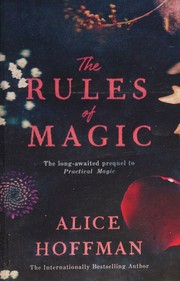
The Rules of Magic
2,686-word summary 12 min read 384 pages in the book
- First published
- 2017
- Publisher
- Scribner
- Pages
- 384
- ISBN
- 9781471157684
- Series
- Practical Magic
Reading options
What's inside (8 sections)
I met the Owens aunts backwards. I saw Practical Magic first, the 1995 novel by Alice Hoffman where Sally and Gillian grow up with Frances and Jet watching from the kitchen, and I always wondered how those two sharp, kind, odd women got to be that way. When a friend handed me The Rules of Magic, the prequel that tells their youth, I read it in two sittings on a rainy weekend. Alice Hoffman published it as a prequel to Practical Magic (1995). The first edition came out Oct 2017 from Scribner and runs 384 pages with ISBN 9781471157684. It follows Franny, Jet, and Vincent Owens through the 1960s, from a small Massachusetts town to Manhattan and back, as they test a family curse that says love will doom any Owens who feels it fully.
The curse hangs over every page without needing much explanation. An ancestor named Maria Owens, left and shamed long ago, set words in motion that still bind her kin. If an Owens truly loves, the beloved will die. Or so the family believes. Their mother Susanna tries to protect them with rules posted like kitchen law. No walking in moonlight. No red shoes. No candles. No brooms. No love. The children hear the rules as both warning and dare. I liked that Hoffman never treats the curse as a puzzle to solve. It is weather. You live under it. You decide whether to go out in rain.
What pulled me in first was how normal the siblings feel inside a magical house. Franny, the eldest girl, is practical and watchful. Jet, younger, is soft voiced and tender toward stray things. Vincent, the boy, is restless and loud and hungry for music and attention. They share a bedroom wall, a backyard, and a mother who loves them but fears their blood. Susanna keeps them apart from other children, keeps a garden of herbs, keeps letters she does not send. The town keeps its distance in return. Owens children mean trouble, people say, and mothers pull their kids closer on the sidewalk.
The house with rules on the wall
The opening chapters stay home, and they are my favorite for texture. Susanna Owens runs a tight house in Massachusetts in the early 1960s. Breakfast is plain. Clothes are mended. The rules are recited until Franny can say them backwards. Do not fall in love. Do not use your gifts to meddle. Do not tell outsiders what you hear in the walls. The house itself seems to listen. Floorboards creak at night. Moths gather at windows. A garden grows things out of season when feelings run high.
Franny tests limits first because she is oldest and most responsible. She reads her mother's books when Susanna is out. She tries small spells and then pretends she did not. Jet follows, quieter, braiding string and talking to birds and stray cats. Vincent performs, drumming on tables, singing too loud, bringing home friends Susanna sends away. One afternoon scene stuck with me. The three sit on the porch while rain starts, and Jet names each bird that lands on the wire while Vincent makes up words for their songs and Franny pretends not to smile. You feel how much they love each other before love becomes dangerous.
Susanna's fear makes sense once Hoffman shows her past. She married, she lost, she blames the curse and her own wanting. She would rather her children be lonely than grieving. She sends Franny away partly to save her, partly because she does not know how to keep a strong girl home. When the siblings finally leave for Manhattan to stay with an uncle, it feels less like escape and more like being pushed out of a nest too early. They pack light. They carry the rules in their heads even as they plan to break them.
Franny in the city
Manhattan in the 1960s hits like cold water. Hoffman writes the Village with shop bells, basement clubs, crowded stoops, and late subways. Franny finds work, finds a room with thin walls, learns to walk fast and look straight ahead. She tells herself she will study, stay careful, avoid attachment. Then she meets a young man in her orbit, kind and curious, who likes how direct she is. He is not from her world. He does not know about curses or herbs or moths at windows. He just likes coffee with her after shifts and walking her home through streets that smell of rain and trash and flowers from a corner stand.
Their love story is plain on purpose, and that plainness makes the curse ache. They cook in a tiny kitchen. He leaves notes. She mends his coat. She tries to keep one foot back, to love a little less, to follow her mother's rule in secret while breaking it in daylight. Hoffman does not give them grand speeches. She gives them dishes and bus rides and a borrowed record player. When illness or accident brushes them, Franny panics and pulls away, then rushes back. I held my breath through these pages because I knew the family story. Any Owens love story comes with a shadow.
Franny also learns craft in the city in a less romantic way. She meets older women who know herbs and hands, who teach her what her mother withheld. How to listen before acting. How to clean a room after grief. How to say no to a customer who wants a spell to force love. Franny is good at this work because she is honest about cost. One customer scene where Franny refuses to tie two people together, even for cash she needs, shows who she will become later as an aunt. She will be the one who tells Sally and Gillian the truth straight, even when they do not want it.
A short paragraph to mark time. Franny chooses love anyway.
Then she pays in the way Owens women always fear. I will not detail the loss beat by beat because Hoffman writes it sparely and it lands harder that way. What matters is what Franny does after. She does not curse love itself. She grieves, she hardens a little, she learns to keep living in a city that does not pause. She writes to Jet in careful lines that hide more than they say. She keeps the apartment clean. She keeps going to work. That endurance becomes the spine of the later aunts.
Jet and the boy who stays kind
Jet's story broke my heart more quietly. Where Franny is flint, Jet is water. She loves animals, stray people, sad songs. In Manhattan she meets a young man who is steady and funny, who does not flinch at her odd family talk. He brings her soup when she is sick. He waits while she feeds pigeons. He learns her siblings' names and uses them right. Their courtship has no tricks. Long walks. Library afternoons. A shared umbrella that is really too small.
Hoffman lets Jet be fully herself here, which I loved. Jet cries easily and does not apologize for it. She talks to moths and means it. She tells fortunes for friends and refuses payment when the news is bad. Her gifts run toward care rather than power. She senses fevers before thermometers do. She knows when Vincent is lying by the sound of his step on stairs. The boy who loves her sees this and does not call it strange. He calls it Jet.
The curse presses on them differently than on Franny. Jet knows the story by heart and tries to love carefully, to keep distance inside closeness. It does not work. Love fills rooms. One night after a scare at a hospital, Jet sits up counting breaths while her love sleeps, trying to bargain with whatever listens. If I am good, she thinks, if I am useful, if I do not ask for more. Hoffman writes that kind of bargaining with clear eyes. Many of us have done it at 2 a.m. beside someone we fear losing.
Jet's loss, when it comes, is not loud. It is a phone call, a waiting room, a coat left on a chair. She folds the coat. She keeps it. She does not scream in the street. She goes back to the apartment and washes cups. Her grief stays in her body for a long time after. Headaches. Tired blood. A reluctance to go out after dark. Vincent tries to joke her back, and she smiles because she loves him, but the smile does not reach her eyes for months. This is the Jet who will later sit in a Massachusetts kitchen with Franny, finishing sentences, guarding Sally and Gillian without smothering them. You see the making of her here.
Vincent and the song that spends
Vincent Owens could have carried his own novel, and sometimes I wished Hoffman had given him more room. He is the youngest, the only boy, handsome and wild, hungry to be loved loudly. In the Village he finds music, late nights, boys and girls who adore him, older men who promise gigs and introductions. He plays, he sings, he charms doormen and waitresses. He also lies when truth would cost him a night out, borrows money he does not return fast, and uses small magic to smooth paths.
Hoffman does not excuse him, but she understands him. Vincent grew up watched with suspicion in a small town. In the city, being wanted feels like air after holding breath. He falls quickly and often. One lover teaches him chords. Another gives him a place to crash. Another sees through him and stays anyway for a while. Vincent wants to be good. He calls home. He sends Jet records. He carries Franny's groceries without being asked when he visits. Then he disappears for three days because a club owner offered a set and a couch and a promise.
Trouble finds him the way it finds charming boys who mix gifts with appetite. A spell to help a friend backfires. A jealous lover talks. A night ends with police lights or a slammed door. Vincent's magic is stronger than his sisters in raw force and weaker in control. He can call wind and stir crowds, but he cannot clean up after. One ugly scene in an alley, all shouting and broken glass, shows the edge Hoffman keeps blunt elsewhere. Vincent is not cruel. He is careless with power in a world that punishes carelessness.
His relationship with his sisters stays the tender thread. Franny scolds him and slips him cash. Jet forgives him faster than he deserves and tells him so. Late in his city stretch, Vincent sits on a fire escape with Jet, both sleepless, and admits he is scared he will never be more than fun for a night. Jet tells him he is more when he stays for breakfast and washes the pan. It is small advice. He tries to follow it. Sometimes he manages. Often he does not. That uneven trying feels true to a nineteen year old with talent and no guardrails.
Becoming the aunts
The last third brings them home, and home is where the book earns its title. The rules of magic, as Hoffman finally states them, are not about herbs or moon phases. They are about conduct. Do as you will, but harm no one. Love asks for courage, not control. Gifts require care. These sound simple on a poster. They cost years to learn.
Susanna's death or absence, which I will leave unspoiled in detail, forces Franny and Jet to decide what kind of Owens women they will be. They return to the Massachusetts house with its creaks and garden and town gossip. They clean. They paint. They take in needy neighbors even when neighbors whisper. Vincent comes and goes, bringing music and mess and love. The sisters learn to set boundaries without shutting doors. They will not force love with spells. They will not use knowledge to punish. They will tell the truth about cost.
This is where future Practical Magic readers will nod. Franny becomes the sharper aunt, direct, funny, no nonsense about dishes or men. Jet becomes the softer aunt, tending moths and gardens, speaking gently to frightened girls. Together they make a home that Sally and Gillian will later flee and then need. Hoffman plants those seeds without winking too hard. A neighbor child left on the porch. A kettle always on. A spare bed made up. A rule spoken once, then lived.
The curse does not lift with a snap. Hoffman is too wise for that. What changes is how the siblings carry it. Franny loves again, carefully, with eyes open. Jet loves in memory and in small daily devotions, and later in ways the book leaves tenderly open. Vincent loves many and learns, slowly, to stay longer and lie less. The family stops trying to outrun doom by refusing love altogether. They accept that love includes loss, and that a curse only wins if fear makes all choices. The final pages in the garden, with sisters side by side and Vincent's music faint from a window, gave me the same ache as the end of Practical Magic. Not triumph. Continuance.
What thins and what warms
Honest criticism first, because 384 pages moves fast and sometimes too fast. This is an episodic book by design, childhood then Franny then Jet then Vincent then home, and some episodes get more air than others. Franny's city love gets full rooms and seasons. Jet's gets a shorter, sadder arc that left me wanting one more happy month before loss, just to feel the weight of what fades. Vincent's stretch speeds through lovers and gigs in montages where names blur. I mixed up two of his friends and had to flip back. A slightly longer middle would have let his charm and damage breathe.
The men, as lovers, can feel thin on purpose yet still thin. Franny's love is kind and steady but drawn in few strokes. Jet's love is kindness itself with little past. Vincent's lovers blur into types. Hoffman centers the siblings, so this is a choice, not an accident. Still, when the curse takes, grief hits harder if we know the lost person as more than goodness. I felt Franny's loss through Franny, not through missing the man himself. Same with Jet. That works emotionally but leaves the romances less memorable than the sister bond.
Stakes also stay cozy by intent, and readers who want high peril may find the middle soft. No battles. No trials. The worst harms are illness, accident, gossip, and self inflicted magical messes. Spells go wrong, but houses do not burn every chapter. For me the softness fits a family saga about daily conduct, yet I skimmed a few herb gathering passages that repeated earlier lessons. The book tells you love costs, then shows it three times in similar shape. The third showing could have been shorter.
What warms outweighs that for me. Hoffman writes houses better than almost anyone. Kitchens smell of soap and thyme. Stairs creak in known places. Gardens grow unruly when feelings do. She writes sisters with exact affection. Franny brushing Jet's hair while Jet talks to a moth on the mirror. Jet saving crusts for birds while Franny pretends annoyance. Vincent drumming on a table until both sisters throw pillows. These small scenes carry the 1960s setting without lectures. History brushes past in clothes, songs, and bus fares.
Read it if you loved Practical Magic (1995) and want the aunts' origin, if you like family magic rooted in kitchens rather than schools, if you want the 1960s in soft focus with grief handled gently. The Rules of Magic is the Practical Magic prequel, series order zero before book one, Oct 2017 from Scribner, 384 pages, and it ends where the aunts begin. Start here or start with Sally and Gillian. Either door opens to the same garden. Bring attention for the quiet chapters. They are the ones that stay.
FAQ
Is The Rules of Magic first in the Practical Magic series?
It is a prequel, series order zero, first published Oct 2017 by Scribner at 384 pages before Practical Magic from 1995, and it stands alone.
What is the Owens curse?
Legend says any Owens who truly loves will lose the beloved, so Susanna posts rules against moonlight, red shoes, and love itself.
Who should read this prequel?
Readers who like family magic, 1960s New York, and quiet grief will enjoy it, if they accept episodic pacing and soft stakes.
Similar books
More from Practical Magic first, then related titles.
Practical Magic
Orphaned sisters Sally and Gillian Owens flee magic and love, until Gillian returns with a dead boyfriend and Sally must face the family curse.
2,974-word summary · 13 min read

The Japanese Lover
A Polish refugee and the son of a Japanese gardener fall in love in San Francisco in 1939, then keep the affair secret for nearly seventy years.
2,286-word summary · 10 min read

The Shadow Sister
Star D'Apliese steps out of her sister's shadow and follows a bookshop clue into the Edwardian life of Flora MacNichol, a woman who gave up love for duty.
2,260-word summary · 10 min read

Magic Burns
A magic flare hits Atlanta, and mercenary Kate Daniels must recover stolen maps, find a missing witch, and keep a teenage girl alive while Celtic gods try to…
2,021-word summary · 9 min read
The Once and Future Witches
Three estranged sisters bring witchcraft back to an 1893 city where magic hides in nursery rhymes and the fight for the vote is also a fight for power.
2,132-word summary · 9 min read

Blood Bonds
Oleander is chained in a Resistance camp, and her five Bonds have to find her before Silas Davies finishes what he started in this third Bonds that Tie book.
2,018-word summary · 9 min read

The Siren
Saved from a shipwreck in 1930, Kahlen becomes a siren who sings men to their deaths for the Ocean, until a boy in a college library makes her want a life she…
2,369-word summary · 11 min read

The Rose & the Dagger
Shahrzad is pulled from her Caliph husband and left in a desert camp of rebels, needing to break his curse and end a war before it ends her.
2,520-word summary · 11 min read

What the Wind Knows
Annie scatters her grandfather's ashes on Lough Gill and is pulled into 1921 Ireland, where she becomes the missing Anne Gallagher and falls for Dr. Thomas…
2,056-word summary · 9 min read

We Hunt the Flame
In a fractured Arabia-inspired world, a disguised huntress and a prince-assassin race to find a magic-restoring book and confront an ancient evil.
2,195-word summary · 10 min read

Blue Moon
Ever Bloom tries to save her immortal boyfriend, Damen, from a mysterious illness while a new student named Roman quietly takes control of her school and her…
1,998-word summary · 9 min read
An Enchantment of Ravens
Isobel, a mortal artist in the fairy town of Whimsy, paints a portrait of the autumn prince and falls in love with him, breaking the laws of her craft.
2,087-word summary · 9 min read

The Storm Sister
Ally D'Aplièse loses her father and her lover within weeks, then follows a brass frog and a Norwegian biography into Anna Landvik's music and the world of…
2,376-word summary · 11 min read
A Fate Inked in Blood
In Norse-inspired Skaland, a fish gutter hiding a goddess's blood is claimed by a jarl, bound by oath, and guarded by the son she cannot want.
1,971-word summary · 9 min read

Savage Bonds
Oli's deadly gift is out in the open, her Bond runs the show, and the Resistance is closer than ever in the second Bonds that Tie novel.
2,431-word summary · 11 min read
The Stonekeeper
After their father's death, Emily and Navin chase a monster into a hidden world to save their mother, and Emily's great-grandfather's amulet offers power at a…
2,753-word summary · 12 min read

The Indigo Spell
Sydney Sage hunts an aging witch, learns forbidden magic, and finally admits she loves Adrian, while the Alchemist tattoo on her cheek may be controlling her.
2,604-word summary · 12 min read

The Girl Who Drank the Moon
A witch who secretly rescues the town's sacrificed babies accidentally enmagicks one with moonlight, and the girl grows up with a power she cannot name.
2,078-word summary · 9 min read
A Deal with the Elf King
A village herbalist is exposed as the hidden Human Queen, married to a cold elf king, and given three months to save his dying kingdom or be bound to it…
2,094-word summary · 9 min read

When the Moon Hatched
An assassin who hears air takes a job that throws her to dragons and a hunter.
2,083-word summary · 9 min read

Rebel Angels
Gemma returns to the realms to bind magic while facing Circe and London season.
2,708-word summary · 12 min read
Grave Mercy
Convent assassin Ismae spares Gavriel and hunts traitors in Brittany.
2,357-word summary · 10 min read
Chain of Gold
Cordelia and James hunt demons in Edwardian London while hearts tangle.
2,364-word summary · 11 min read
Anne's House of Dreams
Newlyweds Anne and Gilbert start in a seaside house with kind neighbors.
2,465-word summary · 11 min read
A Winter's Promise
Ophelia reads objects and is sent to marry Thorn on a cold ark.
2,502-word summary · 11 min read
Broken Bonds
Oleander returns after five years on the run to face the five men she is bonded to, in J. Bree's 2021 opener of resentment, training, and slow trust.
2,582-word summary · 11 min read
A Light in the Flame
Held by Nyktos in the Shadowlands, Sera faces trials, Kolis and the Rot while broken trust is tested.
2,577-word summary · 11 min read
The House at Riverton
In 1999, ninety eight year old maid Grace Bradley tapes the truth about a 1924 shooting at Riverton Manor, poet Robbie Hunter, two sisters and a lie held for…
2,433-word summary · 11 min read

The Golden Lily
Sydney Sage guards Jill at Amberwood Prep in Palm Springs, studies forbidden magic, favors Adrian over Brayden, and faces Alchemist custody in this second…
2,988-word summary · 13 min read

Daughter of No Worlds
A former slave with rare magic hires exiled warrior Max to train her for a daring rescue, sparking slow burn love and wider war in this big 520-page fantasy…
2,529-word summary · 11 min read