
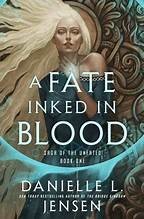
A Fate Inked in Blood
1,971-word summary 9 min read 432 pages in the book
- First published
- 2024
- Publisher
- Del Rey
- Pages
- 432
- ISBN
- 9780593599839
- Series
- Saga of the Unfated (#1)
Reading options
What's inside (9 sections)
Romantasy has a formula, and Danielle L. Jensen knows it well enough to build one with better bones than most. A Fate Inked in Blood arrived in 2024 with a shield maiden, a prophecy, a brooding warrior sworn to protect her, and a blood oath that makes the romance both inevitable and impossible. That is the sales pitch, and it delivers. What surprised me is how much of the book is actually about power: who takes it, who is owed it, and what it costs a young woman when every man around her sees her as a weapon with a heartbeat.
Freya of Selvegr
Freya is twenty years old, and when the book opens she is gutting fish for a village that treats her as her husband's property. Her husband, Vragi, is a petty and violent man who never lets her forget that her family sold her to him. Her father, Erik, died on the night of the wedding, and her mother, Kelda, and brother, Geir, live under the weight of that choice. Freya's response to all of it is to sharpen her plans for a divorce, or, failing that, an axe.
What she hides is the reason her family insisted on the marriage in the first place. Freya carries a drop of the goddess Hlin's blood in her veins, and that makes her the shield maiden of a prophecy: the woman whose magic will unite the fractured nation of Skaland under the one who controls her fate. Her family has spent her whole life telling her to stay quiet and ordinary, because a child of the gods is a treasure to whoever finds her. Freya has spent her whole life wanting to be anything but a treasure.
The world is Norse in texture. Skaland is divided among jarls who raid and feud, and across the water King Harald of Nordeland wants to unify it by conquest. The gods are real in this setting, and so are their children. Every child of a god carries a single drop of divine blood and one gift, and the book treats these gifts as political assets rather than superpowers. Vragi, for instance, is a child of the sea god Njord and can command fish, which is why his village tolerates him.
Betrayal on the Beach
Freya's life breaks because she saves a stranger. She finds a wounded man on the beach and helps him, and when he turns out to be Bjorn, son of Jarl Snorri, she is already in trouble. Her husband, jealous as ever, beats her for it, and then does something worse: he sells her out. He tells Snorri that his wife is the shield maiden of the prophecy, and Snorri arrives with his warband to claim her.
Snorri is the novel's best character and its most effective villain, largely because he never thinks of himself as either. He is a jarl who has spent decades holding his people's loyalty, and he is genuinely beloved by some of his warriors. He is also willing to own a person to secure a prophecy. He forces Freya into a fight to the death against Bjorn in front of his men, as a test of what she is, and Freya, facing a trained warrior with a weapon, does the one thing her family told her never to do. She calls on Hlin's blood, and a shield of light comes down around her.
Snorri ends the fight and then solves his problem by marrying her himself. Freya goes from one abusive husband to a politically convenient one in the space of a week. Her brother Geir protests and gets his leg broken for it. Vragi taunts her at the wedding feast, and Freya takes Bjorn's axe, the one that burns when he touches it, and kills him with it, burning her hand to the bone in the process. That scene sets the tone for everything that follows: Freya's choices cost her, and the book never lets the cost vanish.
Halsar and the Blood Oaths
At Snorri's stronghold, Freya is healed by Liv, a healer with the blood of Eir, and enters a court full of people who each want something from her. The most interesting is Ylva, Snorri's first wife and a volva, a rune-witch who performs the blood-tattoo ritual that marks Freya as one of the god-touched. A shield appears on Freya's left hand, and something deformed and strange appears on her right, which the book holds back as a mystery.
The politics of the oath deserve a moment, because they drive the romance. Ylva binds Freya to Snorri with a blood oath during the ritual, which means Freya cannot kill him, even after he proves how little her consent matters to him. Bjorn, meanwhile, lives under his own blood oath, one sworn before the story began, which limits what he can tell her about his past. The result is two people who want each other and who are each bound to someone else by magic they cannot break. It is a clean romantic engine, and Jensen drives it hard.
The dialogue leans contemporary, and it is the book's most obvious flaw. Characters use words like narcissist in a world of Norse jarls, and the modern therapy vocabulary sits oddly next to the mead halls. Publishers Weekly called the book entertaining historical fluff and noted that Freya's inner angst sometimes feels unmotivated, and that criticism has bite, especially in the middle third where the plot slows to a political crawl.
The War Comes Early
Jarl Gnut attacks Halsar while Snorri is away, which gives Freya her first real battle, and the sequence shows what her gift can do in practice. She cannot fight with a sword, but she can project her shield over the warriors around her, absorbing hits that should kill them. That is a genuinely great magic system for a war story: the protagonist is not a warrior, she is a force multiplier, and every battle becomes about where she stands and who she chooses to protect.
The war also gives the book its best relationship outside the romance. Bodil, one of the few female jarls, can detect lies, and her presence in the camp changes every conversation. She becomes a mentor of sorts to Freya, and her death at the battle of Grindill is the book's cruellest sucker punch. Freya freezes when Bodil is killed by Tora's lightning, her shield fails, and the woman who had taught her how to survive dies in front of her. Freya's response is pure rage: she breaks the gate, kills her way through the enemy, and watches Bjorn take Gnut's head.
Between battles, Jensen builds the romance the way romantasy readers want it built, with training scenes, forced proximity, and a slow slide into an affair that both characters know is insane. Freya and Bjorn become lovers on the march to Grindill, and the book is explicit about it. This is an adult romance, and readers who prefer their fantasy without sex scenes should know that going in. The scenes are earned by the tension, and they are not the only thing happening, which is more than some books in the genre can claim.
The Pilgrimage to Fjalltindr
The mythology section is the strangest and best part of the novel. Freya and Bjorn travel to the mountaintop temple of Fjalltindr, first through tunnels full of draug, cursed undead with a taste for the living, and then up a mountain where a specter tells Freya to make a sacrifice on the first full moon. In the tunnels, Freya does something she did not know she could do. Facing death, she curses the draug to Helheim, and black roots drag the undead into the earth. Nobody, including Freya, understands what that means, and the book lets the reader sit with the dread until the ending explains it.
At the temple, she places coins at the statues of the gods, drinks mushroom tea, sacrifices a bull, and is acknowledged by hooded figures who may or may not be the gods themselves. Jensen writes this sequence with real atmosphere, and Harald is at the temple too, which plants the political threads the ending pulls. There is no tidy magic lesson. Freya leaves with more questions, which is the right way to build a mystery across a duology.
The most important lore arrives through Kelda, Freya's mother. When Geir was a sickly baby, Kelda prayed, and a "goddess" answered with a bargain: she would save the boy in exchange for lying with Kelda and Erik. Geir disappeared the next morning. Then Hlin appeared, returned Geir, and set her own condition, that the child Kelda had just conceived would be Hlin's vessel, with one twist: if the child grew up to show altruism, the divine power she could claim was a fate yet unwoven. That conversation is the book's thesis. Freya's goodness is the variable. Snorri, Harald, and everyone else are betting on a prophecy, and the prophecy is betting on Freya.
The Waterfall and the Roots
The ending has three turns, and they hit in quick succession. Harald's army attacks Grindill, and Freya, knowing she cannot win, tries to end the war by stepping off a cliff. Bjorn stops her, and the two stage their deaths in the waterfall so that Snorri will believe them gone. In a cave afterward, they finally say what they feel and plan a life away from the war.
Then Harald arrives. He exposes Bjorn as his own agent, and Bjorn does not deny it. He calls Harald father, admits his loyalty was to Nordeland all along, and tells Freya that everything she overheard was not what she thought. Freya responds with the power she has been hiding from everyone, including herself. She curses the warband to Helheim, and giant roots drag nearly everyone present into the underworld. Only Bjorn, Harald, and two god-touched warriors escape, and Freya learns the truth about the second mark on her hand: she carries the blood of Hel as well as Hlin. Two bloods, two goddesses, two destinies.
The ending does not resolve the romance. It complicates it, which is the right call for a first book in a duology. Bjorn reveals that his mother, Saga, is alive. Snorri tried to have her murdered at Ylva's urging, and she fled to Nordeland with her son, which means the woman Freya overheard through the wall was Bjorn's mother and not his lover, and Freya's worst assumption was wrong. The book closes with Freya and Bjorn sailing for Nordeland, where she intends to stop being the shield maiden someone else controls and start deciding her own fate. It is a cliffhanger, and it works.
The Verdict
This is a strong debut for its series and a solid recommendation for readers who already live in romantasy. The magic is specific, the politics are legible, the heroine earns her scars, and the love interest has a real secret instead of a fake one. Kirkus called it a captivating first installment and a feminist Viking fantasy, which is fair, and the sales and award attention suggest a lot of readers agreed.
The flaws are equally clear. The middle drags. The prose runs contemporary, and the modern language will pull some readers out of Skaland entirely. The chosen-one framework is doing a lot of heavy lifting, and the book leans on it whenever it needs the plot to move. But the ending, with its roots and its revelations and its two-blooded heroine, is the kind of swing that makes me want to read the second book immediately. For all its familiar parts, A Fate Inked in Blood knows exactly when to stop being a romance and start being a curse.
FAQ
Is A Fate Inked in Blood part of a series?
Yes. It is book one of the Saga of the Unfated, a duology that concludes with A Curse Carved in Bone.
Is A Fate Inked in Blood spicy?
It is a romantasy written for adults with explicit sex scenes, though the romance shares the page with the war and the political maneuvering.
What is Freya's power?
She carries a drop of Hlin's blood, which lets her raise a shield that protects herself and the warriors around her, and it grows into something darker by the end of the book.
Similar books
More from Saga of the Unfated first, then related titles.

Magic Burns
A magic flare hits Atlanta, and mercenary Kate Daniels must recover stolen maps, find a missing witch, and keep a teenage girl alive while Celtic gods try to…
2,021-word summary · 9 min read

The Siren
Saved from a shipwreck in 1930, Kahlen becomes a siren who sings men to their deaths for the Ocean, until a boy in a college library makes her want a life she…
2,369-word summary · 11 min read

The Rose & the Dagger
Shahrzad is pulled from her Caliph husband and left in a desert camp of rebels, needing to break his curse and end a war before it ends her.
2,520-word summary · 11 min read

We Hunt the Flame
In a fractured Arabia-inspired world, a disguised huntress and a prince-assassin race to find a magic-restoring book and confront an ancient evil.
2,195-word summary · 10 min read
The Magician
Sophie and Josh flee to Paris with Nicholas Flamel, where John Dee, Machiavelli, and an awakened god close in on the missing pages of the Codex.
2,162-word summary · 10 min read

Lore
Lore Perseous, the last of a hunted bloodline, is pulled back into the Agon when a wounded Athena offers her revenge against the god who killed her family.
2,188-word summary · 10 min read
When the Moon Hatched
An assassin who hears air takes a job that throws her to dragons and a hunter.
2,083-word summary · 9 min read
A Winter's Promise
Ophelia reads objects and is sent to marry Thorn on a cold ark.
2,502-word summary · 11 min read
A Soul of Ash and Blood
Casteel retells Poppy fall and rise while she sleeps under siege.
2,458-word summary · 11 min read
Daughter of No Worlds
A former slave with rare magic hires exiled warrior Max to train her for a daring rescue, sparking slow burn love and wider war in this big 520-page fantasy…
2,529-word summary · 11 min read
The City of Brass
Cairo con artist Nahri summons djinn Dara and is drawn to Daevabad where Ali questions pureblood rule.
1,993-word summary · 9 min read
Strange the Dreamer
Orphan librarian Lazlo Strange joins a quest to the lost city of Weep, where blue-skinned godspawn haunt dreams.
2,221-word summary · 10 min read
The Alchemyst
Twins Sophie and Josh learn their boss is Flamel as Dee steals the Codex minus two pages.
2,085-word summary · 9 min read
Poison Study
Sentenced to die, Yelena becomes the Commander's poison taster and learns survival in Ixia has a daily price.
2,501-word summary · 11 min read
To Kill a Kingdom
A siren princess turned human must steal a siren-hunting prince's heart to win back the sea.
2,248-word summary · 10 min read

Fire
A human monster who reads minds is pulled into war in the Dells and must decide how to use her power.
2,727-word summary · 12 min read
The Starless Sea
A graduate student finds a book that retells his childhood and follows its clues to an underground Harbor of stories.
2,582-word summary · 11 min read
Wizard's First Rule
Woods guide Richard joins Kahlan and wizard Zedd to find the Boxes of Orden before Darken Rahl, learning why people believe lies.
2,220-word summary · 10 min read
Children of Blood and Bone
White haired Zelie chases magic return with princess Amari hunted by Inan.
2,027-word summary · 9 min read
Finale
Sisters face waking Fates with debts due, loving princes, and choices that break immortal math.
1,995-word summary · 9 min read
Stardust
Tristran Thorn climbs over the wall of Wall to fetch a fallen star and finds Yvaine, witches, and princes hunting her.
2,490-word summary · 11 min read
House of Flame and Shadow
Bryce lands outside Midgard while Hunt sits in Asteri dungeons and the war for two worlds builds.
2,983-word summary · 13 min read
Graceling
Katsa, Graced with killing, breaks from her uncle's use of her and follows a kidnapped prince toward a hidden king.
2,517-word summary · 11 min read
A Kingdom of Flesh and Fire
Poppy travels to Atlantia with Hawke as Casteel while war, prophecies, and her own gifts close in.
3,048-word summary · 14 min read
The Traitor Queen
Exiled Lara returns to free Aren and break her father hold.
2,328-word summary · 10 min read
The Bridge Kingdom
A trained bride spies on Ithicana and its bridge king, then love and invasion force choice.
2,044-word summary · 9 min read
The Thief
A boastful young thief is pulled from a prison to steal a legendary stone for the king's magus, and the story he tells about himself is not the whole story.
2,514-word summary · 11 min read

The Blinding Knife
Kip trains to join the Blackguard while the Prism hides his true identity, loses his colors, and fights a war against a rogue drafter who wants to birth a god.
2,049-word summary · 9 min read

Inkdeath
The final Inkworld novel sends Mo into the land of the dead, leaves Meggie choosing between two boys, and ends the Adderhead's immortality with three written…
2,062-word summary · 9 min read
Hounded
A two-thousand-year-old druid runs a bookshop in Arizona, hides from an Irish god who wants his sword back, and talks to his dog.
2,159-word summary · 10 min read