
Reading options
What's inside (9 sections)
I picked up Hogfather because I wanted a Christmas novel that was not sentimental, and what I got was a book that takes Father Christmas apart on a workbench and asks what is actually inside the red suit. It is also the most argumentative thing Pratchett wrote about belief, and it is funnier and darker than the reputation suggests. Thirty years on, the jokes still land, though a good number of them are aimed at people who have read the earlier books, and the ones that miss are not jokes at all but small traps set for the reader.
Victor Gollancz published it in London on 7 November 1996, and the American edition I have is the HarperPrism hardcover from 1998, 292 pages, ISBN 9780061050466. Page counts swing wildly between editions of this book, so treat any number you see as a description of one printing and not of the novel. It is the twentieth Discworld novel and the fourth of the Death books, after Mort, Reaper Man and Soul Music. It was nominated for the British Fantasy Award in 1997 and came 137th in the BBC's Big Read, which is where most of Pratchett sits by now.
The last night of the year
The Discworld's Christmas is Hogswatch, and Hogswatchnight falls on the 32nd of December, the last day of the year and the shortest day of it. That matters mechanically, because the year cannot turn without the Hogfather. He is the god who brings presents on that night, and the book opens with him missing and a hole in the world's expectations where he should be.
The reason for the hole is the Auditors of Reality, the celestial bureaucrats who want the universe tidy and who audit the rules of things. They cannot simply reach in and remove a god, because the Rules forbid it, so they do what institutions do when they want something done quietly: they commission it. The Assassins' Guild accepts the contract, three million dollars, no questions asked and none answered, and Lord Downey passes the job to a young man named Jonathan Teatime, who has one glass eye and the habit of seeing people as objects to be moved. Teatime does not go at the Hogfather directly. He hires freelance criminals, a failing student wizard and a locksmith, and he finds the Tooth Fairy's country, where children have left their teeth in exchange for money, and he steals the whole collection.
Teeth, on their own, are harmless. Held by the right person, they are a lever. With them, Teatime can reach into the mind of every child on the Discworld and suggest that the Hogfather is not real, and one by one the children stop believing. This is the quiet horror at the centre of the book. Nobody is stabbed. A whole population is simply persuaded, and the world starts to come apart at the joins.
Death in a red suit
The wizards at Unseen University work out the arithmetic fast: if belief in the Hogfather fails, the sun will not come up. The Auditors want an orderly universe, and they have arranged for the sun to stop meaning anything. So somebody has to do the job, and the only candidate with the necessary authority and the necessary lack of imagination is Death.
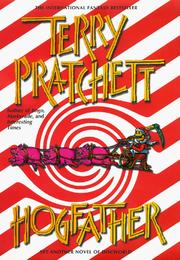
Death is not taking a holiday here. He is filling a vacancy, and he fills it exactly as you would expect: literally, and with no instinct for theatre. He appears down the chimney in a red suit with a false beard and tries out the greeting, and the great joke is that he cannot get the laugh right. Ho, he says. Ho. Ho, he tries again, and Albert, his manservant, has to coach him. The Hogfather's job turns out to involve eating a great deal, and Death attempts this too, and ends up suffering heartburn on the sleigh while Albert declines a sugar piggywiggy. The sleigh is pulled by four boars called Gouger, Rooter, Tusker and Snouter, and Death gets them moving by chanting a word that starts with applesauce.
The giving-out of presents is where he does his best and his worst work. In the grotto of Crumley's department store in the Maul, where the Hogfather display is a popular fixture, Death hands out presents from his sack and the shop fills with people who should not be there. Corporal Nobbs, who is Nobby Nobbs and who has spent his life as the lowest rung of the City Watch, is given a present with merry ravens on the wrapping paper and does not know what to make of it. In a doorway on Money Trap Lane, Death finds Sarah the little match girl, who was not supposed to survive the night, and gives her more life with a timer, because a future is the best present there is.
Albert objects to all of it, in the polite, exhausted way of a man who has watched this happen before: you know it always goes wrong when you start changing things. He is right, but the alternative is a year that does not turn. What Pratchett is doing here is closer to thought experiment than to parody. The Hogfather is a job description, and the job can be done by anyone, badly, as long as the believing continues. What matters is not who wears the suit but whether people still expect to be found.
Susan Sto Helit and the poker
Susan Sto Helit is the reason to read the book, and she is the most stubborn character in the series. She is Death's granddaughter, and she has spent her life trying to be an ordinary woman with an ordinary job. She is a governess in the house of the Gaiters, a family on the way up, and she is good at the work. Mrs Gaiter is far too frightened of her own social superiors to give Susan instructions, so the governess is left to get on with the children, and she is good at that too. She has made up a story about a beanstalk and a boy called Jack and an unpleasant villain, and she edits it as she reads it, and the children love it. What she cannot stand is the other convention of the job, the one the previous governess used, when monsters and bogeymen were the answer to bad behaviour. She has sworn that if she ever finds herself dancing on rooftops with chimney sweeps, she will beat herself to death with her own umbrella.
Her ambivalence is the point. She wants to keep her distance from her grandfather's world, she is extremely good at hiding things from her own head, and then an ordinary evening goes wrong and she is doing the letters the children wrote to the Hogfather when one of them mentions that the Hogfather is her father, and Susan discovers that she cannot lie to a five-year-old and get away with it. Her answer is a masterpiece of tactical parenting, because she appeals to greed rather than faith: does it matter if you get the presents anyway? The children do not care who brings the presents. That is the whole of her theology, and it is also the whole of the plot, since the same logic lets Death keep the world running.
Then her grandfather turns up in the red suit, in the middle of her employers' hallway, on the night before Hogswatch. Susan has spent years preparing for the day her grandfather might need her, and she has spent the same years praying it would not come. It comes. She goes with him, and for the first time she cannot pretend that the supernatural is somebody else's business. She carries a poker. The poker is the whole of her philosophy in one object: something you keep to hand for the thing under the bed, which turns out to be a good deal more useful than a crucifix for a governess in a house with a child who keeps hearing noises.
Wizards and small gods
The Unseen University scenes are where the book is at its funniest and, for a reader new to Pratchett, at their most confusing. Mustrum Ridcully, the Archchancellor, wants a bathroom. The University has a bathroom. It was walled up for reasons nobody remembers, and the room beyond it is a marvel of plumbing designed by a man called Bergholt Stuttley Johnson, with a tap marked Old Faithful and an organ in the next door that must not be allowed to play. The Dean gives the Bursar a present he has bought with his own money, which is a box for keeping dried frog pills in. The Senior Wrangler does the economics of Christmas better than any accountant would: everyone is a net exporter of Hogswatch presents, you spend a fortune on other people, and what is left when the paper is cleared away is one slipper of the wrong colour and a book about earwax.
Meanwhile Hex, the University's walking computer, is trying to work out how to hold the world together. Its memory is stored in beehives, with different pollens standing for different kinds of information, honey thickness encoding depth and the position of the eggs encoding order. It is a lovely joke about computers and also a creepy one, because anyone who tries to tamper with the storage is stung to death, and Adrian wants to shut the whole thing down in the summer holidays.
The wizards also create the gods. A belief vacuum left by the missing Hogfather has to be filled, and the University fills it by accident, mentioning deities that do not exist and then having them exist. Bilious, the Oh God of Hangovers, appears with a hangover that will not shift, a grievance that he does not drink, and a poor sense of how many people are standing in front of him. The University builds a large glass beaker to cure him, adds yoghurt and a dose of Englebert's Enhancer, and the Dean wonders whether the yoghurt was a good idea. A Verruca Gnome turns up. A Hair Loss Fairy. An Eater of Socks and a Stealer of Pencils. Towel Wasps. And, worst of all, the Cheerful Fairy, a being so relentlessly nice that it frightens people. Death's solution to the crisis is to sit down with Hex and ask it, over and over, whether it believes in the Hogfather, until the machine is writing the words YES in capitals. Belief, it turns out, is something you can build out of obedience and repetition.
The Tooth Fairy's tower
The trail leads to the Tooth Fairy's country, a place made out of children's imagination, and Susan goes there with Bilious, Binky and a raven that wants eyeballs. The rules are strict and they are about belief rather than magic. Death's sword will not work there, because children have no concept of death, which means Death himself cannot go, which is the whole reason he needs his granddaughter. The tower is guarded by the things the criminals are most afraid of, and their own childhood fears do the work that a good fight scene would do in a cheaper book.
Teatime is brilliant and belongs in the room. He sees people as objects, and his mistake is that he cannot see a child as a child. He falls from the top of the tower into the heap of teeth. Susan leaves Banjo Lilywhite, the enormous criminal who never wanted the job, to clear them up and carry on the work, and the work turns out to have been the Tooth Fairy's own. The creature in that country is the original bogey man, the one adults invented to frighten children and who became the Tooth Fairy to protect them, collecting their teeth precisely so that nobody else could use them to control them. He dies of exhaustion holding his country together. It is the saddest thing in the book and it happens in a tower.
Susan's ambivalence about her job comes back here. She is very good at this and she hates it, and the moment she chooses it is the moment she throws the poker at Teatime in the Gaiter house, with the blade passing straight through her grandfather, who is not solid enough to be killed by a child's weapon, and into the man who has been trying to murder Christmas. The weapon works because children believe in it. That is the book's thesis stated as a physics problem.
Hounds at the cliff
The Auditors break the Rules at the last, which is what finally allows them to be defeated. Having decided that belief is messy, they take on living shapes, hunting the Hogfather, who has reverted to his older animal form, with dogs. Susan steers the hog over a cliff to safety while Death confronts them, and the confrontation is short and oddly satisfying, because the Auditors have violated the principle that made them unassailable. Having taken a solid shape, they cannot shed it, and they go over the edge of the cliff. The Hogfather turns back into a man in a red suit and flies off into the night, and the year turns with him.
What Death says to Susan afterwards is the best thing in the book, and it is the bit I would put in front of anyone. Humans need fantasy to be human, and the practice of it starts small, with tooth fairies and hogfathers, the little lies that you learn to hold, so that later you can hold the bigger ones: justice, mercy, duty. He also points out, without any relish, that if the Hogfather had simply stayed away forever, the sun would still have come up as a ball of burning gas and lit the world perfectly well. What would have been lost was not light. It was the meaning of the light, which is a harder thing to get back.
Teatime is not finished yet. He follows them to the Gaiter house and considers killing Death with Death's own sword, and Susan throws the poker, and that is the end of him. The small gods vanish as belief goes back to where it belongs, the Hogfather's absence is repaired, and the last pages hand the reader a Discworld where everything has been put back in its box. It is a tidy ending for a book that spends its time arguing that nothing should be put back in its box.
What works and what does not
The jokes here are very British, and a good number of them are references that only pay off if you have read the earlier books: the Ankh-Morpork geography, the Omnian religion, the running gags about the Bursar's mind and the Dean, the way every guild, bank and shop in the city gets a joke about its own bureaucracy. Read fresh, the book is a lot of references and a lot of running about with names that mean nothing to you. Read as the twentieth book in a series, the density is what makes it funny, and the City Watch, the Wizards and the canting crew all arrive with paperwork attached.
The other thing to know is that this is a darker book than its reputation. Publishers Weekly noticed the shift and wrote that Pratchett had moved past humorous fantasy into something closer to a serious contemporary satirist, and the argument about belief and its uses is the sturdiest thing in the novel. Paul Pettengale in Arcane was blunter, rating it six out of ten, saying the jokes were getting more strained and that Pratchett was ticking over rather than revving. That is too harsh. The book is funny in a way that requires attention, and the passages about what the Hogfather is for, about why the Auditors are the villain of the story, and about children and the stories adults tell them, are better than most of what Pratchett wrote afterwards.
It is not for readers who want a warm Christmas story, and it is not really for children despite the subject. The tone is affectionate about the festival and merciless about the industry built around it: the grotto display in the department store, the wrapping paper, the prayers and the fasts, the commercial machinery that runs on the assumption that belief is a resource and that someone, somewhere, will have to do the work of faking it. If that is the version of Christmas you enjoy, the book is bracing. If you want the Hogfather to be a man in a red suit and nothing more, this one takes him apart and shows you the plumbing.
What I take from it is the small argument Death makes to his granddaughter at the end of the night, that you have to learn to believe the little lies before you can hold the big ones, and that the holidays are where most of us do the practising. Pratchett wrote it as a joke with a skeleton in it, which is the best place for that argument to live. Read in December, with the lights on, it does exactly what it was built to do.
FAQ
Do I need to read the other Discworld books first?
No, but you will miss jokes. It is the twentieth Discworld novel and the fourth Death book, and knowing Mort and Soul Music helps with Susan Sto Helit and with Death's tone.
Is Hogfather really a Christmas story?
It is a Discworld novel set on Hogswatchnight, the last night of the year, which the Discworld calendar puts on December 32. The festival is Christmas with the theology and the weather taken out.
What happens if the Hogfather does not come?
The wizards calculate that the sun will not rise and the year cannot turn. That is what pushes Death into the red suit and sends Susan out to find the missing god.
Similar books
More from Discworld first, then related titles.
The Color of Magic
A failed wizard guides a tourist across a flat world on a turtle, with comic fantasy chaos.
2,032-word summary · 9 min read
The Light Fantastic
Rincewind and Twoflower fall off the world while wizards race a red star.
1,974-word summary · 9 min read
Equal Rites
A dying wizard passes his staff to a baby girl, and Granny Weatherwax escorts Esk to Unseen University in Pratchett's third Discworld book.
2,871-word summary · 13 min read
Mort
Death hires apprentice Mort in this 1987 Discworld comedy, where a spared princess splits reality and duty bends for love, with no Rincewind.
2,386-word summary · 11 min read
Sourcery
A dying wizard hides his soul in a staff, his eighth son becomes a sourcerer strong enough to break the world, and Rincewind is sent to stop him with a sock.…
2,404-word summary · 11 min read
Wyrd Sisters
Three Lancre witches rescue a murdered king's baby, hide Lancre's future, and trap a guilty duke with a play in Ankh-Morpork.
3,085-word summary · 14 min read
Guards! Guards!
A drunk captain, his last two guards, and an earnest recruit face a summoned dragon in Ankh-Morpork in Pratchett's funny eighth Discworld book.
2,307-word summary · 10 min read
Reaper Man
Death gets fired and farms while Windle Poons refuses to die.
2,579-word summary · 11 min read
Witches Abroad
Three Lancre witches fly to Genua to stop a fairy godmother from forcing a servant girl into a storybook marriage, and find a city arranged around a happy…
2,651-word summary · 12 min read
Small Gods
God Om trapped as a tortoise must convince novice Brutha to save Omnia from its own church.
2,063-word summary · 9 min read
Men at Arms
The City Watch gets new recruits and a murder case when the Disc's only handgun turns up in Ankh-Morpork, in the fifteenth Discworld novel.
2,216-word summary · 10 min read
Night Watch
Vimes is thrown back in time and must train his young self through a revolution.
2,003-word summary · 9 min read
The Wee Free Men
Nine-year-old Tiffany Aching teams with the Nac Mac Feegle to rescue her brother from the Fairy Queen.
2,600-word summary · 12 min read
Going Postal
A hanged con artist must revive Ankh-Morpork's dead Post Office and outwit a murderous rival in Pratchett's 33rd Discworld novel.
2,228-word summary · 10 min read
A Dirty Job
Grieving San Francisco secondhand shopkeeper Charlie Asher inherits the Death job, collecting souls into vessels while raising little baby Sophie as Minty…
2,454-word summary · 11 min read
Hounded
A two-thousand-year-old druid runs a bookshop in Arizona, hides from an Irish god who wants his sword back, and talks to his dog.
2,159-word summary · 10 min read
Nettle & Bone
Marra, a princess in a convent, leaves to save her abused sister, but first she must finish three impossible tasks: a bone dog, a nettle cloak, moonlight in a…
2,061-word summary · 9 min read
The Bane Chronicles
Eleven stories across five centuries follow Magnus Bane from a ban in Peru to his first date with Alec in this illustrated Shadowhunter companion.
2,470-word summary · 11 min read
Redshirts
Ensigns realize they die to serve a bad TV show's narrative.
2,152-word summary · 10 min read
Mostly Harmless
Arthur makes sandwiches on Lamuella while Ford steals a Guide Mk II that wipes Earths across realities.
2,059-word summary · 9 min read
Abhorsen
Lirael as Abhorsen-in-Waiting must bind the Destroyer Orannis with Sam, Dog, and Mogget.
2,214-word summary · 10 min read

The Blinding Knife
Kip trains to join the Blackguard while the Prism hides his true identity, loses his colors, and fights a war against a rogue drafter who wants to birth a god.
2,049-word summary · 9 min read
Strega Nona
A village witch doctor hires a boy who does not listen, and the pasta pot he was told not to touch floods Calabria with noodles he cannot stop.
2,587-word summary · 11 min read

Inkdeath
The final Inkworld novel sends Mo into the land of the dead, leaves Meggie choosing between two boys, and ends the Adderhead's immortality with three written…
2,062-word summary · 9 min read
Go the Fuck to Sleep
A rhyming bedtime book for adults in which an exhausted father narrates the fourth hour of a toddler's stalling, one profane couplet at a time.
2,291-word summary · 10 min read
Dawnshard
Rysn sails toward forbidden Akinah to save her dying larkin and finds a Dawnshard guarded by the Sleepless.
3,229-word summary · 14 min read
Bone, Vol. 1: Out from Boneville
Three cartoon cousins are run out of Boneville, separated by locusts, and dropped into a valley where rat creatures and an old grudge are waiting.
2,155-word summary · 10 min read
A Long Way Down
Four strangers meet on a London rooftop on New Year's Eve, each planning to jump, and end up making a pact to stay alive until Valentine's Day.
2,145-word summary · 10 min read
The Field Guide
Three siblings move into a creepy Maine estate, anger a brownie, and find a forbidden guide to the fairy world in the first Spiderwick book.
2,033-word summary · 9 min read

Magic Burns
A magic flare hits Atlanta, and mercenary Kate Daniels must recover stolen maps, find a missing witch, and keep a teenage girl alive while Celtic gods try to…
2,021-word summary · 9 min read