
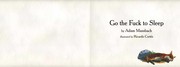
Go the Fuck to Sleep
2,291-word summary 10 min read 32 pages in the book
- First published
- 2011
- Publisher
- Akashic Books
- Pages
- 32
- ISBN
- 9781617750250
Reading options
What's inside (12 sections)
- The book itself, page by page
- Ricardo Cortés and the art that carries the joke
- Where it came from
- The month the PDF got out
- Samuel L. Jackson reads it
- The sequels, the translations, the movie that never happened
- What the argument was about
- The honest case against it
- What it gets right
- Reading it now
- Key takeaways
- FAQ
The first time I read this book out loud, I got about six pages in before I had to stop and check whether my kids could hear me. They could not. They were asleep, which is the entire point of the book and also the reason I was reading it at eleven at night in a hallway rather than in a chair. That is the correct way to encounter it: quietly, in a house where someone has finally gone down, with the specific tiredness of a person who has already done the dishes and the stories and the second glass of water.
It is thirty-two pages. It takes about five minutes. And it is one of the strangest publishing stories of the last fifteen years, a book that started as a Facebook joke and ended up on the bestseller lists before a single copy shipped.
The book itself, page by page
The premise is a bedtime book for adults, written in the singsong rhythm of a classic children's story, in rhyming couplets. The narrator is a father. The child is small and awake and not going anywhere. What changes across the pages is not the situation but the temperature of the father's voice. The early pages are almost tender. He name-checks the animals that are already asleep, cats and whales and eagles and lions, the standard cast of any lullaby, all of them unconscious, all of them doing what his child will not do.
Then the profanity arrives. It escalates, a little at first, then faster, and the joke is that the meter never breaks. The lines keep their nursery bounce while the words get worse. That is the whole machine. You could read the first spread to a toddler without incident. By the middle of the book you could not.
Somewhere in the back half, the father turns on himself. He calls himself a bad parent. It is a sharp turn, and it lands harder than the swearing, because it is the thing every tired parent has thought at 2 a.m. and then felt guilty about for a week. The book does not linger there. It moves on, the way the night does.
The couplets are competent rather than virtuosic, and that is a feature. A more skillful poet would have made the form conspicuous, and you would start admiring the rhymes instead of feeling the exhaustion. Mansbach keeps the lines simple enough that they disappear, which lets the profanity do the work. The rhymes are also doing a second job: they keep the father's voice light no matter how ugly the sentence gets. You cannot fully hear menace in a sing-song. That is why the self-loathing line lands so hard when it arrives, because the meter is still bouncing under it and the bounce starts to feel wrong.
The wife is barely in the book, which is a fair complaint. She appears at the end, when the father creeps out to watch a film with her, and she is a destination rather than a person. The book is about one parent's interior monologue, so that is defensible. It also tells you exactly whose exhaustion the book considers worth a book.
Then he falls asleep. He wakes. The child is asleep, peacefully, finally. He creeps out of the room. He and his wife watch a film. The microwave beeps, the child wakes, and the cycle starts again. That ending is the best-built part of the book. It is not a punchline exactly. It is a description.
The details are what make it work. The glass of water. The requests. The microwave beep. Anyone who has done a bedtime shift knows the beep. It is the sound of a house betraying you.
Ricardo Cortés and the art that carries the joke
Cortés draws it straight. The paintings are gentle and sincere, the kind of soft, warm illustration you would find in a book you actually bought for a child. The child is cute. The rooms are cozy. Nobody in the pictures is swearing.
That mismatch is where most of the humor lives. If the art had been cartoony or sarcastic, the book would have been a novelty item and nothing more. Because the pictures believe in the lullaby, the text's betrayal of the lullaby has somewhere to land.
Macy Halford, writing in The New Yorker, called the book very funny and said Cortés's art is sweet enough to make you cringe. That is the right verb. The sweetness is not decoration; it is the setup.
Where it came from
Mansbach's daughter Vivien was three and could take up to four hours to fall asleep. Four hours is not a typo. Anyone who has had a three-year-old will recognize the number and also recognize the way it stops sounding like an exaggeration after the second week.
One night he posted on Facebook that he was writing a children's book called Go the Fuck to Sleep. Friends responded with such enthusiasm that he actually wrote it. That detail matters, because the book reads like something written fast and in a bad mood, and it was.
He asked his friend Ricardo Cortés, an illustrator, to draw it. Then he took it to Akashic Books, an independent publisher in New York, which is not the obvious home for a profane picture book and turned out to be exactly the right one. Akashic has a long history of publishing things that other houses would have flinched at.
The month the PDF got out
The book was scheduled for October 2011. Then PDFs of advance copies started circulating by email. Booksellers forwarded them to other booksellers. Somebody posted a page. Somebody read it aloud on a podcast. Within weeks it was a thing people sent each other at midnight with no comment, because no comment was needed.
About a month before release, it hit No. 1 on Amazon. The book did not exist yet. There were no reviews, no tour, no campaign. There was a file.
The publisher moved the date up to June 2011 and raised the first printing to 150,000 copies. That is a large number for an independent press and a small number for the demand that was visible at the time, which is why the book was briefly hard to find in the way that only a book with a sudden, unearned-seeming audience can be.
The cover does something clever. The full moon sits over the middle of the title and hides the "uc" in "fuck," so the spine reads as a children's book from across a room. The interior uses the whole word. That design choice is the entire sales pitch in one image: it looks like a gift, and it is one.
Samuel L. Jackson reads it
Audible released an audiobook narrated by Samuel L. Jackson. It runs a little over seven minutes including his introduction and the legal matter, with roughly four and a half minutes of actual reading. If you have heard it, you remember the pause before the first profanity. Jackson plays it straight, at first almost soft, and then he lets the volume come up in steps, and by the end he is not reading a bedtime story, he is delivering a verdict.
It was a finalist for the 2012 Audie Award for Audiobook of the Year and for Humor. That is a strange sentence to write about a book this short, and it is accurate. Four and a half minutes got nominated for the biggest award in the category.
The audio also solved a problem the print version has. When you read the book yourself, you have to commit to the performance, and most people cannot sustain it for five pages without laughing or feeling ridiculous. Jackson removes that burden. He is not embarrassed. He is furious on your behalf.
The sequels, the translations, the movie that never happened
You Have to Fucking Eat followed in 2014. Fuck, Now There Are Two of You came in 2019, which is the correct title for a second child and also the correct sentiment. There are translations, including a Jamaican patois version titled Go de Rass to Sleep, which is a better title than the original in at least one register.
Fox 2000 optioned it for a film. Nothing came of that, at least not in the form anyone expected, and honestly a feature-length version of a five-minute joke is a hard problem. The audiobook is the adaptation that worked.
What the argument was about
The book arrived in the middle of a small culture fight, and the fight is more interesting than most book fights because both sides had a point.
The New Yorker's Macy Halford found it very funny while noting the art was sweet enough to make you cringe. Publishers Weekly's Mark Rotella grouped it with parenting books that let parents laugh at themselves, which is a real category and a useful one. Canongate, the UK publisher, framed it as solidarity for tired parents. That framing is probably the most accurate commercial description anyone gave it.
Then there was the other side. A Macmillan children's publishing executive said the book parodied It's Time to Sleep, My Love by Eric Metaxas and Nancy Tillman. Metaxas complained that it damaged the innocence of lullabies. Mansbach said he had not read that book.
That exchange is worth sitting with. The parody charge assumes the book is aimed at children, and it is not, and the cover is designed to make that clear. But the Metaxas complaint is not stupid either. A book that lives by mimicking a lullaby does borrow something from the lullaby, and the borrowing is not entirely harmless. Parents did leave it on coffee tables. Some of them had four-year-olds who could read the spine.
Some reviewers said the joke goes on too long and that the father ends up in a rage rather than a sigh. I think that criticism is half right. The escalation is the structure, so it cannot stop early without ceasing to be the book. But the last third does tip from exasperation into something colder, and the self-loathing line, which is the most honest moment, also breaks the comedic contract a little. You laugh and then you feel bad, and the book does not do much with the feeling afterward.
The honest case against it
It is a single joke in a thirty-two-page package. You read it in five minutes. The profanity is the whole engine, and engines like that wear out. The second read is noticeably less funny than the first, and the third is mostly an exercise in appreciating Cortés.
It is also a gift book more than a book you return to. People bought it for baby showers, which is a slightly hostile act, and for their own siblings, which is a completely understandable one. It sat on a lot of coffee tables for a year and then went into a box.
The gift economy around it is its own small story. It was one of the few books at the time you could hand to a friend without writing anything in it, because the title said everything and the cover let you do it in public. That is a rare quality in an object. It is also why so many copies exist in near-mint condition, spine uncracked, sitting in the guest room.
And it speaks to a very particular kind of exhaustion. The father in this book has a partner, a house with a microwave and a film to watch, and the leisure to be this tired in this specific, theatrical way. Four hours of bedtime is a crisis of abundance. It has nothing to say to a parent working two jobs, or a parent without another adult in the house, or a parent for whom the microwave beeping is not a comic beat but the sound of a shift starting.
That is not a reason to dislike the book. It is a reason to be precise about what it is. It is a joke told by people who are tired in a comfortable way, and it is very good at being that.
What it gets right
The fourth hour. Not the first, not the second, the fourth, when the child is still awake and you have run out of approaches and the room has gotten smaller. The book captures the specific, unspoken fury of that hour, the one you do not admit to because admitting it makes you feel like a monster.
The self-loathing. When the father calls himself a bad parent, the book stops being a bit and becomes a document. That line is the reason it circulated so widely. People were not sending each other a swear word. They were sending each other permission to have thought it.
And the accuracy of the small stuff. The glass of water. The requests. The beep. Mansbach did not need to invent anything. He had four hours of material and a three-year-old.
Reading it now
I still think the best way to meet this book is the Jackson audio, in a car, alone, on the way home from something. It is four and a half minutes. It does what a good joke does, which is to say the thing you were already thinking in a voice louder than your own.
The print version is a gift. Buy it for someone in the third month of a bad sleeper. Do not buy it for the child. The cover will not save you from that mistake, and neither will the moon.
FAQ
Is Go the Fuck to Sleep a children's book?
No. It is a satire of bedtime books written for adults, though the cover is designed to look like a children's title from a distance.
How long is the Samuel L. Jackson audiobook?
Just over seven minutes including his introduction and the legal matter, with about four and a half minutes of actual reading.
Why did the publication date move up?
PDFs of advance copies circulated by email, the book reached No. 1 on Amazon before release, and Akashic moved the date from October 2011 to June 2011 with a 150,000-copy first printing.
Similar books
Don't Let the Pigeon Drive the Bus!
A bus driver leaves the reader in charge with one rule, and a very persuasive pigeon spends the rest of the book trying to break it.
2,084-word summary · 9 min read
Strega Nona
A village witch doctor hires a boy who does not listen, and the pasta pot he was told not to touch floods Calabria with noodles he cannot stop.
2,587-word summary · 11 min read
Amelia Bedelia
A literal-minded housekeeper follows her employer's list to disastrous and funny effect in the 1963 picture book that made wordplay a children's staple.
2,038-word summary · 9 min read
Click, Clack, Moo: Cows That Type
Cows learn to type, demand electric blankets, and go on strike in a deadpan picture book about negotiation and withheld labor.
2,617-word summary · 12 min read
Caps for Sale
A peddler balances his caps on his head, naps under a tree, and wakes to find monkeys wearing his stock in this 1940 picture book.
2,787-word summary · 12 min read
The Stinky Cheese Man and Other Fairly Stupid Tales
Scieszka and Lane Smith take nine fairy tales apart, joke by joke, while Jack, the narrator, keeps losing the pages.
2,206-word summary · 10 min read
Hogfather
Death fills in for a missing Father Christmas, Susan Sto Helit hunts the Hogfather, and the twentieth Discworld novel turns Santa into a management problem.
2,871-word summary · 13 min read
America (The Book): A Citizen's Guide to Democracy Inaction
Jon Stewart and the Daily Show writers turn a high school civics textbook inside out, with a foreword from beyond the grave.
2,511-word summary · 11 min read
The Zombie Survival Guide: Complete Protection from the Living Dead
Max Brooks's deadpan survival manual explains the Solanum virus, the only ways to destroy the living dead, fortifying a home, and the outbreaks history quietly…
2,650-word summary · 12 min read
A Connecticut Yankee in King Arthur's Court
Hank Morgan, a Connecticut factory man, wakes in King Arthur's England, rises to chief adviser, and rebuilds the kingdom until his own inventions turn on him.
2,193-word summary · 10 min read
Redshirts
Ensigns realize they die to serve a bad TV show's narrative.
2,152-word summary · 10 min read
Miss Nelson Is Missing!
Room 207 gets kind Miss Nelson, then terrible Viola Swamp instead.
2,597-word summary · 12 min read
Wyrd Sisters
Three Lancre witches rescue a murdered king's baby, hide Lancre's future, and trap a guilty duke with a play in Ankh-Morpork.
3,085-word summary · 14 min read
Survivor
Tender Branson, last Creedish survivor, confesses into a flight recorder as his plane dives, from servant to agent-made celebrity messiah in Palahniuk's 1999…
2,683-word summary · 12 min read
The Monster at the End of This Book
Grover begs readers not to turn pages for fear of a monster, until the ending reveals himself.
2,061-word summary · 9 min read
Small Gods
God Om trapped as a tortoise must convince novice Brutha to save Omnia from its own church.
2,063-word summary · 9 min read
Post Office
Chinaski drifts through postal shifts, cheap rooms, horse tracks and rough love in Bukowski's 1971 debut about work, drink and survival.
2,444-word summary · 11 min read
Mostly Harmless
Arthur makes sandwiches on Lamuella while Ford steals a Guide Mk II that wipes Earths across realities.
2,059-word summary · 9 min read
Harold and the Purple Crayon
Harold draws a moon and a path with one purple crayon and walks into the night, through woods and water until he finds his way home.
2,941-word summary · 13 min read
Guess How Much I Love You
Two nutbrown hares try to outshow their love at bedtime in this gentle picture book classic.
2,282-word summary · 10 min read
Curious George
Curious George retold: a monkey sails from Africa to the city, phones the fire station, floats off on balloons, and finds home.
2,979-word summary · 13 min read
Nothing to See Here
A struggling young woman spends one summer caring for twins who burst into flame when upset, in this warm oddball novel.
2,167-word summary · 10 min read
Madeline
Ludwig Bemelmans's 1939 Madeline: the twelve girls in Paris, Miss Clavel, the midnight appendix scare, and why the smallest girl became a classic.
2,944-word summary · 13 min read
Love You Forever
A mother sings the same song through a lifetime until her son sings it back.
2,235-word summary · 10 min read
Breakfast of Champions
A Pontiac dealer breaks down while a broke sci-fi writer brings the book that tells him others are robots.
2,013-word summary · 9 min read
If You Give a Mouse a Cookie
A mouse gets a cookie and turns one small favor into a whole busy day.
2,560-word summary · 11 min read
The Nanny Diaries
NYU student Nan nannies four-year-old Grayer X on Park Avenue, caught between a demanding Mrs. X, an absent Mr. X, and a lonely child who needs her more than…
2,233-word summary · 10 min read
Goodnight Moon
A small bunny says goodnight to each object in the green room in this 1947 bedtime classic.
2,600-word summary · 12 min read
Witches
Colin Hawkins's rhyming picture book teaches small readers to spot witches, flaps and all.
2,783-word summary · 12 min read
The Cat in the Hat
A tall Cat turns a rainy day upside down for Sally and her brother, with Thing One and Thing Two in tow.
2,546-word summary · 11 min read