
Strega Nona
2,587-word summary 11 min read 32 pages in the book
- First published
- 1975
- Publisher
- Prentice Hall
- Pages
- 32
- ISBN
- 9780671666064
Reading options
What's inside (10 sections)
My grandmother's copy of this book had a torn corner on the cover, right where Big Anthony's elbow was, and I remember tracing that tear with my thumb while she read. She was from a small town outside Naples, not Calabria, but she read the whole thing in an exaggerated old-country accent anyway, and when Strega Nona blew her three kisses she made a kissing sound that I can still hear. That is the thing about this book: it is not really about pasta. It is about the sound of a grandmother doing magic.
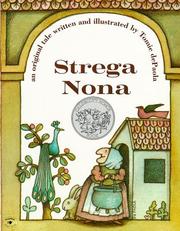
Tomie dePaola wrote and illustrated it in 1975, and it earned a Caldecott Honor in 1976. Thirty-two pages, and it felt enormous in my hands, though most picture books do when you are four. The cover shows her in a black dress and white apron, holding a steaming pot, with the town behind her in flat pink and ochre and green. She looks like somebody's aunt. That is the point.
The woman at the edge of town
Strega Nona means "Grandma Witch," and dePaola establishes immediately that this is a job, not a horror premise. She lives in a little house at the edge of a Calabrian village, and people come to her for headaches and warts and lovesickness. She cures them with herbs and spells the way a doctor writes prescriptions. Nobody in town burns her house down. They knock politely and wait their turn.
This is the first thing that struck me rereading it as an adult: the sheer professionalism of her. She has a business. She has a clientele. She has a garden she needs help with because her back is going and her knees are not what they were. When Big Anthony comes looking for work, she hires him, gives him a room and food and a wage, and explains the terms clearly. Housework, garden, no touching the pasta pot. It is a reasonable contract.
And she is old. DePaola draws her with lines around her eyes and a slight stoop and a face that has been in the sun for seventy years. There is no attempt to make her beautiful or glamorous or cute. She has a nose like a comma and a chin that disappears into her neck. I found her a little ugly when I was small, then stopped caring, because she was clearly the smartest person in the book.
Big Anthony, who does not pay attention
Big Anthony is the engine of the story, and dePaola gives him exactly the face he deserves: round, open, a little slack, hair like a haystack, eyes always looking at the wrong thing. He is not malicious. He is a young man with a strong back and a weak attention span, and the whole plot turns on that weakness.
The one rule of the house is the pot. DePaola does not explain why, which is smart, because a rule with no explanation is exactly the kind of rule a Big Anthony will eventually break. He agrees readily. He probably means it. But the narrator tells us plainly that Big Anthony did not always do what he was told.
One night he cannot stand it. He creeps to the window and watches Strega Nona stand over the pot, sing a little song to it, and blow three kisses at it. The pot fills with pasta. He sees the singing. He sees the pasta. He does not understand that the kisses are the part that matters. He goes to bed believing he has learned the trick.
That is the hinge of the entire book, and it is perfect plotting. The magic has three components and he catches two. Any child understands the mistake instantly, with a kind of superior glee, because children are constantly being told things they only half hear. DePaola never has to explain the moral. The structure does it.
The village laughs
The next day Big Anthony tells everyone in town what he saw. They laugh at him. This is one of the underrated scenes, because dePaola draws the crowd as a wall of skeptical faces, and Big Anthony stands in the middle with his arms out, insisting. Nobody believes him. He is the hired boy. He has never done anything in his life to earn their trust.
So he does what a person with something to prove does. He waits. Two days later Strega Nona announces she is going to visit her friend Strega Amelia, and she will be gone for a while, and she reminds him about the pot, and she leaves. And he takes the pot to the town square.
The sequence that follows is the best thing in the book. He sings the song. Nothing happens for a beat, the crowd smirks, and then the pasta starts to rise. He blows no kisses. He does not know about the kisses. The pot fills. The people cheer. Everyone who laughed at him is now congratulating him, and Big Anthony is a hero for about four pages.
Then the pasta keeps coming.
The town drowns in noodles
DePaola stages the flood like a theater designer. The pasta comes out of the pot in ropes and coils, and it does not stop, and the crowd's delight turns to alarm in stages. First they eat faster. Then they start to look at the pot. Then they start to look at Big Anthony. Then the pasta is at their knees, and then at their waists, and then it is pouring out the doors of houses and down the streets, and Big Anthony keeps singing the song over and over, and it is not working, and he does not know why.
The illustrations here are flat and bright and deliberately artificial. DePaola frames the town scenes inside arched shapes, like windows or stage prosceniums, and the buildings are simple blocks of color with a line of shadow under the eaves. The effect is a puppet show. It keeps the disaster funny, which is delicate, because a real town being buried in food would be a horror. The arch says: this is a story, not a news report.
And the villagers turn. This is where the book gets honest about people. The same crowd cheering him an hour ago is now furious, and they are not furious at the situation, they are furious at him. DePaola does not let them off. They are fair-weather in both directions. They loved him when the pasta was free and they want him punished when it costs them something.
Three kisses
Strega Nona comes home. She walks into a town waist deep in cold pasta and a crowd that is shouting, and she does not panic. She stands at the edge of the square, and she sings, and she blows three kisses at the pot. The pasta stops. Just like that. The pot is a pot again.
The solution is not violence and it is not cleverness and it is not a trick Big Anthony could have figured out. It is the thing he failed to notice. The whole book has been quietly teaching the reader to notice it, so when she does it, the child feels smart rather than surprised. That is craft.
Then she turns to Big Anthony. She does not shout. She does not turn him into a frog. She looks at the mess and she looks at him and she says, in effect, you made it, you eat it. And the last picture is Big Anthony sitting at a table with a fork, facing a mound of pasta taller than he is, with the entire town standing around watching. He has not started. He is going to be there for a long time.
What an adult notices
Here I have to be honest, because I loved it and still think it is close to perfect, but it has a meanness in it that I did not see at six.
The punishment is funny, and it is also a death sentence if you think about it for three seconds. That is an amount of food that would kill a man. DePaola plays it as a joke, children read it as a joke, and the joke works because it is absurd rather than cruel. But there is a discomfort underneath. Big Anthony's crime was showing off. He fed a whole town for free. He is guilty of not listening and of wanting to be admired, which are the two most ordinary sins of being young, and his sentence is to sit in front of a mountain of food until he finishes it while everyone watches.
The moral is blunt in a way that picture books of the seventies often were. Do not use power you do not understand. Fine. True. But the book does not spend much time on the fact that Strega Nona never told him why the rule existed. She said do not touch the pot and left it at that, and the catastrophe is the direct result of an unexplained instruction given to a person she had known for about a week. That is a management failure as much as a moral one.
And the villagers. They are drawn warmly, they have wonderful faces, the town is a pleasure to look at, and they behave badly at every turn. They mock him, they use him, they turn on him, and then they stand around enjoying his punishment. DePaola does not comment. He just draws them. It is a sharper book than its reputation as a cozy read-aloud suggests.
The art, and where it comes from
DePaola trained as a painter and worked as an illustrator for decades, and the composition shows it. He said the book grew out of stories he heard in his Calabrian family and out of collections of Italian folklore, and the pictures look like they were made by someone who had stood in front of Italian frescoes and folk painting. The colors are chalky and warm: rose, ochre, olive, a lot of white. There is almost no shading. Depth comes from overlapping shapes and from the arches.
The faces are the best part. DePaola could draw a nosy neighbor in four lines. The children are round and loud. Strega Nona's face is the most detailed thing in the book, and it is the only face that changes much, which is a nice way of saying she is the only character actually paying attention.
The story itself is old. Versions of the magic pot, the pot that will not stop producing, show up all over Europe, and the Italian versions are usually moral tales about appetite and about the limits of what a person is allowed to command. DePaola did not invent the shape. He took a story he knew and made it his own, mostly by giving it a heroine with a personality and a village with a texture. What he added, I think, is affection. The older versions tend to be satirical. His version likes these people. Even Big Anthony, who is a fool, is a fool you would hire again, because he works hard and he means well.
He said the story is about the danger of using power you do not understand, which is a fair summary, though it undersells how much the book is also about labor. Strega Nona works. She gardens, she mixes remedies, she sees patients, she keeps house. Nobody thanks her for any of it. The town's gratitude arrives only when the pasta is free, and evaporates the moment it costs something.
The book that gets banned
DePaola wrote and illustrated more than two hundred books, and Strega Nona became the character he could not put down. Big Anthony and the Magic Ring came in 1979, giving the fool a ring that grants wishes, which is exactly the kind of premise that ends the way you expect. Strega Nona's Magic Lessons followed in 1982, Merry Christmas, Strega Nona in 1986, and Strega Nona: Her Story in 1996, which goes back and gives the old woman a childhood.
The sequels are pleasant and none is as good as the first. That is not a criticism so much as a fact about how these things work. The first book has a shape so clean you can feel it in your hands: a rule, a violation, a flood, a correction, a punishment. The later books keep the characters and lose the shape, so they become episodes. Big Anthony gets another magical object. Strega Nona teaches a lesson. The town reacts. It is fine. It is not the same.
DePaola died in 2020, at eighty-five, after a career that ran from the early sixties to the end of his life. He kept the same flat, warm, hand-lettered look for most of it, and you can spot a dePaola from across a room.
Strega Nona has been challenged and removed from some American school and public libraries, and the reason is always the same: it depicts witchcraft and magic positively. This is a real thing that happens, mostly in the eighties and nineties and again in the last few years, and the objections are not crazy in their own terms. If you believe depictions of magic are spiritually dangerous for children, this book has a witch as its hero and a magic pot as its plot.
But the objections misunderstand what the book is. Strega Nona is not a gateway to anything. She is a small business owner with a bad back. The magic is a plot device, the way a talking animal is a plot device, and the moral is that you should not mess with things you do not understand, which is about as conservative a lesson as a picture book can teach. The people who wanted it off the shelf were reacting to the word witch on the cover, not to the contents.
It has also been, for fifty years, one of the most reliably loved books in the country. School Library Journal put it on its list of the top hundred picture books of all time in a 2012 poll. It is almost certainly the book dePaola is best known for, which is saying something given the size of his catalog.
I read it to my own kid last year, and the thing that surprised me was how much of the text I had wrong in my memory. I remembered the flood as longer, and more dialogue. What is actually there is a lean, fast, beautifully built story that trusts the pictures to carry the comedy, and the pictures do.
My kid's favorite page is the one where the pasta is coming out of the windows. Mine is still the one where Big Anthony is singing and the crowd starts to look at him differently. That is the moment the book is about, I think. Not the magic, not the punishment. The moment a person realizes that the thing they were so sure of has a part they did not see, and there is no way to go back and watch the kisses again.
We read it four times in a row. On the fourth pass my kid pointed at the last page and asked whether Big Anthony ever finishes. I said I did not think so. She thought about that for a while and then said he should have just listened, which is, I suppose, the whole review.
FAQ
What does the name Strega Nona mean?
It is Italian for Grandma Witch, which is how the village addresses her. She is a folk healer, not a villain.
Why does the pasta pot not stop?
Strega Nona sings to it and blows three kisses to stop it. Big Anthony copies only the song.
Why has the book been challenged in schools?
Some libraries and parents objected that it presents witchcraft and magic in a positive light. It has been challenged or removed in several American school districts.
Similar books
Amelia Bedelia
A literal-minded housekeeper follows her employer's list to disastrous and funny effect in the 1963 picture book that made wordplay a children's staple.
2,038-word summary · 9 min read
Nettle & Bone
Marra, a princess in a convent, leaves to save her abused sister, but first she must finish three impossible tasks: a bone dog, a nettle cloak, moonlight in a…
2,061-word summary · 9 min read
Hounded
A two-thousand-year-old druid runs a bookshop in Arizona, hides from an Irish god who wants his sword back, and talks to his dog.
2,159-word summary · 10 min read
Go the Fuck to Sleep
A rhyming bedtime book for adults in which an exhausted father narrates the fourth hour of a toddler's stalling, one profane couplet at a time.
2,291-word summary · 10 min read
Dealing with Dragons
A princess who hates embroidery runs away to become the cook and librarian for a dragon, then has to outthink wizards, knights, and a plot against the dragon…
2,563-word summary · 11 min read
Click, Clack, Moo: Cows That Type
Cows learn to type, demand electric blankets, and go on strike in a deadpan picture book about negotiation and withheld labor.
2,617-word summary · 12 min read
Caps for Sale
A peddler balances his caps on his head, naps under a tree, and wakes to find monkeys wearing his stock in this 1940 picture book.
2,787-word summary · 12 min read
The Stinky Cheese Man and Other Fairly Stupid Tales
Scieszka and Lane Smith take nine fairy tales apart, joke by joke, while Jack, the narrator, keeps losing the pages.
2,206-word summary · 10 min read
Hogfather
Death fills in for a missing Father Christmas, Susan Sto Helit hunts the Hogfather, and the twentieth Discworld novel turns Santa into a management problem.
2,871-word summary · 13 min read
Sideways Stories from Wayside School
Thirty stories, one class per floor, and a teacher who turns students into apples: Louis Sachar's absurd school classic.
2,045-word summary · 9 min read
Don't Let the Pigeon Drive the Bus!
A bus driver leaves the reader in charge with one rule, and a very persuasive pigeon spends the rest of the book trying to break it.
2,084-word summary · 9 min read

The Bane Chronicles
Eleven stories across five centuries follow Magnus Bane from a ban in Peru to his first date with Alec in this illustrated Shadowhunter companion.
2,470-word summary · 11 min read
Reaper Man
Death gets fired and farms while Windle Poons refuses to die.
2,579-word summary · 11 min read
Miss Nelson Is Missing!
Room 207 gets kind Miss Nelson, then terrible Viola Swamp instead.
2,597-word summary · 12 min read
The Wee Free Men
Nine-year-old Tiffany Aching teams with the Nac Mac Feegle to rescue her brother from the Fairy Queen.
2,600-word summary · 12 min read
Wyrd Sisters
Three Lancre witches rescue a murdered king's baby, hide Lancre's future, and trap a guilty duke with a play in Ankh-Morpork.
3,085-word summary · 14 min read
The Monster at the End of This Book
Grover begs readers not to turn pages for fear of a monster, until the ending reveals himself.
2,061-word summary · 9 min read
Spinning Silver
A moneylender's daughter says she can turn silver to gold, drawing a winter king, a plain duke's daughter, and a poor servant into one hard bargain.
2,813-word summary · 13 min read
Curious George
Curious George retold: a monkey sails from Africa to the city, phones the fire station, floats off on balloons, and finds home.
2,979-word summary · 13 min read
Madeline
Ludwig Bemelmans's 1939 Madeline: the twelve girls in Paris, Miss Clavel, the midnight appendix scare, and why the smallest girl became a classic.
2,944-word summary · 13 min read
Uprooted
The Dragon takes messy Agnieszka instead of perfect Kasia to his tower, and she must learn wild magic to face the corrupt Wood.
2,338-word summary · 10 min read
If You Give a Mouse a Cookie
A mouse gets a cookie and turns one small favor into a whole busy day.
2,560-word summary · 11 min read
Witches
Colin Hawkins's rhyming picture book teaches small readers to spot witches, flaps and all.
2,783-word summary · 12 min read
Stardust
Tristran Thorn climbs over the wall of Wall to fetch a fallen star and finds Yvaine, witches, and princes hunting her.
2,490-word summary · 11 min read
The Cat in the Hat
A tall Cat turns a rainy day upside down for Sally and her brother, with Thing One and Thing Two in tow.
2,546-word summary · 11 min read

The Long Winter
Dakota Territory, 1880: seven months of blizzards cut a town off from the railroad, and a family survives on twisted hay, ground wheat, and a dangerous wheat…
2,210-word summary · 10 min read
The Idiot
A Turkish-American freshman at Harvard falls in love through email with a Hungarian math student and spends a summer in Hungary trying to turn correspondence…
2,019-word summary · 9 min read
The Blinding Knife
Kip trains to join the Blackguard while the Prism hides his true identity, loses his colors, and fights a war against a rogue drafter who wants to birth a god.
2,049-word summary · 9 min read
Size 12 Is Not Fat
Former teen pop star Heather Wells investigates two dorm elevator deaths while juggling her ex, her crush, and a size-12 wardrobe.
2,805-word summary · 12 min read

Make Way for Ducklings
A pair of mallards raise eight ducklings on the Charles River and lead them across Boston to the Public Garden, with a little help from a friendly policeman.
2,044-word summary · 9 min read