
The Stinky Cheese Man and Other Fairly Stupid Tales
2,206-word summary 10 min read 56 pages in the book
- First published
- 1992
- Publisher
- Viking
- Pages
- 56
- ISBN
- 9780670844876
Reading options
What's inside (8 sections)
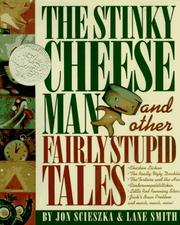
I picked this one up because the cover looked like a joke somebody made at a party. Green block letters, a squashed little man made of cheese, and the phrase "other fairly stupid tales" set in a type that looks like it was dragged across the page. Jon Scieszka wrote it and Lane Smith drew it, Viking published it in 1992, and the edition I have in my hands is 56 pages with the ISBN 9780670844876 on the copyright page. It is a blender of fairy tales with the wires pulled out, and I have read it aloud to children and to adults pretending to be children, and it lands nearly every time.
Jack tells the stories and loses them
The book opens with a chicken, not a tale. Little Red Hen has found a kernel of wheat and is about to begin, and Jack interrupts her. He is the narrator, a farm boy out of Jack and the Beanstalk, and he is also the man who wrote the book you are holding. "You can't tell your story right here," he tells her. "This is the endpaper."
Then the book admits what it is. The dedication page, which arrives after a page boldly labeled Title Page, is printed upside down, and Jack gets ahead of himself by explaining that he already knows about the mistake and it does not matter, because who ever looks at that dedication stuff anyhow. The introduction is really a refusal. A long time ago, people used to tell magical stories of wonder and enchantment, and those stories were called Fairy Tales, and those stories are not in this book. What is in the book are the Fairly Stupid Tales.
This sets up the running joke. The frame characters keep trying to start a story and Jack keeps getting in the way, getting ahead of himself, or losing the pages. Chicken Licken is the first tale, and it runs the way you expect: a green chicken convinced the sky is falling, a scramble to get the President on the phone, and then the sky does fall, because what drops on them is the table of contents, which Jack forgot to include. A book about a book, eating its own contents.
The table of contents itself carries one more gag. Among the listed tales sits "The Boy Who Cried Cow Patty", a story that appears nowhere in the book. The Boy turns up years later, on the back of the dust jacket of the 2002 tenth anniversary edition, where he cries cow patty until he lands in a fresh pile of it behind Mr. Smith's barn and then cries fire. In the original edition, the back of that dust jacket belongs to the Little Red Hen, who complains about having bought the book, asks who "this ISBN guy" is, and notes that she appears on only three of the pages. That is a joke about a book number, made in 1992, and it still lands.
The tales themselves
The Stinky Cheese Man is the title story and the best of the set, because it inverts The Gingerbread Man completely. The gingerbread man runs because everybody wants to eat him. The cheese man runs because everybody wants to eat him, too, but nobody will, because he smells. He is afraid of being near anyone because he expects to be eaten, and nobody wants to eat him, and in the end he is thrown into the river and falls apart. The moral, if you insist on one, is that there are worse fates than being eaten. Scieszka and Smith pointedly skip the lesson. The fox's grin is toothy, a cow's jaw drops as if it were made of clay, and the whole thing has the ghoulish, bad-dream quality that Anselmi described when he wrote about the book for The A.V. Club in 2016.
Little Red Running Shorts is the counterpart to Little Red Riding Hood, and Jack ruins it on purpose. Instead of introducing her, he blurts the entire story including the ending, and afterward she and the wolf refuse to tell it again. The tale had been allotted three pages, so the facing page is blank, a hole in the book where a story should be. It is the most Scieszka joke in the collection, and it works best read aloud precisely because you can see the empty page waiting.
The Princess and the Bowling Ball mocks the privilege of The Princess and the Pea. The prince is tired of his parents rejecting candidates because they cannot feel a pea under a hundred mattresses, so he slips his own bowling ball under the mattresses and passes his own test. The Other Frog Prince is even meaner in its small way. The frog tells the princess that he will turn into a prince if she kisses him, she does, and he says he was just kidding and hops back into the pond. The Really Ugly Duckling refuses Andersen's redemption outright. It does not turn into a swan. It was just a really ugly duckling, and it grew up to be a really ugly duck, and that is the end of it, and the duck is drawn with the lolling, tongue-out frenzy of a lunatic in an old cartoon.
Cinderummelstiltskin welds Cinderella to Rumpelstiltskin, and the name alone does half the work. The Tortoise and the Hair plays on The Tortoise and the Hare with a rabbit growing his hair as the contest, and the story simply stops, its last words being that it is not the end. Jack's Bean Problem gets tugged back and forth between Jack and the Giant, and the text on the page does the tugging, so the physical book itself starts to look like the argument.
Every one of these tales is Scieszka's text and Smith's pictures. That is worth saying plainly, because the collection is often described as a grand anthology of fairy tale parodies, as if a chorus of other writers were involved. The 1992 Viking book is a two-man act: one man writing, one man drawing, and a narrator who keeps interrupting himself.
The foreword, and the look of the page
The foreword offers a sample of what a Fairly Stupid Tale would be, and the sample is Goldilocks and the Three Elephants. Goldilocks goes into the elephants' house, cannot climb onto any of the three chairs to reach the peanut porridge, and goes home. That is the whole joke, and it is also a small masterclass in how Scieszka's parody works. He does not rewrite the plot, he swaps one object and lets the original logic collapse on its own.
The art is where Smith earns his half of the credit, and it is unlike anything else in picture books of that decade. Scieszka's lettering is scratchy and crosshatched, the words often wobbling off the baseline as if typed by a distracted child. Smith's drawings are precise, cold, and slightly repellent, with a cow's jaw and a fox's grin that the A.V. Club reviewer noticed were laced with what he called a subtle malevolence. In a 2017 exhibition statement at the Eric Carle Museum, Smith said the textures in these paintings came from combining oil paint with water-based varnishes, which he was not supposed to do, and that the paint bubbles up like little pebbles. That is the kind of detail you stop seeing once somebody points it out, and then you cannot unsee.
The design keeps interrupting the story. Type sizes swing from huge to tiny. The dedication is upside down. A page is left blank because a story was three pages long. A table of contents falls on a chicken. Anselmi's point about the book is the right one, in my view. It teaches a child that a book is a made thing, with an author who can be wrong, and that the rules of a book are worth noticing.
There is a running argument between the two halves of the art. Scieszka's words look as if a child made them, and Smith's pictures look as if an adult made them while watching a child draw. That gap is the joke and the lesson at once, and it is also why the book still looks strange to adults who expect picture books to be sweet and upholstered. Nothing here is upholstered.
The reception, and the shelf it lives on
The book was honored twice over in its first year. The New York Times Book Review named it a Best Illustrated Children's Book of 1992, and the American Library Association gave it a Notable Children's Book mention the same year, alongside spots on the School Library Journal best books list and Booklist's editors' top of the list. The Caldecott Honor came in 1993, with Emily Arnold McCully taking the medal for Mirette on the High Wire. A Rhode Island Children's Book Award arrived in 1994 and a Golden Archer Award in 1997. In 2012, a School Library Journal poll of picture-book professionals ranked it 91st on a list of the hundred best picture books of all time, and TIME has included it in a similar count.
Critically, the book helped name a category. Scieszka and Smith's book is usually listed as a founding example of the postmodern picture book, the kind that breaks the wall between the story and the object holding it, alongside David Wiesner's The Three Pigs and Anthony Browne's Voices in the Park. By then Scieszka was already famous for The True Story of the Three Little Pigs, his first book from 1989, which turned a fairy tale inside out and made him a name in children's publishing. In 2008 and 2009 he served as the first National Ambassador for Young People's Literature. The Stinky Cheese Man is the more ramshackle of the two big books, and probably the funnier to read in a room full of people.
It has also stayed in print, in a way that many picture books of its generation did not. There is a Scholastic paperback from 1992, a deluxe tenth anniversary edition from 2002, and a shorter reprint from 2015. The cover of my copy is the famous one, a green field with the title in enormous block letters, a pale round badge near the top, a little green man in the middle, and a strip of small pictures down the left edge that you are meant to look at before you read a word.
What drags
The drawing is rough on purpose, and children who are at the stage of wanting neat, finished, reassuring pictures sometimes bounce off it. Scieszka's letters can be genuinely hard to decode when a five-year-old is trying alone, which is exactly why this is a book for reading aloud rather than a book to sit quietly with. The jokes also run uneven, story to story. The Stinky Cheese Man and Little Red Running Shorts are as funny as picture books get. The Tortoise and the Hair is funny once, and its refusal to end is a clever idea that turns thin if you sit with it. The Princess and the Bowling Ball depends on you already knowing the pea story cold.
There is also a datedness that only charmed me. The book loves the printed page, the colophon, the dust jacket, the look of a hardcover from 1992, and readers who have been raised on screens will need the jokes about physical books translated for them. The book has been reissued several times, including a tenth anniversary edition in 2002 with a parody of The Boy Who Cried Wolf on the dust jacket, so if you find a copy in a shop, check which printing you are getting.
Who should read it
Read it aloud. That is the instruction, and it is the whole instruction. It takes about fifteen minutes and it will hold a room of five-year-olds in a way that most books of its era cannot, because the book is doing two things at once, entertaining them and quietly teaching them that books have authors who can mislay a page.
The other thing worth knowing is the family it belongs to. If you loved The True Story of the Three Little Pigs, this is its rougher, sillier, more anarchic sibling, and the two of them make a good pair on a shelf. If your child likes the Wind in the Willows or the Paddington books, they will like the flatness of the jokes and the strangeness of the pictures. If they are at the stage where a story has to end properly, wait a year or two, because several of these tales refuse to oblige, and that is the point.
I still think about the little man made of cheese. He is trying so hard to be chased and nobody will have him. It is a joke about a joke, and it is also a joke about being the thing everyone avoids, which is a strange thing to find in a book for four-year-olds and one of the better reasons to keep it on the shelf.
FAQ
When was The Stinky Cheese Man and Other Fairly Stupid Tales published?
Viking published it in 1992, and the edition cited here, ISBN 9780670844876, runs 56 pages. The deluxe tenth anniversary edition arrived in 2002 and put a parody of The Boy Who Cried Wolf on the dust jacket.
Which awards did the book win?
The New York Times named it a Best Illustrated Children's Book of 1992, and the 1993 Caldecott Honor went to Lane Smith and Jon Scieszka, with Emily Arnold McCully taking the medal. The American Library Association also named it a Notable Children's Book that year.
Do I need to know the original fairy tales to enjoy it?
It helps but it is not required. The book parodies Little Red Riding Hood, The Ugly Duckling, The Gingerbread Man, The Princess and the Pea and The Frog Prince, and a child who knows them gets more out of the jokes, while the frame story with Jack works for anyone.
Similar books
True Story of the Three Little Pigs
A. Wolf tells his side from the Pig Pen: he only wanted sugar for a cake, had a bad cold, and sneezed. You decide.
2,975-word summary · 13 min read

Amelia Bedelia
A literal-minded housekeeper follows her employer's list to disastrous and funny effect in the 1963 picture book that made wordplay a children's staple.
2,038-word summary · 9 min read
The Mitten
Jan Brett retells a Ukrainian folktale about a boy, a lost white mitten, and the woodland animals that crowd inside until a bear sneezes.
2,609-word summary · 12 min read
Click, Clack, Moo: Cows That Type
Cows learn to type, demand electric blankets, and go on strike in a deadpan picture book about negotiation and withheld labor.
2,617-word summary · 12 min read
Caps for Sale
A peddler balances his caps on his head, naps under a tree, and wakes to find monkeys wearing his stock in this 1940 picture book.
2,787-word summary · 12 min read
Don't Let the Pigeon Drive the Bus!
A bus driver leaves the reader in charge with one rule, and a very persuasive pigeon spends the rest of the book trying to break it.
2,084-word summary · 9 min read
Miss Nelson Is Missing!
Room 207 gets kind Miss Nelson, then terrible Viola Swamp instead.
2,597-word summary · 12 min read
The Monster at the End of This Book
Grover begs readers not to turn pages for fear of a monster, until the ending reveals himself.
2,061-word summary · 9 min read
Curious George
Curious George retold: a monkey sails from Africa to the city, phones the fire station, floats off on balloons, and finds home.
2,979-word summary · 13 min read
Madeline
Ludwig Bemelmans's 1939 Madeline: the twelve girls in Paris, Miss Clavel, the midnight appendix scare, and why the smallest girl became a classic.
2,944-word summary · 13 min read
If You Give a Mouse a Cookie
A mouse gets a cookie and turns one small favor into a whole busy day.
2,560-word summary · 11 min read
Witches
Colin Hawkins's rhyming picture book teaches small readers to spot witches, flaps and all.
2,783-word summary · 12 min read
The Cat in the Hat
A tall Cat turns a rainy day upside down for Sally and her brother, with Thing One and Thing Two in tow.
2,546-word summary · 11 min read
Strega Nona
A village witch doctor hires a boy who does not listen, and the pasta pot he was told not to touch floods Calabria with noodles he cannot stop.
2,587-word summary · 11 min read

Make Way for Ducklings
A pair of mallards raise eight ducklings on the Charles River and lead them across Boston to the Public Garden, with a little help from a friendly policeman.
2,044-word summary · 9 min read
Go the Fuck to Sleep
A rhyming bedtime book for adults in which an exhausted father narrates the fourth hour of a toddler's stalling, one profane couplet at a time.
2,291-word summary · 10 min read

Hard Luck
Rowley has a girlfriend, so Greg turns to a Magic 8 Ball, a family Easter hunt and the school yearbook for answers.
2,586-word summary · 11 min read
Clifford the Big Red Dog
Emily Elizabeth picks the smallest puppy in the litter, loves him as hard as she can, and wakes up to a dog the size of a house.
2,092-word summary · 9 min read
The Story of Ferdinand
A gentle Spanish bull would rather smell flowers than fight, and when he is taken to the bullring he simply sits down among the flowers in the ladies' hats.
2,135-word summary · 9 min read
Go, Dog. Go!
Dogs drive, work, play, and climb a tree for a party in this Beginner Book built on repetition, opposites, and one very unpopular hat.
2,196-word summary · 10 min read
George's Marvellous Medicine
George stirs a brew of dozens of household chemicals and gives it to his grumpy grandmother, and the medicine works far better than anyone planned.
2,014-word summary · 9 min read
Frog and Toad Are Friends
Five short stories about a cheerful frog and a grumpy toad who need each other for waking up, swimming, and waiting for the mail.
1,969-word summary · 9 min read
Eligible
Austen's Bennet sisters move to modern Cincinnati, where marriage is a reality show and the house is losing its value.
2,293-word summary · 10 min read
The Third Wheel
Greg tries to find a date for the Valentine's dance, ends up the third wheel in his own plan, and watches Rowley get the girl.
2,019-word summary · 9 min read
Sideways Stories from Wayside School
Thirty stories, one class per floor, and a teacher who turns students into apples: Louis Sachar's absurd school classic.
2,045-word summary · 9 min read
Beezus and Ramona
Nine year old Beezus tries to be a good older sister while four year old Ramona turns every ordinary day into a disaster, until a tenth birthday forces honesty.
2,062-word summary · 9 min read
The Penultimate Peril
Baudelaires as concierges in a hotel sort friends from foes before the end.
2,234-word summary · 10 min read
The End
Baudelaires wash on an island where others decide what safe means.
2,320-word summary · 10 min read
The Complete Fairy Tales
Mermaids, snow queens and tin soldiers in the full Andersen collection.
2,414-word summary · 11 min read
Tales from a Not-So-Fabulous Life
Nikki starts private school and writes mean-girl survival in her diary.
2,587-word summary · 11 min read